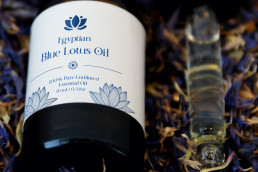
Creative work is not a productivity problem; it is a nervous system problem. The blank page, the empty canvas, the silent studio: each one rewards a particular quality of attention that is soft, curious, and unafraid of being wrong. This article looks at how blue lotus oil creatives have used for generations, both in ritual and in quiet studio practice, can support that specific state, and where its usefulness honestly ends.
Table of Contents
- Why Creative Work Is a Nervous System Problem
- How Blue Lotus Oil Supports Creative States
- Softening the Inner Critic
- Gentle Mood Lift Without Sedation
- Olfactory Anchoring and State-Dependent Recall
- How to Use Blue Lotus Oil for Creative Work
- The Studio Diffuser Session
- The Pre-Session Anointing Ritual
- The Inhaler for Portable Sessions
- Dilution and Safety Summary
- What to Expect: Realistic Timeframes
- When Blue Lotus Oil Is Not the Right Choice
- Complementary Approaches for Creative Practice
- Blending Suggestions for Different Creative Disciplines
- For Writers
- For Visual Artists
- For Musicians and Composers
- For Performers and Dancers
- Frequently Asked Questions
- Where to Go From Here
- Bring Blue Lotus Into Your Studio
It is written and clinically reviewed by Antonio Breshears, ND, CCA, a Bastyr-trained naturopathic doctor and certified clinical aromatherapist. If you are new to the oil itself, the complete guide to blue lotus oil covers the chemistry, extraction methods, and safety data that underpin everything discussed below.
Why Creative Work Is a Nervous System Problem
Most artists and writers will recognise the pattern. You sit down to work; within ninety seconds your mind is calculating whether the piece is any good, whether anyone will like it, whether you should be doing something else, whether the last thing you made was better than this one. The cursor blinks. The brush dries. The melody you almost had dissolves. This is not a discipline failure. It is a sympathetic nervous system running an internal audit while you are trying to play.
Genuine creative flow requires the opposite state. The prefrontal cortex needs to soften its grip (researchers sometimes call this transient hypofrontality), the default mode network needs to wander, and the body needs to feel safe enough to stop scanning for threat. Breath slows, shoulders drop, peripheral vision widens. In that state, associations that the critical mind would reject get a few seconds of air, and occasionally one of them turns out to be the idea you were looking for.
Anything that helps the body drop one gear toward parasympathetic dominance, without dulling the mind, tends to help creative work. This is the specific niche blue lotus oil occupies.
How Blue Lotus Oil Supports Creative States
Blue lotus oil (Nymphaea caerulea) is not a stimulant and not a strong sedative. Its value for creative work lives in a narrower and more interesting space: it takes the edge off self-monitoring without flattening alertness. Three mechanisms matter here.
Softening the Inner Critic
The flavonoid apigenin, present in the absolute, binds to central benzodiazepine receptors and produces a mild anxiolytic effect. In practical terms, the volume on catastrophic self-appraisal drops a notch. You still notice that the second verse is weak; you just notice it with less panic. For many creatives this is the single most useful shift, because fear of being bad is what keeps most work unfinished.
Gentle Mood Lift Without Sedation
Aporphine and nuciferine, the two alkaloids most studied in blue lotus, interact modestly with dopamine and serotonin (specifically 5-HT2A and 5-HT2C) pathways. The reported experience is usually described as a warm, slightly dreamy openness rather than a stimulated high. That dreamy quality is precisely what tends to loosen rigid thinking and allow unusual associations, which is the raw material of most creative breakthroughs.
Olfactory Anchoring and State-Dependent Recall
Scent bypasses the usual cognitive filters and connects directly to the limbic system. If you consistently use the same oil at the beginning of creative sessions, the brain quickly builds an association between that aroma and the state you work in. After two or three weeks, the smell alone begins to cue the state. This is arguably the most reliable benefit of any studio oil, and it is independent of the pharmacology: you are training a conditioned response.
How to Use Blue Lotus Oil for Creative Work
The protocol below assumes you are working with a pure, properly diluted blue lotus absolute or essential oil. Keep expectations modest: this is a supporting tool, not a muse.
The Studio Diffuser Session
For most creatives, passive diffusion is the best entry point. Add two to four drops of blue lotus oil to a cold-mist ultrasonic diffuser and run it for twenty to thirty minutes at the start of a session. Do not run it the entire time you work; the nose habituates within roughly thirty minutes and the effect plateaus. Let the room hold the scent while you work, then refresh only if you take a genuine break and return.
If you find pure blue lotus too sweet for long sessions, blend it with something that gives the air more structure. Frankincense (one drop per two drops of blue lotus) adds a dry, contemplative base note. Bergamot (one drop per one drop) lifts the top and tends to pair well with writing and design work. Cedarwood suits sculpture, woodwork, and anything tactile.
The Pre-Session Anointing Ritual
For writers, composers, and anyone whose work is primarily internal, a small applied ritual often works better than a diffused one. Dilute blue lotus oil to two percent in a carrier such as jojoba or fractionated coconut (roughly twelve drops of oil in a 10 ml roller bottle). Apply to the inner wrists, the hollow of the throat, and behind the ears before you sit down. Three slow breaths, drawn in over the wrists, mark the transition from ordinary life to studio time.
The ritual matters as much as the chemistry. You are telling your nervous system, through smell and through deliberate slowness, that the next block of time is different. Keep the ritual short, thirty to sixty seconds, so it does not become a procrastination device.
The Inhaler for Portable Sessions
If you work in cafés, on trains, or in shared studios where diffusion is not practical, a personal aromatherapy inhaler is the cleanest solution. Add ten to fifteen drops of blue lotus oil to the cotton wick of a blank inhaler tube. Use it before you begin work and whenever you feel the critical mind closing in. Two or three slow inhalations are enough. This is also the most travel-friendly way to keep a consistent olfactory anchor across different locations.
Dilution and Safety Summary
- Face and pulse points: 1 to 2 percent (six to twelve drops per 10 ml carrier)
- Body application: 2 to 3 percent (twelve to eighteen drops per 10 ml carrier)
- Diffuser: 2 to 4 drops per session of 20 to 30 minutes
- Inhaler: 10 to 15 drops on the wick, replace every two to three months
What to Expect: Realistic Timeframes
Within the first session, most users notice a softening of tension in the face and shoulders within five to ten minutes, and a slight shift in how intrusive self-critical thoughts feel. You will not suddenly paint like Rothko. You will probably find it a little easier to stay in the chair.
After two to three weeks of consistent use (roughly four to five sessions a week with the same oil in the same context), the conditioned response begins to set in. The scent itself starts to trigger the shift toward working mode, even before any pharmacological effect registers. This is where the oil earns its place in a studio practice.
If after four weeks you notice no change at all, either the oil is not right for your chemistry (this happens; not every botanical suits every person), or the issue you are trying to address sits outside what aromatherapy can reasonably reach. Clinical burnout, depression, and ADHD are examples of the latter.
When Blue Lotus Oil Is Not the Right Choice
There are circumstances where this oil is either unhelpful or actively inappropriate for creative support.
It is not a stimulant. If your creative block is fundamentally about low energy, poor sleep, under-eating, or chronic fatigue, blue lotus will not supply what is missing and may deepen the lethargy. Address the underlying physiology first.
It does not treat clinical depression or anxiety disorders. Mild situational stress is within the reach of aromatherapy; a depressive episode that has lasted months is not. If you cannot work because you cannot feel anything, or because every attempt to start triggers a panic response, the appropriate move is to see a clinician, not to buy another oil.
Avoid use during pregnancy and breastfeeding. Use caution if you take dopaminergic medications, MAOIs, or significant sedatives, because the alkaloid activity in blue lotus can theoretically interact with these. If you are unsure, speak to a prescriber before adding it to a daily practice.
Finally, blue lotus is legally restricted in Russia, Poland, Latvia, and the US state of Louisiana, and its status in Australia is regulatory-complex. If you live or travel in those jurisdictions, check the rules before ordering.
Complementary Approaches for Creative Practice
Oil is a small lever. It works best when it is one of several supports, not the only one.
Protect the first ninety minutes of your creative day from email, messages, and meetings. Most creative people do their best work in the first block after they wake up, and most creative people waste that block on inbox triage. A scent ritual at the beginning of that block is infinitely more powerful than one at 4 pm on a depleted nervous system.
Work in time-limited sessions, traditionally forty-five to ninety minutes, with genuine breaks between them. The breaks are where the unconscious does its integration; without them, even a perfect olfactory environment will not produce insight.
Consider pairing blue lotus with a single complementary oil that matches the medium. Frankincense for contemplative or spiritual work, bergamot for verbal and narrative work, cedarwood for physical craft, rose for emotional or memoir writing. Keep the palette small; two to three oils total in a studio practice is plenty.
If anxiety is the dominant obstacle, somatic practices (slow breath, gentle movement, vagal toning) will do more than any oil. If procrastination is the dominant obstacle, the problem is usually structural rather than chemical, and the fix is usually to make the first step smaller, not to smell better while avoiding it.
Blending Suggestions for Different Creative Disciplines
These are starting points rather than rules. Adjust to your own nose and your own practice.
For Writers
Blue lotus (two drops) with bergamot (one drop) and a trace of vetiver (one drop) in a diffuser. The bergamot keeps the mind verbal and light; the vetiver grounds the tendency to drift. Good for long-form prose, essays, and scripts.
For Visual Artists
Blue lotus (two drops) with frankincense (two drops) in a diffuser. Slower, more meditative, more suited to work that needs sustained looking. Particularly useful for painters and illustrators working on single pieces over many hours.
For Musicians and Composers
Blue lotus (one drop) with sandalwood (one drop) on a wrist roller at two percent dilution. The sandalwood gives a warm, resonant base that tends to support listening rather than distract from it.
For Performers and Dancers
A pre-performance inhaler with blue lotus (ten drops) and neroli (five drops) on the wick. Used in the ten minutes before going on, this combination addresses both the critical-mind chatter and the physical anxiety that tightens the breath.
Frequently Asked Questions
Does blue lotus oil actually improve creativity, or is it placebo?
The mechanisms are real: apigenin does bind central benzodiazepine receptors, aporphine and nuciferine do have mild dopaminergic and serotonergic activity, and scent does condition state. Whether that produces better art is a separate question that no oil can answer. What it reliably does is lower the activation threshold for starting work.
Will it make me feel high or dissociated?
No, not at the doses used in aromatherapy. The reported experience is a soft, slightly warm openness, not intoxication. If you feel significantly altered, you are using too much or reacting idiosyncratically, and should scale back or stop.
Can I use it every day in my studio?
Yes, within reasonable limits. Diffusing for twenty to thirty minutes once or twice a day is unlikely to cause issues. Take occasional rest days so the conditioned response stays strong; if the scent is constantly present, its state-cueing power fades.
Is it safe to apply to my skin before a long session?
At 1 to 2 percent dilution on pulse points, yes, for most people. Patch test first on the inner forearm if you have sensitive skin. Do not apply neat (undiluted) essential oil or absolute directly to the skin.
Can I combine it with caffeine or nootropics?
Caffeine, in normal amounts, is fine. For nootropics or prescription cognitive medications, check with your prescriber, particularly if anything you take affects dopamine, serotonin, or GABA.
How long before I notice the olfactory anchor effect?
Typically two to three weeks of consistent pairing with creative work. Some people report it sooner; a few need longer. Consistency of context matters more than frequency.
What if I don’t like the smell?
Then the oil will not work as a studio tool, and that is fine. Scent conditioning requires an aroma you find at least neutral, preferably pleasant. Try a different base oil (frankincense and sandalwood are both excellent for creative work) rather than forcing yourself to like blue lotus.
Is the absolute better than the essential oil for creative use?
The absolute has a fuller, sweeter, more honeyed profile and is the form most people associate with blue lotus. True steam-distilled essential oil is rare, lighter in aroma, and less readily available. For studio use, the absolute is usually the more satisfying choice, assuming it is genuinely pure.
How long does a bottle last in regular studio use?
A 5 ml bottle used at two to four drops per session, five sessions a week, typically lasts six to nine months. Stored in dark glass in a cool, dark cupboard, the absolute remains good for three to four years.
Will it help with performance anxiety on stage or at a reading?
It can take the edge off, particularly used as an inhaler in the ten minutes before going on. It is not a substitute for rehearsal, and it will not stop adrenaline entirely; what it tends to do is stop adrenaline from tipping into panic.
Where to Go From Here
If you are assembling a genuine studio practice, treat blue lotus as one well-chosen tool among several rather than a standalone solution. Start with a simple diffuser protocol for two weeks, notice what actually changes, and then decide whether to layer in a roller or inhaler for portability. The complete guide to blue lotus oil is the right next read if you want the fuller picture on chemistry, sourcing, and safety before committing to a daily ritual.
And keep the frame honest. The oil does not make the work. It helps you show up to the work in a slightly better state than you would otherwise. That, repeated across months and years, is how studio practices are actually built.

Antonio Breshears
Antonio Breshears is a renowned expert in holistic medicine and beauty, with over 25 years of research experience dedicated to uncovering the secrets of nature's most powerful remedies. Holding a degree in Naturopathic Medicine, Antonio's passion for healing and well-being has driven him to explore the intricate connections between mind, body, and spirit.
Over the years, Antonio has become a respected authority in the field, helping countless individuals discover the transformative power of plant-based therapies, including essential oils, herbs, and natural supplements. He has authored numerous articles and publications, sharing his wealth of knowledge with a global audience seeking to improve their overall health and well-being.
Antonio's expertise extends to the realm of beauty, where he has developed innovative, all-natural skincare solutions that harness the potency of botanical ingredients. His formulations embody his deep understanding of the healing properties found in nature, providing holistic alternatives for those seeking a more balanced approach to self-care.
With his extensive background and dedication to the field, Antonio Breshears is a trusted voice and guiding light in the world of holistic medicine and beauty. Through his work at Pure Blue Lotus Oil, Antonio continues to inspire and educate, empowering others to unlock the true potential of nature's gifts for a healthier, more radiant life.