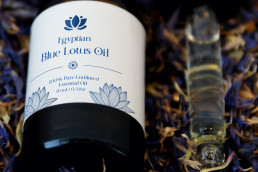
This is a structured 90 day blue lotus practitioner pathway for therapists, aromatherapists, bodyworkers, naturopathic colleagues and serious home practitioners who want to develop genuine clinical fluency with Nymphaea caerulea. Rather than a scatter of tips, it is a staged curriculum: thirty days of sensory and safety grounding, thirty days of formulation practice and thirty days of applied client or self-practice work. By the end you will know how this oil actually behaves on skin, in the nose and in a therapeutic encounter.
Table of Contents
- Why a 90-Day Pathway Rather Than a Weekend Course
- Phase One, Days 1 to 30: Sensory and Safety Grounding
- Daily Olfactory Practice (10 minutes)
- Skin Behaviour Testing
- Safety Literacy
- Phase Two, Days 31 to 60: Formulation Practice
- The Three Base Formulations
- Evaluation Habits
- Working With Counterpoints
- Phase Three, Days 61 to 90: Applied Practice
- Client Intake and Consent
- Three Applied Protocols
- Case Write-Ups
- What to Expect at the End of 90 Days
- Where This Pathway Stops Short
- Frequently Asked Questions
- Where to Go From Here
- Begin Your Practitioner Pathway
It is written and clinically reviewed by Antonio Breshears, ND, CCA, a Bastyr-trained naturopathic doctor and certified clinical aromatherapist. Readers new to the botanical should start with The Complete Guide to Blue Lotus Oil, which supplies the chemistry, extraction and safety context assumed throughout this pathway.
Why a 90-Day Pathway Rather Than a Weekend Course
Blue lotus is not a simple aromatic. The absolute carries aporphine and nuciferine alongside apigenin, quercetin and kaempferol, a chemistry that interacts with dopaminergic tone, serotonergic receptors and the central benzodiazepine site. Its scent is also unusually layered: cooler floral-aquatic at the top, honeyed and almost resinous in the heart, balsamic and faintly smoky at the base. You cannot develop working intuition for either the chemistry or the scent in a weekend. You build it by sitting with the oil daily, across contexts, for long enough that your nose and your hands know it before your mind has to think.
Ninety days is the minimum useful window. It is long enough to move through repeated olfactory exposures, to run two or three formulation iterations, to observe how a single blend behaves on different skins across a full menstrual or sleep cycle, and to notice the honest difference between “I like this oil” and “I know how this oil works”. Practitioners who rush this step tend to overpromise to clients; practitioners who take it seriously tend to quietly become the person other therapists call when they have a blue lotus question.
Phase One, Days 1 to 30: Sensory and Safety Grounding
The first month is deliberately un-clinical. You are training your nose, your skin and your judgement before you touch a client formulation.
Daily Olfactory Practice (10 minutes)
Each morning, place one drop of the absolute on a scent strip, label it with the date and time, and observe it at 0, 5, 20 and 60 minutes. Write down what you smell in plain English: “hay-like”, “pond water at dusk”, “warm honey over old wood”, “something almost medicinal underneath”. Do not consult reference notes first. Your own vocabulary is more useful to you long-term than borrowed descriptors. After thirty days of this, you will be able to distinguish a well-made absolute from an adulterated one by scent alone, and that single skill will save you and your clients a great deal of money.
Skin Behaviour Testing
In week two, begin small patch tests at 1 percent, 2 percent and 3 percent dilution in jojoba on the inner forearm. Observe for twenty-four hours. Note how the scent develops on your own skin (which is different from how it develops on a strip) and whether you see any reactivity. Blue lotus is generally well tolerated but people with dense floral or balsamic sensitivities occasionally react, and you want to know that on your own skin before you meet it on a client’s.
Safety Literacy
Use weeks three and four to commit the safety framework to memory. Avoid in pregnancy and breastfeeding. Caution with dopaminergic medications, MAOIs and heavy sedatives. Awareness of legal restrictions in Russia, Poland, Latvia, the US state of Louisiana and regulatory complexity in Australia; if you work internationally or ship products, you need this in your head, not in a document you will forget to check. Revisit the complete guide and write the contraindication list in your own words until you can recite it without reference.
Phase Two, Days 31 to 60: Formulation Practice
Month two moves from passive learning to active building. You will make, label, date and evaluate your own blends. The aim is not to produce a signature product; it is to understand how blue lotus behaves alongside other materials.
The Three Base Formulations
Make each of these and live with them for at least two weeks before evaluating.
- Evening calm roller: 2 percent blue lotus in jojoba, single material. This is your reference point. Apply to wrists and behind the ears thirty minutes before bed for fourteen nights. Keep a simple note on sleep onset and dream quality.
- Facial ritual serum: 1 percent blue lotus in a base of 70 percent jojoba and 30 percent squalane. Apply two drops to clean, slightly damp skin at night. Observe over fourteen days for tolerance, skin feel and scent development on facial skin.
- Diffuser blend: 2 drops blue lotus with 1 drop frankincense and 1 drop bergamot (FCF) in a standard ultrasonic diffuser. Run for twenty to thirty minutes in a consultation or meditation space. Note how the scent fills the room and how clients or housemates respond without prompting.
Evaluation Habits
For each formulation keep a one-page log: date made, dilution, carrier, observed scent arc, skin response, subjective effect, and any feedback from others. This is where the pathway becomes genuinely clinical. A practitioner with fifteen dated, honest logs has more useful knowledge than one who has read every textbook on the subject.
Working With Counterpoints
In the final week of phase two, experiment with one “counterpoint” blend: blue lotus paired with something that should not obviously work. Vetiver for groundedness, cardamom for lift, a trace of sandalwood for continuity. The point is to discover where blue lotus resists a blend and where it absorbs other oils into its own character. That resistance and absorption is the practical texture of the material, and knowing it is what separates formulation from guessing.
Phase Three, Days 61 to 90: Applied Practice
The final month moves the work into application, either with clients (under your existing scope of practice) or in a structured self-practice if you are a home practitioner.
Client Intake and Consent
Before any client use, write a simple intake addendum for blue lotus: pregnancy and breastfeeding status, current medications (with specific attention to dopaminergic drugs, MAOIs and sedatives), history of reactivity to florals or absolutes, and the client’s own goals (sleep, emotional steadiness, ritual, skin). Obtain informed, written consent. This is good practice regardless of jurisdiction and it trains you to frame blue lotus as a considered intervention rather than an ambient extra.
Three Applied Protocols
Choose three applications to practise across month three. Suggested combinations:
- Sleep support protocol: 2 percent roller applied thirty minutes before bed, four nights per week for three weeks. Track sleep latency, night waking and morning mood using a simple 1 to 10 scale.
- Pre-treatment ritual: a two to three minute diffuser exposure at the opening of a massage, acupuncture or consultation session, with a short grounding breath sequence. Note how sessions open differently compared with your usual baseline.
- Emotional steadiness roller: 1 percent blend used during the day for perimenstrual mood shifts, grief work or transition periods. Apply to wrists morning and mid-afternoon. Observe over a full cycle or a defined three-week period.
Case Write-Ups
Summarise phase three by writing up three short cases, each about 400 words: presenting situation, rationale for blue lotus, protocol used, observed outcome, honest reflection on what you would do differently. These become the foundation of your own practitioner file and, eventually, of any teaching or mentoring you go on to do.
What to Expect at the End of 90 Days
A practitioner who completes this pathway will not be a blue lotus expert, and claiming otherwise would be silly. What they will have is something more useful: calibrated judgement. You will know, within a minute of opening a bottle, whether the material is well-made. You will know which clients are plausible candidates and which are not. You will have three or four formulations you trust, and you will know why you trust them. You will be able to answer a client question about blue lotus with “here is what the evidence supports, here is what I have observed, and here is what I do not yet know”, which is, in the end, the voice of an actual clinician.
Where This Pathway Stops Short
The 90 day blue lotus practitioner pathway is deliberately not a substitute for formal aromatherapy certification, naturopathic training or prescribing authority. If you are practising within a regulated profession, everything here sits inside your existing scope, not beyond it. Blue lotus is not a treatment for diagnosed mood disorders, not a sleep medication, not a substitute for psychiatric or gynaecological care. Clients presenting with severe insomnia, major depressive symptoms, psychosis risk, substance use concerns or complex medication regimes need referral, not a rollerball. The pathway sharpens your tool; it does not expand the job.
Frequently Asked Questions
Do I need prior aromatherapy training to follow this pathway?
Formal training helps but is not strictly required. Bodyworkers, therapists, naturopathic colleagues and serious home practitioners can all benefit. If you are entirely new to essential oils, pair this pathway with a foundational safety course so the dilution and contraindication framework is embedded, not improvised.
How much oil will I use across 90 days?
For the olfactory, skin and formulation work described here, a single 5 ml bottle of a well-made absolute is usually enough, with some to spare for phase three applications. Buying too much early is a common mistake; the oil is concentrated and restraint is part of the skill.
Can I compress the pathway into a shorter timeframe?
You can, but you will lose most of what the pathway is for. The olfactory and skin calibration work depends on repeated exposure across days, not packed sessions. Thirty days of daily practice cannot be condensed into a weekend without defeating the point.
Is it safe to use blue lotus on clients during the pathway?
Only within your existing scope of practice, only with informed consent, and only after phase one and two are complete. Phase three is designed for this. Do not use blue lotus on clients during phase one; you are still learning the material.
What if a client asks about the psychoactive reputation of blue lotus?
Be honest and understated. External aromatic use of a small percentage dilution produces mild, supportive shifts in mood and relaxation; it does not produce intoxication. The historical and ceremonial literature describes preparations and doses that bear little resemblance to modern topical or olfactory use. Most clients appreciate the clarity.
How do I know if the oil I have is authentic?
By the end of phase one, your nose is the primary test. Authentic absolute opens cool and aquatic, deepens into a honeyed floral heart and settles into a balsamic, faintly smoky base over an hour. Oils that stay uniformly sweet, smell primarily of synthetic floral notes or evaporate without a base are almost certainly adulterated. Supplier transparency on extraction method and origin is the second test.
Can I incorporate blue lotus into existing client rituals I already offer?
Yes, and phase three is designed around this. A brief diffuser opening to a massage, a dedicated facial ritual, a take-home rollerball that extends in-clinic work: these are natural integrations. Avoid bolting blue lotus onto every service; selective use protects both the client experience and the material’s character.
What record-keeping do I need to maintain?
Keep formulation logs (date, batch, dilution, carrier), client consent forms, a brief note in each client file when blue lotus is used, and your three case write-ups from phase three. If you are regulated, follow your profession’s standards; if you are not, adopt those standards anyway. Good records are the single clearest marker of a practitioner who takes the work seriously.
What comes after the 90 days?
Most practitioners settle into a steady-state practice where blue lotus is one of perhaps eight to twelve materials they use with genuine fluency. Some go on to teach, write or mentor. A smaller number develop signature formulations. There is no prescribed next step; the pathway exists to make whichever direction you choose an informed one.
Where to Go From Here
Begin with phase one today, even in a small way: one bottle, one scent strip, one notebook. Revisit The Complete Guide to Blue Lotus Oil for the chemistry, extraction and safety context that underpins every phase of this work. The pathway is deliberately unglamorous in its early weeks; that is the feature, not the flaw. Practitioners who sit with the material long enough to know it honestly become the ones clients trust, and that trust is built in the quiet thirty days before anyone else is watching.

Antonio Breshears
Antonio Breshears is a renowned expert in holistic medicine and beauty, with over 25 years of research experience dedicated to uncovering the secrets of nature's most powerful remedies. Holding a degree in Naturopathic Medicine, Antonio's passion for healing and well-being has driven him to explore the intricate connections between mind, body, and spirit.
Over the years, Antonio has become a respected authority in the field, helping countless individuals discover the transformative power of plant-based therapies, including essential oils, herbs, and natural supplements. He has authored numerous articles and publications, sharing his wealth of knowledge with a global audience seeking to improve their overall health and well-being.
Antonio's expertise extends to the realm of beauty, where he has developed innovative, all-natural skincare solutions that harness the potency of botanical ingredients. His formulations embody his deep understanding of the healing properties found in nature, providing holistic alternatives for those seeking a more balanced approach to self-care.
With his extensive background and dedication to the field, Antonio Breshears is a trusted voice and guiding light in the world of holistic medicine and beauty. Through his work at Pure Blue Lotus Oil, Antonio continues to inspire and educate, empowering others to unlock the true potential of nature's gifts for a healthier, more radiant life.