If you are searching for the best blue lotus oil in 2026, you are entering a market that has grown dramatically in the last three years, and not all of that growth has been good for buyers. This guide is for anyone who wants to spend their money well: someone who has read conflicting reviews, noticed price ranges from a few pounds to several hundred, and wants a clear, honest framework for telling genuine Nymphaea caerulea from the synthetic, diluted, or mislabelled material that now dominates online shelves.
Table of Contents
- What the Blue Lotus Oil Market Actually Looks Like in 2026
- What "Best" Actually Means for a Botanical Extract
- The Red Flags That Tell You to Walk Away
- What the Best Blue Lotus Oil of 2026 Should Deliver
- Absolute, Essential Oil, or CO2 Extract: Which to Choose
- How to Vet a Seller in 2026
- Realistic Expectations: What Genuine Oil Will and Will Not Do
- A Note on Price: What You Are Actually Paying For
- When Blue Lotus Oil Is Not the Right Purchase
- Frequently Asked Questions
- Where to Go From Here
- Buy With Confidence in 2026
It is written and clinically reviewed by Antonio Breshears, ND, CCA, a Bastyr-trained naturopathic doctor and certified clinical aromatherapist. For a broader foundation on the botany, chemistry and traditional use of this plant, readers may also want to consult the complete guide to blue lotus oil, which sits as the parent reference for everything discussed here.
What the Blue Lotus Oil Market Actually Looks Like in 2026
The current market breaks into roughly four tiers, and understanding which tier a product belongs to tells you almost everything you need to know before you read a single marketing claim.
At the bottom sit the fragrance oils: synthetic blends, often made from aroma chemicals approximating a water-lily scent, sometimes with no botanical input at all. These are the five-pound-to-fifteen-pound bottles sold in bulk on large marketplaces. They have no therapeutic value and, in several cases tested by independent labs in recent years, contain phthalates and skin-sensitising synthetic musks.
Above these sit the heavily diluted oils: small amounts of genuine blue lotus absolute dispersed in jojoba, coconut fractionate, or mineral oil, sold without disclosing the dilution. These are not dishonest in the sense that they contain no blue lotus, but they are dishonest in presentation, since the buyer believes they are purchasing pure oil.
Higher still you find the genuine but industrial-grade absolutes: real Nymphaea caerulea extracted with petrochemical solvents at scale, often from flowers grown with standard agricultural inputs, and traded through the bulk aromatics market. These are legitimate products with real chemistry, but they are not the finest material available, and they often carry residual solvent notes if purification has been rushed.
At the top sits a very small category: artisanal, low-volume blue lotus oil produced from carefully harvested flowers, either as a premium absolute, a true steam-distilled essential oil, or a supercritical CO2 extract. This is the material that clinical aromatherapists actually reach for, and it is the material this article considers when it uses the phrase “best blue lotus oil 2026”.
What “Best” Actually Means for a Botanical Extract
The word “best” is slippery. For a botanical oil, it has to be defined before it is useful. In 2026 the criteria a serious buyer should apply are these: botanical authenticity, extraction integrity, aromatic complexity, transparent sourcing, appropriate packaging, and honest labelling.
Botanical authenticity means the oil is made from Nymphaea caerulea, the Egyptian blue water lily, and nothing else. Not Nymphaea nouchali (the Indian blue lotus, a different species), not Nelumbo nucifera (the sacred lotus, which is not a lily at all), and not a blend of several species labelled generically as “blue lotus”.
Extraction integrity means the method used is appropriate for the material and the finished oil has been properly purified. Solvent extraction, which produces the absolute, is the most common method because the delicate floral chemistry does not survive steam distillation easily. A good absolute has had its solvent residues reduced to parts-per-million levels and smells clean. A poor absolute smells chemical.
Aromatic complexity is the honest test that requires no lab. A real blue lotus oil opens with a cool, slightly aquatic floral top note, moves through a deep honeyed-floral heart that carries a faint spiced warmth, and settles into a balsamic, almost smoky base. A synthetic will be linear: sweet at the top, sweet in the middle, thin at the base. If the scent does not evolve on your skin over thirty minutes, it is probably not what it claims to be.
The Red Flags That Tell You to Walk Away
Certain patterns on a product page almost guarantee that the oil is not worth buying, regardless of how attractive the bottle or how persuasive the marketing.
The first is price that is too low. Genuine blue lotus absolute requires between three thousand and five thousand flowers to produce a single gram of finished oil. The labour of harvesting, the seasonality of the bloom, and the yield ratio combine to make anything priced under roughly forty pounds per millilitre highly suspect. A ten-millilitre bottle at fifteen pounds cannot, mathematically, contain pure blue lotus absolute.
The second is vague sourcing. If the product page does not name the country of origin, the extraction method, or at minimum the supplying region, treat that silence as information. Reputable sellers in 2026 name their source, usually Egypt or, occasionally, Sri Lanka or Thailand for related species clearly labelled as such.
The third is implausible claims. Blue lotus oil is a genuinely useful aromatic with modest calming effects mediated by its alkaloid and flavonoid content. It is not a cure for anxiety disorders, depression, insomnia, or chronic pain. Pages that promise dramatic clinical outcomes are marketing to desperation, not informing buyers.
The fourth is clear plastic or clear-glass bottles. Blue lotus absolute degrades under UV exposure. Anyone serious about product integrity uses amber or cobalt glass, stored upright, sealed with a reduction dropper or orifice insert.
The fifth is a missing batch number or production date. Absolutes have a usable life of roughly three to four years when stored well. Without a date, you cannot know what you are buying.
What the Best Blue Lotus Oil of 2026 Should Deliver
A buyer investing in genuine material in the current market should expect several things in return for the price paid.
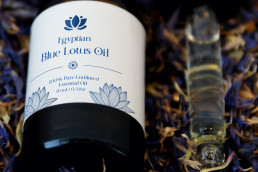
The oil should arrive in an amber or cobalt glass bottle, typically five or ten millilitres, with a clearly printed label showing the Latin binomial Nymphaea caerulea, the country of origin, the extraction method, the batch number, and a production or bottling date. The cap should be intact, the orifice reducer clean, and the bottle itself full to the shoulder rather than half-empty from evaporation during long shelf storage.
When opened, the oil should pour slowly: a genuine absolute is viscous, resinous at cooler temperatures, and sometimes semi-solid until warmed between the hands. A thin, watery liquid that pours like olive oil is almost always diluted.
The colour should sit somewhere between deep amber and olive-brown, occasionally with faint greenish undertones. A bright blue liquid is a dye tell-tale. Blue lotus flowers are blue; blue lotus oil is not.
The scent, finally, should carry real depth. On a smelling strip it should remain interesting after an hour. On skin it should evolve. It should not smell like soap, perfume, or the inside of a sweet shop.
Absolute, Essential Oil, or CO2 Extract: Which to Choose
Three extraction methods dominate the genuine blue lotus market, and each has its place.
The absolute is the most widely available and, for most uses, the most practical. It is produced by solvent extraction (usually hexane followed by ethanol washing) and yields a richly aromatic, viscous oil with the full complexity of the flower’s chemistry preserved. Its flavonoid and alkaloid content is robust. For inhalation, diffusion, perfumery, and diluted topical use, a well-made absolute is an excellent choice.
The true steam-distilled essential oil is rare, expensive, and aromatically lighter. Distillation captures the volatile top notes beautifully but leaves behind many of the heavier molecules responsible for blue lotus’s characteristic depth. This is the material to seek out for certain clinical inhalation applications where solvent traces are a concern, but for most buyers the extra cost is not justified by the aromatic profile.
The supercritical CO2 extract occupies the premium tier. It uses pressurised carbon dioxide as the solvent, leaves no residue, and captures both volatile and heavier compounds in a single pass. It is the cleanest and chemically most complete representation of the flower, and it is priced accordingly. For buyers who want the very finest material available and are willing to pay for it, a CO2 extract is the considered choice.
How to Vet a Seller in 2026
Beyond the product itself, the seller matters. A few practical checks separate serious producers from opportunists.
Ask whether they can provide a gas chromatography / mass spectrometry (GC/MS) report for the batch you are buying. Reputable sellers will either publish these on the site or send them on request. The report should show a chromatogram consistent with published profiles of Nymphaea caerulea, with detectable levels of nuciferine, aporphine, and characteristic flavonoids. If a seller cannot produce this document or does not understand what you are asking for, that is informative.
Check how they talk about the plant. A seller who writes knowledgeably about the difference between Nymphaea caerulea and Nelumbo nucifera, who distinguishes between absolute and essential oil without being prompted, and who discusses safety considerations openly is more likely to be selling genuine material than one whose copy consists of generic wellness phrasing.
Look at the breadth of their catalogue. A company selling three hundred different essential oils, all at similar price points, is almost certainly a reseller of bulk stock and unlikely to have meaningful control over any one product’s quality. A company that specialises in blue lotus, or in a small selection of botanicals they clearly know intimately, is more likely to have done the work.
Read their returns and storage policy. Serious sellers tell you how to store the oil, what degradation looks like, and what they will do if the bottle arrives compromised. A transparent returns policy is a signal of confidence in the product.
Realistic Expectations: What Genuine Oil Will and Will Not Do
Even the best blue lotus oil of 2026 is a botanical with modest, characterful effects. Setting expectations honestly is part of buying well.
Used in a diffuser at two to four drops in water, genuine blue lotus absolute produces a distinctive, calming atmosphere that many users describe as grounding. The effect is real but not dramatic. It is not a sedative in the pharmacological sense; it will not put an anxious person to sleep the way a benzodiazepine does. It shifts mood at the margins, particularly when paired with intentional breathing or an evening wind-down ritual.
Applied topically at a two to three percent dilution in a good carrier (jojoba is the classic pairing), the oil can support a slower, more parasympathetically dominant state when used on pulse points or across the solar plexus. It also has a gentle affinity for dry, stressed skin, where its flavonoid content provides mild antioxidant support.
What it will not do is replace clinical care for a diagnosed anxiety disorder, depression, insomnia, or any pain syndrome. A buyer who approaches blue lotus oil as a pleasurable, ritualising addition to an existing self-care practice will be well served. A buyer who approaches it as a replacement for therapy or medication will be disappointed and, potentially, poorly served.
A Note on Price: What You Are Actually Paying For
Price is often the most confusing element for a first-time buyer, so it helps to be explicit about what the money covers.
The raw flowers are harvested by hand, usually in the early morning when the blooms are open and the volatile oils are at their peak. A single kilogram of flowers yields only a tiny fraction of a gram of absolute. The extraction process, whether solvent, steam, or CO2, requires specialised equipment, skilled operators, and careful post-processing. Shipping an aromatic extract internationally involves documentation, customs, and cold-chain considerations. Reputable sellers also invest in laboratory testing, proper packaging, and customer education.
When all of this is summed, the realistic floor for a genuine five-millilitre bottle of pure blue lotus absolute in 2026 sits somewhere around the mid-to-upper two-figure range in pounds sterling, and ten-millilitre bottles of premium CO2 material routinely reach three figures. Buyers should calibrate their expectations against this baseline. Anything substantially below it is almost certainly not what it claims to be.
When Blue Lotus Oil Is Not the Right Purchase
Even the finest material is not for everyone. Blue lotus oil should be avoided during pregnancy and breastfeeding, as its alkaloid content has not been adequately studied in these populations. Caution is warranted for anyone taking dopaminergic medications (including Parkinson’s therapies), monoamine oxidase inhibitors, or strong sedatives, since theoretical interactions cannot be ruled out.
Legal considerations also matter. The plant and its preparations are restricted or prohibited in several jurisdictions, including Russia, Poland, Latvia, and the US state of Louisiana, with regulatory complexity in Australia. Buyers in these regions should verify local law before purchasing.
Finally, if the primary goal is acute symptom relief for a diagnosed condition, aromatic oils of any kind are an adjunct rather than a primary intervention. A consultation with an appropriately qualified clinician should come first.
Frequently Asked Questions
What is the best blue lotus oil to buy in 2026?
The best blue lotus oil in 2026 is a genuine Nymphaea caerulea extract, ideally an absolute or CO2 extract, sourced transparently from Egypt, packaged in dark glass, accompanied by batch documentation, and priced in line with realistic production costs. Brand matters less than the underlying evidence of authenticity.
How can I tell if blue lotus oil is real?
Check the Latin binomial on the label, look for viscous dark amber liquid (not bright blue), smell for aromatic evolution over time, ask for a GC/MS report, and apply the price floor test. If any of these checks fail, assume the product is not what it claims to be.
Is blue lotus absolute better than essential oil?
For most uses, yes. The absolute preserves more of the flower’s full chemistry, including the heavier floral and resinous notes that give blue lotus its characteristic depth. True steam-distilled essential oil is rare, lighter in profile, and generally reserved for specific clinical inhalation contexts.
How much should I pay for a real five-millilitre bottle?
Expect to pay somewhere in the mid-to-upper two-figure range in pounds sterling for a genuine five-millilitre bottle of pure blue lotus absolute in 2026. Premium CO2 extracts routinely cost more. Prices substantially below this range are a strong indicator of dilution or synthetic substitution.
What colour should blue lotus oil be?
Genuine oil ranges from deep amber to olive-brown, sometimes with faint greenish undertones. A bright blue or turquoise liquid indicates added dye and is a reliable signal that the product is not authentic.
How long does blue lotus oil last?
A well-made absolute, stored in dark glass in a cool, dark place, remains in good condition for three to four years. Essential oils and CO2 extracts have similar shelf lives when stored properly. Exposure to heat, light, or oxygen accelerates degradation.
Can I use blue lotus oil on my face?
Yes, at a one to two percent dilution in a suitable carrier such as jojoba or rosehip. A patch test is sensible before first use, and anyone with a known sensitivity to floral aromatics should introduce the oil cautiously. It is not suitable for use around the eyes.
Is blue lotus oil safe during pregnancy?
No. Blue lotus oil should be avoided during pregnancy and breastfeeding. The alkaloid content has not been adequately studied in these populations, and the prudent clinical position is to abstain.
Where is the best blue lotus oil produced?
The finest material in 2026 generally originates in Egypt, the plant’s native range, where harvesting traditions and extraction infrastructure are most mature. Sri Lankan and Thai producers supply related species, but these should be clearly labelled and understood as different plants.
What is the difference between blue lotus oil and blue lotus perfume?
A perfume is a formulated product containing blue lotus alongside other aromatic materials, fixatives, and a solvent base, usually alcohol. A pure oil contains only the botanical extract itself. Perfumes are for scent; pure oils are for aromatherapy, skincare formulation, and ritual use.
Where to Go From Here
If this guide has given you the framework to identify genuine material, the next step is to read more deeply about the plant itself and its place in traditional and contemporary practice. The complete guide to blue lotus oil gathers the botany, chemistry, history, and practical usage into a single reference, and it is the recommended starting point for anyone who wants to understand what they are buying, not just which bottle to choose.
For readers who already know the material and are ready to purchase, the final section below points to the product we stand behind: a small-batch, transparently sourced blue lotus oil made to the standards this article has described.

Antonio Breshears
Antonio Breshears is a renowned expert in holistic medicine and beauty, with over 25 years of research experience dedicated to uncovering the secrets of nature's most powerful remedies. Holding a degree in Naturopathic Medicine, Antonio's passion for healing and well-being has driven him to explore the intricate connections between mind, body, and spirit.
Over the years, Antonio has become a respected authority in the field, helping countless individuals discover the transformative power of plant-based therapies, including essential oils, herbs, and natural supplements. He has authored numerous articles and publications, sharing his wealth of knowledge with a global audience seeking to improve their overall health and well-being.
Antonio's expertise extends to the realm of beauty, where he has developed innovative, all-natural skincare solutions that harness the potency of botanical ingredients. His formulations embody his deep understanding of the healing properties found in nature, providing holistic alternatives for those seeking a more balanced approach to self-care.
With his extensive background and dedication to the field, Antonio Breshears is a trusted voice and guiding light in the world of holistic medicine and beauty. Through his work at Pure Blue Lotus Oil, Antonio continues to inspire and educate, empowering others to unlock the true potential of nature's gifts for a healthier, more radiant life.