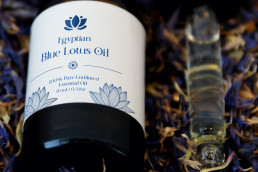
The story of blue lotus ayurveda is quieter than the Egyptian one, but arguably more continuous. While Egypt revered Nymphaea caerulea in temple ritual and royal tomb, the lotus family (including blue-flowered water lilies known in Sanskrit as utpala, nilotpala, and kuvalaya) threaded itself into Indian medicine, poetry, and spiritual practice over thousands of years. This article maps what classical Ayurveda actually says about blue lotus, how its actions translate into modern language, and where a contemporary blue lotus oil ritual sits within that older framework.
Table of Contents
- A Note on Botany and Sanskrit Terms
- Blue Lotus in the Classical Ayurvedic Texts
- Dosha, Dhatu, and the Logic of Cooling
- Traditional Uses of Blue Lotus in Indian Medicine
- Cooling fevers and heat conditions
- Skin and the external body
- Mental and emotional balance
- Female reproductive support
- Spiritual and ritual use
- Modern Blue Lotus Oil Through an Ayurvedic Lens
- How to Use Blue Lotus Oil in an Ayurveda-Informed Way
- Abhyanga and self-massage
- Face and heart application
- Aromatic inhalation
- Nasya (with caution)
- Realistic Expectations and Honest Limits
- When Blue Lotus Oil Is Not the Right Choice
- Complementary Practices in an Ayurvedic Routine
- Frequently Asked Questions
- Where to Go From Here
- Bring the Tradition Home
It is written and clinically reviewed by Antonio Breshears, ND, CCA, a Bastyr-trained naturopathic doctor and certified clinical aromatherapist. If you are new to this plant, the complete guide to blue lotus oil offers a broader orientation to its chemistry, extraction, and uses; this article focuses specifically on the Ayurvedic lineage and how that knowledge shapes intelligent use today.
A Note on Botany and Sanskrit Terms
Before going further, a small but important clarification. The English word “lotus” has been used loosely for two botanically distinct plants: the true lotus (Nelumbo nucifera, the sacred pink or white lotus that rises above the water) and the water lily (Nymphaea species, which floats on the surface). Ayurvedic texts are similarly layered. Sanskrit distinguishes several terms, and translators have not always agreed on which plant each refers to.
Padma and kamala most often refer to Nelumbo nucifera. Utpala, nilotpala, and kuvalaya generally point to blue or blue-violet water lilies in the Nymphaea family, which is where Nymphaea caerulea sits. Indivara is another term frequently glossed as blue lotus. The classical compendia, Charaka Samhita, Sushruta Samhita, and the later Bhavaprakasha Nighantu, use these words across poetry, pharmacology, and ritual, so the boundary is sometimes blurred.
For the purposes of this article, “blue lotus” refers to Nymphaea caerulea and its close botanical relatives, the plants most clearly matched to the Sanskrit terms nilotpala and indivara. Where a classical source clearly means the pink lotus instead, the two are not interchangeable.
Blue Lotus in the Classical Ayurvedic Texts
The Bhavaprakasha Nighantu, a sixteenth-century materia medica that remains a standard reference, lists utpala (blue water lily) with specific properties. It is described as cooling in potency (sheeta virya), sweet and slightly astringent in taste (madhura and kashaya rasa), and light in quality. Its key indicated actions include raktapitta (a category that covers bleeding disorders and excess heat in the blood), daha (burning sensation), trishna (excessive thirst), and mental agitation associated with heat.
The Charaka Samhita, the older foundational text on internal medicine, references lotus preparations in formulas for bleeding disorders, fevers, and conditions marked by heat and inflammation. Cooling floral infusions, including those made from lotus petals, appear in recipes for restoring fluid balance during the hot seasons and in convalescence.
The Sushruta Samhita, the surgical compendium, references lotus species in the context of wound care, skin soothing preparations, and the treatment of burning sensations. Petals and stamens were pounded into pastes, infused into medicated ghees, or steeped in water for topical and internal use.
Across these sources, a consistent picture emerges. Blue lotus is understood as a cooling, calming, slightly astringent plant that addresses conditions of excess heat, whether that heat shows up as fever, inflammation, bleeding, burning, thirst, irritability, or mental restlessness.
Dosha, Dhatu, and the Logic of Cooling
Ayurveda organises bodily function around three doshas: vata (air and movement), pitta (fire and transformation), and kapha (earth and cohesion). Blue lotus, with its cooling potency and sweet-astringent taste, is classically understood as a pitta-pacifying plant. It also modestly pacifies vata when vata is aggravated by dryness and heat, although its light quality means it is not primarily grounding in the way heavy oils and roots are.
In modern terms, this translates reasonably well. Pitta excess describes patterns of inflammation, heat, irritability, skin reactivity, acid-related complaints, and a certain kind of driven mental overactivity. The chemistry of Nymphaea caerulea, including its apigenin and other flavonoid content, aligns with a gentle anti-inflammatory and calming action that matches this traditional framing. The plant is not a strong sedative; it is, in both languages, a cooling influence that takes the edge off without suppressing.
Regarding the tissues (dhatus), blue lotus is classically said to nourish rasa (the plasma and lymphatic tissue) and benefit rakta (blood) by pacifying its heat. Its use in convalescent formulas, particularly for people recovering from fevers or blood-related disorders, draws on this tissue-level action.
Traditional Uses of Blue Lotus in Indian Medicine
Cooling fevers and heat conditions
Petal infusions were, and in some households still are, used as a cooling drink during high pitta seasons and during convalescence from febrile illness. Blue lotus was combined with other cooling herbs such as chandana (sandalwood), ushira (vetiver), and mukta (pearl) in classical preparations designed to reduce burning sensations and restore fluids.
Skin and the external body
Topical pastes and medicated oils containing lotus species appear throughout the surgical and dermatological sections of the classical texts. The plant’s astringent and cooling qualities made it useful for inflamed skin, minor burns, and the kind of hot, reactive complexion that Ayurveda associates with aggravated pitta. Blue lotus was blended into taila preparations (medicated oils in a sesame base) for facial massage and into lepa preparations (pastes) for acute skin issues.
Mental and emotional balance
This is where the Ayurvedic and Egyptian traditions start to echo each other. Blue lotus is described in the classical texts as calming to the mind (manas), reducing pitta-related agitation, and supporting sleep when heat and irritability are interfering with rest. It was used in nasya (nasal application of medicated oils), in aromatic baths, and in cooling floral infusions intended to settle the mind at the end of a hot day.
Female reproductive support
Cooling plants with rasa-nourishing and blood-pacifying actions are a consistent theme in Ayurvedic formulas for pitta-type menstrual difficulties: heavy bleeding, burning pelvic sensations, and the irritable, overheated quality that sometimes accompanies the cycle. Blue lotus and related lotus species appear in several such formulas, usually in combination rather than alone.
Spiritual and ritual use
As in Egypt, the ritual and medicinal uses of the plant blur into each other. Blue lotus appears in descriptions of deities, particularly forms of Vishnu, Lakshmi, and Saraswati, and is associated with expanded awareness, devotional practice, and the heart centre. Petals were used in temple offerings, in bath waters for purification, and in the preparation of sacred ointments. The assumption threading through all of this is that the plant does not merely smell pleasant; it carries a quality that supports the subtle body as well as the gross body.
Modern Blue Lotus Oil Through an Ayurvedic Lens
The oil most people encounter today, Egyptian blue lotus absolute extracted from thousands of flowers per gram, is a modern product. It is not what classical Ayurvedic practitioners worked with, and honesty requires saying so. The traditional preparations were water-based infusions, medicated ghees, sesame-oil tailas, and dried petal powders. An essential-oil-grade floral absolute is a different extract with a different concentration profile.
That said, the core chemistry of the plant carries through. The alkaloids and flavonoids that give blue lotus its cooling, calming character are present in the absolute, often in higher relative concentration than in a water infusion. Used correctly and in the right context, a modern blue lotus oil can honour the Ayurvedic framing of the plant rather than contradict it.
The Ayurvedic logic gives a reasonably clear answer to the question of when this oil is most appropriate. It is best suited to pitta-aggravated patterns: overheated skin, irritable or overactive mental states, hot and reactive emotional weather, and the kind of insomnia that comes from a mind that will not stop running. It is less obviously the right oil for a cold, depleted vata state (where warmer, heavier oils are usually more appropriate) or for kapha heaviness (where stimulating and drying aromatics suit better).
How to Use Blue Lotus Oil in an Ayurveda-Informed Way
Abhyanga and self-massage
Abhyanga, the daily self-massage with warm oil, is one of Ayurveda’s defining practices. The classical base is usually sesame for vata, coconut or sunflower for pitta, and mustard or sesame for kapha. Blue lotus oil, being cooling and floral, blends beautifully into a pitta-pacifying abhyanga oil. Add two to three drops of blue lotus absolute per 10ml of coconut or sunflower carrier and apply warm (not hot) to the body, moving toward the heart. This is particularly suited to hot seasons, post-sun recovery, and the kind of day that has left you wound tight and overheated.
Face and heart application
For facial use, a 1 percent dilution (approximately one drop per 10ml of carrier) in a light carrier such as jojoba or fractionated coconut oil respects the sensitivity of the skin while still carrying the plant’s cooling signature. Applied to the face, the chest, and the heart centre before evening practice, meditation, or sleep, this aligns with how the plant has been used in devotional and cooling contexts for centuries.
Aromatic inhalation
Two to four drops in a diffuser, or one drop on a tissue held near the face, offers the fastest route into the olfactory-limbic system. This is the modern equivalent of the classical bath and ritual uses. The inhaled aromatic carries the plant’s settling character into the nervous system without requiring any skin application at all.
Nasya (with caution)
Nasya, the classical nasal oil application, is a specific therapeutic procedure traditionally performed with ghee or sesame-based medicated oils. A modern undiluted floral absolute is not appropriate for direct nasal application. If you wish to honour the nasya tradition, work with a qualified Ayurvedic practitioner using properly formulated nasya oils, and keep your blue lotus absolute for topical dilution and inhalation.
Realistic Expectations and Honest Limits
Used as described above, a blue lotus oil ritual within an Ayurveda-informed routine tends to produce a modest, cumulative shift. Within the first few sessions, most people notice a gentle cooling of mental and emotional intensity, a slight softening of reactivity, and an easier transition into evening rest. Over two to four weeks of consistent use, the effect becomes more reliable, more of a familiar doorway into a calmer state rather than a surprise.
What it does not do, in either the Ayurvedic or the modern reading, is override serious imbalance. A genuinely aggravated pitta state with significant inflammation, persistent insomnia, or mood disturbance requires a proper Ayurvedic or clinical assessment. The oil is a supportive daily ally; it is not a standalone treatment for any condition, and the classical texts themselves never pretended otherwise. Blue lotus almost always appears in formulas alongside other herbs and within broader lifestyle prescriptions.
When Blue Lotus Oil Is Not the Right Choice
Ayurveda is precise about matching remedies to constitutions and states. Blue lotus oil is not universally appropriate. Avoid it in pregnancy and breastfeeding. Use caution if you are taking dopaminergic medications, MAOIs, or significant sedatives, since the alkaloid profile of the plant has mild central activity that could interact. A cold, heavy, dull state (classically kapha excess, or vata with strong cold qualities) is not the right fit; warmer, more stimulating aromatics serve better there.
If you are acutely unwell, running a high fever, experiencing significant mood disturbance, or dealing with a condition that has not been properly assessed, speak to a clinician, an Ayurvedic practitioner, or both, before layering in a new aromatic ritual. Blue lotus pairs best with a life that is already broadly in order; it is not a rescue remedy for a life that is not.
Complementary Practices in an Ayurvedic Routine
An Ayurveda-informed evening routine that uses blue lotus oil well looks roughly like this. A cooling dinner, eaten without screens and not too late. A short walk after eating. A warm (not hot) oil massage, briefer if time is short, with the blue-lotus-infused carrier described above. A simple breath practice, slow nasal breathing for five to ten minutes, with the oil diffusing nearby. Early lights-out, screens away, and room kept cool.
Supportive herbs in the background of such a routine might include brahmi, ashwagandha, shatavari, or jatamansi, chosen according to individual constitution and taken under appropriate guidance. Other cooling essential oils that blend beautifully with blue lotus in a pitta-pacifying context include sandalwood, vetiver, rose, and Roman chamomile. These are not substitutes for each other; each carries its own signature, and the craft lies in combining them thoughtfully rather than layering them thickly.
Frequently Asked Questions
Is blue lotus the same as the sacred lotus in Ayurveda?
No. The sacred lotus (Nelumbo nucifera), usually called padma or kamala, is a different plant from blue water lily species (Nymphaea caerulea and relatives), usually called utpala, nilotpala, or indivara. Both are revered, but they have distinct botanical profiles and somewhat different classical indications.
What dosha does blue lotus balance?
Blue lotus is classically understood as primarily pitta-pacifying, because of its cooling potency and sweet-astringent taste. It also modestly supports vata when heat and dryness are involved. It is not generally recommended for kapha-dominant states where warmer, more stimulating plants are a better match.
Does Ayurveda use blue lotus for sleep?
Yes, in a particular way. Classical texts describe blue lotus as calming to the mind and useful where pitta-type heat and irritability are interfering with rest. This matches the modern experience of the oil: it tends to help most with the kind of insomnia that comes from an overactive, overheated mind rather than with cold, anxious, restless vata-type sleeplessness, which responds better to warmer, grounding oils.
Can blue lotus oil be used in abhyanga?
Yes, when properly diluted into a suitable carrier. Two to three drops of blue lotus absolute per 10ml of coconut or sunflower oil makes an excellent pitta-pacifying abhyanga blend. The absolute itself is too concentrated to use neat.
Is the modern blue lotus absolute classical?
No. Classical Ayurvedic preparations used water infusions, medicated ghees, sesame-oil tailas, and dried petal powders. Solvent-extracted floral absolute is a modern product. The plant’s core chemistry carries through, but the extract form and concentration differ significantly from what classical practitioners worked with.
Can I take blue lotus internally following Ayurvedic tradition?
Blue lotus absolute is not intended for internal use. Traditional internal preparations used dried petals, decoctions, or medicated ghees prepared according to specific protocols, not concentrated essential oil. If you wish to use blue lotus internally, work with a qualified Ayurvedic practitioner using appropriate preparations.
Is blue lotus safe in pregnancy according to Ayurveda?
Classical texts do list several cooling plants as cautious during pregnancy, and modern practice follows a similar principle for concentrated essential oil extracts. Blue lotus absolute should be avoided in pregnancy and breastfeeding. For any aromatic use during pregnancy, consult a qualified practitioner.
Which carrier oil does Ayurveda prefer for blue lotus?
For a pitta-pacifying intention, coconut or sunflower oils are the classical bases. Sesame is more warming and is traditionally reserved for vata applications. For facial use, jojoba works well because it is light and non-comedogenic, even though it is not classically Ayurvedic.
Does blue lotus have a place in modern Ayurvedic clinical practice?
Yes, though usually in classical preparations rather than as a solvent-extracted absolute. Petal powders, decoctions, and medicated ghees containing blue lotus continue to appear in formulations for heat-related conditions, skin issues, and emotional agitation. The modern oil is better understood as an aromatherapy product that aligns with Ayurvedic principles rather than as a classical Ayurvedic medicine.
How does blue lotus compare to other cooling Ayurvedic oils?
Sandalwood is more deeply cooling and grounding, with a meditative quality. Vetiver is earthier and more stabilising. Rose is more cardiac and emotional. Blue lotus sits between these, floral and slightly aquatic in character, with a distinctive quality of lifted calm. In practice, these oils blend beautifully rather than competing, and thoughtful formulations often use several together.
Where to Go From Here
The Ayurvedic framing gives a useful discipline to modern use of this plant. It suggests when the oil is appropriate (hot, reactive, overactive states), which carriers suit best (coconut, sunflower, jojoba), and which companion practices amplify its action (abhyanga, cooling breath practices, calming routines in pitta seasons). It also sets honest limits: this is a cooling, supportive plant, not a treatment for significant imbalance. For a broader orientation to the plant’s chemistry, extraction methods, and modern clinical considerations, the complete guide to blue lotus oil is the best next stop.

Antonio Breshears
Antonio Breshears is a renowned expert in holistic medicine and beauty, with over 25 years of research experience dedicated to uncovering the secrets of nature's most powerful remedies. Holding a degree in Naturopathic Medicine, Antonio's passion for healing and well-being has driven him to explore the intricate connections between mind, body, and spirit.
Over the years, Antonio has become a respected authority in the field, helping countless individuals discover the transformative power of plant-based therapies, including essential oils, herbs, and natural supplements. He has authored numerous articles and publications, sharing his wealth of knowledge with a global audience seeking to improve their overall health and well-being.
Antonio's expertise extends to the realm of beauty, where he has developed innovative, all-natural skincare solutions that harness the potency of botanical ingredients. His formulations embody his deep understanding of the healing properties found in nature, providing holistic alternatives for those seeking a more balanced approach to self-care.
With his extensive background and dedication to the field, Antonio Breshears is a trusted voice and guiding light in the world of holistic medicine and beauty. Through his work at Pure Blue Lotus Oil, Antonio continues to inspire and educate, empowering others to unlock the true potential of nature's gifts for a healthier, more radiant life.