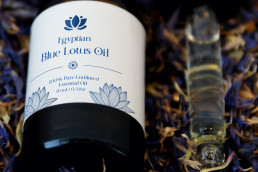
The equinoxes, those two moments each year when day and night hold equal weight, have long drawn people toward reflection, threshold-crossing, and quiet ceremony. If you are considering using blue lotus oil for equinox rituals, whether that means a simple solo anointing, a structured meditation, or a small gathering with friends, this article lays out what the oil genuinely contributes to the experience, how to prepare it at sensible dilutions, and which ceremonial elements pair well with its cooler, honeyed-floral character.
Table of Contents
- What an Equinox Ritual Actually Is
- How Blue Lotus Oil Fits the Equinox Mood
- The scent carries a "liminal" quality
- The chemistry encourages parasympathetic settling
- It has genuine historical resonance
- How to Use Blue Lotus Oil for Equinox Rituals
- The five-minute anointing
- The diffuser meditation
- The ritual bath
- The small-gathering ceremony
- What to Expect: Realistic Timeframes
- When Blue Lotus Oil Is Not the Right Choice
- Complementary Elements for Equinox Work
- Structuring the Two Equinoxes Differently
- Frequently Asked Questions
- Where to Go From Here
- Mark Your Equinox with Intention
It is written and clinically reviewed by Antonio Breshears, ND, CCA, a Bastyr-trained naturopathic doctor and certified clinical aromatherapist. For a broader grounding in the oil’s chemistry, scent profile, and traditional uses, readers may want to start with the complete guide to blue lotus oil, which serves as the master reference for this site.
What an Equinox Ritual Actually Is
An equinox ritual is, at its simplest, a deliberate pause timed to a celestial marker. The spring equinox (around 20 or 21 March in the Northern Hemisphere, September in the Southern) marks the tipping point into lengthening days; the autumn equinox signals the reverse. For thousands of years, across wildly different cultures, these moments have been treated as thresholds worth marking: the Egyptian civic calendar noted them, Celtic and Germanic traditions wove them into planting and harvest cycles, and contemporary practitioners from yoga studios to secular meditators still use them as natural checkpoints.
You do not need to subscribe to any particular spiritual framework to find an equinox ritual useful. At its core, the practice is psychological: a structured moment to look back on the half-year that has passed, notice what needs releasing or strengthening, and set a loose intention for the half-year ahead. What aromatic oils contribute, blue lotus included, is sensory anchoring. A scent used deliberately at moments of reflection becomes, over repeated seasons, a cue that helps you drop more quickly into that reflective state.
How Blue Lotus Oil Fits the Equinox Mood
Blue lotus oil has a particular character that suits threshold moments rather well, and it is worth understanding why before you splash it into a diffuser and hope for the best.
The scent carries a “liminal” quality
The top notes are cool and aquatic, almost water-like, which sounds unusual but reads clearly on the nose. The heart is deeply honeyed-floral. The base tips into something faintly smoky and balsamic. That three-part arc, cool opening, warm middle, grounded base, mirrors the structure most people instinctively want in a transition ritual: pause, descend, settle. It is not a cheerful, uplifting floral like neroli, and it is not a sedating base note like vetiver. It sits in between, which is where equinox energy sits.
The chemistry encourages parasympathetic settling
The flavonoids in the oil, particularly apigenin, interact with central benzodiazepine receptors in ways that support a gentle shift toward parasympathetic dominance. The alkaloids, aporphine and nuciferine, contribute subtle dopaminergic and serotonergic activity. The practical upshot is that inhaling blue lotus tends to produce a softening rather than a sedation. You remain alert, you can still think and write and speak, but the nervous system is quieter. This is exactly the state ritual work benefits from; a full sedative would put you to sleep, and a stimulant would prevent introspection.
It has genuine historical resonance
Blue lotus (Nymphaea caerulea) appears throughout ancient Egyptian iconography associated with rebirth, the sun’s daily return, and threshold states. Whether or not you weight that historical connection spiritually, there is something satisfying about using a plant in a ceremonial context where it has been used for thousands of years. It lends the ritual a continuity that purely novel materials cannot.
How to Use Blue Lotus Oil for Equinox Rituals
Below are four approaches ranging from the minimal to the more elaborate. Choose according to your temperament and time available. None is more correct than another.
The five-minute anointing
For those who want something brief but real. Blend 1 drop of blue lotus absolute with roughly 10 drops of jojoba or fractionated coconut oil in a small dish or the palm of one hand. This gives you a dilution around 3 percent, appropriate for targeted skin application. Dab lightly on the pulse points of the wrists, behind the ears, and at the centre of the chest over the sternum. Sit for five minutes. Breathe normally, do not try to force a meditative state. Let the scent arrive and notice what thoughts surface. That is the whole practice.
The diffuser meditation
Place 2 to 4 drops of blue lotus in an ultrasonic diffuser with water, in a room where you will not be interrupted for 20 to 30 minutes. Sit with a journal or simply with eyes closed. A useful structure for the spring equinox is to spend the first ten minutes noticing what the winter has deposited in you, the second ten minutes noticing what wants to begin, and the final stretch simply breathing without agenda. For the autumn equinox, reverse the polarity: what has this summer ripened, and what needs to be composted before winter.
The ritual bath
Bathing is a remarkably effective ritual container because it handles three things at once, the physical warming, the sensory immersion, and the enforced stillness. To prepare, blend 3 to 5 drops of blue lotus absolute thoroughly into a tablespoon of full-fat milk, unscented liquid castile soap, or a plain carrier oil. Essential oils do not dissolve in water directly, and skipping this dispersant step leaves neat oil droplets floating on the surface, which is both wasteful and potentially irritating. Add the dispersed mixture to a drawn bath. Soak for 20 to 30 minutes, ideally by candlelight, ideally without your phone.
The small-gathering ceremony
If you are hosting two to six others, a longer arc works well: light a single beeswax candle, diffuse 3 drops of blue lotus, and offer each person a cotton pad bearing a single drop of the oil diluted in jojoba to hold or set beside them. Invite everyone to share, if they wish, one thing they are releasing and one thing they are welcoming. Close with a few minutes of silence. The oil is not doing the heavy lifting here, the shared vulnerability is, but the scent binds the evening together in memory in a way that strengthens the ritual if you repeat it across seasons.
What to Expect: Realistic Timeframes
Within the first two or three minutes of inhalation, most people notice a subtle softening in the breath and a very slight slowing of internal chatter. This is the olfactory-limbic pathway doing its work, the scent reaches the amygdala and hippocampus before it reaches conscious thought. Within ten to fifteen minutes of continued exposure in a diffuser or bath setting, the parasympathetic shift tends to deepen enough that sitting still becomes genuinely comfortable rather than effortful.
What you should not expect is anything approaching intoxication, dramatic vision, or mystical experience. Blue lotus oil, used aromatically at ritual dilutions, is modestly effective at supporting a reflective state. It is not psychoactive in any clinically meaningful sense when inhaled or applied topically. Accounts of profound altered states associated with blue lotus generally relate to ingested preparations in much larger quantities, which is a different practice with different considerations and is not what this article addresses.
Over repeated use, meaning if you use the same oil for the same ritual across several equinoxes, you will likely find the scent itself becomes a rapid cue. The nervous system learns the association. By the second or third use, simply opening the bottle can begin producing the settling response. This is a feature, not a placebo problem; it is how conditioned sensory cues work, and it is one of the most practical reasons to maintain consistent rituals across years.
When Blue Lotus Oil Is Not the Right Choice
Some honest limits worth naming before you build a ritual around the oil.
Pregnancy and breastfeeding. Blue lotus oil is avoided in both. The alkaloid content has not been adequately studied in these contexts, and caution is the sensible default. Choose a different ritual oil, such as a well-diluted rose or frankincense, for these seasons of life.
Certain medications. If you take dopaminergic medications (for Parkinson’s disease, restless legs syndrome, or some psychiatric indications), MAOIs, or strong sedatives, speak with a practitioner before using blue lotus regularly, even aromatically. The interactions are theoretical rather than well-documented at inhalation doses, but caution is warranted.
Scent sensitivities and migraines. If you are prone to scent-triggered migraines, blue lotus’s honeyed-floral character may be a trigger, and no ritual benefit outweighs that. Test with a single drop on a tissue held at arm’s length before committing to a bath or prolonged diffuser session.
Legal restrictions. Blue lotus faces regulatory restrictions in Russia, Poland, Latvia, the US state of Louisiana, and regulatory complexity in Australia. Check local rules before ordering or travelling with the oil.
Grief that needs company, not scent. If an equinox happens to fall during acute grief or a mental health crisis, a ritual oil is a supplement, not a substitute for human support or clinical care. Use the ritual if it helps, but do not lean on it to do what a therapist, friend, or physician should be doing.
Complementary Elements for Equinox Work
Blue lotus does not need to work alone. Several companions extend what the oil does well.
Other oils. For spring equinox work, where a sense of emerging and opening serves the ritual, a single drop of neroli or bergamot in the diffuser alongside the blue lotus lifts the top without overwhelming the heart. For autumn, where descent and integration are the themes, vetiver or sandalwood adds depth. Keep supporting oils to one drop against two or three of the blue lotus, so the character of the lotus remains the central thread.
Candlelight. A single beeswax or soy candle changes the entire sensory register of a room. Overhead lighting pulls the nervous system into task mode; candlelight invites reflection. This is not mysticism, it is simply how the human visual system responds to light quality.
A simple journal prompt. Rituals held entirely in the head tend to evaporate. Writing something down, even a single sentence for each equinox, creates a record you can revisit. A useful prompt structure is: what am I releasing, what am I carrying forward, what am I welcoming.
Movement or stillness, chosen deliberately. Some people do ritual work better after a short walk outside; others need to sit still from the start. Know your own tendency and do not fight it. The oil works in either mode.
Seasonal food and drink. A cup of warm, unsweetened tea or a simple seasonal fruit at the close of the ritual grounds the experience back into the body. This is particularly useful after longer sessions where you may feel slightly floaty.
Structuring the Two Equinoxes Differently
One of the small pleasures of building a ritual practice around blue lotus oil equinox observances is allowing the two poles to feel genuinely different rather than identical ceremonies marked by calendar dates.
The spring equinox has an outward, generative quality. Use slightly brighter lighting, pair the oil with a lifting companion like bergamot, keep the journaling forward-facing, and perhaps hold the ritual earlier in the day. The questions worth sitting with are about what wants to be planted, named, or begun.
The autumn equinox tips inward. Lower the lights further, pair the oil with a grounding companion like vetiver or frankincense, extend the silent portion, and hold the ritual closer to dusk. The questions here concern what has ripened, what needs to be honoured and released, and how you want to enter the darker half of the year.
Holding this polarity across the two equinoxes gives your practice a shape that tracks the actual quality of the light outside your window, and it prevents ritual from becoming a repeated identical gesture that loses meaning over time.
Frequently Asked Questions
Do I need to use blue lotus on the exact day of the equinox?
No. Within a window of three or four days either side, the astronomical event is effectively the same. Many people prefer the weekend nearest the equinox for practical reasons; the ritual is no less valid for being shifted by a day or two.
Can I combine blue lotus oil with other ritual tools I already use?
Yes, with one caveat. If you already burn heavy resins like frankincense or myrrh during ritual, the diffuser version of blue lotus may be overwhelmed by the smoke. Consider using the oil topically (anointing) rather than aromatically in those settings, so each element has space to be noticed.
How much oil do I actually need for a year of equinox rituals?
Very little. A 5 ml bottle of pure blue lotus absolute, stored properly in dark glass in a cool place, easily covers two equinox rituals per year for several years, along with occasional use between. The oil is potent at low dilutions, and restraint serves both your budget and the ritual itself.
Is blue lotus oil psychoactive during ritual use?
Not in any meaningful way when used aromatically or topically at the dilutions described here. It supports a settled, reflective state through olfactory-limbic pathways and mild parasympathetic activation, but it does not produce altered consciousness, visions, or intoxication. Accounts of stronger effects relate to ingested preparations, which are a separate practice.
How do I store the oil between rituals?
Keep it in its original dark glass bottle, upright, in a cool, dark place away from temperature swings. A cupboard works; a bathroom shelf usually does not, because of humidity and heat. Properly stored, the absolute keeps its character for three to four years.
Can I share the same diluted blend with a partner or friend during a joint ritual?
Yes, with a fresh cotton pad or clean area of skin for each person. The blend itself can be shared from a single small dish or rollerball prepared just before the ritual begins.
What if the scent feels too heavy or sweet?
Reduce the dose. One drop in a diffuser with a small companion oil like bergamot often reads more balanced than two or three drops of lotus alone, particularly for those who find deep florals cloying. Personal response to floral notes varies considerably, and there is no virtue in forcing a scent that does not suit you.
Do children or teenagers participate well in a family equinox ritual with blue lotus?
Aromatic diffusion in a shared room at a low drop count (1 to 2 drops) is generally fine for older children and teenagers in a brief ritual setting, provided no one in the room has scent sensitivities or relevant medical conditions. Skip topical application on children. For younger children, simpler rituals without essential oils often work better.
Is there a difference between the spring and autumn rituals in terms of the oil itself?
The oil is the same; the surrounding ritual shifts the mood. Using brighter companion oils, lighter lighting, and morning timing for spring, versus deeper companions, candlelight, and dusk timing for autumn, does more to differentiate the two ceremonies than any change in the lotus itself.
How long before I notice a “ritual cue” response to the scent?
Usually by the second or third repetition of the same ritual with the same oil, the scent begins acting as a rapid cue to drop into the reflective state. This is classical conditioning of a sensory anchor, and it is one of the real long-term benefits of consistent practice across years.
Where to Go From Here
If this is your first equinox ritual with blue lotus oil, keep the first attempt simple: one drop diluted, five minutes of stillness, a sentence written in a notebook. The ritual you can actually complete is worth more than the elaborate one you abandon halfway through. Revisit the practice at the next equinox, adjust, and let the ritual grow as it wants to. For readers who want to deepen their understanding of the oil’s broader properties, extraction methods, and safety profile, the complete guide to blue lotus oil covers the full picture in one place.

Antonio Breshears
Antonio Breshears is a renowned expert in holistic medicine and beauty, with over 25 years of research experience dedicated to uncovering the secrets of nature's most powerful remedies. Holding a degree in Naturopathic Medicine, Antonio's passion for healing and well-being has driven him to explore the intricate connections between mind, body, and spirit.
Over the years, Antonio has become a respected authority in the field, helping countless individuals discover the transformative power of plant-based therapies, including essential oils, herbs, and natural supplements. He has authored numerous articles and publications, sharing his wealth of knowledge with a global audience seeking to improve their overall health and well-being.
Antonio's expertise extends to the realm of beauty, where he has developed innovative, all-natural skincare solutions that harness the potency of botanical ingredients. His formulations embody his deep understanding of the healing properties found in nature, providing holistic alternatives for those seeking a more balanced approach to self-care.
With his extensive background and dedication to the field, Antonio Breshears is a trusted voice and guiding light in the world of holistic medicine and beauty. Through his work at Pure Blue Lotus Oil, Antonio continues to inspire and educate, empowering others to unlock the true potential of nature's gifts for a healthier, more radiant life.