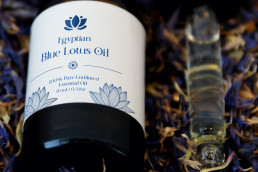
This article is written for facialists, estheticians, and skin therapists who want to understand how blue lotus oil behaves in a professional treatment setting. It covers the clinical reasoning for why blue lotus oil facialists reach for *Nymphaea caerulea* in particular, the sensory and psychological effect it creates on the table, the dilutions that work for different treatment phases, and the honest limits of what this oil can do on skin.
Table of Contents
- Why Facialists Are Turning to Blue Lotus Oil
- The Chemistry Facialists Should Actually Know
- What the Oil Is Not
- Where Blue Lotus Oil Fits in a Treatment Protocol
- 1. The Opening Ritual
- 2. The Facial Massage
- 3. Post-Extraction or Post-Procedure Calming
- 4. The Close
- Dilutions for Professional Use
- Matching Blue Lotus Oil to Skin Type and Treatment Goal
- What to Expect on the Table
- When Blue Lotus Oil Is Not the Right Choice
- Sourcing and Storage for Professional Use
- Pricing and Client Positioning
- Complementary Oils in a Facialist's Kit
- Frequently Asked Questions
- Where to Go From Here
- Professional-Grade Blue Lotus, Honestly Sourced
It is written and clinically reviewed by Antonio Breshears, ND, CCA, a Bastyr-trained naturopathic doctor and certified clinical aromatherapist. For a broader foundation on the oil’s chemistry, sourcing, and safety, readers may want to start with the complete guide to blue lotus oil before applying it in a treatment context.
Why Facialists Are Turning to Blue Lotus Oil
A facial is never purely a skin treatment. The client arrives with a nervous system, not just a face, and the quality of the result depends heavily on whether that nervous system settles during the hour on your table. This is where blue lotus oil earns its place in a professional kit. It is not a high-performance active in the way a retinoid or an acid is. It is instead a quiet psychosensory tool, one that shifts the client from anxious arrival to parasympathetic stillness faster than most florals, and that does so without the cloying sweetness of jasmine or the heady intensity of tuberose.
The other reason facialists are paying attention is the oil’s behaviour under touch. The absolute warms quickly on the fingertips, releases its honeyed-floral heart within a few seconds of contact with skin, and carries a cool aquatic top note that reads as expensive almost universally. Clients who do not know the botanical name can usually tell that something unusual is happening on their skin, and they can tell within the first two or three minutes of the treatment. For a practice that relies on retention and referrals, that early sensory signal matters.
The Chemistry Facialists Should Actually Know
You do not need to memorise a constituent list to use blue lotus oil well, but a few facts help you choose it over alternatives with confidence. The oil contains small amounts of aporphine and nuciferine, two alkaloids with mild activity at dopamine and serotonin receptors, and a useful set of flavonoids including apigenin, quercetin, and kaempferol. Apigenin in particular binds at central benzodiazepine receptors at low affinity, which is part of why the oil produces a recognisable calming effect when inhaled rather than merely a pleasant smell.
For the skin itself, the flavonoid fraction carries modest antioxidant and anti-inflammatory activity. This is not dramatic; you should not position blue lotus oil as a treatment for rosacea or active inflammatory acne. What it does do, reliably, is support a treatment protocol aimed at calming reactive or post-procedure skin, particularly when paired with appropriate hydrating and barrier-supporting actives in the rest of the routine.
What the Oil Is Not
It is worth being direct here. Blue lotus oil is not a clarifying oil, not an astringent, not a clinical-grade anti-ageing active, and not a substitute for sunscreen, retinoids, or acids in a results-driven protocol. If a client books a treatment expecting visible skin change, blue lotus oil is a supporting character in the experience, not the lead. Positioning it otherwise sets up disappointment.
Where Blue Lotus Oil Fits in a Treatment Protocol
There are four distinct moments in a facial where the oil earns its place, and each one calls for a slightly different dilution or method.
1. The Opening Ritual
Before the first cleanse, most experienced facialists perform some version of a settling ritual: a breath, a pressure point sequence at the décolleté or shoulders, a warm towel over the eyes. This is the ideal point to introduce blue lotus oil. A single drop of the neat absolute warmed between your palms, offered at a distance of about fifteen centimetres from the client’s nose for three slow breaths, does more for nervous system state than any amount of guided breathing instruction. The olfactory-limbic pathway is direct; the client does not have to try.
2. The Facial Massage
During the massage phase, blue lotus oil is best incorporated at one to two percent dilution in a carrier your skin type tolerates well. Jojoba is the most forgiving, squalane is lighter and cleaner for oily or combination skin, and a blend of jojoba and a small fraction of rosehip works well for mature or photo-damaged skin. At two percent, a thirty millilitre bottle takes approximately eighteen drops of the absolute, and that quantity carries a full massage sequence without overwhelming the room.
3. Post-Extraction or Post-Procedure Calming
After extractions, after microdermabrasion, or after a gentle peel, skin is reactive and the nervous system is usually on edge from the sensation. A compress with a single drop of blue lotus oil dispersed in a small bowl of warm water, applied for two or three minutes over a barrier cream or recovery balm, shifts the client palpably. The oil is not going on the procedural area directly at this stage; it is working through inhalation while the compress does its thermal work.
4. The Close
At the end of the treatment, a single drop on the client’s pulse point (wrist or behind the ear, with consent) sends them out of the room carrying the scent. This is both a generosity and a quiet marketing act; clients remember the scent long after they forget the cleanser you used.
Dilutions for Professional Use
Facialists often err on the side of over-dilution, which wastes the oil’s effect, or occasionally under-dilution, which creates sensitivity risk. The numbers below are a working reference.
- Facial massage oil: 1 to 2 percent in jojoba, squalane, or a bespoke blend. This is roughly nine to eighteen drops per thirty millilitres of carrier.
- Décolleté and shoulder massage: 2 to 3 percent, as the skin is less reactive and the aromatic effect benefits from slightly more oil.
- Compress or steam bowl: 1 drop per 250 millilitres of warm water, stirred to disperse.
- Ambient diffusion in the treatment room: 2 to 4 drops in an ultrasonic diffuser, run for fifteen minutes before the client arrives rather than during the treatment itself.
- Pulse point finish: 1 drop neat, applied sparingly and only on intact skin with client consent.
Never exceed three percent on the face. The oil is well tolerated at these dilutions in the majority of skin types, but reactive skin and clients on multiple actives at home benefit from the lower end of the range.
Matching Blue Lotus Oil to Skin Type and Treatment Goal
The oil is unusually versatile across skin types because its primary effect is sensory and nervous system orientated, but there are still pairings that work better than others.
Reactive, sensitive, and rosacea-prone skin: Blue lotus oil is a reasonable choice here specifically because it is quiet on the skin. Keep the dilution at one percent, use it in a jojoba or squalane base, and skip the neat pulse point application at the end. The calming effect on the nervous system is often more useful for this client than any topical active you could select.
Mature and photo-damaged skin: The flavonoid antioxidant profile is genuinely useful as part of a broader protocol. Combine with a carrier that carries its own weight, such as rosehip or camellia, and position the oil as part of a ritual rather than as the active driver of change.
Oily and congested skin: Less obvious, but workable. Use squalane as the carrier, keep the dilution at one percent, and reserve the oil for the massage phase rather than leaving it on overnight. The oil does not clog pores at these dilutions in my experience, but it also does not address congestion directly.
Stressed and sleep-deprived clients: This is where blue lotus oil genuinely shines. The treatment outcome for this client is as much about parasympathetic recovery as it is about the skin itself, and the oil does more of that work than any other single ingredient in a facialist’s kit.
What to Expect on the Table
Within the first three to four minutes of the opening ritual and massage, most clients visibly soften. Breathing slows, the jaw releases, and shoulders drop away from the ears. This is the effect you are paying for. It is not dramatic in the way a strong sedative would be; clients do not fall asleep immediately (though some do drift off during the massage), and they do not become disorientated. They simply arrive at a state of rest more quickly and more reliably than they would with a less distinctive aromatic.
On the skin itself, the effect is modest and cumulative across a series of treatments. A single facial with blue lotus oil incorporated will not produce a visible change that the client attributes to the oil specifically. What the oil contributes is a better sensory experience and a marginally better inflammatory environment for whatever else you are doing. Over a series of six treatments, clients notice that they feel different during and after their facials with you, and that feeling becomes part of why they rebook.
When Blue Lotus Oil Is Not the Right Choice
A short list of situations where it is best to leave the oil out of the treatment entirely:
- Pregnancy. The oil is avoided throughout pregnancy. This is the standard precautionary position and is worth upholding without exception in a professional setting.
- Breastfeeding. Same precautionary position applies. Offer an alternative aromatic for this phase.
- Clients on dopaminergic medications or MAOIs. The mild alkaloid activity is probably not clinically significant at facial dilutions, but the precautionary stance is to avoid it, and clients on these medications should be using aromatherapy under their own physician’s guidance.
- Clients with known floral allergies. As with any absolute or essential oil, patch test first.
- Active severe acne with broken skin. Not because the oil aggravates acne, but because broken skin increases absorption unpredictably, and this is not the context in which blue lotus oil’s strengths are most useful.
- Clients who genuinely dislike the scent. Blue lotus is distinctive, and a small fraction of clients find it cloying. The treatment experience is ruined if they spend the hour tolerating a scent they do not enjoy. Always offer it rather than imposing it.
Sourcing and Storage for Professional Use
Professional use demands more rigour around sourcing than personal use does. You are applying this oil to dozens of clients a week, you are responsible for what goes on their skin, and your insurance and reputation depend on traceability. A few standards to hold to:
Choose a supplier who can name the botanical (*Nymphaea caerulea*, not *Nelumbo nucifera*, which is the pink lotus and a different plant with a different chemistry), who can state the extraction method (solvent-extracted absolute is the most common; supercritical CO2 is the premium option), and who can provide a GC-MS report on request. The absolute is naturally viscous at room temperature and clients often notice the colour, which ranges from deep amber to a burnt-orange brown. An oil that is pale, watery, and cheap is almost certainly diluted or synthetic.
Store working bottles in dark glass, away from direct sunlight and away from the heat of a towel warmer or a lamp. Shelf life for a properly stored absolute is three to four years. Decant into smaller working bottles weekly rather than opening the master bottle repeatedly, as oxidation accelerates with repeated air exposure.
Pricing and Client Positioning
Blue lotus oil is expensive at the source. Three thousand to five thousand flowers go into a single gram of absolute, and that cost has to be reflected somewhere in your pricing structure if you are using the oil generously. The two workable approaches are to build it into the price of a signature treatment (the “blue lotus facial” as a premium tier), or to offer it as an add-on for an additional fee on any facial in your menu.
The signature approach tends to work better for practices with a well-established clientele who book by brand name. The add-on approach works better for newer practices and for walk-in-heavy locations. Either way, resist the temptation to dilute the oil heavily to stretch it; the entire point of including it is the effect it produces at clinically meaningful concentrations, and a one-drop-per-bottle version fools no one.
Complementary Oils in a Facialist’s Kit
Blue lotus oil does not need company to be effective, but it blends beautifully with a small set of other aromatics for specific treatment goals. Roman chamomile reinforces the calming effect for very anxious clients. Frankincense adds a grounding base note for mature skin treatments. Neroli lifts the floral heart and works well for clients who find blue lotus alone too heavy. Sandalwood, particularly Australian, deepens the base and suits evening or winter treatments. Avoid pairing with anything sharp or medicinal (tea tree, eucalyptus, peppermint) in the same treatment; the scent profiles clash and the sensory effect is ruined.
Frequently Asked Questions
Is blue lotus oil safe to use on every client?
At facial-appropriate dilutions of one to two percent, it is well tolerated by the majority of skin types. Exceptions are pregnancy, breastfeeding, clients on dopaminergic or MAOI medications, and clients with known floral allergies. Patch test before first use.
What carrier oil works best for a blue lotus facial massage?
Jojoba is the most universally forgiving and is my default for a mixed clientele. Squalane is lighter and cleaner for oily skin. A jojoba and rosehip blend works well for mature or photo-damaged skin. Avoid heavier nut oils in clients with any nut allergy history.
Can I use blue lotus oil immediately after a chemical peel or microneedling?
Not directly on the treated area. It can be used aromatically (diffused, on a compress, at the pulse point) to support the client’s recovery experience, but it should not be layered on compromised skin until the barrier has re-established.
How much oil do I actually need per treatment?
Very little. A well-designed protocol uses roughly one to three drops of the neat absolute across the entire treatment, distributed between the opening ritual, a small portion added to the massage oil, and optionally a drop at the close. Generosity is less about quantity than about placement.
Does blue lotus oil help with acne?
Only indirectly. It is not an antimicrobial or a sebum regulator, and it should not be positioned to clients as an acne treatment. It can support a calmer inflammatory environment as part of a broader protocol, which is a modest contribution, not a clinical one.
What is the difference between blue lotus absolute and blue lotus essential oil?
Most commercially available blue lotus oil is an absolute, produced by solvent extraction. True steam-distilled essential oil is rare and more volatile in character. Supercritical CO2 extraction produces a cleaner profile at premium price. For facial work, the absolute is the standard and the easiest to work with.
Will clients recognise the scent?
Most will not name it, but most will notice that it is unusual, distinctive, and expensive-feeling. This works in your favour. It becomes “the scent at your studio” rather than a generic floral they have smelled elsewhere.
How do I introduce blue lotus oil to clients who are scent-cautious?
Offer it rather than apply it. Hold the opened bottle at a respectful distance and let them take two or three breaths; ask whether they would like it included in their treatment. Clients who dislike the scent are rare but real, and their autonomy in this matters as much as anyone else’s.
Can I make my own blue lotus facial serum to retail?
You can, subject to your local cosmetics regulations, which in most jurisdictions require stability testing, proper labelling, and preservation if any water phase is involved. An oil-only serum is simpler from a regulatory standpoint than a cream or lotion. Work with a cosmetic chemist if retailing seriously, not just anecdotally.
How long does a bottle last in a busy practice?
A ten millilitre bottle of absolute, used at the dilutions described here across four or five facials a day, lasts a working practitioner approximately four to six weeks. Store the master bottle cool and dark, decant into smaller working bottles weekly, and replace every three years at the outside.
Where to Go From Here
If this article has answered the questions specific to your practice, the next useful read is the complete guide to blue lotus oil, which covers the botanical, chemical, and historical context in more depth than a clinical protocol requires. From there, the category pillar on practitioner and wholesale topics addresses pricing structures, sourcing relationships, and retailing considerations in greater detail, which is worth reviewing before you commit to incorporating the oil at scale in your menu.

Antonio Breshears
Antonio Breshears is a renowned expert in holistic medicine and beauty, with over 25 years of research experience dedicated to uncovering the secrets of nature's most powerful remedies. Holding a degree in Naturopathic Medicine, Antonio's passion for healing and well-being has driven him to explore the intricate connections between mind, body, and spirit.
Over the years, Antonio has become a respected authority in the field, helping countless individuals discover the transformative power of plant-based therapies, including essential oils, herbs, and natural supplements. He has authored numerous articles and publications, sharing his wealth of knowledge with a global audience seeking to improve their overall health and well-being.
Antonio's expertise extends to the realm of beauty, where he has developed innovative, all-natural skincare solutions that harness the potency of botanical ingredients. His formulations embody his deep understanding of the healing properties found in nature, providing holistic alternatives for those seeking a more balanced approach to self-care.
With his extensive background and dedication to the field, Antonio Breshears is a trusted voice and guiding light in the world of holistic medicine and beauty. Through his work at Pure Blue Lotus Oil, Antonio continues to inspire and educate, empowering others to unlock the true potential of nature's gifts for a healthier, more radiant life.