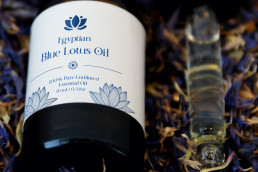
Sound healing works through the nervous system, not just the ears. When a gong bath, crystal bowl session or tuning fork treatment is at its best, the participant drops into a parasympathetic state where breath slows, muscle tone softens and time feels loose. The right scent, introduced at the right moment, can shorten the on-ramp into that state considerably. This article is for sound practitioners who want to understand why blue lotus oil has quietly become a favourite among facilitators, and how to use it safely and effectively in a group setting. If you are researching blue lotus oil sound healers use in their practice, you will find specific protocols, realistic expectations and practitioner-grade safety notes below.
Table of Contents
- Why Scent Belongs in a Sound Session
- The Chemistry Behind the Sound Practitioner's Interest
- How Sound Healers Are Using Blue Lotus Oil in Practice
- Room Anointing Before Arrival
- Participant Anointing at the Heart or Brow
- Facilitator's Personal Dilution
- Post-Session Integration
- A Practical Protocol for a Sound Bath of Twelve to Twenty Participants
- What to Expect: Realistic Results Across a Series of Sessions
- When Blue Lotus Oil Is Not the Right Choice for a Session
- Complementary Oils and Approaches for Sound Work
- Sourcing Considerations for Practitioners
- Frequently Asked Questions
- Where to Go From Here
- Practitioner-Grade Blue Lotus Oil
It is written and clinically reviewed by Antonio Breshears, ND, CCA, a Bastyr-trained naturopathic doctor and certified clinical aromatherapist. For readers new to this botanical, the complete guide to blue lotus oil covers chemistry, sourcing and safety in depth, and this cluster assumes some of that groundwork.
Why Scent Belongs in a Sound Session
The olfactory nerve is the only cranial nerve with a direct line into the limbic system. Sound reaches the limbic brain too, of course, but it travels through the auditory cortex first and undergoes a degree of cognitive processing along the way. Scent bypasses that processing almost entirely. Within two or three breaths of a distinctive aroma being introduced, the amygdala, hippocampus and hypothalamus have already registered it and begun modulating autonomic tone.
This matters for sound work because the limitation of a sound bath is not the sound; it is the participant’s ability to let the sound in. A nervous system still in sympathetic drive, carrying the last hour of traffic or a difficult conversation, will hear the bowls but not feel them. Scent can lower that guard before the first note. Used well, it becomes part of the induction, not an afterthought.
Blue lotus oil is particularly well suited to this role because it does not smell like any of the common essentials participants have encountered in yoga studios or spas. It is unfamiliar in a way that rewards attention. The top is cool and faintly aquatic, the heart is deeply honeyed and floral with a slight narcotic quality, and the base carries a soft balsamic-smoky note. Participants often describe the scent as grounding and uplifting simultaneously, which is exactly the state a skilled facilitator is trying to create acoustically.
The Chemistry Behind the Sound Practitioner’s Interest
Blue lotus absolute, distilled from the flowers of Nymphaea caerulea, contains a distinctive alkaloid and flavonoid profile. The alkaloids of note are aporphine, a weak dopamine agonist, and nuciferine, which shows weak dopamine antagonism and some serotonin receptor activity at 5-HT2A and 5-HT2C sites. The flavonoids include apigenin, quercetin and kaempferol, with apigenin binding weakly at the central benzodiazepine receptor.
The clinical translation of this profile is modest but real: a gentle anxiolytic and parasympathetic tilt, without strong sedation. Participants do not become drowsy; they become settled. This is the right direction of travel for a sound session, where you want attention to remain available but anxious scanning to drop away. If the oil were a strong sedative, participants would simply fall asleep, miss the work and wake up groggy. Because it is not, they tend to stay in the liminal, slightly suggestible state that sound practitioners recognise as the sweet spot of a good session.
It is worth being honest that the evidence base here is a combination of traditional use, in vitro receptor studies and practitioner observation. There are no large clinical trials on blue lotus in group sound therapy settings. What there is, is several thousand years of Egyptian ceremonial use, a consistent pharmacological rationale and the accumulated experience of sound facilitators who have adopted it in the last decade.
How Sound Healers Are Using Blue Lotus Oil in Practice
In working with facilitators and teaching practitioner workshops, a few application patterns come up repeatedly. Each has a different purpose, and most skilled practitioners combine two or three across a single session.
Room Anointing Before Arrival
Before participants enter, the space is prepared acoustically (bowls tuned, gongs positioned, blankets laid) and olfactorily. A small amount of blue lotus oil, two to four drops, is placed in a nebulising or ultrasonic diffuser and run for fifteen to twenty minutes before the room opens. By the time people arrive, the scent is present but not dominant. It sets the tonal centre of the room the way a drone note sets the tonal centre of a raga.
Avoid over-diffusing. Blue lotus has a long-tail scent, and a room that smells strongly of it on arrival will feel cloying rather than spacious. You want the nose to register it at a whisper, not a shout.
Participant Anointing at the Heart or Brow
This is the most common ceremonial application. A pre-diluted rollerball at 2 to 3 percent in jojoba (roughly 18 to 27 drops per 30ml bottle) is offered to each participant on arrival. They apply a small amount to the inside of the wrists, the heart centre over the sternum or the brow, according to their comfort and the tradition the facilitator is working within.
The practical advantages are several. First, every participant gets a consistent dose delivered safely pre-diluted, avoiding the skin sensitisation risk that neat application could introduce. Second, the act of self-anointing is itself a transition ritual, signalling to the nervous system that the ordinary day has been set aside. Third, because the oil is on the participant’s own skin, the scent travels with them as they settle onto their mat, providing a continuous olfactory anchor throughout the session.
Facilitator’s Personal Dilution
Many sound practitioners keep a personal rollerball for their own use, applied to the pulse points before a session begins. This is partly practical (the facilitator needs to be in the same parasympathetic state they are trying to induce), and partly about coherence. If you are leading a group into a specific state, your own nervous system is part of the instrument.
Post-Session Integration
Some facilitators offer a second, smaller application at the close of the session, during the integration period when participants are sitting up, drinking water and beginning to re-enter ordinary consciousness. The same scent, now associated with the journey just completed, helps bookend the experience and gives participants an anchor they can return to at home by smelling their own wrist.
A Practical Protocol for a Sound Bath of Twelve to Twenty Participants
The following is a template, not a prescription. Adjust for room size, ventilation and participant sensitivity.
Room preparation. Fifteen to twenty minutes before participants enter, place three to four drops of blue lotus oil in an ultrasonic diffuser positioned centrally in the room, or two drops in a passive diffuser on each side of the room for a larger space. Turn the diffuser off when participants begin to arrive, or run it on a low intermittent setting. You want the scent present at a trace, not actively pumping.
Rollerball offering. Prepare a 10ml or 30ml rollerball at 2 to 3 percent dilution in jojoba oil (roughly six to nine drops in 10ml, or eighteen to twenty-seven drops in 30ml). Offer it at the entry point with a brief explanation that it is blue lotus oil, and invitation rather than expectation. Always have an unscented alternative available for participants who cannot or prefer not to use it.
Facilitator application. Apply to your own wrists and the base of your throat two or three minutes before beginning, then take three slow breaths with the scent before striking the first bowl.
Integration. As participants sit up, offer them the rollerball again if they wish, and suggest they may want to smell their wrist when they encounter a stressful moment during the coming week. The associative conditioning that happens during a deep parasympathetic state is genuinely useful.
What to Expect: Realistic Results Across a Series of Sessions
A single session with blue lotus oil present will feel subtly different from a session without it; participants often report that the room felt softer or more held, even when they cannot identify why. Do not expect dramatic commentary after the first session. The effect is atmospheric rather than theatrical.
Across a series of six to eight sessions with the same group, something more interesting emerges. Participants begin to associate the scent with the state, and the induction time shortens. By the fourth or fifth session, many people drop into parasympathetic dominance within the first few minutes of arrival, before a single bowl has been struck. This is classical conditioning at work, and it is one of the most useful applications of scent in a long-form practice.
If you run drop-in classes with varying attendees, the conditioning effect is weaker but the in-session atmospheric effect remains. The oil is still doing useful work; it is simply not compounding across sessions the way it does with a closed group.
When Blue Lotus Oil Is Not the Right Choice for a Session
Group settings introduce safety considerations that solo use does not. The following situations call for either modification or omission.
Pregnant or breastfeeding participants. Blue lotus is avoided in pregnancy and lactation due to theoretical concerns about alkaloid exposure and the absence of safety data in these populations. Ambient diffusion at low levels in a ventilated room is generally considered acceptable, but direct topical application is not. Always ask about pregnancy privately at intake, and offer unscented alternatives without drawing group attention to the question.
Participants on dopaminergic medications, MAOIs or heavy sedatives. The theoretical interaction risk with aporphine and nuciferine is low at aromatherapy doses, but practitioners should err on the side of caution. Ask about medication at intake. If someone is on a relevant medication, offer ambient scent only and skip topical application for that individual.
Known fragrance sensitivity or asthma. Some participants have genuine reactivity to strong scents, and a sound session is not the place to discover this. Ventilation, lower diffusion doses and the availability of unscented rollerballs resolve most cases.
Children’s sessions. For sound work with children under twelve, skip blue lotus. The safety data is thin, and simpler, better-studied oils (lavender, Roman chamomile) are more appropriate.
Legal considerations for travelling facilitators. Blue lotus is restricted in Russia, Poland, Latvia and the US state of Louisiana, with regulatory complexity in Australia. Facilitators who travel internationally should check the legal status in any country they are working in before carrying product across borders.
Complementary Oils and Approaches for Sound Work
Blue lotus oil does not need to work alone, and many experienced sound facilitators blend it with other botanicals depending on the intended tone of the session.
For sessions oriented toward grief release or emotional processing, a small amount of rose otto or rose absolute alongside blue lotus adds a softening, heart-centred quality. For sessions focused on deep meditative descent, a trace of frankincense (particularly Boswellia sacra or carterii) extends the base and lengthens the perceived time in the session. For morning or energising sound work, blue lotus pairs surprisingly well with a small amount of bergamot or neroli to lift the top without losing the grounding heart note.
Beyond scent, the usual foundations of good sound work matter more than any oil: well-tuned instruments, unhurried pacing, a facilitator who is themselves regulated, and a room that is warm enough, dark enough and private enough for participants to let go. Scent is a useful multiplier on these foundations, not a substitute for them.
Sourcing Considerations for Practitioners
Professional sound practitioners have different sourcing needs from hobbyist users. The volume is higher, the participants are more varied in sensitivity, and the liability profile is different. A few things to check when selecting a supplier:
Confirm the botanical source is genuinely Nymphaea caerulea and that the product is labelled as absolute, essential oil or supercritical CO2 extract clearly. Ask for a GC-MS report or certificate of analysis; any legitimate supplier can provide one. Check that the product is supplied in dark glass with a dropper or orifice reducer, not plastic. Verify the origin (Egypt is the traditional source) and the extraction method. Solvent-extracted absolute is most common; steam-distilled true essential oil is rare and carries a different scent profile with a lighter body. Supercritical CO2 extract sits between the two.
For group practice, budget for about 5 to 10ml per month of active running, depending on session frequency and size. A little goes a long way when used with the restraint described above.
Frequently Asked Questions
Will blue lotus oil make participants feel intoxicated during a sound session?
No. At aromatherapy doses through inhalation or low-percentage topical application, blue lotus oil produces a gentle parasympathetic tilt, not intoxication. Participants remain oriented and aware throughout the session. The compounds responsible for the more pronounced effects in traditional tea or wine preparations are present at much higher concentrations than anything delivered by diffused or dermally applied oil.
How much oil should I use in a diffuser for a room of twenty people?
Two to four drops total in an ultrasonic diffuser, run for fifteen to twenty minutes before participants arrive, is sufficient for most room sizes up to around forty square metres. Larger spaces may benefit from two diffusers running the same small dose rather than one diffuser with a larger dose.
Can I use blue lotus oil neat on participants?
No. Always pre-dilute in a suitable carrier (jojoba is preferred for its stability and skin feel) at 2 to 3 percent for topical application. Neat application risks skin sensitisation, and in a group setting you cannot individually assess each participant’s skin tolerance.
What is the difference between blue lotus absolute and blue lotus essential oil?
Blue lotus absolute is solvent-extracted from the flowers and is the most common form on the market. True steam-distilled blue lotus essential oil is rare and more expensive. Both work for sound session applications; the absolute has a fuller, more honeyed body, while the distilled oil is lighter and more aquatic.
How long does the scent last once applied to skin?
At 2 to 3 percent dilution on pulse points, expect a perceptible scent for two to four hours, with the heart and base notes lingering longest. This is usually ideal for a sound session of 60 to 90 minutes, with the scent still present during integration.
Does it matter which carrier oil I use for the rollerball?
Jojoba is the best choice for group practice because it is technically a liquid wax, has an extremely long shelf life (five years plus), and does not oxidise the way seed oils can. Fractionated coconut oil is a reasonable second choice. Avoid sweet almond or grapeseed for rollerballs that may sit unused for months between sessions.
Is there a conditioning effect if the same group returns repeatedly?
Yes, and it is one of the more useful aspects of working with scent in a regular practice. By the fourth or fifth session, many participants begin to drop into the session state within minutes of smelling the oil, through associative conditioning. This is a genuine advantage of using the same scent consistently rather than rotating oils.
Can I sell rollerballs to my participants for home use?
In most jurisdictions yes, provided you comply with local cosmetic labelling requirements, include proper ingredient listings, batch numbers and safety warnings, and have appropriate product liability insurance. This is worth taking professional advice on rather than assuming; the regulatory picture varies considerably between countries and even between states or provinces.
How should I store the oil between sessions?
In dark glass, in a cool dark cupboard, away from heat and light. Properly stored blue lotus absolute has a shelf life of three to four years. Rollerballs, once opened and in regular use, are best replaced every six to nine months to maintain scent quality, even though the oil itself is still viable for longer.
Can I combine blue lotus oil with sage smudging or palo santo in the same session?
It is possible but generally not recommended in the same room within a short time window; the smoke-heavy aromatics of sage and palo santo will dominate and mask the subtler blue lotus notes, and combined particulate and volatile oil load can be uncomfortable for sensitive participants. If you want to use both, smudge the space, ventilate for fifteen minutes, then introduce the blue lotus diffusion.
Where to Go From Here
Blue lotus oil sits well within a thoughtful sound practice precisely because it does not try to do too much. It settles the nervous system by a degree or two, makes the room feel held, and gives participants an olfactory anchor they can carry home. The limits of the oil are the limits of any single tool; it cannot substitute for skilled facilitation, well-tuned instruments or an environment that feels safe. Within those realistic expectations, it is genuinely useful. Facilitators new to the botanical will find the complete guide to blue lotus oil a thorough grounding in chemistry, sourcing and safety, and from there the practical protocols above can be adapted to your own tradition and room.

Antonio Breshears
Antonio Breshears is a renowned expert in holistic medicine and beauty, with over 25 years of research experience dedicated to uncovering the secrets of nature's most powerful remedies. Holding a degree in Naturopathic Medicine, Antonio's passion for healing and well-being has driven him to explore the intricate connections between mind, body, and spirit.
Over the years, Antonio has become a respected authority in the field, helping countless individuals discover the transformative power of plant-based therapies, including essential oils, herbs, and natural supplements. He has authored numerous articles and publications, sharing his wealth of knowledge with a global audience seeking to improve their overall health and well-being.
Antonio's expertise extends to the realm of beauty, where he has developed innovative, all-natural skincare solutions that harness the potency of botanical ingredients. His formulations embody his deep understanding of the healing properties found in nature, providing holistic alternatives for those seeking a more balanced approach to self-care.
With his extensive background and dedication to the field, Antonio Breshears is a trusted voice and guiding light in the world of holistic medicine and beauty. Through his work at Pure Blue Lotus Oil, Antonio continues to inspire and educate, empowering others to unlock the true potential of nature's gifts for a healthier, more radiant life.