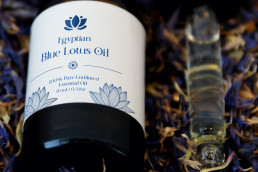
If you have been reading about blue lotus and keep running into the word nuciferine, you are in good company. It is the alkaloid that does most of the pharmacological heavy lifting in Nymphaea caerulea, and it is also the compound most often misrepresented online. This article is a careful, clinically honest review of the nuciferine blue lotus research literature: what the molecule actually does, which claims are reasonably well-attested, which are extrapolated from adjacent species, and what this means for anyone using blue lotus as an aromatic or botanical preparation.
Table of Contents
- What Nuciferine Actually Is
- The Receptor Profile: What Nuciferine Binds To
- Dopamine receptors
- Serotonin receptors
- Adrenergic and histamine receptors
- What the Animal Research Shows
- Antipsychotic-like behaviour
- Sedative and anxiolytic-like effects
- Metabolic and anti-inflammatory signals
- Neuroprotective signals
- Human Data: What We Actually Have
- How Much Nuciferine Is Actually in Blue Lotus Oil?
- Implications for How People Actually Use Blue Lotus
- Interactions Worth Taking Seriously
- What Still Needs to Be Studied
- Frequently Asked Questions
- Where to Go From Here
- Experience the Chemistry, Responsibly
It is written and clinically reviewed by Antonio Breshears, ND, CCA, a Bastyr-trained naturopathic doctor and certified clinical aromatherapist. If you want the broader botanical, historical, and safety picture first, start with The Complete Guide to Blue Lotus Oil, then return here for the specific chemistry of nuciferine.
What Nuciferine Actually Is
Nuciferine is an aporphine-type alkaloid. Structurally, it belongs to the same broad chemical family as apomorphine, a well-studied dopaminergic compound used clinically in Parkinson’s disease, but its pharmacology diverges in important ways. It was first isolated from sacred lotus (Nelumbo nucifera), which is where the name comes from, and it is also present, in smaller but meaningful quantities, in Nymphaea caerulea, the Egyptian blue water lily that we refer to as blue lotus.
This shared naming creates a recurring problem in the popular literature. A great deal of what is written about “blue lotus nuciferine” is actually drawn from studies on Nelumbo nucifera extracts, which contain nuciferine alongside a different supporting cast of alkaloids (notably higenamine and neferine). The two plants are not even in the same botanical family. When reading any claim about blue lotus and nuciferine, the first question to ask is always: was this study done on Nymphaea caerulea, or on Nelumbo, or on isolated nuciferine in cell and animal models?
In Nymphaea caerulea, nuciferine appears alongside aporphine (a closely related alkaloid with its own weak dopaminergic profile) and a rich flavonoid fraction including apigenin, quercetin, and kaempferol. The combined effect of this mix is what produces the calm, faintly euphoric, mildly introspective character that traditional use describes, and no single molecule fully accounts for it.
The Receptor Profile: What Nuciferine Binds To
The most frequently cited paper on nuciferine’s pharmacology is the 2016 work by Farrell and colleagues, who screened the molecule across a broad panel of central nervous system receptors. Their findings form the backbone of almost every serious discussion of this compound, and they are worth understanding in their own right rather than through secondary summaries.
Dopamine receptors
Nuciferine behaves as a weak antagonist at the dopamine D2 receptor family, including D2, D3, and D4 subtypes. This is chemically interesting because it places nuciferine in the same general class of action as atypical antipsychotic medications, though with much lower potency and a different binding profile. The practical implication is modest. At the doses reached through aromatic or culinary use of blue lotus, you are nowhere near the receptor occupancy that clinical D2 blockers produce. What you likely get is a subtle dampening of dopaminergic drive, which may contribute to the characteristic “quieting of mental chatter” that users report.
Aporphine, the other headline alkaloid in blue lotus, has been described as a weak dopamine agonist in some preparations. The net effect of the two together is probably best described as gentle dopaminergic modulation rather than a clear push in either direction.
Serotonin receptors
The more striking finding from the receptor screen is nuciferine’s activity at serotonin receptors, particularly 5-HT2A and 5-HT2C. It acts as an antagonist or inverse agonist at 5-HT2A, the same receptor targeted by classic psychedelics (though psychedelics act as agonists, which is the opposite direction). This is the mechanism that has generated most of the interest in nuciferine as a potential antipsychotic candidate, because 5-HT2A antagonism is one of the pharmacological signatures of several second-generation antipsychotic drugs.
Again, dose matters enormously. Research-grade nuciferine administered to animal models at milligram-per-kilogram doses produces behavioural changes consistent with this receptor profile. Aromatic inhalation of blue lotus absolute delivers a tiny fraction of that dose, and the molecule’s bioavailability through the olfactory route is not well characterised.
Adrenergic and histamine receptors
Nuciferine shows additional affinity for certain adrenergic and histamine receptors. The clinical meaning of these interactions is not fully worked out, but they likely contribute to the mild sedative and vasodilatory effects observed in animal studies and, anecdotally, in human users.
What the Animal Research Shows
Beyond receptor binding, several in vivo studies have examined what nuciferine actually does in living systems. The most frequently replicated findings fall into four broad areas.
Antipsychotic-like behaviour
In rodent models, nuciferine produces behavioural effects similar to those of clinical antipsychotics: reduced hyperlocomotion induced by amphetamine, reduced head-twitch response to 5-HT2A agonists, and attenuation of certain stereotyped behaviours. This is a consistent signal across multiple laboratories, and it is genuinely interesting. It does not, however, mean that inhaling blue lotus oil treats psychosis. The doses used are pharmacological, the route is parenteral or oral, and the model is a rat.
Sedative and anxiolytic-like effects
Several studies on Nelumbo extracts, and a smaller number on isolated nuciferine, show reductions in locomotor activity and increases in time spent in open areas of anxiety-screening tasks like the elevated plus maze. These effects are modest, not as dramatic as diazepam, and they overlap substantially with what apigenin (the flavonoid) produces. In blue lotus specifically, the calming profile people describe is almost certainly a combined effect of nuciferine, aporphine, and the flavonoid fraction working together, not nuciferine acting alone.
Metabolic and anti-inflammatory signals
A growing body of work, mostly on nuciferine extracted from Nelumbo leaves, suggests effects on lipid metabolism, insulin sensitivity, and inflammatory markers. These studies are almost entirely on oral extracts at doses far exceeding anything achievable through aromatic use of blue lotus. They are not relevant to the question of whether blue lotus oil helps you sleep. They are relevant only if you are researching lotus alkaloids as potential oral therapeutics, which is a different project.
Neuroprotective signals
A handful of cell-culture studies suggest that nuciferine may have neuroprotective properties against certain oxidative and neurotoxic insults. Again, interesting, but far from clinical application, and far from anything blue lotus oil users are meaningfully accessing.
Human Data: What We Actually Have
This is the part where the honest answer is short. There are essentially no well-designed, placebo-controlled human trials of nuciferine specifically, and none on blue lotus absolute as a whole preparation. What we have is a handful of case reports, one or two small observational studies on Nelumbo leaf extracts for metabolic parameters, and a large body of traditional use evidence stretching back several thousand years in Egyptian, Mediterranean, and Asian contexts.
The traditional evidence is not nothing. Plants with genuinely inert pharmacology tend not to stay in continuous ritual and medicinal use for millennia. But traditional use cannot tell you dose-response relationships, cannot separate individual alkaloids from the whole-plant matrix, and cannot substitute for modern clinical trials. Anyone who tells you that nuciferine is a proven treatment for anxiety, insomnia, or any clinical condition is overreading the evidence. Anyone who tells you it has no real pharmacology is underreading it. The truthful position is somewhere in the middle: a genuinely bioactive molecule with a plausible mechanism, a reasonable animal literature, and an undersupplied human literature.
How Much Nuciferine Is Actually in Blue Lotus Oil?
This is the question that makes most of the more dramatic claims about blue lotus fall apart. Alkaloid content in Nymphaea caerulea is modest to begin with, measured in fractions of a percent of the dried flower by weight, and varies substantially by growing conditions, harvest timing, and post-harvest handling.
More importantly, extraction method determines how much of that alkaloid fraction ends up in the final product. Solvent extraction, which produces the absolute most commonly sold as “blue lotus oil”, captures the alkaloids reasonably well alongside the waxes, pigments, and aromatic molecules. Steam distillation, which produces a true essential oil, captures almost none of the nuciferine, because alkaloids are generally not volatile enough to come across in the steam. Supercritical CO2 extraction sits somewhere in between, often tuned to favour either the aromatic or the alkaloid fraction depending on the pressure profile used.
What this means in practice: if someone is talking about “nuciferine in their blue lotus essential oil” and the product is a true steam-distilled essential oil, the nuciferine content is probably negligible. If the product is an absolute or a CO2 extract, the nuciferine content is real but still modest, typically in the range of trace to low percent of total alkaloid content. Inhalation delivers a fraction of that. Topical application, with appropriate dilution, delivers less still. This is not a criticism of the plant; it is simply an honest account of what aromatic preparations can and cannot deliver pharmacologically.
Implications for How People Actually Use Blue Lotus
Given all of the above, how should nuciferine research inform the way a thoughtful person uses blue lotus oil? A few reasonable takeaways.
First, the calming, subtly mood-lifting effect that careful users describe is biologically plausible. It is not placebo alone. The combination of low-dose nuciferine (via 5-HT2A modulation and mild D2 dampening), aporphine, and the flavonoids apigenin, quercetin, and kaempferol (acting on GABA and anti-inflammatory pathways) gives a reasonable mechanistic basis for what people report. The effect should be expected to be gentle, cumulative, and context-dependent rather than dramatic.
Second, the olfactory-limbic pathway almost certainly contributes as much as the direct pharmacological effect at the doses used in aromatic application. The brain’s response to a complex, beautiful botanical aroma is itself a physiological event. Trying to disentangle “true nuciferine effect” from “olfactory-limbic modulation through a pleasant scent associated with intentional practice” is probably a false dichotomy. Both are real, and both are part of how the oil works.
Third, claims that blue lotus oil will produce antipsychotic, strongly sedative, or psychedelic-like effects are not supported by the weight of evidence. The nuciferine research points to a subtle, pharmacologically coherent molecule, not a potent one. Expectations should be calibrated accordingly.
Interactions Worth Taking Seriously
Even at modest doses, there are a few situations where nuciferine’s receptor activity warrants caution. If you are on dopaminergic medication (levodopa, pramipexole, ropinirole, or similar), the theoretical interaction with nuciferine’s weak D2 antagonism is worth discussing with your prescribing clinician before adopting regular blue lotus use. The same applies to anyone on antipsychotic medication, where the direction of interaction is uncertain and compounding effects are plausible.
People on serotonergic medication, particularly serotonin-modulating antidepressants and MAOIs, should also exercise caution. The 5-HT2A/2C activity of nuciferine is unlikely to cause problems at aromatic doses, but clinical-grade certainty is not available, and when the downside is serotonin syndrome or similar, caution is cheap.
Blue lotus is avoided in pregnancy and breastfeeding on general precautionary grounds, and this position does not change in light of the nuciferine literature. If anything, the receptor profile reinforces the case for avoidance in those contexts.
What Still Needs to Be Studied
The honest list of research gaps is long. Human pharmacokinetic data on nuciferine through aromatic, oral, and topical routes would be immensely useful; almost none exists. Placebo-controlled trials of standardised blue lotus preparations for sleep, anxiety, or mood would clarify the clinical picture. Work on how the alkaloid and flavonoid fractions interact, synergise, or buffer one another in the whole-plant matrix would address one of the most interesting open questions in the field. Finally, studies that compare Nymphaea caerulea directly with Nelumbo nucifera, rather than conflating the two, would end a great deal of popular confusion.
Until that work happens, the responsible position is to treat blue lotus as what it is: a botanically fascinating, modestly pharmacologically active aromatic preparation with a long traditional use history, a plausible mechanistic story centred on nuciferine and supporting compounds, and an appropriately humble set of claims.
Frequently Asked Questions
Is nuciferine in blue lotus the same as nuciferine in sacred lotus?
Chemically, yes: nuciferine is a single defined molecule regardless of source. Botanically, the two plants are entirely different species in different families. Most published nuciferine research has been done on material extracted from Nelumbo nucifera, and extrapolating those findings directly to Nymphaea caerulea requires caution, since the surrounding alkaloid and flavonoid matrix is different.
Does blue lotus oil contain enough nuciferine to produce strong effects?
No, not in any reasonable sense of “strong”. Alkaloid content in the flower is modest, extraction captures only part of it, and inhalation delivers a small fraction of what is in the bottle. The effects reported by users are real but gentle, and they reflect combined action with aporphine and the flavonoids rather than a potent nuciferine dose.
Is nuciferine psychoactive?
At pharmacological doses in animal studies, yes, in the sense that it produces measurable behavioural changes consistent with its receptor profile. At the doses delivered by aromatic use of blue lotus, “psychoactive” overstates what is happening. “Subtly mood-modulating” is more accurate.
Is nuciferine an antipsychotic?
It has antipsychotic-like activity in animal models, and its receptor profile resembles aspects of atypical antipsychotic drugs. It is not an approved medication, has not been tested in controlled human trials for psychosis, and using blue lotus as a substitute for prescribed psychiatric care is not appropriate.
Does steam-distilled blue lotus essential oil contain nuciferine?
Very little. Alkaloids like nuciferine are generally not volatile enough to come through steam distillation in meaningful amounts. True steam-distilled essential oils are prized for their aromatic purity but contain only trace alkaloid content. Solvent-extracted absolutes and CO2 extracts retain more.
Will blue lotus oil interact with my antidepressant?
At aromatic doses, a clinically significant interaction is unlikely but not excluded, particularly with MAOIs or with medications that act strongly on serotonin or dopamine. If you are on any psychiatric medication, mention blue lotus use to your prescribing clinician so the decision is made with full information.
Is there any human trial data on nuciferine?
Very little of high quality. A few small studies on Nelumbo leaf extracts for metabolic parameters exist, and scattered case reports involve lotus preparations more broadly. There are no large placebo-controlled trials of isolated nuciferine in humans, which is one of the most significant gaps in the field.
Does nuciferine cause tolerance or dependence?
There is no evidence that it does, and its receptor profile does not suggest a dependence-prone pharmacology. That said, absence of evidence is not evidence of absence, and long-term daily use at high doses is simply not something the literature covers.
Is the nuciferine in blue lotus oil standardised?
No, not in the way a pharmaceutical would be. Natural variation in the flower, differences in extraction method, and batch-to-batch variability all affect the final alkaloid content. A well-made absolute from a reputable supplier will be more consistent than a generic product, but even high-quality blue lotus oil is a botanical preparation, not a standardised extract.
Should I take nuciferine as an isolated supplement instead?
Isolated nuciferine supplements exist, mostly derived from sacred lotus. Whether to use them is a different question from whether to use aromatic blue lotus oil, and it raises concerns about dose, purity, and receptor-level effects that do not apply in the same way to aromatic use. If that is the direction you are considering, work with a clinician who can look at your full medication list and health picture.
Where to Go From Here
If you arrived here looking for a clean yes-or-no on whether nuciferine “does something”, the honest answer is: yes, it does, in a way that is pharmacologically coherent and mechanistically sensible, and at the doses delivered by aromatic use of blue lotus, the effect is subtle rather than dramatic. That is not a disappointing answer; it is an accurate one, and it matches both the traditional use literature and the available modern research. For the broader picture of blue lotus chemistry, history, and practical use, return to The Complete Guide to Blue Lotus Oil, where the alkaloid and flavonoid story is placed alongside everything else you might want to know before choosing a bottle.

Antonio Breshears
Antonio Breshears is a renowned expert in holistic medicine and beauty, with over 25 years of research experience dedicated to uncovering the secrets of nature's most powerful remedies. Holding a degree in Naturopathic Medicine, Antonio's passion for healing and well-being has driven him to explore the intricate connections between mind, body, and spirit.
Over the years, Antonio has become a respected authority in the field, helping countless individuals discover the transformative power of plant-based therapies, including essential oils, herbs, and natural supplements. He has authored numerous articles and publications, sharing his wealth of knowledge with a global audience seeking to improve their overall health and well-being.
Antonio's expertise extends to the realm of beauty, where he has developed innovative, all-natural skincare solutions that harness the potency of botanical ingredients. His formulations embody his deep understanding of the healing properties found in nature, providing holistic alternatives for those seeking a more balanced approach to self-care.
With his extensive background and dedication to the field, Antonio Breshears is a trusted voice and guiding light in the world of holistic medicine and beauty. Through his work at Pure Blue Lotus Oil, Antonio continues to inspire and educate, empowering others to unlock the true potential of nature's gifts for a healthier, more radiant life.