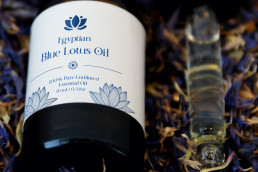
If you have found your way here, you are probably curious about whether blue lotus oil endocannabinoid interactions are a real biochemical thing or just marketing language borrowed from the cannabis world. It is a fair question, and the answer is more interesting than a straight yes or no. Blue lotus (Nymphaea caerulea) contains a constellation of alkaloids and flavonoids with plausible, partial, and mostly indirect points of contact with the endocannabinoid system. This article walks through what is genuinely supported, what is speculative, and what the practical implications are for someone using the oil on skin or in a diffuser.
Table of Contents
- What the Endocannabinoid System Actually Is
- Blue Lotus Chemistry: What Is Actually in the Oil
- How Blue Lotus May Indirectly Touch the Endocannabinoid System
- Apigenin, FAAH and Anandamide Tone
- Shared Downstream Effects on Stress Physiology
- Flavonoid Anti-Inflammatory Activity and CB2-Mediated Tone
- What This Means in Practical Use
- Suggested Use for ECS-Adjacent Goals
- Realistic Timeframes and What to Notice
- When Blue Lotus Oil Is Not the Right Choice
- Complementary Approaches Worth Considering
- Häufig gestellte Fragen
- Where to Go From Here
- Experience the Oil Itself
It is written and clinically reviewed by Antonio Breshears, ND, CCA, a Bastyr-trained naturopathic doctor and certified clinical aromatherapist. For a broader orientation to the plant, its chemistry and its traditional uses, readers may find it helpful to pair this piece with The Complete Guide to Blue Lotus Oil, which sits as the master reference for the site.
What the Endocannabinoid System Actually Is
Before asking whether a plant “acts on the endocannabinoid system”, it is worth being precise about what that system actually is, because the phrase gets used very loosely online. The endocannabinoid system (ECS) is a regulatory network present throughout the mammalian body. It has three principal components: the receptors (mainly CB1, concentrated in the central nervous system, and CB2, concentrated in immune tissue and the periphery), the endogenous ligands that bind those receptors (anandamide and 2-arachidonoylglycerol, or 2-AG), and the enzymes that build and break down those ligands (the most studied being fatty acid amide hydrolase, FAAH, and monoacylglycerol lipase, MAGL).
The ECS does not have one job. It modulates mood, appetite, sleep, pain signalling, inflammation, stress response, and immune tone. It is best thought of as a buffering system, a way the body fine-tunes other signals rather than a primary driver of any single function. That matters here, because claims that a substance “activates the endocannabinoid system” are almost always too broad to be meaningful. The useful question is always narrower: which receptor, which enzyme, which tissue, at what concentration.
Blue Lotus Chemistry: What Is Actually in the Oil
The pharmacologically interesting constituents of Nymphaea caerulea fall into two main families. The alkaloids are dominated by aporphine (a weak dopamine receptor agonist) and nuciferine (a weak dopamine receptor antagonist with activity at serotonin 5-HT2A and 5-HT2C receptors). The flavonoids include apigenin, quercetin and kaempferol, with apigenin being the most researched for its central nervous system effects through the benzodiazepine binding site of the GABA-A receptor.
None of these are classical endocannabinoids. None of them bind CB1 or CB2 with the affinity of THC, CBD, or even the minor plant cannabinoids from hemp. What is worth paying attention to, though, is that several of these molecules have documented indirect effects on ECS tone, largely through flavonoid pathways and through shared downstream targets that the ECS also modulates. That is a more modest claim than “blue lotus oil activates your endocannabinoid system”, and it is the only one the evidence currently supports.
How Blue Lotus May Indirectly Touch the Endocannabinoid System
There are three plausible points of contact worth discussing, and it is useful to take them one at a time rather than blur them together.
Apigenin, FAAH and Anandamide Tone
Apigenin is the most interesting of the blue lotus flavonoids in this context. Preclinical work on various flavonoids, including apigenin, has suggested mild inhibitory effects on FAAH, the enzyme that degrades anandamide. In simple terms, if FAAH is slowed, anandamide (the body’s own cannabinoid-like molecule) lingers slightly longer at its receptors. This is the same general mechanism by which several experimental anti-anxiety compounds are being investigated.
The caveat is large. The FAAH effect of apigenin in the test tube is weak relative to dedicated FAAH inhibitors, and apigenin also binds GABA-A receptors, which is a more direct and better-characterised mechanism for its calming effect. Whether topical or inhaled doses of blue lotus oil deliver enough apigenin systemically to produce meaningful FAAH inhibition in humans is not established. The honest read is that an indirect, mild, supportive influence on anandamide tone is biologically plausible but not clinically proven.
Shared Downstream Effects on Stress Physiology
The ECS is one of several systems that help shut off the stress response once a stressor has passed. Blue lotus oil, through its olfactory-limbic action and through the GABAergic effect of apigenin, also dampens sympathetic tone and promotes parasympathetic dominance. The two systems converge on similar outcomes (lower heart rate variability disruption, easier transition to rest, reduced rumination) without needing to act on the same receptors.
This convergence is probably why people who use blue lotus oil describe effects that sound similar in texture to mild cannabinoid modulation: a softening of anxiety, a loosening of muscle holding patterns, a gentler relationship with one’s own thoughts. The mechanism is different; the felt sense overlaps.
Flavonoid Anti-Inflammatory Activity and CB2-Mediated Tone
CB2 receptors sit largely on immune cells and are involved in modulating inflammatory signalling. Flavonoids such as apigenin, quercetin and kaempferol all have documented anti-inflammatory activity in preclinical models, much of which operates through NF-kB and related pathways rather than through direct CB2 binding. However, these pathways are interlinked with CB2-mediated tone in the skin and in peripheral tissue. Applied topically, a well-formulated blue lotus oil blend delivers flavonoids to the skin where they can contribute to a calmer local inflammatory profile.
Again, the language matters. This is not the same as saying blue lotus oil “activates CB2”. It is saying the flavonoids and the ECS are both participants in the same regulatory conversation, and supporting one gently tends to be compatible with the other.
What This Means in Practical Use
If you are considering blue lotus oil specifically because you have read about its endocannabinoid effects, it is worth recalibrating expectations. The oil is not a substitute for cannabinoid products. It will not produce the same neurological signature as THC, and it will not deliver the FAAH or CB receptor modulation of a targeted cannabinoid formulation. What it offers is a gentler, multi-system nudge toward parasympathetic balance, with some contributory flavonoid activity that sits in the neighbourhood of ECS support without being ECS support in the narrow pharmacological sense.
For people who already use CBD or hemp-derived products and are curious about adding blue lotus oil, the practical experience tends to be that the two feel complementary rather than redundant. CBD works largely through FAAH inhibition, TRPV1, 5-HT1A and other targets. Blue lotus works through GABA-A, serotonergic and dopaminergic pathways, with olfactory-limbic amplification when inhaled. They occupy different seats at the same table.
Suggested Use for ECS-Adjacent Goals
If the reason for using blue lotus oil is stress modulation, sleep onset support, or easing low-grade inflammatory skin tension (all outcomes that overlap with ECS functions), the following approaches are reasonable:
- Diffusion: 2 to 4 drops in a cool-mist diffuser, used for 20 to 30 minutes in the evening. This is the most direct route to the olfactory-limbic pathway and the easiest way to feel the calming edge of the oil.
- Topical on the torso or inner wrists: 2 to 3 percent dilution in jojoba or fractionated coconut oil, applied to the chest, wrists or nape of neck before sleep. This combines skin absorption with passive inhalation.
- Targeted skin application: 3 percent dilution on areas of reactive or inflamed skin, no more than once or twice daily, to take advantage of the flavonoid anti-inflammatory effect.
These protocols are modest by design. Blue lotus oil is not a dramatic intervention; it is a supportive one, and more is not better. Using too much of the oil, or using it too frequently, tends to blunt rather than amplify its effect, probably because the olfactory system habituates and the nervous system stops registering the signal as novel.
Realistic Timeframes and What to Notice
Effects that are plausibly ECS-adjacent (calmer stress response, easier sleep onset, reduced skin reactivity) tend to show up incrementally rather than suddenly. The olfactory calming effect is often felt within the first session, within minutes of diffusion starting. The subtler effects on sleep quality and skin inflammatory tone usually require two to three weeks of consistent use to become clearly noticeable, and they show up as a softening of baseline rather than a dramatic change.
What is worth tracking: time to fall asleep, subjective ease of the evening wind-down, frequency of skin flare-ups, sense of being able to disengage from rumination. What is not worth tracking: any expectation of a cannabinoid-style intoxicating effect, because there is no pharmacological basis for it and attempting to produce one by over-application is both ineffective and potentially irritating to the skin.
When Blue Lotus Oil Is Not the Right Choice
There are situations where reaching for blue lotus oil in pursuit of ECS-related goals is either inappropriate or insufficient, and these are worth being explicit about.
Pregnancy and breastfeeding. Blue lotus oil is avoided during both because the alkaloid profile has not been established as safe for these populations. This is the strongest contraindication.
Use alongside dopaminergic medications, MAOIs or heavy sedatives. The aporphine and nuciferine content means caution is appropriate, and clinical supervision is advisable if you are on Parkinson’s medication, antipsychotics, or strong sleep pharmaceuticals.
Diagnosable endocannabinoid-related conditions. If a clinician is working with you on something like a suspected clinical endocannabinoid deficiency, migraine, fibromyalgia or significant pain syndromes, blue lotus oil is not a substitute for that care. It may be a reasonable adjunct for its general calming effect, but it should not displace targeted treatment.
Acute mental health crises. The oil is a gentle tool. It is not a psychiatric intervention and should not be treated as one.
Complementary Approaches Worth Considering
For people interested in supporting ECS tone more broadly, a few things are better evidenced than any aromatic oil and are worth mentioning in the same breath as blue lotus:
- Regular moderate exercise, which raises anandamide and is one of the most reliable natural modulators of ECS activity.
- Sleep regularity, which affects endocannabinoid rhythms directly.
- Omega-3 intake, since anandamide and 2-AG are built from fatty acid precursors.
- Stress practices that engage the vagus nerve (breathwork, cold exposure, meditation), which have convergent effects with both ECS and parasympathetic tone.
Blue lotus oil slots in best as an evening ritual overlay on these foundations rather than as a standalone ECS strategy. Used that way, its modest contribution becomes more evident, because the substrate is already primed.
Häufig gestellte Fragen
Does blue lotus oil contain cannabinoids?
No. Blue lotus oil does not contain THC, CBD, or any other phytocannabinoid. Its active compounds are alkaloids (aporphine, nuciferine) and flavonoids (apigenin, quercetin, kaempferol). Any interaction with the endocannabinoid system is indirect and largely through flavonoid-mediated pathways.
Does blue lotus oil bind CB1 or CB2 receptors?
There is no good evidence that blue lotus constituents bind CB1 or CB2 with clinically relevant affinity. Effects on ECS tone, where they exist, appear to be indirect, operating through enzymes such as FAAH and through parallel pathways that the ECS also modulates.
Can I use blue lotus oil alongside CBD?
For most healthy adults, yes. They work through different mechanisms and users frequently find them complementary. If you are on prescription medication, or if you are using high-dose CBD therapeutically, check with a clinician first because both substances touch drug-metabolising enzymes.
Will blue lotus oil produce a cannabis-like high?
No. There is no pharmacological basis for a cannabinoid-style intoxication from blue lotus oil. What users describe is a softer, floral-driven calming effect with a gentle mood lift, quite different in character from cannabinoid effects.
Is apigenin in blue lotus oil the same as apigenin in chamomile?
It is the same molecule. Chamomile is a better-known dietary source of apigenin, and blue lotus contributes a different but overlapping flavonoid profile. Both plants share the GABA-A pathway as a central mechanism of calming action.
How much blue lotus oil do I need to affect my endocannabinoid system?
This is the wrong question, because the oil is not a targeted ECS modulator. Using it at standard aromatherapy dilutions (1 to 3 percent topically, 2 to 4 drops in a diffuser) is sufficient for the calming, mood and skin effects it is reasonably known for. Higher doses do not produce stronger ECS effects; they simply waste the oil and risk skin irritation.
Does blue lotus oil help with ECS-related conditions like migraine or fibromyalgia?
There is no reliable evidence that it does, and these conditions warrant clinical evaluation. Some people find aromatherapy supportive as part of a wider management plan, but blue lotus oil should not be positioned as a treatment for these diagnoses.
Can blue lotus oil raise anandamide levels?
Preclinical work on apigenin suggests mild FAAH inhibitory activity, which would in theory prolong anandamide signalling slightly. Whether aromatherapy doses reach relevant tissue concentrations in humans is unproven. The effect, if present, is modest.
Is there clinical research on blue lotus oil and the endocannabinoid system specifically?
No direct clinical trials link blue lotus oil to measurable ECS outcomes. What exists is preclinical work on individual constituents (particularly apigenin) and broader literature on olfactory effects of floral oils. Any ECS claims about blue lotus oil specifically should be read as extrapolation, not established fact.
Is blue lotus oil legal where cannabis is not?
In most jurisdictions, yes, because it is not a cannabinoid-containing product. There are a few regions with their own restrictions on blue lotus (Russia, Poland, Latvia, the US state of Louisiana, and regulatory complexity in Australia), which are unrelated to cannabis law. Check local rules before buying or travelling with the oil.
Where to Go From Here
If this article has been useful, the most helpful next step is probably to read The Complete Guide to Blue Lotus Oil, which places the chemistry discussed here into the wider picture of traditional use, extraction methods and practical application. Readers interested in the underlying flavonoid and alkaloid pharmacology will also find value in the other articles in the chemistry and extraction category, which go deeper into specific constituents without the ECS framing.
The short version of everything above is this: blue lotus oil is not an endocannabinoid product, and treating it as one sets up the wrong expectations. What it is, with reasonable clinical honesty, is a gently calming floral oil whose flavonoids live in the same regulatory neighbourhood as ECS-supportive compounds, and whose use alongside healthy ECS habits makes sensible, undramatic sense.

Antonio Breshears
Antonio Breshears ist ein renommierter Experte für ganzheitliche Medizin und Schönheit und verfügt über mehr als 25 Jahre Forschungserfahrung, in denen er sich der Erforschung der Geheimnisse der wirksamsten Heilmittel der Natur gewidmet hat. Mit einem Abschluss in Naturheilkunde hat Antonios Leidenschaft für Heilung und Wohlbefinden ihn dazu motiviert, die komplexen Zusammenhänge zwischen Geist, Körper und Seele zu erforschen.
Im Laufe der Jahre hat sich Antonio zu einer angesehenen Autorität auf diesem Gebiet entwickelt und unzähligen Menschen dabei geholfen, die transformative Kraft pflanzlicher Therapien – darunter ätherische Öle, Kräuter und natürliche Nahrungsergänzungsmittel – zu entdecken. Er hat zahlreiche Artikel und Publikationen verfasst und teilt sein umfangreiches Wissen mit einem weltweiten Publikum, das seine allgemeine Gesundheit und sein Wohlbefinden verbessern möchte.
Antonios Fachwissen erstreckt sich auch auf den Bereich der Schönheitspflege, wo er innovative, rein natürliche Hautpflegelösungen entwickelt hat, die die Kraft pflanzlicher Inhaltsstoffe nutzen. Seine Rezepturen spiegeln sein tiefes Verständnis für die heilenden Eigenschaften der Natur wider und bieten ganzheitliche Alternativen für alle, die einen ausgewogeneren Ansatz für die Selbstpflege suchen.
Dank seiner langjährigen Erfahrung und seines Engagements in diesem Bereich ist Antonio Breshears eine vertrauenswürdige Stimme und ein Leitstern in der Welt der ganzheitlichen Medizin und Schönheitspflege. Durch seine Arbeit bei Pure Blue Lotus Oil inspiriert und informiert Antonio weiterhin andere und befähigt sie dazu, das wahre Potenzial der Gaben der Natur für ein gesünderes und strahlenderes Leben zu erschließen.