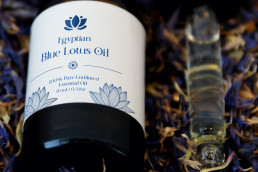
Blue lotus oil has a place in contemplative practice that dates to some of the oldest continuous traditions in recorded history. It is used across Egyptian, Ayurvedic, and later Mediterranean religious contexts in essentially the same way: as a scented anointing oil applied before sitting, as an aromatic presence in the practice space, and as a ritual marker that separates practice time from ordinary time. This pillar is the reference on what blue lotus does for modern meditation and yoga practice, how to use it well, and how to avoid the overwrought spiritual language that surrounds the territory without adding much useful.
Table of Contents
- The Egyptian Contemplative Inheritance
- How Blue Lotus Supports Practice
- Anointing: The Point-of-Attention Practice
- Specific Practice Types
- Sitting Meditation (Concentrative or Open)
- Breathwork and Pranayama
- Yoga Asana Practice
- Loving-Kindness (Metta) Practice
- Yoga Nidra and Body Scan
- Contemplative Inquiry (Jnana Yoga, Self-Inquiry)
- Tantric and Subtle-Body Practice
- Group and Sangha Practice
- Setting Up a Practice Space with Blue Lotus
- Blends for Practice
- Common Mistakes
- Safety
- Frequently Asked Questions
- Where to Go From Here
- A Companion to Your Practice
It is written and clinically reviewed by Antonio Breshears, ND, CCA, a Bastyr-trained naturopathic doctor and certified clinical aromatherapist. For the broader historical context, our pillar on the history and cultural significance of blue lotus oil is the parent reference; for the health and wellness view, blue lotus oil health and wellness benefits covers the adjacent territory.
The Egyptian Contemplative Inheritance
Blue lotus appears in Egyptian religious and funerary art consistently across roughly three millennia. It is the flower held by the deceased in tomb paintings, the flower associated with Nefertem (god of perfume, healing, and the sensual-contemplative life), and the flower soaked in wine and oil for ritual use. The contemplative dimension of this tradition is often underemphasised in modern accounts, which favour the hedonistic reading (intoxication, sexuality), but the underlying practice was substantially contemplative.
The Egyptian understanding, to the extent it can be reconstructed, treated blue lotus as a tool for what we might now call limbic and emotional opening. The flower closes at night, disappears into the water, and opens again at dawn: a daily enactment of death, rebirth, and the dissolution of fixed form. Scented oil anointed on the body in preparation for ritual or for the journey through the dream-state carried the associations of the flower itself.
This tradition fed into later Mediterranean and Near Eastern practice and contributed to the general association of scented oils with ritual, contemplation, and the preparation of the body for non-ordinary states. Modern contemplative use sits within that lineage, whether or not the practitioner is aware of it.
How Blue Lotus Supports Practice
Stripping away the mystical framing, four concrete effects are relevant to contemplative practice.
First, the olfactory-limbic shift. Scent is the most direct route to limbic-system regulation available to conscious practice. A few breaths of an evocative aromatic moves the nervous system out of whatever state it arrived in and toward a parasympathetic, alert-but-settled baseline. Blue lotus is particularly effective at this because of its depth and complexity; brighter single-note oils (citrus, mint) produce more energising shifts, while blue lotus settles without dulling. For the full mechanism, our pillar on chemical composition and therapeutic properties covers the chemistry.
Second, the anchoring of attention. A scent applied at the start of practice and still present at its end is a continuous reference point. When attention drifts (as it does), the smell returns it to now. This is mechanically useful in a way that is distinct from the oil’s pharmacology; it is a feature of having a stable sensory anchor.
Third, the conditioning effect. Over weeks and months of consistent use, the association between the scent and the contemplative state becomes strong enough that the scent itself evokes the state. Experienced practitioners who have used a consistent oil for their sitting practice for years often find that a brief inhalation at a difficult moment during the day accesses something of the settled quality of their practice. This is neuroscientifically well-founded and practically valuable.
Fourth, the modest pharmacological effect. The apigenin-GABAergic and aporphine-dopaminergic activity described in the chemistry pillar contribute a gentle quieting of the default-mode activity that interferes with sitting practice. This is not strong enough to dominate the practice (and would be counterproductive if it were; practice works with whatever mind shows up, not against it), but it shifts the starting conditions slightly.
Anointing: The Point-of-Attention Practice
The traditional and practical form of using scented oil for practice. Three points on the body receive the oil before sitting.
The third-eye point (midway between the eyebrows, on the forehead). One drop of diluted blue lotus blend (2 percent in jojoba or fractionated coconut; see our carrier oil pairings pillar). This is the anchor point in traditional practice for concentration and inner seeing.
The base of the throat (in the suprasternal notch). One drop. Associated with the expressive and communicative dimensions of practice, and a point where the scent stays close to the breath through the sitting.
The wrists. One drop on each. These bring the scent close to the resting hands (typically in lap or knee position during sitting), providing a peripheral aromatic presence that complements the head-region application.
The anointing itself is done slowly, with attention, ideally as the first deliberate act of the practice. The pause to apply the oil sets the transition between ordinary time and practice time. For some practitioners this is the most valuable dimension of the whole practice; the moment of intention-setting is what the practice turns on.
Specific Practice Types
Sitting Meditation (Concentrative or Open)
Blue lotus supports both concentrative (focused-attention) and open-awareness sitting practice. The scent anchors the attention without competing with it, which makes it a good companion to samatha, anapana, shikantaza, and similar traditions.
The standard protocol: diffuser started fifteen minutes before the sit, anointing done as the transition into posture, sit without further intervention. For longer sits, a light reapplication at the midpoint is acceptable but rarely needed.
Breathwork and Pranayama
Blue lotus integrates well with breathwork practices but the applications divide by type. For slow, regulated pranayama (nadi shodhana, ujjayi, extended exhale practices), the oil supports the parasympathetic quality these practices cultivate. Anointing at the pulse points and allowing the scent to enter the breath is the typical pattern.
For activating or heating pranayama (kapalabhati, bhastrika, breath of fire), a lighter aromatic presence or none at all is preferable. The slowing quality of blue lotus runs counter to these practices and dulls their effect.
Yoga Asana Practice
A diffuser during a home practice session provides the aromatic presence without interfering with the physical work. Avoid heavy topical application before practice; the oil in the skin combined with sweating can be uncomfortable, and the olfactory signal diminishes as the practice heats.
For restorative and yin yoga, where the body is still for extended periods, topical application is more comfortable and the aromatic presence supports the reflective quality of these practices particularly well.
Loving-Kindness (Metta) Practice
The emotional-opening quality of blue lotus is particularly well-suited to metta and other heart-centred practices. Apply the diluted oil to the centre of the chest (sternum) in addition to the standard anointing points. The tactile warmth and the scented presence of the heart centre supports the internal turn the practice requires.
Yoga Nidra and Body Scan
The overlap with sleep-oriented practice is strong here. Blue lotus’s sleep-supporting qualities risk tipping a body scan or yoga nidra into actual sleep if the aromatic dose is too heavy. Use a lighter application (one drop at the wrists only) for these practices, or a room-level diffuser set for a shorter duration. Our article on sleep and dreams covers the related sleep-adjacent territory.
Contemplative Inquiry (Jnana Yoga, Self-Inquiry)
The slower, more reflective quality of contemplative inquiry pairs well with blue lotus. The oil is used here less as a state-shifter than as a companion; the scent marks the contemplative frame and supports the sustained attention that inquiry requires. Anointing the third eye and the wrists is the standard pattern.
Tantric and Subtle-Body Practice
A note of practical caution here, because the territory is rich with overclaims. Traditional Tantric practice treats scented oils as aids to what it calls ojas cultivation; in modern subtle-body frameworks, blue lotus is often associated with the third-eye, crown, or heart chakras depending on the framework. The particular chakra assignments vary across lineages and traditions and should be taken as experiential rather than doctrinal.
Our articles on spiritual benefits and metaphysical benefits cover this territory in more detail, with appropriate epistemological humility about what is traditional practice, what is personal experience, and what is modern synthesis.
Group and Sangha Practice
A diffused presence during group practice works well at low dose (two drops for a mid-sized room). Individual anointing is best left to practitioners’ own preference; scent sensitivity varies and a room where every practitioner has anointed heavily can become uncomfortable. The courteous default is light aromatic use at the room level, with individual practitioners adjusting their personal use as suits them.
Setting Up a Practice Space with Blue Lotus
For those with a dedicated home practice space, the aromatic conditioning compounds substantially over time. A few practical suggestions.
- A consistent oil. The conditioning benefit comes from repeated exposure to the same scent in the same context. Changing the oil each week undoes the work. Blue lotus alone, or a simple blue lotus-frankincense blend, is the traditional approach and the one that compounds most reliably.
- A dedicated diffuser. An ultrasonic diffuser kept in the practice space and used only for practice time preserves the associational specificity.
- A dedicated anointing blend. A small bottle of blue lotus at 2 percent in jojoba, kept with the practice supplies. Reserved for practice time. This is more than a sentimental detail; it is what makes the conditioning effect reliable.
- The beginning and end. Applying the oil marks the transition into practice; a deliberate cleaning or capping of the bottle at the end marks the return. These small rituals carry the container of the practice.
Blends for Practice
Four combinations earn particular mention.
- Blue lotus with frankincense, 2:1 favouring blue lotus. The classic contemplative pairing across several traditions. Frankincense contributes a grounding woody-resinous note that deepens the floral.
- Blue lotus with sandalwood, 1:1. The most traditional Indian meditation combination for this kind of floral. Calming, sustained, particularly good for longer sits.
- Blue lotus with lavender, 2:1 favouring blue lotus. A gentler, more accessible blend for those new to contemplative aromatic practice. Also a good choice for yoga nidra and restorative work.
- Blue lotus with myrrh, 3:1 favouring blue lotus. A more contemplative-grief combination, appropriate for mourning or loss-related practice. Intense; not for daily use.
Common Mistakes
Four come up repeatedly.
- Treating the oil as a state-shifter rather than a practice companion. Blue lotus does not replace the work of practice; it supports it. Those who reach for it expecting a shortcut to meditative states are disappointed. Those who use it consistently alongside their practice find the practice gradually deepens.
- Changing the oil constantly. Conditioning requires consistency. A different aromatic each week produces the novelty effect but not the cumulative benefit.
- Over-application. More is not better. A single drop at each anointing point, and two to three drops in the diffuser, is the therapeutic dose. Higher concentrations are distracting and dull the subtler effects.
- Ignoring the contemplative content. The oil is a container, not a contents. Without the actual practice of sitting, breathing, inquiring, or moving, the aromatic is a pleasant scent. With the practice, it compounds usefully.
Safety
The standard blue lotus safety considerations apply to contemplative use: dilution in a carrier oil for topical application, avoidance in pregnancy, caution with specific medication classes. The full detail is in our reference on blue lotus oil safety, side effects and precautions. Nothing about contemplative use changes these basic cautions.
One additional note: for practitioners exploring deeper contemplative states (long retreats, intensive practice), the modest dopaminergic modulation of blue lotus should be considered alongside any other factors affecting the nervous system. If in doubt, use less, or discuss with a qualified practitioner.
Frequently Asked Questions
How does blue lotus oil help with meditation?
Through four mechanisms: a parasympathetic shift via the olfactory-limbic pathway, attention anchoring via the consistent sensory reference, conditioning of the scent-state association over weeks of use, and mild GABAergic and dopaminergic support that quiets default-mode activity.
Which chakra is blue lotus oil associated with?
Traditional associations vary across lineages. Most commonly the third eye (ajna) and crown (sahasrara) in modern subtle-body frameworks, though older traditions also associate the flower with the heart. The associations are experiential rather than doctrinal and should be held loosely.
Can I apply blue lotus oil directly to the third eye point?
Yes, if diluted. One drop of a 2 percent blend (blue lotus in jojoba or fractionated coconut carrier) applied to the forehead between the eyebrows. Never apply undiluted blue lotus to the skin, and avoid getting the oil into the eyes.
How long before meditation should I apply blue lotus oil?
Three to five minutes is enough for the oil to settle into the skin and the aromatic presence to emerge. For diffuser use, fifteen minutes before starting the sit allows the room to reach an even aromatic presence.
Does blue lotus oil produce altered states of consciousness?
Not in the strong sense. The oil’s pharmacological effect is modest and supports rather than alters ordinary consciousness. Reported stronger effects in the traditional literature usually refer to whole-flower wine infusions at much higher doses than aromatic or topical oil use delivers. Do not expect dramatic experiential shifts from the oil alone.
Is blue lotus oil used in any specific meditation tradition?
It has historical connection to Egyptian ritual practice, which contributed to later Mediterranean and Near Eastern contemplative use. It is not traditionally a Buddhist, Hindu, or Christian aromatic (frankincense holds that position in the Near Eastern and Mediterranean Christian and Islamic traditions; sandalwood and rose in the Indian traditions), but it has been adopted into contemporary eclectic practice across many traditions.
Can blue lotus oil help with overcoming distractions in meditation?
Indirectly. The scent serves as a sensory anchor that attention can return to when it drifts, which makes the return to practice a cleaner movement than an effortful cognitive one. Distraction itself is the practice, not a problem to be eliminated; the oil makes working with distraction gentler.
Should I use blue lotus oil every time I meditate?
Consistency is what produces the conditioning benefit, so yes, if the cumulative effect is what you want. Practising without the oil from time to time is also reasonable and teaches you to access the practice without the aromatic cue, which is a useful independence.
Can blue lotus oil be used for yoga classes I teach?
At low diffused dose, yes. Be attentive to student scent sensitivities and allergies, and avoid heavy concentrations. A few drops in a diffuser at the start of class, ventilating the space between sessions, is the courteous default. Never apply topical oil to students without explicit consent.
How does blue lotus oil compare with frankincense for meditation?
Different character. Frankincense is grounding, resinous, and associated with the contemplative traditions of the Near East; blue lotus is deeper, floral, and associated with the Egyptian contemplative-sensory tradition. Both are excellent meditation aromatics and many practitioners use both, sometimes blended. For sustained focused practice, frankincense alone is often sufficient; for emotional-opening or dream-work practice, blue lotus contributes something frankincense does not.
Where to Go From Here
For the historical and cultural background the practice tradition draws on, see our pillar on the history and cultural significance of blue lotus oil. For the spiritual and subtle-body dimensions specifically, our articles on spiritual benefits and metaphysical benefits. For the sleep and dream-work adjacency (particularly relevant to yoga nidra and dream yoga), our pillar on sleep and dreams. For the underlying chemistry, chemical composition and therapeutic properties. Everything on this site is hosted at Pure Blue Lotus Oil.

Antonio Breshears
Antonio Breshears is a renowned expert in holistic medicine and beauty, with over 25 years of research experience dedicated to uncovering the secrets of nature's most powerful remedies. Holding a degree in Naturopathic Medicine, Antonio's passion for healing and well-being has driven him to explore the intricate connections between mind, body, and spirit.
Over the years, Antonio has become a respected authority in the field, helping countless individuals discover the transformative power of plant-based therapies, including essential oils, herbs, and natural supplements. He has authored numerous articles and publications, sharing his wealth of knowledge with a global audience seeking to improve their overall health and well-being.
Antonio's expertise extends to the realm of beauty, where he has developed innovative, all-natural skincare solutions that harness the potency of botanical ingredients. His formulations embody his deep understanding of the healing properties found in nature, providing holistic alternatives for those seeking a more balanced approach to self-care.
With his extensive background and dedication to the field, Antonio Breshears is a trusted voice and guiding light in the world of holistic medicine and beauty. Through his work at Pure Blue Lotus Oil, Antonio continues to inspire and educate, empowering others to unlock the true potential of nature's gifts for a healthier, more radiant life.