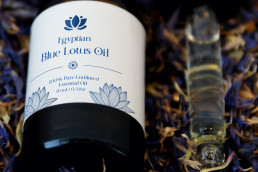
This guide is for spa owners, apothecary founders, clinical aromatherapists, and beauty brands considering a blue lotus oil private label programme. It covers the realities of sourcing genuine Nymphaea caerulea, what a credible formulation looks like, minimum order quantities, regulatory and labelling considerations, and the commercial decisions that separate a durable luxury launch from a forgettable one.
Table of Contents
- What a Private-Label Programme Actually Is
- Why Blue Lotus Is a Difficult Raw Material to Private-Label
- Yield and cost
- Three extraction methods, three different products
- Legal and regulatory complexity
- What a Credible Blue Lotus Oil Private Label Formulation Looks Like
- Facial oils and serums
- Body oils and ritual oils
- Pulse-point rollers and targeted blends
- Diffuser blends
- Pure oils
- Minimum Order Quantities, Lead Times, and Pricing Structure
- Labelling, Compliance, and What Your Name Actually Means on the Box
- Cosmetic versus aromatherapy positioning
- Aromatherapy and wellbeing claims
- Pregnancy, breastfeeding, and medication cautions
- Packaging, Shelf Life, and the Unglamorous Details That Matter
- Story, Provenance, and the Part That Cannot Be Subcontracted
- Choosing a Private-Label Partner: What to Ask
- Realistic Timelines From First Conversation to First Shipment
- When a Private-Label Programme Is the Wrong Choice
- Frequently Asked Questions
- Where to Go From Here
- Experience the Benchmark First
It is written and clinically reviewed by Antonio Breshears, ND, CCA, a Bastyr-trained naturopathic doctor and certified clinical aromatherapist. For general botanical, chemistry, and safety grounding, readers new to the material should begin with The Complete Guide to Blue Lotus Oil, which this practitioner-facing article assumes as background.
What a Private-Label Programme Actually Is
A private-label arrangement, sometimes called own-label or contract manufacturing, is one in which a supplier produces a finished product to your specification and packages it under your brand. You do not own the distillation equipment, the raw material contracts, or the fill line. You own the brand, the story, the retail relationship, and, crucially, the regulatory responsibility for the product you sell.
For blue lotus oil specifically, this usually takes one of three shapes. The first is a straightforward re-bottling arrangement: you receive bulk absolute or pre-diluted oil and place it into your own packaging. The second is a custom blend: the supplier formulates a bespoke fragrance, ritual oil, or cosmetic product around a blue lotus base to your brief. The third is a full finished-goods contract, where the supplier produces a catalogued range (facial oil, pulse-point roller, diffuser blend, ceremonial oil) and you select from it, applying your own branding.
Each route has different cost profiles, different minimum order quantities, and very different margins. Choosing between them is the first meaningful commercial decision a brand makes.
Why Blue Lotus Is a Difficult Raw Material to Private-Label
Blue lotus is not like lavender or sweet orange. The raw material supply is small, the extraction is laborious, and adulteration in the global market is rampant. A private-label programme that does not grapple honestly with these realities tends to produce either a beautiful-looking product with nothing much in the bottle, or a compliance headache six months after launch.
Yield and cost
It takes roughly three to five thousand fresh flowers to produce a single gram of true absolute. That arithmetic is what sets the floor price for honest blue lotus oil. When a wholesale quotation lands noticeably below the prevailing market for authentic Egyptian material, the likely explanation is dilution with a cheaper floral absolute, dilution with fragrance oil, or a fragrance-grade reconstruction marketed as the real thing. A credible private-label partner will be transparent about yield, origin, and batch-level documentation.
Three extraction methods, three different products
Solvent-extracted absolute is the most common commercial form and is what most “blue lotus oil” actually is. True steam-distilled essential oil is rare, lower yielding, and very expensive. Supercritical CO2 extracts sit in between and often present the most rounded aromatic profile. Each has different sensory, regulatory, and formulation behaviour. A private-label brief should state explicitly which extract the finished product will contain, because conflating them in marketing copy is a fast way to lose credibility with informed customers and practitioners.
Legal and regulatory complexity
Blue lotus is not a globally uniform commodity. It is restricted in Russia, Poland, and Latvia, and is listed as a controlled substance in the US state of Louisiana. Australian importation sits in a grey regulatory space that shifts over time. A private-label partner should be able to tell you, without hesitation, which markets they can and cannot ship your finished product into, and what labelling language is required in each. If they cannot, that is a significant risk that transfers straight to your brand.
What a Credible Blue Lotus Oil Private Label Formulation Looks Like
The question I am asked most often by prospective private-label clients is some version of: “How strong should the blue lotus be in the finished product?” There is no single answer, because the honest percentage depends on what the product is for.
Facial oils and serums
A one to two percent inclusion of blue lotus absolute in a well-chosen carrier system is generally appropriate for leave-on facial use. The carrier matters as much as the active: jojoba for sebum compatibility, squalane for a weightless finish, rosehip or prickly pear for restorative brightness. At these percentages the product performs as a genuine botanical treatment, not merely a scented oil, while remaining within sensible dilution ranges for daily facial application.
Body oils and ritual oils
Two to three percent is typical for a body or ritual oil, where the skin surface is larger and application frequency is lower. At these levels the aromatic signature, the cooler floral-aquatic top, the honeyed floral heart, and the balsamic, slightly smoky base, holds its shape on skin for several hours.
Pulse-point rollers and targeted blends
Three percent is a reasonable ceiling for a pulse-point roller intended for occasional emotional support use. Above this, cost escalates quickly without a proportionate gain in either aromatic or physiological effect.
Diffuser blends
For ambient diffusion, the blue lotus content does not need to be high. Two to four drops of a finished diffuser blend containing ten to twenty percent blue lotus in a supporting aromatic matrix (sandalwood, frankincense, a touch of neroli or jasmine) is more than enough to scent a treatment room. Overloading a diffuser blend with expensive absolute is poor formulation economics.
Pure oils
If the programme is a pure, undiluted absolute in a dropper bottle, the formulation question collapses into a sourcing question. The only thing that matters is provenance, purity, and the documentation that supports both.
Minimum Order Quantities, Lead Times, and Pricing Structure
MOQs for a serious blue lotus private-label programme typically sit higher than for more common botanicals, because the underlying raw material is sourced in smaller batches and cannot be conjured on demand.
As a working guide, expect MOQs in the range of 250 to 1,000 units per SKU for finished-goods contracts, with the lower end available for re-bottling arrangements using an existing bulk stock and the higher end for fully bespoke formulations that require a dedicated compounding run. Lead times of eight to twelve weeks are normal once the formulation and artwork are signed off, longer if custom glass or bespoke packaging is involved.
Pricing is usually structured in tiered bands: a unit cost at MOQ, a lower unit cost at two or three times MOQ, and a further step down at wholesale-volume commitments. A credible partner will show you the landed cost per millilitre of the active ingredient separately from the packaging and labour cost, because this transparency is what allows you to price your retail range intelligently.
Labelling, Compliance, and What Your Name Actually Means on the Box
Once your brand is on the bottle, you are the responsible person in the eyes of most regulatory frameworks. This is often under-appreciated by founders moving into botanicals from adjacent categories.
Cosmetic versus aromatherapy positioning
In the UK and EU, a product marketed for topical application to skin is a cosmetic and must have a Cosmetic Product Safety Report, a responsible person on file, notification through the appropriate portal, and labelling that complies with INCI conventions and allergen declaration rules. A private-label partner with cosmetic experience can produce or arrange the CPSR, but the obligation to keep it current sits with the brand on the label.
Aromatherapy and wellbeing claims
Therapeutic claims (“treats anxiety”, “cures insomnia”, “heals”) are not defensible under cosmetic law and are a fast route to enforcement action. Language about ritual, atmosphere, emotional wellbeing, sensory experience, and traditional use is defensible when handled carefully. The formulation might be excellent; the labelling is often what determines whether the product stays on shelves.
Pregnancy, breastfeeding, and medication cautions
Blue lotus oil is avoided in pregnancy and breastfeeding and deserves caution alongside dopaminergic medications, MAOIs, and heavy sedatives, because of its aporphine and nuciferine alkaloid content. These cautions belong on the outer packaging and the accompanying literature, not only on the website. A private-label partner should supply draft caution language as part of the formulation package.
Packaging, Shelf Life, and the Unglamorous Details That Matter
Blue lotus absolute is a costly, oxidation-sensitive material. Packaging choices that look beautiful on a brand deck can materially shorten the usable life of the product once it is in a customer’s hands.
Dark glass, amber or cobalt, is strongly preferred over clear glass or plastic for any oil-based formulation. A well-made pure absolute stored in dark glass, kept cool and out of direct light, has a shelf life in the region of three to four years. Once blended into a carrier or cosmetic matrix, the shelf life is determined by the carrier system and any antioxidants added at compounding; eighteen to thirty months is typical for a well-formulated facial or body oil.
Dropper inserts, roller balls, and pump fitments all have their own compatibility and migration considerations. Cheap rubber bulbs degrade in contact with essential oil over time and can contaminate the product with a dull, rubbery off-note. Any private-label programme should specify oil-compatible closures from the outset.
Story, Provenance, and the Part That Cannot Be Subcontracted
The commercial landscape for blue lotus oil private label is increasingly crowded, and the customers who buy it, spa clients, practitioners, informed enthusiasts, are reading carefully. The part of the programme that cannot be delegated to a manufacturer is the story you tell about where the flowers come from, how they are processed, who handles them, and why your brand chose this ingredient rather than a cheaper floral.
That story should be accurate. If the absolute is Egyptian, say so and explain what that means. If the extract is CO2 rather than solvent, say so. If your formulation is a one and a half percent facial oil in jojoba, do not imply it is a neat absolute. The brands that endure in this category are the ones whose marketing copy would survive being read by a clinical aromatherapist with a raised eyebrow.
Choosing a Private-Label Partner: What to Ask
When evaluating a supplier for a blue lotus private-label programme, the quality of the answers to a handful of specific questions tells you almost everything you need to know.
Ask for the country of origin and the harvest year of the current batch. Ask which extraction method was used and whether it was performed in-house or contracted. Ask for a GC-MS report for the current batch and read it, or have a consulting aromatherapist read it on your behalf. Ask about their maximum weekly fill capacity and whether your launch volume fits comfortably inside it or consumes most of it. Ask which markets they have shipped finished goods into in the last twelve months and request redacted examples of the labelling used.
Ask, finally, what happens if a retail customer reports an adverse reaction. A credible partner has a process: batch traceability, a response protocol, retained samples, and an insurance position. A partner who improvises this answer on the call is not ready to support a brand at retail scale.
Realistic Timelines From First Conversation to First Shipment
Founders habitually underestimate this. A well-executed blue lotus oil private label launch, from initial brief to first pallet leaving the facility, typically takes four to six months. The phases look approximately like this: two to four weeks for brief and formulation direction; four to six weeks for sampling and sensory approval; three to four weeks for artwork, regulatory review, and packaging procurement; six to eight weeks for compounding, filling, and quality release. Custom glass or a bespoke fragrance brief can extend any of these phases meaningfully.
Planning backwards from a retail launch date, with honest contingency for reformulation rounds and packaging slippage, is what separates brands that arrive on shelf in time for the season they planned for from brands that quietly miss it.
When a Private-Label Programme Is the Wrong Choice
Private label is a powerful route to market, but it is not always the right one. If the volumes you realistically expect to sell in the first twelve months are below typical MOQs, the cost of holding stock will eat your margin and your cash flow. If the point of difference you want to sell is the distillation itself, the craft, the artisan, the farm story, you are better served by a distribution partnership with a producer rather than by private-labelling their output under your name. If the retail price you need to hit is below the honest cost of genuine material at your inclusion level, the answer is not to find a cheaper supplier; it is to rework the concept.
There is no shame in deciding, after a sober look at the numbers, that private labelling blue lotus is not the right first move for a young brand. A smaller range, built around more forgiving botanicals, can establish the retail relationships and cash position that make a blue lotus launch feasible a year or two later.
Frequently Asked Questions
What is the minimum order quantity for a blue lotus oil private label programme?
MOQs vary by supplier and complexity. Straightforward re-bottling arrangements can start around 250 units per SKU. Fully bespoke formulations typically begin at 500 to 1,000 units per SKU, because the compounding run has to justify the dedicated handling of an expensive raw material.
How can I verify the authenticity of bulk blue lotus oil offered by a supplier?
Request a recent GC-MS analytical report for the specific batch you will receive, confirm the country of origin and harvest year, and compare the quoted price against the prevailing market for authentic Egyptian Nymphaea caerulea. Prices meaningfully below market are the most reliable red flag for adulteration or reconstruction.
What is the honest inclusion percentage for a blue lotus facial oil?
One to two percent absolute in a compatible carrier system is appropriate for leave-on facial use. Higher percentages increase cost significantly without a proportionate gain in performance and move outside sensible dilution ranges for daily facial application.
Do I need a cosmetic safety report for a private-label blue lotus oil sold in the UK or EU?
Yes. Any product marketed for topical application to skin in the UK or EU requires a Cosmetic Product Safety Report, a registered responsible person, and notification through the appropriate portal. A competent private-label partner will arrange or support the CPSR, but the brand on the label carries the ongoing responsibility.
What shelf life should I print on a finished blue lotus oil product?
A pure absolute in dark glass, kept cool and out of light, has a practical shelf life of three to four years. A blended facial or body oil typically carries eighteen to thirty months depending on the carrier system and antioxidant strategy. Period-after-opening marks follow standard cosmetic conventions.
Can I make therapeutic claims about the product?
No. Claims that the product treats, cures, or heals specific conditions are not defensible under cosmetic law in most markets and attract enforcement risk. Language describing ritual use, atmosphere, sensory experience, and emotional wellbeing is defensible when handled with care and alongside appropriate cautions.
Which markets should I avoid shipping a finished blue lotus product into?
Blue lotus is restricted in Russia, Poland, and Latvia, and is listed as a controlled substance in the US state of Louisiana. Australian import rules sit in a grey area that has shifted over time and warrants current advice before any shipment. Your private-label partner should be able to confirm their current capability in each market.
Should the product carry pregnancy and medication cautions?
Yes. Blue lotus oil is avoided in pregnancy and breastfeeding and warrants caution alongside dopaminergic medications, MAOIs, and heavy sedatives, because of its alkaloid profile. These cautions belong on outer packaging and accompanying literature, not only on the website.
How long does a typical private-label launch take from brief to first shipment?
Four to six months is realistic for a well-executed launch. Custom glass, bespoke fragrance briefs, and complex multi-SKU ranges can extend this meaningfully. Planning backwards from the retail launch date with honest contingency is essential.
Is solvent-extracted absolute acceptable for a luxury private-label positioning?
Yes, provided the marketing copy describes it accurately. Solvent-extracted absolute is the standard commercial form of blue lotus and is what most luxury houses use. Problems arise only when brands imply their absolute is a steam-distilled essential oil or a CO2 extract when it is not.
Where to Go From Here
A blue lotus oil private label programme succeeds when three things are aligned: the raw material is honestly what the label says it is, the formulation and packaging match the positioning, and the brand story can withstand informed scrutiny. Founders who take the time to get these three elements right tend to build a small, durable range that commands its price and retains its customers. Founders who skip a step tend to learn the same lesson at retail cost.
If you are still developing the botanical and clinical grounding that will inform your brief, The Complete Guide to Blue Lotus Oil is the right starting point. It covers the chemistry, the extraction methods, the safety profile, and the sensory architecture in the depth that a practitioner-facing brand needs to be able to speak about its own product with credibility.

Antonio Breshears
Antonio Breshears is a renowned expert in holistic medicine and beauty, with over 25 years of research experience dedicated to uncovering the secrets of nature's most powerful remedies. Holding a degree in Naturopathic Medicine, Antonio's passion for healing and well-being has driven him to explore the intricate connections between mind, body, and spirit.
Over the years, Antonio has become a respected authority in the field, helping countless individuals discover the transformative power of plant-based therapies, including essential oils, herbs, and natural supplements. He has authored numerous articles and publications, sharing his wealth of knowledge with a global audience seeking to improve their overall health and well-being.
Antonio's expertise extends to the realm of beauty, where he has developed innovative, all-natural skincare solutions that harness the potency of botanical ingredients. His formulations embody his deep understanding of the healing properties found in nature, providing holistic alternatives for those seeking a more balanced approach to self-care.
With his extensive background and dedication to the field, Antonio Breshears is a trusted voice and guiding light in the world of holistic medicine and beauty. Through his work at Pure Blue Lotus Oil, Antonio continues to inspire and educate, empowering others to unlock the true potential of nature's gifts for a healthier, more radiant life.