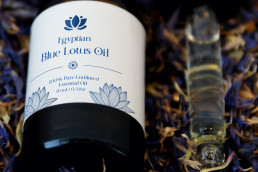
This guide is for spa directors, treatment managers, and senior therapists who are considering adding genuine Egyptian blue lotus oil to their treatment menu and want to understand how a blue lotus oil spa partnership works in practice. It covers the commercial terms, the clinical and olfactory rationale for using Nymphaea caerulea in a spa setting, how to formulate treatments that do the ingredient justice, and the honest limits of what blue lotus can deliver for your guests.
Table of Contents
- What a Blue Lotus Oil Spa Partnership Actually Is
- Who the programme is designed for
- Why Genuine Blue Lotus Matters in a Spa Context
- The scent profile
- The physiological response
- The narrative
- How the Partnership Programme Works
- Tier one: Introductory partnership
- Tier two: Integrated partnership
- Tier three: Signature partnership
- Formulating Spa Treatments With Blue Lotus Oil
- Signature facial protocol
- Signature body ritual
- Crown and scalp treatment
- Diffusion in treatment rooms
- Training Your Therapists
- What Your Guests Will Actually Experience
- Safety, Contraindications, and Guest Screening
- Commercial Considerations
- When a Partnership Is Not the Right Choice
- Frequently Asked Questions
- Where to Go From Here
- Partner With a Genuine Ingredient
It is written and clinically reviewed by Antonio Breshears, ND, CCA, a Bastyr-trained naturopathic doctor and certified clinical aromatherapist. If you want the broader clinical and botanical background before reading on, see The Complete Guide to Blue Lotus Oil, which covers the chemistry, history, and clinical applications in depth.
What a Blue Lotus Oil Spa Partnership Actually Is
A spa partnership, at least as we run it, is not simply a wholesale account with a larger discount. It is a working relationship designed around the fact that blue lotus absolute is an unusual ingredient: it is expensive, highly concentrated, regulated in some jurisdictions, and genuinely transformative when formulated correctly. A partnership gives a spa access to verified material, technical support on dilution and protocol design, marketing language that is clinically honest, and training resources for the therapists who will actually be using the oil on guests.
The programme exists because we have watched too many spas buy a small bottle of something labelled “blue lotus”, dilute it to homeopathic levels in a commodity massage base, charge a premium for it, and then wonder why the treatment did not land. Genuine Nymphaea caerulea absolute is a serious aromatic ingredient. It deserves, and requires, a serious approach.
Who the programme is designed for
The partnership is a good fit for luxury day spas, destination spas, resort wellness programmes, boutique hotel spas, and clinically-oriented wellness centres that want to offer a signature treatment built around a genuinely rare aromatic. It is also well suited to floatation centres, breathwork studios, and yoga and meditation retreats where the olfactory-limbic effects of blue lotus complement the underlying practice.
It is not the right fit for volume-driven chain spas running twenty minute rotations on commodity margins; the economics do not work, and the ingredient will be wasted.
Why Genuine Blue Lotus Matters in a Spa Context
Spa guests are increasingly sophisticated. They can tell the difference between a synthetic floral reconstruction and a true botanical absolute, even if they cannot articulate why. The difference lives in three places: the scent itself, the physiological response, and the story the treatment tells.
The scent profile
Real Nymphaea caerulea absolute opens with a cooler, slightly aquatic floral top, moves into a deep honeyed heart with a distinct waxy-floral character, and dries down to a balsamic, faintly smoky base that lingers on skin for hours. No synthetic reproduction captures the full arc. Guests who have smelled the real thing once can recognise it again, and increasingly they do.
The physiological response
The active chemistry of blue lotus absolute includes aporphine (a weak dopaminergic alkaloid), nuciferine (a modulator of serotonin 5-HT2A and 5-HT2C receptors), and a suite of flavonoids including apigenin, quercetin, and kaempferol. Apigenin binds at central benzodiazepine receptor sites at low affinity. Taken together, and delivered by inhalation via the olfactory-limbic pathway, these constituents encourage a shift into parasympathetic dominance: slower breath, lower shoulder tension, a noticeable softening around the eyes and jaw within the first ten to fifteen minutes of a treatment. This is not a strong sedative effect, and no responsible practitioner should claim it is, but it is a reasonably well-attested and quietly reliable one.
The narrative
Three to five thousand flowers are required to produce a single gram of absolute. The flower has a 3,000 year documented ceremonial history in ancient Egypt. These are not marketing embellishments; they are simply the facts, and they give your therapists something genuine to say during the pre-treatment consultation.
How the Partnership Programme Works
The structure is intentionally simple. There are three tiers, distinguished by annual volume commitment and the level of formulation and training support included.
Tier one: Introductory partnership
Designed for spas adding a single blue lotus signature treatment to an existing menu. Includes wholesale pricing on 5ml, 10ml, and 15ml bottles of pure absolute, a formulation consultation covering one signature protocol, and a digital training pack for up to four therapists. Suitable for spas performing ten to thirty blue lotus treatments per month.
Tier two: Integrated partnership
Designed for spas building a small range of blue lotus treatments (typically a facial, a full-body ritual, and a scalp or crown treatment). Includes larger-format wholesale access, bespoke formulation support across multiple protocols, an in-person or video-based therapist training session, marketing copy reviewed for clinical accuracy, and optional private-label blending into a carrier base of your choosing.
Tier three: Signature partnership
Designed for destination spas and resort wellness programmes building a flagship blue lotus experience. Includes priority allocation of premium extraction lots (solvent absolute and supercritical CO2), co-developed signature blends, on-site therapist training, a clinical reference document specific to your treatment menu, and ongoing consultation on safety, pregnancy protocols, and contraindications.
Terms, minimums, and pricing are provided on enquiry, because they depend on the jurisdiction, the treatment format, and whether private-label blending is involved.
Formulating Spa Treatments With Blue Lotus Oil
The single most common mistake in spa formulation is under-dilution in the wrong places and over-dilution in the right ones. Blue lotus absolute is potent enough that a facial formulation needs no more than one percent concentration to deliver the scent and the physiological effect; a body oil can sit comfortably at two to three percent; a targeted pulse-point or crown oil can run at three percent. Going higher does not improve the experience and compresses your margin for no therapeutic gain.
Signature facial protocol
A blue lotus facial oil blended at one percent in a base of jojoba and squalane, with perhaps a small addition of rosehip for the nourishment layer, performs beautifully. The facial massage itself is where the olfactory benefit lands: the guest is supine, breathing deeply, with the aromatic concentration naturally highest near the nose. Fifteen minutes into the treatment the parasympathetic shift is usually visible in the guest’s breath rate and facial tension.
Signature body ritual
A warm stone or traditional Swedish body treatment works well with a body oil blended at two percent blue lotus in a base of fractionated coconut or sweet almond. For treatments longer than sixty minutes, a slightly lower concentration of one and a half percent reduces the risk of olfactory fatigue in the guest and the therapist alike.
Crown and scalp treatment
Blue lotus has a particularly strong affinity with crown and scalp work, both culturally (the flower was historically associated with the crown in Egyptian iconography) and practically (scalp massage opens the breath and the aromatic molecules reach the olfactory bulb directly). A three percent dilution in a golden jojoba base, warmed slightly, used for a twenty minute scalp and neck treatment, is memorable in a way that generic aromatherapy simply is not.
Diffusion in treatment rooms
Two to four drops in a cold-diffusion nebuliser at the start of a treatment, switched off before the guest enters the deeper stages of relaxation, scents the room without saturating it. Avoid heat-based diffusers, which degrade the more volatile top notes.
Training Your Therapists
The quality of a blue lotus treatment is determined almost entirely by what the therapist knows and how they present the treatment to the guest. The partnership programme includes training materials that cover five areas.
First, the botanical background: what Nymphaea caerulea is, where it grows, how the absolute is extracted, and why it costs what it does. Therapists who can answer a guest’s question about the ingredient with confidence deliver a visibly better treatment.
Second, the clinical mechanism: how to describe the alkaloid and flavonoid activity in plain language without overclaiming. “It works with your nervous system to encourage a calmer state” is accurate; “it will cure your anxiety” is not.
Third, the safety profile: pregnancy and breastfeeding avoidance, caution around dopaminergic medications, MAOIs, and heavy sedatives, and the specific regulatory situation in jurisdictions such as Russia, Poland, Latvia, the US state of Louisiana, and the complexity around Australia.
Fourth, the consultation script: how to open the pre-treatment conversation, what to ask about medications and pregnancy status, and how to adjust the protocol for guests who present with contraindications.
Fifth, the treatment mechanics themselves: pacing, pressure, the ideal moment to introduce the oil to the guest’s olfactory field, and how to manage the wind-down so the parasympathetic state the oil encourages is protected rather than disrupted.
What Your Guests Will Actually Experience
Honest expectation-setting protects the treatment and the relationship with your guest. Here is what genuine blue lotus absolute reliably produces in a well-formulated spa protocol.
Within the first five to ten minutes of inhalation, most guests report a softening of mental chatter and a slower, deeper breath pattern. Between ten and twenty minutes, a visible release of shoulder, jaw, and brow tension is typical. By the end of a sixty minute treatment, guests often describe a state they might call “dreamy”, “floaty”, or “quietly euphoric”, though the precise language varies considerably.
What blue lotus does not reliably produce: dramatic sedation, sleep, hallucination, or a strong psychoactive experience. Guests who arrive expecting those effects, perhaps having read overheated marketing copy elsewhere, will be disappointed. Training your front-of-house team to set realistic expectations at the point of booking is essential.
Safety, Contraindications, and Guest Screening
The pre-treatment consultation for any blue lotus protocol should include specific screening questions beyond the standard spa intake. Pregnancy and breastfeeding are absolute contraindications; the oil should not be used in any form, including diffusion, in treatments on guests in these categories. Offer an alternative aromatic treatment using, for example, neroli or rose, both of which have stronger safety data in pregnancy.
Guests taking dopamine-modulating medications (certain antipsychotics, Parkinson’s medications, some antidepressants with dopaminergic activity) should be handled with caution; the aporphine and nuciferine in blue lotus have weak activity at these receptors and the interaction profile is not fully characterised. When in doubt, diffuse in the room rather than applying topically, and keep the session short.
Guests on MAOIs or heavy sedatives: avoid entirely, or consult the prescribing physician.
Guests with known floral allergies: offer a patch test twenty-four hours before the treatment, or switch to a non-floral protocol.
Commercial Considerations
A blue lotus signature treatment priced correctly sits in the upper quartile of your treatment menu. The ingredient cost per treatment, even at generous application levels, is modest compared to the retail price differential the ingredient justifies. The margin structure rewards spas that commit to genuine material and correct formulation; it punishes spas that cut corners and are then caught out by sophisticated guests.
We recommend pricing the signature treatment at a meaningful premium to your standard equivalent (a blue lotus facial at a clear step above your standard luxury facial, for example) and protecting that price point by never offering the treatment at discount. The ingredient carries a story; the story is undermined by promotional pricing.
When a Partnership Is Not the Right Choice
If your spa operates on volume and cannot support the ingredient cost at therapeutic dilutions, the partnership will not work commercially. If your treatment menu does not allow at least forty-five minutes for an aromatic treatment, the oil does not have time to do its work and you are wasting the ingredient. If your therapists are not trained in aromatherapy principles and you cannot invest in the training materials the programme provides, the treatment will not land.
These are not soft limits. Blue lotus absolute is one of the most expensive aromatic ingredients in commercial aromatherapy, and using it badly produces a worse guest experience than using a well-formulated lavender or neroli treatment at a lower price point.
Frequently Asked Questions
What is the minimum order for a blue lotus oil spa partnership?
Minimums vary by tier and by whether the partnership involves private-label blending. The introductory tier has a modest minimum suitable for a single signature treatment; the signature tier involves priority allocation and larger volume commitments. Specific figures are provided on enquiry.
Do you offer private-label blending for spa clients?
Yes, at the integrated and signature partnership tiers. We can blend pure blue lotus absolute into a carrier base of your specification, label to your brand standards, and supply in treatment-room appropriate formats.
How do we verify the blue lotus oil is genuine?
Every lot ships with documentation of origin and extraction method. The three extraction types we supply (solvent absolute, steam distilled essential oil, and supercritical CO2) each have distinct characteristics, and we are happy to walk your formulation lead through how to recognise each in a sensory evaluation.
Can we use blue lotus oil in a pregnancy massage?
No. Blue lotus is avoided in pregnancy and breastfeeding. The programme training includes specific guidance on alternative aromatic treatments for guests in these categories.
What is the shelf life of blue lotus absolute in a spa setting?
Properly stored blue lotus absolute (dark glass, cool, away from light) holds its character for three to four years. In a working spa, we recommend decanting only what you will use within a month into your treatment-room bottles, keeping the master stock sealed and cool.
How much oil do we need per treatment?
At one percent in a facial formulation, a sixty minute facial uses roughly fifteen to twenty drops of pure absolute per fifty millilitres of blended oil, across potentially ten treatments. A two percent body blend uses roughly thirty to forty drops per fifty millilitres, across roughly five to six full-body treatments. Exact figures depend on your formulation and treatment length.
Can we offer blue lotus oil for retail alongside the treatment?
Yes, and we recommend it. Guests who respond strongly to the treatment frequently ask to take the aromatic home. Retail-format bottles can be supplied through the partnership at wholesale terms.
What kind of training is included?
Training depth varies by tier. The introductory tier includes a digital training pack; the integrated tier includes a live video training session; the signature tier includes on-site therapist training and a bespoke clinical reference document.
Are there jurisdictions where we cannot offer blue lotus treatments?
Yes. Blue lotus is restricted or regulated in Russia, Poland, Latvia, the US state of Louisiana, and has regulatory complexity in Australia. We cannot supply into markets where the ingredient is restricted, and partnership enquiries from these jurisdictions are handled case by case.
How long does it take to set up a partnership?
From first enquiry to first treatment on the menu, most partnerships move in four to eight weeks, depending on whether private-label blending is involved and how much formulation and training work is required. Signature tier partnerships with bespoke development can take longer.
Where to Go From Here
If you are considering a blue lotus oil spa partnership, the most useful next step is usually a sensory sample. Until you and your formulation lead have smelled genuine Nymphaea caerulea absolute, the rest of the conversation is abstract. Reach out through our practitioner enquiry channel, describe your spa, your current menu, and what you are hoping to build, and we will send a small evaluation sample along with a tailored outline of how the partnership might work for your specific operation. For the broader clinical background that will inform your therapist training, The Complete Guide to Blue Lotus Oil is the reference document we point most new partners toward first.

Antonio Breshears
Antonio Breshears is a renowned expert in holistic medicine and beauty, with over 25 years of research experience dedicated to uncovering the secrets of nature's most powerful remedies. Holding a degree in Naturopathic Medicine, Antonio's passion for healing and well-being has driven him to explore the intricate connections between mind, body, and spirit.
Over the years, Antonio has become a respected authority in the field, helping countless individuals discover the transformative power of plant-based therapies, including essential oils, herbs, and natural supplements. He has authored numerous articles and publications, sharing his wealth of knowledge with a global audience seeking to improve their overall health and well-being.
Antonio's expertise extends to the realm of beauty, where he has developed innovative, all-natural skincare solutions that harness the potency of botanical ingredients. His formulations embody his deep understanding of the healing properties found in nature, providing holistic alternatives for those seeking a more balanced approach to self-care.
With his extensive background and dedication to the field, Antonio Breshears is a trusted voice and guiding light in the world of holistic medicine and beauty. Through his work at Pure Blue Lotus Oil, Antonio continues to inspire and educate, empowering others to unlock the true potential of nature's gifts for a healthier, more radiant life.