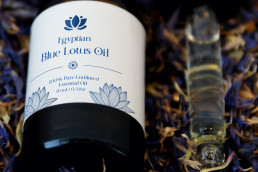
If you have been shopping for blue lotus oil and noticed prices ranging from a few pounds to several hundred for the same nominal volume, you are not imagining things. The blue lotus oil cost per ml is one of the most confusing figures in the essential oil market, and most of that confusion is deliberate. This article breaks down what you are actually paying for when you buy blue lotus oil by the millilitre, why the price variance is so extreme, and how to tell whether a given bottle represents honest value or a margin built on dilution and marketing.
Table of Contents
- Why Blue Lotus Oil Is Expensive in the First Place
- What "Cost Per ML" Actually Measures
- Typical Price Ranges You Will See
- Under £2 per ml
- £2 to £8 per ml
- £10 to £25 per ml
- £25 to £60 per ml
- Above £60 per ml
- Why the Same Volume Can Cost So Differently
- Raw material authenticity
- Dilution status
- Extraction method
- Bottle size and packaging
- Brand and retail margin
- How to Calculate Honest Value Per ML
- Signs You Are Overpaying or Underpaying
- Likely overpriced
- Likely underpriced (and therefore suspect)
- Likely honest
- What to Expect From a Fair Purchase
- When Cost Per ML Is the Wrong Question
- Frequently Asked Questions
- Where to Go From Here
- Honest Pricing, Genuine Material
It is written and clinically reviewed by Antonio Breshears, ND, CCA, a Bastyr-trained naturopathic doctor and certified clinical aromatherapist. For broader context on the material, its chemistry, and the full landscape of buying considerations, readers may want to start with the complete guide to blue lotus oil, which covers the foundation this cost discussion builds on.
Why Blue Lotus Oil Is Expensive in the First Place
Before getting into per-millilitre figures, it helps to understand the raw material economics. Blue lotus (Nymphaea caerulea) produces a small flower with a modest aromatic yield. Estimates from reputable producers suggest somewhere between 3,000 and 5,000 hand-picked flowers are required to produce a single gram of genuine absolute. The flowers must be harvested in a narrow window, processed quickly, and handled carefully to preserve the delicate aromatic and alkaloid profile.
On top of that, cultivation is concentrated in a few regions (principally Egypt, parts of Thailand, and Sri Lanka), and regulatory friction around the plant in certain jurisdictions adds export complexity. The result is a genuinely expensive raw material. A fair wholesale figure for pure blue lotus absolute, before bottling, branding, and retail markup, sits in the range that makes sub-ten-pound bottles essentially impossible without dilution or adulteration.
This is the baseline you should carry with you: if a bottle of “pure blue lotus oil” is priced at a level that would barely cover postage on a few grams of the actual raw material, the maths simply does not work. Something has been cut, substituted, or renamed.
What “Cost Per ML” Actually Measures
Cost per ml is a useful comparison tool, but only if you are comparing like with like. A 5 ml bottle at £50 works out at £10 per ml. A 10 ml bottle at £75 works out at £7.50 per ml. On the surface, the second looks like better value. But that calculation is only meaningful if both bottles contain the same thing at the same concentration.
In practice, the three variables that determine what you are actually buying per millilitre are:
- Purity, meaning whether the bottle contains 100 percent blue lotus absolute or absolute pre-diluted in a carrier oil (often jojoba or fractionated coconut).
- Extraction method, meaning solvent-extracted absolute, steam-distilled essential oil, or supercritical CO2 extract, each with different yields, costs, and aromatic profiles.
- Authenticity, meaning whether the aromatic material is genuinely Nymphaea caerulea or a blend reconstructed from cheaper florals and synthetic aroma molecules designed to smell roughly similar.
Once these three variables are accounted for, the cost per ml figure becomes a useful signal rather than a misleading headline number.
Typical Price Ranges You Will See
Here is a realistic map of the market as of current pricing, in pounds sterling. These are observed ranges, not recommendations, and they describe what is out there rather than what is honest.
Under £2 per ml
Bottles priced in this band are almost never pure blue lotus absolute. They are usually one of three things: a fragrance oil (synthetic aroma chemicals in a carrier, intended for soap and candle making), a heavy dilution of trace genuine material in a large volume of jojoba or coconut, or a reconstructed blend using cheaper florals like jasmine sambac or ylang ylang to mimic the scent profile. These products are not necessarily fraudulent if they are accurately labelled, but most are not.
£2 to £8 per ml
This band typically contains pre-diluted absolutes, often 5 to 10 percent blue lotus in a carrier oil. For some uses, particularly topical application where you would dilute anyway, these can represent reasonable value if the percentage is honestly disclosed. The problem is that many sellers in this range do not disclose the dilution ratio, which makes the cost per ml figure meaningless for comparison.
£10 to £25 per ml
This is roughly the band where genuinely pure, solvent-extracted blue lotus absolute from reputable suppliers tends to sit once bottled for retail. The wide range reflects differences in sourcing quality, bottling size (smaller bottles carry higher per-ml costs because of fixed packaging overheads), and brand positioning. A 5 ml bottle of honest absolute at this price range is behaving about as it should.
£25 to £60 per ml
This band contains premium-grade absolutes, small-batch artisan extractions, and supercritical CO2 extracts. The higher price reflects lower yields, more careful processing, and in some cases genuinely superior aromatic and therapeutic quality. Whether the premium is worth it depends on what you are using the oil for. For clinical aromatherapy work or ritual-grade perfumery, the difference can be perceptible. For a diffuser at the end of the day, perhaps less so.
Above £60 per ml
Prices above this level are usually a mix of very small bottle sizes (1 ml or 2 ml sample vials where packaging dominates the cost), genuinely exceptional material, or straightforward luxury positioning. At this level, provenance documentation and GC-MS testing become reasonable to expect from any honest seller.
Why the Same Volume Can Cost So Differently
Two bottles labelled “10 ml blue lotus oil” can cost £15 and £250 respectively. Here are the factors that actually drive the difference.
Raw material authenticity
The single largest cost driver. Real Nymphaea caerulea absolute has a wholesale floor price below which nothing genuine can be sold. Product priced beneath that floor has been substituted or diluted, full stop. GC-MS testing is the only way to verify authenticity with certainty, and reputable sellers will provide test results on request.
Dilution status
A 10 ml bottle of 5 percent blue lotus in jojoba contains roughly 0.5 ml of actual absolute. A 10 ml bottle of undiluted absolute contains 10 ml. These are not the same product, and honest cost per ml comparison has to account for concentration.
Extraction method
Solvent-extracted absolute is the most common and usually the most affordable form of genuine blue lotus oil. Steam-distilled essential oil is rarer (the yields are so low it is barely commercially viable) and correspondingly more expensive. Supercritical CO2 extracts are premium products with excellent aromatic fidelity and typically command the highest prices per ml among genuine products.
Bottle size and packaging
Smaller bottles carry higher per-ml costs because the cost of the bottle, cap, dropper, label, and box is largely fixed. A 1 ml sample vial might cost £1 in packaging alone, which means the per-ml figure looks inflated even when the oil itself is fairly priced. This is why buying slightly larger bottles (if you will use them within the 3 to 4 year shelf life) is usually more economical.
Brand and retail margin
Luxury positioning, dropshipping middlemen, and marketplace fees all add layers of cost that do not improve the oil. A bottle sold through a reputable apothecary with direct sourcing will often cost less per ml than the same quality material sold through a multi-tiered retail chain.
How to Calculate Honest Value Per ML
When you encounter a product, run the following quick checks to translate the sticker price into a meaningful cost per ml of actual blue lotus content.
- Find the concentration. If the label says “pure” or “100 percent”, note that claim but treat it as provisional. If it says “10 percent dilution in jojoba”, take the seller at their word and calculate accordingly.
- Divide the price by total ml to get headline cost per ml.
- Multiply that figure by the inverse of the concentration to get cost per ml of actual blue lotus material. A £30 bottle of 10 ml at 10 percent dilution gives £3 per headline ml but £30 per ml of actual absolute.
- Compare that final figure against the realistic pure-absolute range (£10 to £25 per ml for standard retail quality). Anything dramatically below that range should prompt a closer look at provenance.
This calculation is not glamorous, but it is the single most useful exercise a buyer can do.
Signs You Are Overpaying or Underpaying
Price alone will not tell you whether you are being well served, but extreme prices in either direction carry useful information.
Likely overpriced
A bottle sold at luxury-tier per-ml pricing (above £40 per ml for standard absolute) without any supporting documentation, from a brand without a clear sourcing story, is most likely charging a premium for packaging and positioning rather than material quality. You can often find identical or better oil for half the price from a direct artisan supplier.
Likely underpriced (and therefore suspect)
A “pure” 10 ml bottle at under £15 is mathematically unlikely to contain what it claims. The raw material cost alone at that volume exceeds the retail price. The most common explanations are synthetic reconstruction, heavy dilution without disclosure, or substitution with cheaper florals. None of these are worth the saving.
Likely honest
A seller who tells you the extraction method, discloses the origin region, states whether the oil is diluted, provides GC-MS data on request, and prices the product in the realistic range for its claimed quality is behaving as an honest supplier. Cost per ml that sits in the defensible middle of the market, with transparent documentation, is usually what you want.
What to Expect From a Fair Purchase
When you buy blue lotus oil at a fair price, here is what a reasonable experience looks like. The bottle arrives in dark glass, usually amber or cobalt, appropriately sized for the volume. The scent on opening is cool and floral at the top, with a deep honeyed-floral heart developing over a minute or two, settling into a slightly balsamic base. The material is viscous rather than watery, golden to amber in colour, and a single drop is enough to scent a small space or a pulse point.
Used at standard dilutions (1 to 2 percent in facial applications, 2 to 3 percent for body work, a few drops in a diffuser), a 5 ml bottle will last most users several months. Calculated across that lifespan, even a £100 bottle works out to a modest cost per use. This is the frame I would encourage you to hold alongside the per-ml figure: cost per application is often the more practically useful number for a material used this sparingly.
When Cost Per ML Is the Wrong Question
For a small number of buyers, the cost per ml figure is genuinely secondary. If you are using blue lotus oil in clinical aromatherapy work, formulating for a small perfumery line, or using it as part of a personal ritual where the material quality is inseparable from the experience, the honest quality of the oil matters more than the per-ml price. Paying £25 per ml for something genuine is better than paying £3 per ml for something that is not what it claims to be, even if the latter looks like the bargain on paper.
Conversely, if you want a pleasant floral note for diffusing and are not especially invested in the specific chemistry of Nymphaea caerulea, an honestly labelled pre-diluted product or even a clearly marked fragrance oil may serve you well at a fraction of the cost. The ethical issue is not the dilution or the synthetic; it is the misrepresentation.
Frequently Asked Questions
What is the average cost per ml for pure blue lotus oil?
For genuinely pure, solvent-extracted blue lotus absolute from a reputable retail supplier, expect to pay somewhere between £10 and £25 per ml. Premium CO2 extracts and small-batch artisan products can run £25 to £60 per ml. Anything dramatically below £10 per ml for a product claiming to be pure should be treated with scepticism.
Why is blue lotus oil so much more expensive than other floral oils?
Yield is the main reason. It takes roughly 3,000 to 5,000 hand-picked flowers to produce one gram of genuine absolute, cultivation is geographically concentrated, and the harvesting window is narrow. These factors push the raw material cost far above more common florals like lavender or geranium.
Is a £10 bottle of blue lotus oil real?
Almost certainly not in the sense of being pure Nymphaea caerulea absolute. At that price, the product is most likely a synthetic fragrance, a heavy dilution, or a reconstructed blend of cheaper florals. Some of these products are perfectly usable for their intended purpose but should not be mistaken for genuine blue lotus absolute.
Does a higher cost per ml mean better oil?
Not necessarily. Above a certain threshold, additional price often reflects packaging, branding, and retail margin rather than material quality. The sweet spot for honest pure absolute tends to sit in the £10 to £25 per ml range. Above that, you should expect documentation and provenance to justify the premium.
How do I compare a diluted oil to a pure oil on cost per ml?
Multiply the headline cost per ml by the inverse of the concentration. A 10 percent dilution at £3 per ml is equivalent to £30 per ml of actual absolute. This gives you a like-for-like figure to compare against pure products.
Why does a 1 ml sample cost more per ml than a 10 ml bottle?
Fixed packaging costs dominate small bottle pricing. The bottle, cap, dropper, label, and box can easily cost more than the oil inside a 1 ml vial. Buying a slightly larger size, within what you will realistically use in the 3 to 4 year shelf life, almost always improves cost per ml.
Is CO2-extracted blue lotus worth the extra cost per ml?
For users who value aromatic fidelity and the fullest possible preservation of the plant’s volatile profile, yes. CO2 extraction typically produces a cleaner, more complete aromatic than solvent extraction, without residual solvent concerns. For general diffuser use, solvent-extracted absolute from a reputable source is usually sufficient.
How long should one bottle last?
At standard use (a few drops in a diffuser, or 1 to 3 percent dilution for topical application), a 5 ml bottle of pure absolute lasts most users three to six months. A 10 ml bottle often lasts close to a year. This is worth factoring in when the per-ml price looks high in isolation.
What documentation should a seller provide at higher price points?
For products priced above about £20 per ml, it is reasonable to ask for the country of origin, the extraction method, and GC-MS test results confirming authenticity and major chemical constituents. Sellers who cannot or will not provide this information should be treated cautiously regardless of their price.
Can I use a cheaper dilution instead of paying for pure oil?
If the dilution is honestly labelled and the base carrier suits your intended application, a pre-diluted product can be sensible value. The issue is not dilution itself; it is undisclosed dilution sold at pure-oil prices. An openly labelled 10 percent absolute in jojoba is a legitimate product at a legitimate price.
Where to Go From Here
Understanding cost per ml is really understanding what you are buying, and the per-millilitre figure is only meaningful once you have decoded the concentration, extraction method, and authenticity behind it. For the broader context on chemistry, applications, and how to identify a supplier worth trusting, the complete guide to blue lotus oil brings these threads together. If you are weighing a specific purchase, run the calculations described above, ask the questions the supplier should be willing to answer, and judge the price by what is actually in the bottle rather than what is printed on the label.

Antonio Breshears
Antonio Breshears is a renowned expert in holistic medicine and beauty, with over 25 years of research experience dedicated to uncovering the secrets of nature's most powerful remedies. Holding a degree in Naturopathic Medicine, Antonio's passion for healing and well-being has driven him to explore the intricate connections between mind, body, and spirit.
Over the years, Antonio has become a respected authority in the field, helping countless individuals discover the transformative power of plant-based therapies, including essential oils, herbs, and natural supplements. He has authored numerous articles and publications, sharing his wealth of knowledge with a global audience seeking to improve their overall health and well-being.
Antonio's expertise extends to the realm of beauty, where he has developed innovative, all-natural skincare solutions that harness the potency of botanical ingredients. His formulations embody his deep understanding of the healing properties found in nature, providing holistic alternatives for those seeking a more balanced approach to self-care.
With his extensive background and dedication to the field, Antonio Breshears is a trusted voice and guiding light in the world of holistic medicine and beauty. Through his work at Pure Blue Lotus Oil, Antonio continues to inspire and educate, empowering others to unlock the true potential of nature's gifts for a healthier, more radiant life.