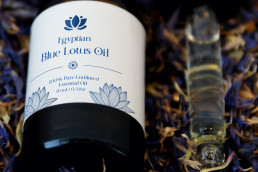
This guide is written for practitioners: massage therapists, energy workers, psychotherapists who use scent in session, somatic coaches, yoga and breathwork facilitators, midwives who work in the postnatal window, and bodyworkers of every school. If you are considering bringing blue lotus oil into your treatment room and you want a practitioner-level answer rather than a marketing one, the sections below cover what blue lotus oil therapists most often ask about: what the oil actually does, where it fits within a session, how to dilute and apply it safely, and when to leave it out of the protocol entirely.
Table of Contents
- Why Practitioners Are Reaching for Blue Lotus
- The Chemistry Practitioners Should Know
- How Blue Lotus Oil Supports Different Modalities
- Massage and Bodywork
- Psychotherapy and Counselling Rooms
- Breathwork, Yoga Nidra, and Meditation Facilitation
- Energy Work and Subtle Practices
- Postnatal and Midwifery Contexts
- Practical Protocols for the Treatment Room
- Diffuser Use
- Massage Blend
- Anointing and Ritual Blends
- Compress and Wrap Work
- What to Expect: Realistic Timeframes for Client Response
- When Blue Lotus Oil Is Not the Right Choice
- Client Consent, Documentation, and Safety Practice
- Complementary Approaches and Blending Partners
- Sourcing and Quality for Practitioner Use
- Frequently Asked Questions
- Where to Go From Here
- Practitioner-Grade Blue Lotus Oil
It is written and clinically reviewed by Antonio Breshears, ND, CCA, a Bastyr-trained naturopathic doctor and certified clinical aromatherapist. For the chemistry, history, and broader therapeutic context that underpins the recommendations here, readers may wish to begin with the complete guide to blue lotus oil, which this article assumes as background reading.
Why Practitioners Are Reaching for Blue Lotus
Blue lotus oil sits in an unusual position in the aromatherapy cabinet. It is not a strong sedative, not an analgesic, and not a mood-altering compound in any dramatic sense. What it does, reasonably well, is soften the edge of a client’s nervous system so that whatever modality you are practising can work more easily. The scent is quiet, deep, and slightly unfamiliar to most clients, which means it does not carry the associations that lavender or frankincense inevitably do.
For practitioners whose work depends on the client dropping into a parasympathetic state, a state of receptive rest rather than guarded vigilance, that unfamiliarity is genuinely useful. A new scent creates a new container. Clients who have learned to brace against lavender because they associate it with clinical settings often relax more readily with something they have not met before. This is the simplest and most defensible case for bringing blue lotus oil into therapy work.
The Chemistry Practitioners Should Know
You do not need to memorise the full phytochemistry, but a working understanding helps you speak sensibly to clients who ask. The oil’s activity comes principally from two groups of compounds. The alkaloids, aporphine and nuciferine, have weak interactions with dopamine and serotonin receptors. Aporphine is a mild dopamine agonist; nuciferine is a mild dopamine antagonist with some 5-HT2A and 5-HT2C activity. In plain terms, this gives the oil a gentle balancing effect on mood rather than a strong push in any direction.
The flavonoid fraction, led by apigenin with supporting quercetin and kaempferol, is where most of the calming effect likely comes from. Apigenin binds at central benzodiazepine receptors at low potency, which is consistent with what practitioners observe in session: a reduction in fidgetiness, a softening of the breath, a willingness to close the eyes. This is not sedation. Clients do not become drowsy or disoriented. They become easier to work with.
Route of delivery matters here. Most of what happens in a treatment room is olfactory, meaning the scent reaches the limbic system via the olfactory pathway within seconds and nudges autonomic tone. Topical application through massage oil or compress offers a slower, lower-dose effect on skin and mood, while true systemic absorption from a session is minimal.
How Blue Lotus Oil Supports Different Modalities
Massage and Bodywork
In massage, blue lotus oil is best used as an accent rather than the primary carrier scent. The absolute is rich, viscous, and expensive, so diluting a drop or two into your neutral massage oil, or into a secondary blend you apply to the chest, neck, and temples at the start of the session, gives you most of the benefit without burning through the bottle. A 1 percent dilution in a light carrier is ample for body work; 2 percent is the ceiling unless you are targeting a small area. The aim is a scent that lingers softly in the room, not a heavy floral cloud.
Psychotherapy and Counselling Rooms
For therapists who work with scent as an ambient cue, a diffuser running 2 to 4 drops in water for fifteen to twenty minutes before the client arrives, then switched off, produces the right quality: a faint, almost unconscious background that the client notices only if they look for it. This supports the associative cueing that talk therapists use intentionally. Over weeks of sessions, the scent becomes part of the container. Clients walk in, meet the smell, and the body begins to settle before the conversation starts. For trauma-informed work, introduce the scent slowly and always ask at the first session whether any scent is unwelcome.
Breathwork, Yoga Nidra, and Meditation Facilitation
Here the oil earns its reputation. The slightly honeyed, cool-floral top note combined with the balsamic base is notably supportive of slow, deep breathing. A single drop on a tissue placed near the mat, or a diffuser running quietly at the back of the room, is enough for a class of six to ten. Avoid direct application to clients in these settings; the group context makes individual skin reactions harder to track.
Energy Work and Subtle Practices
Practitioners working in Reiki, craniosacral therapy, polarity, or similar modalities often describe blue lotus as supporting their own state as much as the client’s. A tiny amount applied to the practitioner’s own wrists or sternum before a session, at 2 percent dilution, is a reasonable ritual. The effect on the client is indirect: a practitioner who is more settled does better work.
Postnatal and Midwifery Contexts
In postnatal care, where tired, tender, and emotionally exposed clients are common, blue lotus is a gentle choice for the treatment room. It must be kept off the client’s body if they are breastfeeding, and out of direct contact with the baby. Ambient diffusion only, and always with the window option in mind: if the mother finds the scent too strong, it must be possible to clear it quickly.
Practical Protocols for the Treatment Room
Diffuser Use
For a typical treatment room of twelve to twenty square metres, 2 to 4 drops in an ultrasonic diffuser is sufficient. Run the diffuser for fifteen to twenty minutes before the client arrives and then switch it off. Continuous diffusion throughout a session is usually too much and risks scent fatigue for both practitioner and client. If your room is larger or better ventilated, you may go to 5 drops; beyond that, the character of the oil starts to feel heavy rather than quiet.
Massage Blend
For a full-body massage oil, blend at 1 percent in a light carrier such as fractionated coconut, jojoba, or sweet almond. In practice this is approximately six drops of blue lotus absolute per 30 ml of carrier. For a targeted application to the upper chest, neck, and shoulders, 2 percent is acceptable, which works out to roughly twelve drops per 30 ml.
Anointing and Ritual Blends
For practitioners who close or open a session with a small anointing gesture, pre-blend at 2 to 3 percent in jojoba and store in a small roller bottle. A single pass along the client’s inner wrists, or a pause with the open bottle under the nose, is plenty. This is where the ceremonial character of the oil, rooted in its Egyptian history, becomes an honest part of the practice rather than theatre.
Compress and Wrap Work
For warm compress work across the abdomen, lower back, or sacrum, add one to two drops of blue lotus oil to the warm water bath before soaking the cloth. The heat releases the volatile top notes gently. This pairs particularly well with cycle-support work for clients who experience dysmenorrhoea.
What to Expect: Realistic Timeframes for Client Response
Within a single session, most clients will notice a softening within the first five to ten minutes of exposure. This usually shows as a slower breath, a release of facial tension, and a quieter quality to their speech if they are speaking at all. Clients who arrive in an activated state, having come straight from work or a difficult commute, may take longer, closer to fifteen or twenty minutes, and in those cases the scent is doing useful work even when the client has not yet consciously registered the shift.
Across a series of sessions, the association strengthens. By the third or fourth visit, many clients will report that simply entering the room begins the settling process. This is a straightforward conditioned response and it is one of the reasons to keep the scent distinct to your practice rather than using it at home.
Practitioners should not expect, or promise, dramatic effects. Blue lotus oil is modestly effective rather than dramatic. It reliably supports the work; it does not replace it.
When Blue Lotus Oil Is Not the Right Choice
There are clients and contexts where the oil should be left out of the protocol. Pregnancy is the clearest: blue lotus is avoided during pregnancy across all trimesters, and its use in breastfeeding clients is best limited to brief ambient diffusion with the client’s explicit consent, and never in direct contact with the infant.
Clients taking dopaminergic medications, MAOIs, or strong sedatives should not receive blue lotus topically, and ambient diffusion should be discussed with them in advance. The interactions are theoretical rather than well-documented, but the caution is appropriate given how little clinical research exists on combined exposures.
Clients with a known sensitivity to florals, or with reactive airways such as poorly controlled asthma, should be asked before the oil is introduced. A good default question at intake is simply: “Are there any scents you find difficult or that trigger symptoms?” This invitation catches most problems before they happen.
Geographic and legal considerations also matter for practitioners. Blue lotus is restricted in Russia, Poland, Latvia, and the US state of Louisiana, and faces regulatory complexity in Australia. Practitioners operating in or travelling to these jurisdictions should verify the current position before offering the oil in sessions.
Finally, blue lotus oil is not a substitute for clinical care. If a client presents with symptoms that suggest an underlying condition, whether that is depression that is not lifting, insomnia that is not responding, persistent pain, or trauma symptoms outside your scope, refer. The oil supports good practice; it does not carry the work.
Client Consent, Documentation, and Safety Practice
Bringing any aromatic material into a treatment setting raises the standard of what counts as informed consent. At intake, include a specific question about essential oil sensitivities and a brief note about what you use in the room. If you apply oils topically, the client should know what is on the blend, at what dilution, and have the option to decline.
Patch testing is good practice for any client receiving topical blue lotus for the first time. A drop of the diluted blend on the inner forearm, left for twenty-four hours, rules out the handful of genuine sensitivities you will meet over a career. Document what you used, the dilution, and the client’s response in your session notes. This is not defensive practice; it is basic professionalism.
Store the oil properly. Dark glass, cool and dark location, tightly capped. A good-quality absolute holds up for three to four years under these conditions. If the oil begins to smell flat, sharp, or sour rather than its characteristic honeyed-floral character, retire the bottle. An oxidised oil is both less effective and more likely to provoke skin reactions.
Complementary Approaches and Blending Partners
Blue lotus blends well with oils that share its register without competing with it. For grounding work, a small amount of frankincense or sandalwood supports the base notes of blue lotus nicely. For clients who need lift rather than further settling, a touch of neroli or bergamot opens the blend without overwhelming the lotus character. For cycle and reproductive support, clary sage and geranium pair intuitively.
Outside the bottle, the practitioner’s usual tools remain central. Breath pacing, room temperature, lighting, the quality of silence you hold, the state of your own nervous system: all of these do more work than any oil. Think of blue lotus as a quiet collaborator rather than a centrepiece.
For clients working on sleep or anxiety between sessions, it is reasonable to suggest a simple home ritual, a single drop on a tissue by the bed, or a two-drop diffuser run before sleep, rather than sending them away with a full blend. Keep it minimal and keep it within what they can manage.
Sourcing and Quality for Practitioner Use
Practitioner-grade blue lotus oil is almost always an absolute rather than a true essential oil; steam-distilled blue lotus is rare and expensive, and supercritical CO2 extraction sits between the two on both cost and character. For treatment-room work, a good solvent-extracted absolute is the most practical choice. The density of the raw material, roughly three to five thousand flowers per gram of absolute, means the oil is inherently costly; dilution at 1 to 2 percent for topical work reflects both safety and economy.
Ask suppliers for batch documentation: GC-MS where available, origin, and extraction method. Any supplier who cannot answer these questions is not a supplier for clinical use. If you are sourcing in quantity for a clinic or school, wholesale relationships become worth exploring, and most reputable sellers will accommodate practitioner accounts with appropriate credentials.
Frequently Asked Questions
Can I use blue lotus oil on every client by default?
No. Make it an opt-in element of your practice, introduced at intake and offered rather than imposed. Pregnant clients, clients on dopaminergic medication or strong sedatives, and clients with scent sensitivities should be screened out at the start.
What dilution is safe for a full-body massage?
One percent in a neutral carrier is the sensible default, which is approximately six drops per 30 ml. Two percent is acceptable for targeted application to smaller areas such as the upper chest or neck.
Will clients feel anything noticeable from the scent alone?
Most will notice a softening of breath and a settling quality within five to ten minutes. It is a quiet effect rather than a dramatic one. Some clients will not consciously register anything and will simply feel that the session “went well”.
Is blue lotus oil legal to use in my practice?
In most jurisdictions, yes. It is restricted in Russia, Poland, Latvia, and the US state of Louisiana, and faces regulatory complexity in Australia. Check your local position if you are unsure, particularly if you travel to teach or work.
Can I use it on pregnant clients?
No. Blue lotus is avoided during pregnancy. For postnatal clients who are breastfeeding, brief ambient diffusion with consent is acceptable, but topical application is best avoided while feeding.
How long does a bottle last in clinical use?
A 5 ml bottle, used at practitioner-appropriate dilutions for diffusion and occasional topical blends, typically lasts three to six months in a busy practice. Properly stored absolute remains good for three to four years, so even slow use does not waste the investment.
Does blue lotus oil interact with other oils in a blend?
It blends cooperatively with sandalwood, frankincense, neroli, bergamot, clary sage, and geranium. Avoid blending it with aggressive top notes such as peppermint or eucalyptus, which flatten the character of the lotus entirely.
Should I offer clients a take-home product with blue lotus in it?
Only if you are trained and insured to formulate. A simple roller blend at 2 percent, with clear labelling and clear instructions, is reasonable for many practitioners. Anything more complex, and you should be working with a qualified aromatherapist or cosmetic formulator.
What do I do if a client reports feeling unusually drowsy after a session?
This is uncommon but not unheard of. Reduce the diffusion time, lower the topical dilution, and review whether the client is on medications that might amplify the effect. If it persists, remove the oil from that client’s sessions.
How should I document blue lotus use in my session notes?
Record the oil used, the method, the dilution if topical, and any response from the client. Brief notes are enough; the point is a traceable record in case of any later question.
Where to Go From Here
If blue lotus oil fits your practice, introduce it gradually. Start with ambient diffusion in the treatment room for a few weeks, observe how clients respond, and only then consider topical blends. Build a short protocol for yourself, a favoured dilution, a handful of trusted blend partners, a clear intake question, and let the oil become a small, reliable part of your practice rather than a centrepiece. For the broader chemistry, extraction methods, and safety profile that sit behind everything above, the complete guide to blue lotus oil covers the ground in depth and is the natural next read.

Antonio Breshears
Antonio Breshears is a renowned expert in holistic medicine and beauty, with over 25 years of research experience dedicated to uncovering the secrets of nature's most powerful remedies. Holding a degree in Naturopathic Medicine, Antonio's passion for healing and well-being has driven him to explore the intricate connections between mind, body, and spirit.
Over the years, Antonio has become a respected authority in the field, helping countless individuals discover the transformative power of plant-based therapies, including essential oils, herbs, and natural supplements. He has authored numerous articles and publications, sharing his wealth of knowledge with a global audience seeking to improve their overall health and well-being.
Antonio's expertise extends to the realm of beauty, where he has developed innovative, all-natural skincare solutions that harness the potency of botanical ingredients. His formulations embody his deep understanding of the healing properties found in nature, providing holistic alternatives for those seeking a more balanced approach to self-care.
With his extensive background and dedication to the field, Antonio Breshears is a trusted voice and guiding light in the world of holistic medicine and beauty. Through his work at Pure Blue Lotus Oil, Antonio continues to inspire and educate, empowering others to unlock the true potential of nature's gifts for a healthier, more radiant life.