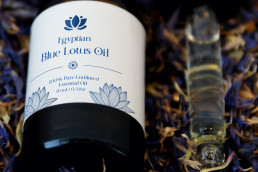
Blue lotus oil moon rituals sit at the crossroads of ancient Egyptian temple practice and modern contemplative ritual, and for good reason: the flower itself was sacred to lunar symbolism in its closing and opening with the cycle of night and day. This article is written for readers who keep a moon practice, whether casual or devoted, and who want to know exactly how to work with blue lotus oil (Nymphaea caerulea) across the new and full moon phases without falling into either superstition or flat scepticism. You will find dilutions, anointing points, pairing suggestions, and honest commentary on what the oil does and does not do for a ritual.
Table of Contents
- Why Blue Lotus and the Moon Belong Together
- What Blue Lotus Oil Actually Does in a Ritual Context
- New Moon Rituals: Intention and Receptivity
- Preparing the Space
- The Anointing Protocol
- Working with the Scent
- Full Moon Rituals: Illumination and Release
- A Different Atmosphere
- The Release Practice
- How to Use Blue Lotus Oil for Moon Rituals: A Summary Protocol
- What to Expect: Realistic Timeframes and Effects
- When Blue Lotus Oil Is Not the Right Choice
- Complementary Approaches for Deepening Moon Practice
- Frequently Asked Questions
- Where to Go From Here
- Begin Your Moon Practice
It is written and clinically reviewed by Antonio Breshears, ND, CCA, a Bastyr-trained naturopathic doctor and certified clinical aromatherapist. For the broader botanical and chemical context behind the oil used in these rituals, readers may find it useful to first skim The Complete Guide to Blue Lotus Oil, which covers extraction, chemistry, and safety in greater depth than this cluster can.
Why Blue Lotus and the Moon Belong Together
The association between Nymphaea caerulea and lunar cycles is not a modern marketing invention. In ancient Egyptian iconography, the blue lotus opens in the morning and closes at dusk, mirroring the daily rhythm of the sun, but its nocturnal resting state and watery habitat placed it equally in the domain of lunar deities and the goddess Nut, who arches across the night sky. The flower is depicted at banquets, funerary rites, and in temple scenes precisely because it was understood to bridge waking and dream, the visible and the hidden, solar clarity and lunar receptivity.
Whether or not one accepts this symbolism literally, the practical point is this: the oil has a genuine olfactory character that lends itself to contemplative, inward-turning work. Its scent profile (cooler floral-aquatic top, deep honeyed-floral heart, balsamic-smoky base) slows the breath, softens the face, and pulls attention inward in a way that pairs naturally with the reflective quality of moon rituals. This is not mystical claim-making. It is the reliable effect of a complex floral absolute on the olfactory-limbic pathway, which communicates directly with the parts of the brain that handle mood, memory, and autonomic tone.
What Blue Lotus Oil Actually Does in a Ritual Context
Before setting out protocols, it helps to name plainly what the oil contributes and what it does not. Blue lotus absolute contains small amounts of aporphine and nuciferine alkaloids along with flavonoids including apigenin, quercetin, and kaempferol. When the oil is inhaled, these compounds are not reaching the brain in pharmacologically significant concentrations in the way a tea or tincture might. What is reaching the brain, very directly, is olfactory information about a distinctive and chemically complex floral.
The effect on most people is a modest shift toward parasympathetic dominance: slightly slower breathing, softened shoulders, a mild downward-settling of attention. It is not a strong sedative. It will not override anxiety, grief, or distraction on its own. What it will do, reliably, is give the nervous system a consistent sensory cue that the current moment is set apart from ordinary time. This is the actual mechanism by which any ritual oil supports ritual: the scent becomes anchored to the ritual state through repetition, so that over weeks and months the smell alone begins to evoke the interior quality of the practice.
For moon rituals specifically, this matters. A new moon intention-setting practice benefits from a state of quiet receptivity. A full moon release practice benefits from a state of honest self-observation. The oil supports the entry into both states without determining their content.
New Moon Rituals: Intention and Receptivity
The new moon phase, traditionally, is a time for quiet seeding rather than dramatic declaration. The sky is dark. The lunar light that would normally illuminate the night is absent. In practice, this corresponds to a practice of listening inward before speaking outward, of asking what genuinely wants to take root before committing to a stated intention.
Preparing the Space
The setup for a new moon practice should be deliberately understated. One or two candles, a small vessel of water on the altar (a nod to the lotus’s aquatic origin), and the oil itself. Avoid overloading the space with competing scents. If you burn incense, do it before the ritual begins, not during, so that the blue lotus can register clearly on its own.
The Anointing Protocol
For a new moon ritual, a simple anointing blend is appropriate: one drop of blue lotus absolute in a teaspoon of jojoba or fractionated coconut oil, which comes to roughly a 1 percent dilution. From this, anoint three points:
- The centre of the forehead, lightly, using a single fingertip
- The hollow of the throat
- The inside of each wrist
As you anoint each point, pause for two breaths before moving to the next. This is not a ceremony of speed. The pace itself is part of the practice.
Working with the Scent
Once anointed, sit comfortably. Bring the wrist to the nose and inhale slowly through the nose for a count of four, hold briefly, exhale for a count of six. Repeat five or six times. The extended exhale is a simple but effective parasympathetic cue, and the scent reinforces it.
Now, and only now, turn toward intention. Rather than drafting a list of goals, ask a single question: what is genuinely asking to grow in this cycle? Write what comes without editing. Many practitioners find that what emerges at the new moon, with the oil as a sensory anchor, differs from what they would have written in ordinary daytime consciousness. This is the value of the practice.
Full Moon Rituals: Illumination and Release
If the new moon is seeding, the full moon is revelation. The sky is fully lit. What has been accumulating, often unconsciously, becomes visible. The traditional full moon practice is release: acknowledging what no longer serves and allowing it to leave with the waning light.
A Different Atmosphere
Full moon ritual spaces can carry a slightly different texture than new moon ones. Where the new moon invites stillness, the full moon can accommodate a touch more intensity: a little more candlelight, perhaps a window opened to the moon itself if the weather permits. Blue lotus oil suits both moods because its scent profile has both the quiet aquatic top note and the deeper balsamic base, so it reads differently depending on the emotional tone one brings to it.
The Anointing Protocol
For full moon work, a slightly richer blend is appropriate: two drops of blue lotus absolute in a teaspoon of jojoba, which comes to roughly 2 percent. Anoint:
- The centre of the forehead
- The centre of the sternum, over the heart space
- The base of the skull where it meets the neck
- The inside of each wrist
The addition of the heart point and the base-of-skull point is deliberate. Full moon release work tends to involve the chest (where much of the felt experience of grief, resentment, and attachment registers) and the base of the skull (where held tension tends to accumulate when we have been gripping something we are not yet ready to put down).
The Release Practice
Once anointed, sit with a piece of paper. Breathe with the oil for several minutes, following the same slow pattern as the new moon practice. Then write what you are ready to release. Not what you think you should release. What you are genuinely, honestly ready to let go of in this cycle. This distinction matters, and the oil’s effect of slowing the mind tends to make the honest answer more accessible than the performative one.
Some practitioners burn the paper afterwards. Some bury it. Some simply fold it and tuck it away. The disposal method matters less than the act of naming clearly.
How to Use Blue Lotus Oil for Moon Rituals: A Summary Protocol
For readers who want a compact reference, here is the essential protocol for both phases:
- New moon: 1 percent dilution (one drop per teaspoon of carrier), anoint forehead, throat, wrists. Practice intention-setting.
- Full moon: 2 percent dilution (two drops per teaspoon of carrier), anoint forehead, heart, base of skull, wrists. Practice release.
- Diffuser alternative: 2 to 3 drops in a diffuser, run for 20 minutes before and during the ritual.
- Breathing pattern: 4-count inhale, brief hold, 6-count exhale, for 5 to 6 cycles.
- Duration: 20 to 40 minutes is typical; longer is not necessarily better.
What to Expect: Realistic Timeframes and Effects
It would be dishonest to suggest that a single moon ritual with blue lotus oil produces a dramatic transformative experience. Most people, on their first attempt, notice a pleasant scent, a slight shift in breathing, and a mildly altered quality of attention. That is the truthful baseline.
What develops over time, across three to six lunar cycles of consistent practice, is more interesting. The scent becomes anchored to the ritual state. Picking up the bottle begins to produce, almost reflexively, the settling of attention that previously took ten minutes of breathing to access. This is classical associative conditioning, and it is the genuine mechanism by which scent-anchored ritual accumulates power. It is not magic. It is reliable neurobiology, and it works.
Expect, realistically:
- First ritual: pleasant but unremarkable; a subtle calming effect
- By the third cycle: the scent begins to evoke ritual state more quickly
- By the sixth cycle: the oil functions as a reliable anchor into contemplative attention
- Over longer periods: a genuine deepening of practice, though this depends far more on the practitioner than on the oil
When Blue Lotus Oil Is Not the Right Choice
There are situations where even a beautifully constructed moon ritual should not involve blue lotus oil, and it is worth naming them plainly. Pregnant and breastfeeding people should avoid the oil entirely, regardless of how gentle the application. Those taking dopaminergic medications, MAOIs, or substantial sedative medications should consult a prescriber before incorporating it into regular ritual practice, because the alkaloid content, while small, interacts with these pathways.
Those with significant floral allergies, particularly to water lilies or related plants, should patch test first: a single drop of the diluted blend on the inner forearm, left for 24 hours, to confirm no reaction before using on the face or heart space.
Children under the age of 12 should not be anointed with blue lotus oil as part of ritual practice. This is a conservative position, but it is the responsible one given the alkaloid profile and the absence of safety data in paediatric use.
Finally, if a ritual practice is being used to substitute for clinical care of depression, anxiety, trauma, or psychosis, no oil will supply what the practice cannot. Ritual supports a life. It does not replace treatment.
Complementary Approaches for Deepening Moon Practice
Blue lotus oil is one element of a moon ritual, not the whole of it. Readers who want to deepen the practice might consider a few complementary approaches that pair naturally with it.
Journalling consistency matters more than journalling elegance. A cheap notebook kept faithfully across twelve lunar cycles will teach you more about your own patterns than any amount of ritual theatre. The oil is the anchor; the writing is the record.
Paired oils can extend the profile. For new moon work, a drop of frankincense in the same carrier deepens the meditative quality without muddying the lotus note. For full moon release work, a drop of vetiver or sandalwood grounds the heavier emotional material that often surfaces.
Physical position matters. The practice benefits from a stable, upright seat rather than a reclined one. Reclining invites drowsiness; upright sitting keeps attention available.
Regularity over intensity. A twenty-minute practice done on every new and full moon for a year will produce more than a three-hour elaborate ritual done once and abandoned. The compounding effect of scent-anchored ritual depends entirely on repetition.
Frequently Asked Questions
Can I do blue lotus oil moon rituals if I do not practice any particular spiritual tradition?
Yes. The practice described here is structured around breathing, attention, and writing, with the oil as a sensory anchor. It does not require affiliation with any tradition. Many secular practitioners use lunar cycles simply as a reliable rhythm for self-reflection, and the oil supports the contemplative attention regardless of metaphysical framing.
How much oil should I use per ritual?
For anointing, one to two drops of absolute in a teaspoon of carrier oil is sufficient for a full session. For diffusing, two to three drops in the water reservoir. The oil is concentrated, and using more rarely produces better results; it typically produces a muddier scent profile and wastes product.
Is the absolute or the essential oil better for moon rituals?
The solvent-extracted absolute is the most widely available form and is well-suited to ritual use, with a fuller and more honeyed profile than steam distillation produces. A supercritical CO2 extract is also excellent if available. True steam-distilled essential oil is rare and tends to have a lighter scent character.
Can I wear blue lotus oil as a perfume outside of ritual?
Yes, at appropriate dilution (1 to 2 percent on skin). However, if you are building the scent as a ritual anchor, wearing it casually can dilute the association. Some practitioners reserve the oil exclusively for ritual use for this reason.
What if I miss a lunar cycle?
It does not undo previous work. Simply return to the practice at the next new or full moon. Ritual is resilient to interruption; the neural association reestablishes quickly on resumption.
Can I do a moon ritual during the day if the moon phase is technically during daylight hours in my timezone?
Yes. The exact hour of the lunar phase is less important than practising within a day or two of it. Many practitioners do new moon work in the morning and full moon work in the evening, regardless of the precise astronomical timing.
Does the oil work better under actual moonlight?
There is no pharmacological reason it would. That said, the quality of attention one brings to a ritual performed under direct moonlight tends to be different from one performed under electric light, and this difference matters for the practice itself.
Can I share anointing oil with a partner for joint moon rituals?
Yes, provided neither partner has skin sensitivities or contraindications. Joint practice can deepen both partners’ work, though it is worth each person having time for their own silent reflection within the shared ritual.
How long does a diluted anointing blend last?
A blend prepared in jojoba, which is technically a liquid wax rather than a true oil, will remain stable for six to twelve months if kept in a dark glass bottle away from heat and light. Fractionated coconut oil also keeps well. Avoid preparing blends in oils that oxidise quickly.
What is the difference between moon rituals and other seasonal rituals using the oil?
Moon rituals follow the 29.5-day lunar cycle and emphasise intention and release. Seasonal rituals, such as solstice or equinox practices, follow the solar year and tend to emphasise larger arcs of change. The oil suits both, and many practitioners integrate them.
Where to Go From Here
A moon practice with blue lotus oil is one of the more forgiving and quietly rewarding ritual structures available. It asks for twenty minutes roughly twice a month, a small bottle of oil, and the willingness to write honestly. Over time, it produces a more coherent relationship with one’s own cycles of wanting and releasing than most more elaborate practices manage. For readers who want to explore the chemistry and extraction methods that shape what the oil actually contains, The Complete Guide to Blue Lotus Oil is the best starting point. For those ready to begin their own practice, the next new moon is an excellent place to start.

Antonio Breshears
Antonio Breshears is a renowned expert in holistic medicine and beauty, with over 25 years of research experience dedicated to uncovering the secrets of nature's most powerful remedies. Holding a degree in Naturopathic Medicine, Antonio's passion for healing and well-being has driven him to explore the intricate connections between mind, body, and spirit.
Over the years, Antonio has become a respected authority in the field, helping countless individuals discover the transformative power of plant-based therapies, including essential oils, herbs, and natural supplements. He has authored numerous articles and publications, sharing his wealth of knowledge with a global audience seeking to improve their overall health and well-being.
Antonio's expertise extends to the realm of beauty, where he has developed innovative, all-natural skincare solutions that harness the potency of botanical ingredients. His formulations embody his deep understanding of the healing properties found in nature, providing holistic alternatives for those seeking a more balanced approach to self-care.
With his extensive background and dedication to the field, Antonio Breshears is a trusted voice and guiding light in the world of holistic medicine and beauty. Through his work at Pure Blue Lotus Oil, Antonio continues to inspire and educate, empowering others to unlock the true potential of nature's gifts for a healthier, more radiant life.