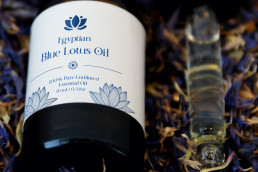
If you are shopping for blue lotus oil usa sources, the landscape looks larger than it actually is. Dozens of sites list the product, but only a handful sell genuine Nymphaea caerulea at credible strength and purity. This guide walks you through what is legal where, what quality markers to check, which red flags give away a diluted or synthetic product, and how to navigate the one US state (Louisiana) where the picture is genuinely complicated.
Table of Contents
- Is Blue Lotus Oil Legal in the USA?
- Federal Regulatory Status
- Why Most Blue Lotus Oil Sold in the USA Is Not What It Claims
- Category 1: Fragrance Oils Labelled as Blue Lotus
- Category 2: Heavily Diluted Absolutes
- Category 3: Adulterated or Blended Oils
- What Genuine Blue Lotus Oil Costs in the USA
- Quality Markers to Check Before You Buy
- 1. The Latin Name on the Label
- 2. Country of Origin
- 3. Extraction Method
- 4. Batch Information and Testing
- 5. Packaging
- 6. Return Policy and Customer Support
- Where to Actually Buy: Types of US Suppliers
- Specialist Aromatherapy Retailers
- Direct-From-Source Luxury Apothecaries
- Large Aromatherapy Brands
- Online Marketplaces (Amazon, Etsy, eBay)
- Local Health Food Stores and Metaphysical Shops
- Shipping, Customs, and Domestic Delivery
- What to Do When Your Bottle Arrives
- When Blue Lotus Oil Is Not the Right Purchase
- Frequently Asked Questions
- Where to Go From Here
- Trusted Blue Lotus Oil, Shipped in the USA
It is written and clinically reviewed by Antonio Breshears, ND, CCA, a Bastyr-trained naturopathic doctor and certified clinical aromatherapist. For broader context on chemistry, extraction methods, and how the oil is actually used, the complete guide to blue lotus oil is the natural companion piece to this buying guide.
Is Blue Lotus Oil Legal in the USA?
Yes, with one state-level exception. At the federal level, Nymphaea caerulea is not a controlled substance. It is not scheduled by the DEA, not restricted by the FDA as an import, and not flagged by US Customs for personal quantities. You can legally purchase, possess, and use blue lotus oil in 49 of 50 states without any special permit or medical authorisation.
The one exception is Louisiana. Under Louisiana State Act 159 (passed in 2005), Nymphaea caerulea is listed alongside a group of plants restricted for human consumption. The act does not make the plant illegal to own if you can demonstrate it is for ornamental, aesthetic, or decorative purposes, but it does prohibit sale, possession, or cultivation for the purpose of ingestion. In practice, this means that a Louisiana resident buying a luxury aromatherapy oil labelled for external use and olfactory enjoyment is in a grey zone rather than clearly prohibited territory. Most reputable vendors will still ship to Louisiana addresses for topical and diffuser use, but if you live in the state and want to be thorough, a quick consultation with a local attorney is the honest recommendation.
Outside Louisiana, no state restricts blue lotus oil. It is not on any state controlled substances list in California, New York, Texas, Florida, or anywhere else. You can buy it online, ship it domestically, and carry it across state lines without concern.
Federal Regulatory Status
The FDA does not approve essential oils as medicines, which is true for every aromatherapy product, not just blue lotus. What this means practically is that vendors cannot make disease-treatment claims (“cures anxiety”, “treats insomnia”), but the oil itself is entirely legal to sell as a cosmetic, fragrance, or aromatherapy product. Reputable suppliers word their marketing carefully for this reason, describing effects in terms of relaxation, mood support, and sensory experience rather than medical outcomes.
Why Most Blue Lotus Oil Sold in the USA Is Not What It Claims
This is the uncomfortable part of the buying guide. The US market for blue lotus oil is flooded with three categories of product that are not, strictly speaking, blue lotus oil at all. Understanding these categories before you spend money is the single most useful thing this article can give you.
Category 1: Fragrance Oils Labelled as Blue Lotus
Many products sold on Amazon, Etsy, and general wellness marketplaces under the name “blue lotus oil” are synthetic fragrance compositions, often made in laboratories from aroma chemicals designed to evoke a floral-aquatic scent. These are perfectly legal and perfectly useless for aromatherapy. They contain no Nymphaea caerulea. The giveaway is almost always price: if a 10 ml bottle costs less than about 30 USD, it is almost certainly fragrance oil.
Category 2: Heavily Diluted Absolutes
The second category is genuine blue lotus absolute that has been diluted, often to 5 percent or 10 percent, in a carrier like jojoba or fractionated coconut oil, and then sold at a price that would only make sense for the undiluted absolute. The dilution itself is not the problem; many vendors sell pre-diluted oils transparently and at fair prices. The problem is when the dilution is not disclosed and the buyer thinks they are paying for 10 ml of pure absolute. Always check the product description for dilution percentage. If it is not stated, assume it is either diluted or the vendor is not being fully transparent.
Category 3: Adulterated or Blended Oils
The third category is blue lotus absolute that has been stretched with cheaper florals like ylang ylang, jasmine sambac, or synthetic aroma compounds that mimic the honeyed-floral character. This is harder to detect without GC-MS testing, but the scent profile is a useful clue. Genuine blue lotus has a distinctive three-stage development: a cooler, slightly aquatic top note, then a deep honeyed-floral heart, then a balsamic-smoky base. If the oil smells simply “floral” without that evolution, or if it reminds you overwhelmingly of jasmine or ylang ylang, it is likely blended.
What Genuine Blue Lotus Oil Costs in the USA
Honest pricing is one of the clearest filters you can apply. Genuine blue lotus absolute requires 3,000 to 5,000 hand-picked flowers per gram of oil. That agricultural reality sets a price floor that no legitimate vendor can go below for long.
For pure, undiluted absolute in the USA, expect to pay roughly:
- 2 ml: 40 to 70 USD
- 5 ml: 90 to 160 USD
- 10 ml: 170 to 300 USD
- 30 ml: 450 to 800 USD
Prices below this range for undiluted absolute are a strong indicator that the product is either diluted without disclosure, adulterated, or synthetic. Prices substantially above this range are not necessarily fraudulent; premium suppliers with supercritical CO2 extraction, small-batch Egyptian sourcing, or certified organic status will price at the upper end of the market or a little beyond. But if you are seeing 10 ml bottles advertised at 20 USD, the arithmetic of flower-to-oil ratios tells you immediately that something is wrong.
Quality Markers to Check Before You Buy
When evaluating a US supplier, these are the indicators that genuinely matter, in rough order of importance.
1. The Latin Name on the Label
The product should be labelled Nymphaea caerulea (sometimes spelled coerulea). Not “blue lotus” alone, not “blue lily”, not “Nelumbo” (which is a different plant, the sacred or Indian lotus). If the Latin binomial is not printed on the bottle or in the product description, the vendor either does not know what they are selling or is hiding something.
2. Country of Origin
Authentic blue lotus is grown predominantly in Egypt, with some production in Thailand and Sri Lanka. Egyptian material is generally considered the reference standard for scent profile and alkaloid content. A vendor who cannot tell you where their flowers were grown is a vendor who is buying from a middleman and has not done their own sourcing.
3. Extraction Method
Three methods are used: solvent extraction (producing an absolute, by far the most common), steam distillation (producing a true essential oil, rare and very low-yielding), and supercritical CO2 extraction (premium, clean, relatively recent). Any of these can produce excellent oil. What matters is that the vendor states the method clearly. Vague phrases like “natural extraction” or “traditional methods” usually indicate the vendor does not actually know.
4. Batch Information and Testing
Premium suppliers can provide GC-MS (gas chromatography-mass spectrometry) reports for their batches on request. These reports show the chemical profile of the oil and are the closest thing to proof of authenticity available. You do not need to read the report yourself; the fact that the vendor can provide one is the signal. Vendors who refuse, deflect, or do not understand the request are not operating at a professional standard.
5. Packaging
Blue lotus oil should be sold in dark glass, almost always amber or cobalt blue. It should never be sold in plastic (which degrades the oil through leaching) or clear glass (which allows UV damage). The bottle should have a proper orifice reducer or dropper for controlled dispensing.
6. Return Policy and Customer Support
This sounds mundane but is revealing. Vendors confident in their product tend to have generous return policies and responsive support. Vendors selling questionable material tend to have strict no-return policies buried in the fine print.
Where to Actually Buy: Types of US Suppliers
Specialist Aromatherapy Retailers
Small, specialist aromatherapy companies that focus on therapeutic-grade oils are generally the best option for US buyers. These suppliers tend to have direct relationships with distillers in Egypt and elsewhere, carry proper documentation, and price in line with the agricultural reality of the product. They will not be the cheapest option, but they will be the most reliable.
Direct-From-Source Luxury Apothecaries
A smaller number of US-facing suppliers specialise specifically in blue lotus and related ritual or ceremonial botanicals. Because their entire business depends on this single product category, their sourcing tends to be more rigorous and their staff more knowledgeable. If you plan to use blue lotus oil regularly, building a relationship with a specialist supplier is worth the effort.
Large Aromatherapy Brands
Some of the better-known US essential oil brands carry blue lotus absolute. Quality is typically acceptable but not exceptional, and prices can be inflated by marketing overhead. The advantage is traceability and customer service; the disadvantage is that you are paying for the brand as much as for the oil.
Online Marketplaces (Amazon, Etsy, eBay)
Approach with genuine scepticism. There are legitimate sellers on these platforms, but they are heavily outnumbered by fragrance-oil resellers and adulterators taking advantage of the brand protection that marketplaces offer sellers. If you buy through a marketplace, apply every quality check in this article with extra care, and do not be swayed by high review counts; review manipulation on these platforms is a known and persistent problem.
Local Health Food Stores and Metaphysical Shops
Rare in the USA but occasionally present. Quality varies wildly. The advantage is that you can smell the oil before buying, which is genuinely useful once you know the authentic scent profile.
Shipping, Customs, and Domestic Delivery
Domestic shipping within the USA is straightforward. Blue lotus oil is not a restricted substance for USPS, UPS, or FedEx, and standard ground or air delivery works without issue. Most suppliers ship in padded packaging to protect the glass bottle, and reputable vendors offer tracked delivery as standard.
If you are buying from an international supplier shipping into the USA, customs processing is generally uneventful. Blue lotus oil is classified as a cosmetic or fragrance for import purposes, not as a botanical drug or controlled substance. You may see a brief customs delay on your tracking, but seizures are effectively unheard of for personal quantities.
The one practical consideration is temperature. Blue lotus absolute is relatively stable, but extreme heat during summer shipping can degrade the top notes. If you are ordering in July or August, either request expedited shipping or time your order for the evening delivery window.
What to Do When Your Bottle Arrives
When the oil arrives, do three quick checks before using it.
First, inspect the bottle. Dark glass, intact seal, clear labelling with Latin name and batch or lot number. Second, open and smell it at arm’s length first, not directly under your nose. Authentic blue lotus has a cool, slightly aquatic-floral top note that opens within a few seconds. If the first impression is overwhelmingly sweet, synthetic, or alcohol-sharp, that is a warning sign. Third, dab a very small amount on a cotton pad or tissue and let it develop for 20 to 30 minutes. Genuine absolute will shift through floral, honeyed, and finally balsamic-smoky phases. A one-note scent that stays identical throughout is almost always synthetic or heavily adulterated.
If anything about the oil seems wrong, contact the vendor promptly. Reputable suppliers will refund or replace without argument.
When Blue Lotus Oil Is Not the Right Purchase
Blue lotus oil is not a universal product, and there are people for whom buying it is simply not the right decision regardless of US availability.
Pregnant and breastfeeding women should avoid it; the alkaloid content has not been adequately studied in these populations and the conservative clinical position is avoidance. People taking dopaminergic medications (including some Parkinson’s treatments and certain antipsychotics) should consult their prescriber first, because the aporphine and nuciferine alkaloids interact with dopamine receptors. People on MAOIs or heavy sedatives should likewise check in with a clinician. Anyone expecting a strong psychoactive effect will be disappointed; the oil is relaxing and mood-softening, not intoxicating.
Louisiana residents should think carefully about whether the grey-zone legal status is acceptable for their circumstances before ordering.
Frequently Asked Questions
Is blue lotus oil legal in all 50 US states?
It is legal in 49 states with no restrictions. Louisiana has a specific state law (Act 159) restricting Nymphaea caerulea for human consumption, which creates a grey zone for topical and aromatherapy use. Elsewhere in the USA, no state or federal restrictions apply.
Can I buy blue lotus oil on Amazon?
You can, but the majority of listings are either synthetic fragrance oils or heavily diluted products sold at inflated prices. If you buy from Amazon, apply the quality checks in this guide rigorously: Latin name on the label, stated extraction method, credible pricing, and a vendor with a traceable presence outside the platform.
Why is blue lotus oil so expensive in the USA?
Because genuine absolute requires 3,000 to 5,000 flowers per gram of oil, and the flowers are hand-harvested in Egypt and surrounding countries at very short picking windows each morning. The price reflects the agricultural reality. A 10 ml bottle at 20 USD cannot possibly be authentic.
Do I need any kind of licence or permit to buy it?
No. In 49 states, blue lotus oil is a standard cosmetic or aromatherapy product with no age verification, permit, or prescription required. Louisiana is the only state where any complication exists.
Can I bring blue lotus oil on a domestic flight?
Yes, subject to standard TSA liquid rules. Bottles under 100 ml in your carry-on, or standard luggage rules for checked bags. It is not a restricted substance for air travel within the USA.
How can I tell if the blue lotus oil I bought is real?
Check the Latin name on the label (Nymphaea caerulea), price against the ranges in this guide, bottle material (dark glass), and perform the scent evolution test: authentic absolute develops through cool-floral, honeyed-floral, and balsamic-smoky phases over 20 to 30 minutes. For deeper certainty, request a GC-MS report from the supplier.
Should I buy diluted or undiluted blue lotus oil?
Both are legitimate products. Undiluted absolute is more concentrated and versatile but requires you to dilute it yourself before topical use (typically 1 to 3 percent in a carrier). Pre-diluted oils are ready to use but cost more per gram of actual blue lotus. The right choice depends on how you plan to use it and how comfortable you are with DIY dilution.
What is the best extraction method for US buyers?
Solvent-extracted absolute is the most widely available and produces a rich, traditional scent profile. Supercritical CO2 extraction is cleaner and more modern but commands a premium price. Steam-distilled blue lotus essential oil is rare, expensive, and has a lighter scent. For most US buyers, a high-quality Egyptian absolute is the sensible starting point.
Can I import blue lotus oil from Egypt directly?
Yes, personal-quantity imports clear US customs without issue. The practical question is whether the time, shipping cost, and language barrier are worth it compared to buying from a reputable US-facing supplier with Egyptian sourcing already in place.
How should I store my blue lotus oil after it arrives?
In its original dark glass bottle, tightly closed, in a cool dark cupboard away from temperature fluctuations. Properly stored, a genuine absolute maintains its quality for 3 to 4 years. Avoid refrigeration (which can cause the absolute to thicken and crystallise) and never leave the bottle in direct sunlight or near a heat source.
Where to Go From Here
Once you have identified a reputable US supplier and a bottle you trust, the next useful step is understanding how to actually use the oil well. The complete guide to blue lotus oil covers chemistry, extraction, dilution, and application methods in depth, and is the natural next read after this buying guide. For buyers outside the USA, the geographic guides cover the specific legal and practical landscape in the UK, Canada, Australia, and the EU, each of which has its own quirks worth knowing before you order.

Antonio Breshears
Antonio Breshears is a renowned expert in holistic medicine and beauty, with over 25 years of research experience dedicated to uncovering the secrets of nature's most powerful remedies. Holding a degree in Naturopathic Medicine, Antonio's passion for healing and well-being has driven him to explore the intricate connections between mind, body, and spirit.
Over the years, Antonio has become a respected authority in the field, helping countless individuals discover the transformative power of plant-based therapies, including essential oils, herbs, and natural supplements. He has authored numerous articles and publications, sharing his wealth of knowledge with a global audience seeking to improve their overall health and well-being.
Antonio's expertise extends to the realm of beauty, where he has developed innovative, all-natural skincare solutions that harness the potency of botanical ingredients. His formulations embody his deep understanding of the healing properties found in nature, providing holistic alternatives for those seeking a more balanced approach to self-care.
With his extensive background and dedication to the field, Antonio Breshears is a trusted voice and guiding light in the world of holistic medicine and beauty. Through his work at Pure Blue Lotus Oil, Antonio continues to inspire and educate, empowering others to unlock the true potential of nature's gifts for a healthier, more radiant life.