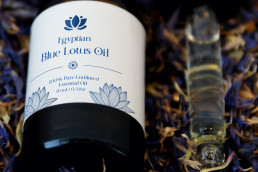
If you meditate seriously, whether you sit with the breath, practise mantra, work with visualisations, or simply try to drop below the surface chatter of a busy mind, the oil you diffuse or anoint matters more than most people realise. This article is for practitioners who want to choose the best blue lotus oil for meditation with their eyes open: what to look for on the label, what the chemistry actually does to the nervous system, how to use it during a sit, and which grades of oil are worth the money versus which are just perfumed marketing.
Table of Contents
- Why Blue Lotus Oil and Meditation Go Together
- What Makes an Oil Genuinely Suitable for Meditation
- Extraction Method
- Flower Count and Provenance
- Transparency on Carrier and Dilution
- Batch Testing
- The Chemistry That Matters for a Meditation Practice
- How to Use Blue Lotus Oil During Meditation
- Diffusion
- Anointing
- Aromatic Inhalation
- What to Expect: Realistic Timeframes
- When Blue Lotus Oil Is Not the Right Choice
- Complementary Approaches
- How to Shop for the Best Blue Lotus Oil for Meditation
- Frequently Asked Questions
- Where to Go From Here
- Oil Worthy of Your Practice
It is written and clinically reviewed by Antonio Breshears, ND, CCA, a Bastyr-trained naturopathic doctor and certified clinical aromatherapist. For a broader grounding in the plant, its chemistry, and its traditional uses, readers may want to begin with the complete guide to blue lotus oil, which covers the material this article assumes you already understand.
Why Blue Lotus Oil and Meditation Go Together
The pairing is not accidental. Nymphaea caerulea, the Egyptian blue water lily, appears in tomb paintings, funerary texts, and ritual vessels throughout dynastic Egypt, almost always in contexts that imply altered states: mortuary banquets, visionary encounters with the gods, the unfolding of the soul after death. The flower also features in Indian iconography as a throne or attribute of deities associated with inner awakening. Whether any of this reflects actual widespread ritual use or simply symbolic association is contested by scholars, but what is not contested is that the plant contains compounds that gently modulate the exact neural systems meditation works with.
In practical terms, a well-made blue lotus oil helps meditation in three ways that matter. It softens sympathetic arousal, the fight-or-flight tone that keeps the mind scanning for threats and the body braced. It occupies the olfactory-limbic pathway with a scent that the brain codes as safe, floral, and slightly narcotic, which anchors attention. And at sufficient dose, the trace alkaloids and flavonoids appear to produce a mild shift in the quality of awareness, described by long-term users as a kind of soft, warm receptivity rather than sedation. None of this is dramatic. Blue lotus is not ayahuasca and it is not a benzodiazepine. It is a subtle tool, which is precisely why it suits contemplative practice.
What Makes an Oil Genuinely Suitable for Meditation
The phrase “best blue lotus oil meditation” returns a great many products, and most of them fail one or more of the basic tests. Before spending money, work through the following criteria.
Extraction Method
There are three legitimate ways to produce blue lotus oil. Solvent extraction yields what is correctly called an absolute, the most common form on the market, and the form that carries the richest aromatic profile because delicate compounds survive the low-temperature process. Steam distillation produces a true essential oil but requires enormous quantities of flower material and is therefore rare and expensive. Supercritical CO2 extraction sits between the two, producing a clean, solvent-free extract with broad chemistry and a premium price.
For meditation purposes, any of the three can work, but the absolute tends to give the fullest olfactory experience and the CO2 extract tends to be cleanest. Avoid anything labelled simply “blue lotus fragrance oil” or “blue lotus blend”. These are almost invariably synthetic reconstructions suspended in cheap carrier, and they will do nothing for the nervous system beyond providing a pleasant smell.
Flower Count and Provenance
Between three thousand and five thousand flowers are needed to produce a single gram of absolute. This is not a marketing flourish, it is botanical reality. If a bottle is priced as though it were lavender or peppermint, something is wrong with the supply chain. Either the oil is adulterated with cheaper florals, cut with carrier without declaration, or not really blue lotus at all. Egyptian-grown *Nymphaea caerulea* remains the traditional benchmark and, in my clinical experience, tends to produce the most reliable results for meditation work.
Transparency on Carrier and Dilution
Many reputable suppliers sell blue lotus absolute pre-diluted in jojoba or fractionated coconut oil, typically at five or ten percent. This is perfectly legitimate and often more useful for topical application, but the label must say so clearly. If you pay for what you think is undiluted absolute and receive a ten percent dilution, you have paid ten times too much. Read the percentage, always.
Batch Testing
The best suppliers provide gas chromatography and mass spectrometry reports on request, which identify the actual aromatic compounds present. You do not need to be a chemist to read these. What you are looking for is a plausible profile of fatty acids, floral compounds, and detectable trace alkaloids. If a supplier cannot produce any testing documentation at all, consider that a reason to look elsewhere.
The Chemistry That Matters for a Meditation Practice
Understanding what the oil is doing under the hood helps you use it intelligently rather than superstitiously. Blue lotus contains two alkaloids of interest: aporphine, which acts as a weak agonist at dopamine receptors, and nuciferine, which acts as a weak antagonist at dopamine receptors and also shows activity at 5-HT2A and 5-HT2C serotonin receptors. The apparent contradiction of having both an agonist and an antagonist is part of why the plant produces a stabilising rather than stimulating or sedating effect. It nudges the system toward balance rather than pushing it in one direction.
On top of the alkaloid profile sits a flavonoid layer, principally apigenin, quercetin, and kaempferol. Apigenin binds at the central benzodiazepine receptor site, producing mild anxiolytic effects without the dependence or cognitive impairment associated with pharmaceutical benzodiazepines. Quercetin and kaempferol contribute anti-inflammatory and vasodilatory activity, which in practical terms means a softening of the physical tension many meditators carry in the face, jaw, and upper chest.
When inhaled, volatile aromatic compounds reach the olfactory bulb within seconds and project directly into the limbic system, bypassing the prefrontal cortex entirely. This is why scent affects mood and arousal faster than almost any other sensory input. A meditation-appropriate oil is one whose aromatic signature signals safety and depth to the limbic system without the stimulation of sharp citrus or the drowsiness of heavy sedatives. Blue lotus sits in exactly that window.
How to Use Blue Lotus Oil During Meditation
There are three applications that work well, and they can be used singly or in combination depending on the kind of practice you are doing.
Diffusion
The simplest and, for most people, the most useful approach. A cool-mist ultrasonic diffuser filled with filtered water takes two to four drops of blue lotus absolute, placed somewhere in the meditation room but not directly under the nose. Begin the diffuser five to ten minutes before you sit, so the scent has time to distribute evenly rather than arriving in waves. Run it for the duration of the sit, or set it to cycle on and off if you meditate for longer than forty-five minutes. Avoid diffusing the oil at high concentration for hours, as olfactory fatigue sets in quickly and the effect diminishes.
Anointing
A traditional approach and, in my view, a genuinely useful one. Dilute the absolute to two or three percent in jojoba or fractionated coconut oil (roughly two drops of absolute per teaspoon of carrier), and apply a small amount to the wrists, behind the ears, at the base of the throat, or to the centre of the forehead before sitting. The act of anointing itself becomes a transition ritual, a signal to the body that ordinary activity has ended and contemplative space has begun. Over weeks and months, the nervous system comes to associate the scent with practice, and the sit deepens more quickly as a result.
Aromatic Inhalation
For longer or more demanding sits, particularly silent retreats or extended vipassana-style practice, a drop of undiluted absolute on a personal inhaler stick or a dedicated handkerchief can be useful as a mid-sit reset. When attention drifts or dullness sets in, a slow breath from the inhaler re-anchors the limbic system without breaking posture or opening the eyes. Used sparingly, this is one of the more elegant applications.
What to Expect: Realistic Timeframes
Blue lotus is not pharmaceutical. It will not knock you into a trance state on first use, and any supplier suggesting otherwise is selling something other than what they claim. Realistic expectations look like this.
In the first few sits, most people notice a pleasant floral atmosphere and a mild softening of physical tension, particularly around the face and shoulders. The effect is subtle enough that sceptical practitioners often dismiss it. Over the first two to three weeks of regular use, conditioned response begins to build: the scent itself becomes a cue for parasympathetic activation, and the body begins to settle faster when the oil appears. This is where most of the benefit actually comes from. The oil does not do meditation for you, it reliably shortens the window between sitting down and actually being settled.
After a month or more of daily practice with the oil, many practitioners report a qualitative shift in the texture of their sits: a warmer, more receptive, less effortful quality. Whether this is due to the alkaloid and flavonoid profile acting cumulatively, to conditioned association, or to some combination of both is not entirely clear, but it is reasonably well-attested in the clinical aromatherapy literature and in my own client work.
What you should not expect is visionary content, psychedelic imagery, or profound altered states from the oil alone. These belong to different plants and different practices.
When Blue Lotus Oil Is Not the Right Choice
There are circumstances in which I would not recommend the oil for meditation, or for anything else.
Pregnancy and breastfeeding are clear contraindications. The plant’s alkaloid profile has not been adequately studied in these contexts and the prudent default is avoidance. Anyone taking dopaminergic medications for Parkinson’s disease, dopamine antagonists for psychiatric conditions, or MAOIs should discuss use with their prescriber before regular inhalation, as theoretical interaction exists even at aromatherapy doses. People with a known sensitivity to floral absolutes, or with reactive airway conditions aggravated by scent, should patch test and trial carefully before committing to daily use.
Legal status also matters. The plant is restricted in Russia, Poland, Latvia, and the US state of Louisiana, and the regulatory position in Australia is complicated. Check your jurisdiction.
Finally, if meditation itself is being used to bypass a clinical mental health issue that requires proper care, no oil will substitute for that care. Blue lotus can support a stable practitioner. It cannot do the work of a therapist, a psychiatrist, or a trauma specialist.
Complementary Approaches
The oil works best as one element within a coherent practice environment rather than as a standalone fix. A few things pair particularly well.
A consistent sit time trains circadian cues that reinforce whatever conditioning the oil builds. Twenty minutes at the same hour daily will outperform ninety minutes whenever you can manage it. A dedicated space, even if that space is only a folded blanket in a corner, gives the body and mind a spatial cue to match the olfactory one. Simple breath regulation, such as an extended exhalation for the first few minutes of the sit, amplifies parasympathetic engagement and synergises with the flavonoid activity of the oil.
For practitioners who enjoy layered aromatics, small amounts of frankincense (particularly *Boswellia carterii* or *sacra*) blend well with blue lotus without overwhelming it, as do trace amounts of sandalwood or vetiver for grounding. Avoid blending with anything sharp or stimulating, such as peppermint or rosemary, which will pull the nervous system in the opposite direction.
How to Shop for the Best Blue Lotus Oil for Meditation
Putting the criteria together, here is the short version of how I would shop if I were starting again.
Look for a named botanical (*Nymphaea caerulea*), a stated country of origin (Egypt is the traditional benchmark, though other sources exist), a clear extraction method (absolute, CO2, or steam-distilled), a declared dilution if any, and a supplier willing to share batch documentation. Price should reflect the three-to-five-thousand-flowers-per-gram reality. Packaging should be dark glass, ideally amber or cobalt, with a proper dropper or orifice reducer. The scent, when opened, should be complex and layered: a cooler floral-aquatic top, a deep honeyed-floral heart, and a balsamic, slightly smoky base. A flat, single-note sweetness suggests synthetic or heavily adulterated material.
Stored properly in a cool, dark place, a genuine blue lotus absolute will keep its aromatic integrity for three to four years, which is plenty of time for meditation use even if you sit daily.
Frequently Asked Questions
What is the single most important thing to look for when buying blue lotus oil for meditation?
Transparency. A supplier who names the extraction method, the botanical, the country of origin, and any dilution, and who can produce some form of batch testing on request, is almost always selling real material. A supplier who does none of these things almost always is not.
Is an absolute or an essential oil better for meditation?
Either can work. Absolutes carry a fuller aromatic profile because delicate compounds survive solvent extraction, while true steam-distilled essential oils are rarer and more expensive. For meditation purposes, a well-made absolute is typically the more practical choice.
How many drops should I diffuse during a sit?
Two to four drops in a standard ultrasonic diffuser is plenty. More is not better, and olfactory fatigue sets in quickly at higher concentrations.
Can I apply the oil directly to my skin before meditating?
Not neat. Dilute the absolute to two or three percent in a carrier such as jojoba or fractionated coconut oil, then apply to pulse points or the forehead. Neat application is unnecessary and can cause sensitisation over time.
Will blue lotus oil make me sleepy during meditation?
Generally no. It is not a strong sedative. What it tends to produce is a soft, alert receptivity rather than drowsiness, which is why it suits contemplative practice rather than bedtime, though some users do find it mildly drowsy at higher doses.
How long does it take to notice an effect on my practice?
Most people notice a mild calming effect immediately. The larger benefit, where the scent becomes a conditioned cue for parasympathetic settling, builds over two to three weeks of daily use.
Can I combine blue lotus oil with other meditation oils?
Yes, carefully. Frankincense, sandalwood, and vetiver all complement blue lotus without overwhelming its character. Avoid stimulating oils such as peppermint or rosemary during practice.
Is blue lotus oil safe to use daily?
For most healthy adults, yes, at typical aromatherapy doses. Pregnancy, breastfeeding, and certain medication regimens are exceptions, and anyone with reactive airways should patch test and trial gradually.
Why is genuine blue lotus oil so expensive?
Because three to five thousand flowers are required to produce a single gram of absolute. If a product is priced like an ordinary essential oil, it is almost certainly not the real material.
Does blue lotus oil produce visions or psychedelic effects?
No. The oil is a subtle nervous-system modulator, not a visionary compound. Claims of dramatic altered states from aromatic use alone are marketing, not pharmacology.
Where to Go From Here
If you have arrived at this article because you were shopping for a meditation oil and wanted to avoid wasting money on something synthetic or adulterated, the short version is this: read the label carefully, pay what the botany requires, and choose a supplier who is willing to show their work. If you want a fuller picture of the plant, its chemistry, and its wider uses beyond the meditation cushion, the complete guide to blue lotus oil is the best place to continue reading.

Antonio Breshears
Antonio Breshears is a renowned expert in holistic medicine and beauty, with over 25 years of research experience dedicated to uncovering the secrets of nature's most powerful remedies. Holding a degree in Naturopathic Medicine, Antonio's passion for healing and well-being has driven him to explore the intricate connections between mind, body, and spirit.
Over the years, Antonio has become a respected authority in the field, helping countless individuals discover the transformative power of plant-based therapies, including essential oils, herbs, and natural supplements. He has authored numerous articles and publications, sharing his wealth of knowledge with a global audience seeking to improve their overall health and well-being.
Antonio's expertise extends to the realm of beauty, where he has developed innovative, all-natural skincare solutions that harness the potency of botanical ingredients. His formulations embody his deep understanding of the healing properties found in nature, providing holistic alternatives for those seeking a more balanced approach to self-care.
With his extensive background and dedication to the field, Antonio Breshears is a trusted voice and guiding light in the world of holistic medicine and beauty. Through his work at Pure Blue Lotus Oil, Antonio continues to inspire and educate, empowering others to unlock the true potential of nature's gifts for a healthier, more radiant life.