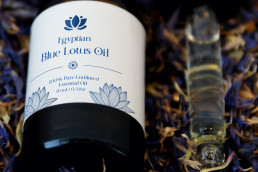
Blue lotus oil is rarely used neat. It is a precious, concentrated material, usually an absolute, and its real character tends to emerge when it is diluted into a well-chosen carrier or thoughtfully partnered with other aromatics. The question most readers arrive with is not whether to blend it but how: which oils complement the honeyed, balsamic, faintly smoky personality of Nymphaea caerulea, which ratios actually work on the skin and in a diffuser, and how to adapt a base formula for sleep, for mood, for sensual use, or for skincare. This pillar is the frame for all of that.
Table of Contents
- How Blue Lotus Oil Behaves In A Blend
- Four Ways Blue Lotus Oil Works In Formulations
- Applications: What To Blend For
- Sleep And Night-Time Blends
- Mood, Anxiety, And Emotional Support
- Sensual And Intimate Blends
- Meditation And Spiritual Practice
- Facial Oils And Serums
- Body Oils, Balms, And Massage Blends
- Bath Blends And Shower Steamers
- Perfumery And Solid Scents
- Hair And Scalp Blends
- Diffuser And Room Blends
- Matching Blends To Your Use Case
- How To Build A Blue Lotus Blend From Scratch
- Realistic Timeframes
- What Blue Lotus Oil Blends Do Not Do
- Carriers, Dilutions, And Format Standards
- Safety Considerations For Blending
- Storage And Shelf Life Of Blends
- Frequently Asked Questions
- Where To Go From Here
- Final Thoughts
- Start With An Oil Worth Blending
It is written and clinically reviewed by Antonio Breshears, ND, CCA, a Bastyr-trained naturopathic doctor and certified clinical aromatherapist. For foundational context on the oil itself, its chemistry, and its history, please begin with our complete guide to blue lotus oil; the recipes and formulations in this pillar assume that baseline understanding and build on it.
How Blue Lotus Oil Behaves In A Blend
Before reaching for a recipe, it helps to understand what blue lotus brings to a formulation. Chemically, a good Egyptian absolute contains a tangle of aromatic molecules, fatty esters and waxes, plus trace alkaloids such as aporphine and nuciferine and flavonoids including apigenin, quercetin, and kaempferol. Perfumery-wise, it sits as a heart-to-base material: not a lifting top note, not a dense fixative, but a floral heart that anchors and rounds whatever sits above it.
In practical blending terms, this means three things. First, blue lotus tends to soften and humanise sharper materials: citrus peels, bright herbs, green florals. Second, it pairs gracefully with other heart and base notes that share its honeyed-balsamic axis, rose absolute, jasmine sambac, sandalwood, vetiver, frankincense, without being overpowered. Third, because it is expensive and potent, it is almost always used at low percentages: a fraction of a percent in perfume accords, one to two percent of the essential oil portion of a skincare blend, rarely more than a couple of drops in a diffuser. A little genuinely goes a long way.
Blending blue lotus is therefore less about volume and more about placement. You are not pouring it in; you are positioning it carefully so that its particular character, that cool, watery floral opening that melts into honey and warm wood, does the work it is best at.
Four Ways Blue Lotus Oil Works In Formulations
Across the cluster articles linked below, four mechanisms recur. Understanding them makes formulation choices easier.
The first is olfactory-limbic: the scent itself, inhaled, reaches the limbic system rapidly via the olfactory pathway and modulates mood, autonomic tone, and arousal. This is why diffuser blends, roll-ons worn at the pulse points, and pillow mists can shift how the nervous system sits without any transdermal effect.
The second is topical-skincare: the waxes, esters, and flavonoids in the absolute contribute mild antioxidant and soothing behaviour when delivered in a well-formulated oil or balm. This is modest rather than dramatic; blue lotus is a supportive, comforting ingredient, not a replacement for a retinoid or a serious hydrator.
The third is sensory-ritual: the act of anointing, massaging, bathing, or misting is itself therapeutic. The oil provides the olfactory cue that signals the brain to shift states, whether that is from work into rest, from distraction into intimacy, or from agitation into calm.
The fourth, more speculative and honestly acknowledged, is mild neuroactive influence via the trace alkaloids when the oil is inhaled over time. The evidence here is suggestive rather than settled, and this pillar treats it as a gentle bonus rather than the main event.
Applications: What To Blend For
This pillar acts as the hub for a series of cluster articles, each covering a specific application. Below is a brief tour of each area with a pointer to the dedicated guide.
Sleep And Night-Time Blends
The most requested category. Blue lotus partners beautifully with lavender, Roman chamomile, sandalwood, vetiver, and frankincense for evening rituals. A pillow mist at around one percent in an alcohol-water base, a roll-on at two percent on the wrists and chest, or a diffuser blend of two drops blue lotus with three of lavender and one of vetiver will give most people a gentle nudge toward parasympathetic dominance. It is not a sedative; it is a cue. See our dedicated sleep blends article for full recipes and troubleshooting.
Mood, Anxiety, And Emotional Support
For daytime anxiety, blue lotus pairs with bergamot, neroli, and petitgrain, bright citrus and small-leaf materials that lift without stimulating. For low mood, it works with rose, geranium, and a touch of ylang ylang. These are not pharmaceutical interventions; they are atmosphere, context, and self-soothing ritual that can meaningfully change the texture of a difficult day. See the emotional support cluster for specific inhaler and roll-on formulas.
Sensual And Intimate Blends
Blue lotus has a long association with eros, earned partly through history and partly through its warm, faintly animalic heart. For intimate blends it combines with jasmine sambac, rose, sandalwood, and a restrained trace of vetiver or patchouli. These live in body oils at two to three percent total essential oil, in solid perfumes at higher percentages, and in massage bases made with jojoba or fractionated coconut. See our sensual blends cluster for full recipes, safety notes, and which materials to avoid near mucosa.
Meditation And Spiritual Practice
For contemplative use, blue lotus joins frankincense, myrrh, sandalwood, and occasionally cedarwood. These are quieter, resinous, grounding blends intended for diffusion during practice or anointing at the brow and throat before sitting. The character is closer to incense than perfume. See the meditation blends cluster for traditional-style and modern minimalist formulas.
Facial Oils And Serums
In skincare, blue lotus at one to two percent of the essential oil portion, diluted into a carrier such as jojoba, squalane, or rosehip, contributes antioxidant support and a beautifully comforting scent. It pairs with rose, helichrysum, and frankincense for mature skin, and with Roman chamomile and sandalwood for sensitive skin. See the facial oils cluster for complete serum recipes calibrated to skin type.
Body Oils, Balms, And Massage Blends
At two to three percent, blue lotus anchors body oils intended for after-bath use, post-workout wind-down, or massage. It combines well with lavender, sandalwood, bergamot, and clary sage in this register. The carrier matters: sweet almond and jojoba give a lighter feel, whereas a balm base with beeswax and shea produces a slower, more occlusive finish. See the body oils and balms cluster for format-specific recipes.
Bath Blends And Shower Steamers
Blue lotus does not dissolve in water and should never be dropped directly into a bath. Properly blended into a dispersant, polysorbate 20, a full-fat milk, a bath oil with castile, or incorporated into a bath salt with a carrier, it produces a softly fragrant soak. Shower steamers and aromatic cloths offer a lower-cost alternative. See the bath blends cluster for safe, effective methods.
Perfumery And Solid Scents
As a perfumery ingredient, blue lotus absolute is extraordinary: a heart note that reads as water, honey, and warm resin in turn. In alcohol-based perfume it sits at around one to three percent of the total fragrance oil load, partnered with citrus and herb tops and sandalwood or vetiver bases. In solid perfume formats, built on jojoba and beeswax, the percentages can be slightly higher because evaporation is slower. See the perfumery cluster for accord construction and full formulas.
Hair And Scalp Blends
For hair, blue lotus joins rosemary, lavender, and cedarwood in scalp oils, and partners with ylang ylang and sandalwood in lengths-and-ends finishing oils. The use case is comfort, scent, and a modest circulatory nudge from partner oils, rather than dramatic growth claims. See the hair cluster for pre-wash, scalp, and finishing formulas.
Diffuser And Room Blends
Ultrasonic diffusers are the simplest entry point. Two to four total drops in a standard diffuser, distributed across two or three oils, is plenty. Blue lotus in a diffuser reads best when paired with one brighter oil and one grounding one: for example, one drop blue lotus, two drops bergamot, one drop sandalwood. See the diffuser blends cluster for morning, afternoon, evening, and bedroom formulations.
Matching Blends To Your Use Case
The quickest way to choose a starting formula is to clarify what you actually want the blend to do, and then match the intention to a format and a partner palette.
If the goal is state change within ten minutes, say, arriving home stressed and wanting to decompress, reach for inhalation: a personal inhaler, a diffuser blend, or a pulse-point roll-on. Here, the partners should be fast, familiar, and emotionally legible: lavender, bergamot, neroli, frankincense.
If the goal is slow, cumulative support across weeks, for example skin comfort or a nightly sleep ritual, reach for topicals: facial oils, body oils, balms. Here, the partners should be skin-friendly, low in irritation risk, and chosen for the skin type as much as the scent: rose, chamomile, sandalwood, helichrysum.
If the goal is atmosphere and context, a dinner, a meditation, a bath, a shared intimate evening, reach for diffusion, misting, and anointing rituals. The partners here can be more adventurous because you are building a scene rather than treating a symptom: jasmine, vetiver, patchouli, frankincense, clary sage.
If the goal is personal fragrance, reach for perfumery formats and commit to a full accord rather than a one-note dilution. Blue lotus is wasted as a solo; it shines when given company at the top and bottom of the pyramid.
How To Build A Blue Lotus Blend From Scratch
A reliable way to build a blend, rather than chasing recipes, is to follow a simple sequence.
Begin with the intention in one clear sentence: “A pre-sleep roll-on that helps me settle in ten minutes.” Choose the format next: roll-on, so a 10ml bottle with jojoba carrier at around three percent total essential oil, which is roughly six drops of essential oil in a 10ml bottle.
Then choose a lead partner that carries most of the functional work. For sleep, lavender. For mood, bergamot. For skin, rose or chamomile. This partner typically occupies fifty to sixty percent of the essential oil portion.
Add blue lotus as the heart, usually twenty to thirty percent of the essential oil portion, which means one to two drops in a six-drop roll-on. This is where beginners over-reach; less is genuinely more.
Finish with a base or grounding note such as sandalwood, vetiver, or frankincense at ten to twenty percent, one drop in the same roll-on, to anchor the blend and extend its longevity on the skin.
Let the blend rest for at least twenty-four hours before judging it. Essential oil blends mature; what smells disjointed on day one often reads as coherent on day three.
Realistic Timeframes
Different formats produce different onset curves, and knowing this in advance prevents disappointment.
Inhalation formats, diffusers, personal inhalers, pillow mists, pulse-point roll-ons, act within minutes. The olfactory-limbic pathway is fast. If a diffuser blend does not shift your mood or arousal within ten to fifteen minutes of steady inhalation, the recipe probably needs adjustment rather than more time.
Topical formats for skincare work over weeks. A facial oil with blue lotus is not a rapid active; it is a supportive, comforting layer that contributes to overall skin mood. Give a new facial oil at least four to six weeks of consistent nightly use before judging its contribution.
Ritual formats, bath blends, anointing oils, meditation diffusions, are immediate in their atmospheric effect but cumulative in their psychological one. The reliable benefit is that your nervous system learns to associate that scent with a particular state, so that over weeks the blend itself becomes a cue.
What Blue Lotus Oil Blends Do Not Do
Honesty is easier than managing disappointment later. Here is what blue lotus blends will not do, whatever the recipe.
They will not sedate you into sleep. Blue lotus is a gentle nudge toward rest, not a pharmaceutical sedative. People with significant insomnia need proper assessment and a more comprehensive plan.
They will not cure anxiety disorders or depression. These are real conditions that deserve real care. A well-made roll-on is a helpful companion, not a treatment.
They will not function as a contraceptive, an aphrodisiac in the pharmacological sense, or a reliable libido drug. Sensual blends create atmosphere and increase sensory engagement; they do not bypass underlying physical or relational issues.
They will not resolve moderate or severe skin conditions. Active acne, rosacea flares, eczema, and significant pigmentation require targeted treatment. A blue lotus facial oil can sit alongside that care; it cannot replace it.
They will not make a bad-quality oil smell good. If your blue lotus is adulterated or rancid, no blending partner will fix it. Start with honest material.
They will not last indefinitely. Finished blends have shorter shelf lives than their component oils. Most topical blends are best used within six to twelve months of mixing.
Carriers, Dilutions, And Format Standards
A short, reliable reference, because most formulation mistakes are dilution mistakes.
- Facial oils and serums: one to two percent total essential oil in a carrier such as jojoba, squalane, or rosehip.
- Body oils: two to three percent total essential oil in sweet almond, jojoba, or fractionated coconut.
- Roll-ons and targeted blends: three percent total essential oil, typically six drops of essential oil per 10ml of carrier.
- Balms: one to three percent total essential oil in a beeswax-butter-oil base.
- Alcohol perfumes: fifteen to twenty-five percent fragrance oil load in perfumer’s alcohol for eau de parfum strength, with blue lotus as one to three percent of the total formula.
- Bath blends: four to six drops total essential oil per bath, always predispersed in a carrier, never dropped directly into the water.
- Diffusers: two to four total drops per diffuser fill.
Choose carriers by feel and skin type. Jojoba is a universal safe default. Squalane suits oilier or reactive skin. Rosehip is rich in fatty acids and suits mature skin. Sweet almond is lovely for body work but can sensitise some people over time. Fractionated coconut is light, stable, and nearly odourless, useful when you want the aromatic blend to dominate.
Safety Considerations For Blending
Blue lotus oil is well tolerated when used within normal aromatherapy guidelines, but a few category-level safety points are worth noting.
Always patch test a new topical blend on the inner forearm for twenty-four hours before wider use, especially for facial oils and anything intended for sensitive areas.
Avoid use during pregnancy and breastfeeding. This applies to blue lotus and to several of its common blending partners, clary sage, rosemary, and jasmine among them, so pregnancy-safe formulation is a separate discipline and not the default.
Be cautious if you take dopaminergic medications, MAOIs, or heavy sedatives; speak with a qualified prescriber before regular use. Inhalation at normal aromatherapy doses is unlikely to produce meaningful interactions, but the honest position is to check rather than assume.
Keep finished blends away from direct sunlight and heat. Amber or cobalt glass, a cool cupboard, and tight caps will extend the life of a well-made blend considerably. Citrus oils in particular oxidise quickly and can carry phototoxicity risk if applied to skin exposed to UV; follow the guidance in the relevant cluster articles for bergamot and similar oils.
Never use essential oils neat on children’s skin, on broken skin, or near the eyes and mucous membranes. Intimate blends require special attention to partners and dilution; the dedicated cluster article covers this in detail.
Storage And Shelf Life Of Blends
A finished blend lives a shorter life than its ingredients. The moment you combine materials with different oxidation rates, you begin a clock. Most topical blends in carrier oils are best within six to twelve months; alcohol-based perfumes and solid perfumes tend to last longer, often a year or two. Water-containing products such as mists and toners need either a proper preservative or very small batches with quick turnover, because microbial risk is real once water enters the formula.
Store everything in dark glass, tightly capped, in a cool, dark cupboard. Label each bottle with the date, the formula, and the dilution. This single habit, writing it down, will save you more frustration than any exotic ingredient.
Frequently Asked Questions
How many drops of blue lotus oil should go into a blend?
As a rule of thumb, blue lotus usually sits at twenty to thirty percent of the essential oil portion of a blend. In a typical 10ml roll-on at three percent total essential oil, that is one to two drops of blue lotus with four to five drops of partner oils. In a diffuser, one to two drops is almost always enough.
What oils does blue lotus blend best with?
Lavender, Roman chamomile, bergamot, neroli, rose, jasmine sambac, sandalwood, vetiver, frankincense, and ylang ylang are the reliable partners. For brighter lifts, add petitgrain or bergamot; for deeper grounding, sandalwood or vetiver; for floral richness, rose or jasmine.
Can I use blue lotus oil neat on the skin?
It is generally not recommended. Blue lotus absolute is concentrated and expensive; diluting it into a carrier both stretches the material and significantly reduces the risk of irritation. A one to three percent dilution is the normal starting point for most topical uses.
What carrier oil works best with blue lotus?
Jojoba is the universal default: stable, long-lasting, and suited to most skin types. Squalane is a good choice for reactive or oilier skin; rosehip for mature skin; fractionated coconut for a neutral, light-feeling body oil.
How do I make a simple pre-sleep blend?
In a 10ml roll-on with jojoba, add two drops blue lotus, three drops lavender, and one drop vetiver. Let it rest for twenty-four hours, then roll onto the wrists, behind the ears, and over the sternum about thirty minutes before bed.
Can blue lotus go in a bath?
Yes, but it must be predispersed, never dropped directly into the water. Stir four to six drops total essential oil into a tablespoon of full-fat milk, an unscented bath oil, or a dispersant such as polysorbate 20, and then add the mixture to a full bath.
How long does a homemade blue lotus blend last?
Most topical blends in carrier oil are best used within six to twelve months. Alcohol and solid perfumes last longer, often one to two years. Keep everything in dark glass, tightly capped, away from heat and light, and label with the date of blending.
Is blue lotus safe to blend with during pregnancy?
No. Blue lotus is best avoided during pregnancy and breastfeeding, and several common blending partners are also restricted in pregnancy. Pregnancy-safe aromatherapy is a separate discipline; consult a qualified aromatherapist for appropriate alternatives.
Can I blend blue lotus with CBD oil?
You can add a suitable CBD extract into a carrier oil base and then add blue lotus and partner essential oils within the standard dilution ranges. Keep total essential oil load within the guidelines above; CBD is a separate active and does not count toward the essential oil percentage.
Why does my blend smell different after a few days?
Essential oil blends mature. Top notes settle, heart and base notes integrate, and the overall profile usually becomes more coherent over three to seven days. Judge a blend at a week rather than on the day you mix it.
Can I use blue lotus in a candle?
Blue lotus absolute is expensive for candle use and some of its more delicate aromatic components degrade at burning temperatures. If you wish to try, use it at the low end of the recommended fragrance load for your wax and expect a softer, more muted throw than a synthetic equivalent.
How do I know if my blue lotus oil is good enough to blend with?
A genuine Egyptian blue lotus absolute opens with a cool, faintly watery floral note, deepens into warm honey and wood, and finishes with a light balsamic-smoky trace. It should not smell sharp, chemical, or one-dimensional. If it does, no blending partner will rescue it; source better material before formulating.
Where To Go From Here
This pillar is the map; the cluster articles are the territory. If you came looking for a sleep blend, head to the sleep blends article. If you are thinking about a signature personal scent, the perfumery cluster is the right place to start. For skincare, the facial oils and body oils articles cover the specifics in depth. Regardless of where you begin, the principles on this page apply: match the format to the intention, keep blue lotus at a modest percentage of the essential oil portion, choose partners with care, dilute honestly, store properly, and let the finished blend rest before you judge it. Everything downstream of that is refinement.
Final Thoughts
Good blending with blue lotus rewards patience and restraint more than ambition. The oil does its most interesting work when it is given room to breathe inside a thoughtful accord, used at a modest percentage, paired with partners that share its sensibility, and allowed a few days to settle before being judged. Treat each blend you make as a small experiment, label it honestly, note how it behaves over the first week, and keep a simple record of what worked and what did not. Over a few months this practice, more than any single recipe, is what builds a personal library of formulas that actually earn their place in your daily rituals. Start with one intention, build one blend well, and let the rest follow from there.

Antonio Breshears
Antonio Breshears is a renowned expert in holistic medicine and beauty, with over 25 years of research experience dedicated to uncovering the secrets of nature's most powerful remedies. Holding a degree in Naturopathic Medicine, Antonio's passion for healing and well-being has driven him to explore the intricate connections between mind, body, and spirit.
Over the years, Antonio has become a respected authority in the field, helping countless individuals discover the transformative power of plant-based therapies, including essential oils, herbs, and natural supplements. He has authored numerous articles and publications, sharing his wealth of knowledge with a global audience seeking to improve their overall health and well-being.
Antonio's expertise extends to the realm of beauty, where he has developed innovative, all-natural skincare solutions that harness the potency of botanical ingredients. His formulations embody his deep understanding of the healing properties found in nature, providing holistic alternatives for those seeking a more balanced approach to self-care.
With his extensive background and dedication to the field, Antonio Breshears is a trusted voice and guiding light in the world of holistic medicine and beauty. Through his work at Pure Blue Lotus Oil, Antonio continues to inspire and educate, empowering others to unlock the true potential of nature's gifts for a healthier, more radiant life.