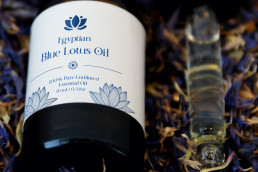
Blue lotus oil occupies an unusual place in a practitioner’s shelf. It is not a workhorse like lavender or frankincense, it is not a pharmacological heavyweight, and it is not a cheap material you can fold into every blend without thinking. It is a specialist note: expensive, low-dose, emotionally resonant, and genuinely useful for a narrow but meaningful range of clinical and therapeutic contexts. This pillar sets out how naturopaths, clinical aromatherapists, massage therapists, bodyworkers, cosmetic formulators, yoga and meditation teachers, and ceremony facilitators can use Nymphaea caerulea responsibly, sourcing it well, dosing it honestly, and positioning it within a broader therapeutic framework rather than overselling it.
Table of Contents
- How Blue Lotus Oil Works in a Clinical or Therapeutic Setting
- Clinical and Professional Applications
- Naturopathic and Integrative Medical Practice
- Clinical and Holistic Aromatherapy
- Massage Therapy and Bodywork
- Yoga, Meditation, and Breathwork Teachers
- Ceremony, Ritual, and Facilitated Inner Work
- Cosmetic and Skincare Formulation
- Spa, Wellness, and Hospitality Programmes
- Counsellors, Psychotherapists, and Trauma-Informed Practitioners
- Wholesale and Supply Chain Considerations
- Matching the Material to Your Practice
- How to Use Blue Lotus Oil in Professional Settings
- Realistic Timeframes and What to Expect
- What Blue Lotus Oil Does Not Do in Professional Practice
- Safety and Contraindications for Clinical Use
- Building Blue Lotus Into a Treatment Menu or Product Line
- Documentation, Ethics, and Professional Standards
- Frequently Asked Questions
- Where to Go From Here
- Professional-Grade Blue Lotus, Sourced Transparently
It is written and clinically reviewed by Antonio Breshears, ND, CCA, a Bastyr-trained naturopathic doctor and certified clinical aromatherapist. For readers who want the foundational material on the oil itself, its chemistry, history, and scent profile, the complete guide to blue lotus oil is the parent resource and sits above this practitioner-facing pillar.
How Blue Lotus Oil Works in a Clinical or Therapeutic Setting
To use blue lotus oil well in practice, you have to understand what it is actually doing, and what it is not. The oil contains a small suite of aporphine-type alkaloids (aporphine itself and nuciferine), both of which show mild dopaminergic and serotonergic activity in pharmacological studies. Alongside these sit flavonoids including apigenin, quercetin, and kaempferol, with apigenin having reasonably well-attested binding at central benzodiazepine sites. None of this makes the oil a sedative in the pharmacological sense; the volatile fraction that reaches the nose through inhalation or the skin through topical application is small, and the clinical effect you see is usually subtler and more relational than drug-like.
In practice, three mechanisms matter for therapeutic work. First, olfactory-limbic signalling: the aroma travels directly to the amygdala, hippocampus, and orbitofrontal cortex, which is why blue lotus reliably shifts state within a breath or two for many clients. Second, parasympathetic priming through slow, deep inhalation of a pleasant aromatic: the breath pattern does as much work as the molecule, and the oil simply makes the breath pattern more likely. Third, a cultural and associative layer, because blue lotus carries ceremonial and mythological weight that many clients bring into the room with them, and that association is therapeutically real even if it is not strictly pharmacological.
The practical upshot: blue lotus oil is a state-shifter, a scent anchor, and a signature note. It is modestly effective as a standalone anxiolytic or mood support, and it is considerably more useful when it is layered into a broader treatment plan, be that bodywork, meditation facilitation, counselling, ceremony, or cosmetic formulation.
Clinical and Professional Applications
The category of practitioner and wholesale use is broad, and different professions will approach the oil in different ways. What follows is an application map: each subsection sets out the typical use pattern, the honest limits, and the questions practitioners should ask before committing to this material in a clinical or commercial context.
Naturopathic and Integrative Medical Practice
For naturopathic doctors, functional medicine clinicians, and integrative practitioners working with anxiety, sleep-onset difficulty, trauma-adjacent presentations, and mild mood regulation, blue lotus oil is a useful adjunct rather than a primary intervention. It will not replace adaptogens, amino acid precursors, CBT-based referrals, or medication where those are clinically indicated. It can, however, function as a daily scent anchor for a patient learning to down-regulate before bed, as a grounding aid in session for clients who struggle with embodied presence, and as a standing recommendation for a home ritual that supports parasympathetic tone. Treat it as you would a gentle botanical tea: a small, reliable, low-risk input that earns its place through consistency rather than potency.
Clinical and Holistic Aromatherapy
For certified aromatherapists, blue lotus is a specialist oil rather than a daily utility. Its cost, restricted availability, and low-dose profile make it inappropriate for every blend, but for targeted work (grief processing, pre-sleep protocols, emotional integration following somatic release) it is genuinely useful at one to three percent in a carefully constructed formulation. It layers beautifully over sandalwood, Roman chamomile, frankincense, and vetiver, and it can lift or deepen rose and jasmine blends. The honest caveat is that most “blue lotus aromatherapy” you will see online is either adulterated material or a fragrance accord labelled as the real thing, so supply chain scrutiny is the first professional skill required.
Massage Therapy and Bodywork
Bodyworkers typically use blue lotus in one of two ways: as a pre-session scent ritual on a tissue or steam bowl to set the tone of the room, or as a very low-percentage addition (around 0.5 to 1 percent) to a carrier blend for finishing strokes and chest, neck, and décolletage work. It is rarely used as a full-body massage oil because the cost is prohibitive and because the scent is better appreciated in small, deliberate moments rather than saturated across an hour. The material pairs well with lymphatic, craniosacral, and somatic-experiencing styles of work where the quality of presence matters more than the mechanical intensity.
Yoga, Meditation, and Breathwork Teachers
For teachers running classes, workshops, or retreats, blue lotus is a reliable anchor for savasana, yoga nidra, restorative sequences, and seated meditation. A drop or two on a diffuser cloth at the front of the room, or a passive personal inhaler offered to students, gives consistent olfactory signalling that the space is safe and the nervous system can settle. Over time, repeated pairing of the scent with the practice builds a conditioned response, which is arguably the most valuable thing the oil does in this context.
Ceremony, Ritual, and Facilitated Inner Work
Facilitators working in ceremonial, ritual, or consciousness-exploration contexts have a long cultural association with blue lotus, reaching back to Egyptian funerary and priestly use. Contemporary use tends to be anointing, scent consecration of ritual space, and personal pre-ceremony preparation. The oil is not a psychoactive material in the drug sense; claims that it produces altered states on its own should be treated sceptically. Its role in ceremony is symbolic, relational, and associative, which is not a criticism but a clarification of scope.
Cosmetic and Skincare Formulation
Formulators working on premium facial oils, serums, eye contour products, and high-end balms use blue lotus absolute as a signature note and a mild anti-inflammatory flavonoid contributor. Typical inclusion rates sit between 0.1 and 0.5 percent in leave-on products, with the upper end reserved for premium positioning where the scent is meant to register clearly. It is rarely used in wash-off products because the material is wasted. The regulatory environment for cosmetic use is relatively permissive in most markets, but batch documentation, GC-MS profiles, and allergen declarations are non-negotiable for professional work.
Spa, Wellness, and Hospitality Programmes
Luxury spas, wellness resorts, and signature treatment programmes increasingly feature blue lotus as a headline ingredient. Here the considerations are operational: consistent supply, batch variation management, staff training on safe dilution, storage protocols to protect the material from heat and light, and menu design that actually showcases the oil rather than burying it. A single signature facial or finishing ritual that uses blue lotus well is more commercially meaningful than spreading small amounts across an entire menu.
Counsellors, Psychotherapists, and Trauma-Informed Practitioners
Therapists who permit or encourage client-controlled scent anchoring in session can use blue lotus as one option among several for clients who respond to aromatic cues. The ethical framing matters: the client should be given agency to accept, refuse, or change the scent, and the oil should never be applied topically by the therapist. A small personal inhaler that the client owns and brings to session is the cleanest protocol.
Wholesale and Supply Chain Considerations
Blue lotus oil is one of the most adulterated materials in the aromatic market. The flower is expensive to grow and harvest (three to five thousand flowers per gram of absolute is the commonly cited density), the extraction is solvent-intensive for absolutes or capital-intensive for supercritical CO2, and the global supply is genuinely limited. That combination creates strong economic pressure to cut, dilute, or outright substitute the material, and a large portion of what is sold under the blue lotus name on open marketplaces is either diluted in a neutral oil without disclosure, reconstructed from synthetic aroma chemicals, or simply mislabelled jasmine or lily material.
For practitioners sourcing in any professional volume, the minimum due diligence is a current GC-MS report keyed to the batch you are buying, a clear declaration of extraction method (solvent absolute, steam distilled, or supercritical CO2), country of origin and grower or cooperative documentation where possible, and a written confirmation that the material is neither diluted nor reconstructed. Reputable suppliers will provide these without resistance. Suppliers who stall, substitute documentation, or cannot answer specific chemistry questions should be avoided regardless of price.
Matching the Material to Your Practice
Different practice contexts warrant different forms of the oil, different volumes, and different price points. The following framework helps match the supply to the use case.
- Solvent-extracted absolute is the most common form, with the richest and most complete scent profile. It is the default for aromatherapy, perfumery, cosmetic formulation, and ceremony. Residual solvent should be declared and within accepted limits.
- Steam-distilled essential oil is rare, lighter in scent, and generally more suited to applications where solvent residues are undesirable (sensitive skin, niche medical contexts). Supply is limited and cost per millilitre is high.
- Supercritical CO2 extract sits at the premium end, with a clean aromatic profile and no solvent residue. It is the preferred material for discerning skincare formulators and for practitioners who prioritise purity of processing.
On volume: most clinical practitioners, aromatherapists, and bodyworkers do well on a 5 millilitre or 10 millilitre professional bottle replaced roughly annually. Formulators and spa programmes typically work with 30 millilitre or 50 millilitre units and rotate stock more aggressively to preserve freshness. Bulk purchasing beyond that requires cold storage, amber glass decanting, and a clear usage plan, because the material will slowly oxidise even under good conditions, with a realistic working window of three to four years for a well-stored absolute.
How to Use Blue Lotus Oil in Professional Settings
The practical protocols differ from casual home use chiefly in documentation, dilution discipline, and consent. A workable default set of parameters for practitioners looks like the following.
- Diffusion in treatment rooms: two to four drops in a standard ultrasonic diffuser, run for fifteen to twenty minutes before the client arrives and then switched off during the session so the scent is present but not saturating. Continuous diffusion through a full session tends to cause olfactory fatigue and headaches in sensitive clients.
- Topical finishing blends: one to two percent in a carrier for face and décolletage, two to three percent for body work on specific areas, three percent as a short targeted application. For most bodywork, the scent value is in the final five to ten minutes of a session rather than the whole treatment.
- Personal inhalers and scent anchors: three to five drops on the wick of a blank aromatherapy inhaler, offered to the client for self-directed use. This is the cleanest protocol for consent-sensitive contexts.
- Cosmetic inclusion rates: 0.1 to 0.5 percent in leave-on products, documented in the formulation sheet with allergen declarations per the applicable regulatory framework.
Storage is unglamorous and decisive. Keep the oil in amber or cobalt glass, in a cool dark cupboard, away from heat sources, ideally under twenty degrees Celsius. Decant working quantities into smaller bottles and leave the bulk stock undisturbed. Date every bottle on receipt and again on first opening. Discard material that has developed a noticeably rancid or flat note, which for a well-stored absolute is typically a four-year horizon.
Realistic Timeframes and What to Expect
Practitioners who set honest expectations with clients avoid the two common failure modes: overclaim that leads to disappointment, and underclaim that leaves genuinely useful outcomes unrecognised. For most applications of blue lotus oil, the timeframes look roughly like this.
State-shifting in session is immediate: within two to three breaths, most clients notice a softening of jaw, shoulders, and breathing rate, and a corresponding shift in emotional register. This is not dramatic; it is the kind of subtle change that a skilled practitioner notices in the body before the client articulates it. For sleep-onset support used as an evening ritual, the effect tends to build over one to three weeks of consistent use, as the conditioned association between the scent and the bedtime wind-down strengthens.
For skincare inclusion, the scent and sensory signature are immediate, whereas flavonoid-associated anti-inflammatory effects, if they are going to register clinically, will show over four to eight weeks of consistent use in a broader formulation. For ceremonial and ritual use, the effect is intrinsic to the moment rather than cumulative; the material either serves the ritual or it does not, and that is usually clear within the first use.
Across all contexts, the honest principle is that blue lotus oil works best when it is a small, consistent, well-placed element in a larger structure. Expecting it to carry the therapeutic load on its own is the most common reason practitioners walk away disappointed.
What Blue Lotus Oil Does Not Do in Professional Practice
A pillar page owes the reader a candid account of where the material ends. For practitioners, the honest limits are these.
- It is not a sedative in the pharmacological sense and will not replace benzodiazepines, Z-drugs, or clinically indicated anxiolytic medication. Anyone marketing it as such is overreaching.
- It is not a psychoactive in the drug sense. Claims that topical or low-dose aromatic use produces altered states of consciousness are not supported by the evidence. The oil supports state shifts; it does not cause them.
- It is not a substitute for trauma-informed clinical care. It can be a useful adjunct in a psychotherapeutic context, but it is not a treatment for post-traumatic stress disorder, major depression, or severe anxiety on its own.
- It is not a replacement for well-formulated active skincare. It contributes scent, experience, and mild flavonoid activity; it does not out-perform retinoids, alpha hydroxy acids, or peptides for age-related or textural concerns.
- It is not suitable for pregnancy or breastfeeding clients, and it is not a general-use oil for paediatric aromatherapy. Both contexts should default to exclusion.
- It is not a commodity ingredient. The cost, variability, and scarcity mean it belongs in signature positioning rather than in every product a practitioner offers.
Safety and Contraindications for Clinical Use
The safety profile of blue lotus oil in professional practice is generally favourable at appropriate dilutions, but several categories warrant explicit attention. Pregnancy and breastfeeding are standard exclusions, reflecting the broader precautionary principle around absolutes containing mildly dopaminergic alkaloids. Clients on dopaminergic medications (for example, levodopa-based Parkinson’s treatments or certain prolactin-modulating drugs) should not use the oil without physician oversight, because of the theoretical interaction with nuciferine and aporphine activity.
Clients on monoamine oxidase inhibitors or strong serotonergic medications should be approached with the same caution that applies to most aromatic materials with alkaloid content. Clients on heavy sedatives or alcohol at therapeutic levels should avoid stacking blue lotus on top, not because the oil is a strong sedative but because the additive relaxation may be undesirable in a client who is already functionally depressed in arousal terms.
Known allergy to waterlilies or lotus family plants is a straightforward exclusion. Patch testing before first topical use, even at low dilution, is good clinical practice. Informed consent paperwork for aromatherapy work should list blue lotus explicitly if it is used in the session, alongside the other oils in the blend.
Regulatory context varies. The material is restricted in Russia, Poland, Latvia, and the US state of Louisiana, and Australian use carries some regulatory complexity. Practitioners working internationally or shipping finished products across borders should verify the current status in each jurisdiction rather than assuming a uniform framework.
Building Blue Lotus Into a Treatment Menu or Product Line
The commercial and menu-design question that most practitioners eventually ask is where the oil belongs in their offer. A workable principle: blue lotus is a headline ingredient, not a background one. If you are including it, it should be visible in the name of the treatment, the description of the product, and the price point, because clients who value it want to know it is there and clients who do not will not notice its absence in a generic offering.
A well-placed signature facial that uses blue lotus in the finishing serum, a sleep ritual massage that uses it in the décolletage finishing blend, a premium eye oil that uses it at its effective cosmetic rate, or a ceremonial anointing oil for ritual work are all examples of positioning that earns the cost of the material. Spreading a drop here and there across a menu dilutes the economic case and rarely registers with clients in a meaningful way.
Documentation, Ethics, and Professional Standards
Practitioners working with a material of this cost, cultural weight, and supply complexity should keep unusually clean records. At a minimum: batch numbers and GC-MS reports kept on file, inclusion rates for every formulation, consent documentation for every client session that uses the oil, and sourcing lineage that can be defended if a regulator, a professional body, or a serious client asks. Ethical use also means not leaning on the cultural and mythological weight of the plant without acknowledgement, and not making therapeutic claims beyond what the evidence supports. This is a material with a real tradition behind it, and treating that tradition with care is both a professional and a human obligation.
Frequently Asked Questions
Is blue lotus oil strong enough to be used as a primary anxiolytic in clinical practice?
No. It is a useful adjunct for mild cases and a meaningful addition to a broader plan, but it should not be positioned as a primary treatment for clinically significant anxiety. Patients with moderate or severe presentations need a full clinical assessment and, where appropriate, referral.
What is the best form of blue lotus for professional aromatherapy work?
Solvent-extracted absolute is the standard for most aromatherapy applications because its scent profile is the most complete. Supercritical CO2 extract is preferred where solvent residues are a concern or where premium positioning warrants the cost. Steam-distilled essential oil is rare and niche.
What dilution should I use for professional bodywork?
One to two percent for face and décolletage, two to three percent for targeted body work, and up to three percent for short, localised applications. Whole-body dilution is rarely cost-effective and usually unnecessary.
How do I verify that a supplier is selling genuine material?
Ask for a batch-specific GC-MS report, a clear statement of extraction method, country of origin, and written confirmation that the oil is neither diluted nor reconstructed. Reputable suppliers provide these without friction. Evasive answers are a clear signal to walk away.
Can I use blue lotus oil with pregnant or breastfeeding clients?
No. Standard precautionary practice excludes the oil in pregnancy and breastfeeding. This is the default across reputable aromatherapy training and clinical practice.
Is blue lotus oil legal to use and sell in my jurisdiction?
It is legal in most countries but restricted in Russia, Poland, Latvia, and the US state of Louisiana, with regulatory complexity in Australia. Check the current status in each jurisdiction you operate in before committing to commercial use.
How long does a bottle last in regular clinical use?
A 5 or 10 millilitre bottle typically lasts a clinical aromatherapist or bodyworker around twelve months at realistic session volume. Formulators and spa programmes will move through larger units faster. Working bottles should be used within the oil’s realistic shelf life of three to four years from production.
What is the correct inclusion rate for a premium facial oil?
Between 0.1 and 0.5 percent in leave-on cosmetic products, with the upper end reserved for signature positioning where the scent should register clearly. Higher inclusion rates rarely produce a proportional benefit and inflate cost unnecessarily.
Does blue lotus interact with medications?
Theoretical interactions exist with dopaminergic medications, monoamine oxidase inhibitors, strong serotonergic drugs, and heavy sedatives. In practice, topical and inhalation use at reasonable dilutions presents a low risk, but clients on these medications should be reviewed individually and, where appropriate, cleared by their physician.
Can I blend blue lotus with other high-value florals?
Yes. It layers particularly well with rose, jasmine, sandalwood, Roman chamomile, frankincense, and vetiver. These pairings are the backbone of most professional blue lotus formulations, both in aromatherapy and in premium skincare.
Is there any evidence that blue lotus produces altered states of consciousness?
Not in the drug sense, and not from topical or standard aromatic use. The oil supports state shifts through olfactory-limbic signalling and parasympathetic priming, and its cultural association with altered states is real and meaningful, but claims of drug-like effects from the oil alone are not supported by the evidence.
What is the single most important thing a new practitioner should know?
Source carefully. Everything else follows. An adulterated or reconstructed material will not do the clinical work you expect, will undermine client trust, and will misrepresent the plant. A properly sourced, well-stored, honestly positioned bottle of blue lotus absolute is a quiet, reliable professional asset.
Where to Go From Here
If you are new to the material itself, the complete guide to blue lotus oil sits above this pillar and covers the chemistry, history, extraction methods, and scent profile in more detail. From there, practitioners building a sourcing, formulation, or menu strategy can work out the specific fit for their practice, whether that is a single signature treatment in a wellness spa, a premium facial oil in a cosmetic line, or a quiet standing recommendation in a naturopathic clinic. The material rewards precision and honest positioning, and punishes overreach. Used within its genuine scope, it is one of the more distinctive professional tools available in the aromatic medicine cabinet.

Antonio Breshears
Antonio Breshears is a renowned expert in holistic medicine and beauty, with over 25 years of research experience dedicated to uncovering the secrets of nature's most powerful remedies. Holding a degree in Naturopathic Medicine, Antonio's passion for healing and well-being has driven him to explore the intricate connections between mind, body, and spirit.
Over the years, Antonio has become a respected authority in the field, helping countless individuals discover the transformative power of plant-based therapies, including essential oils, herbs, and natural supplements. He has authored numerous articles and publications, sharing his wealth of knowledge with a global audience seeking to improve their overall health and well-being.
Antonio's expertise extends to the realm of beauty, where he has developed innovative, all-natural skincare solutions that harness the potency of botanical ingredients. His formulations embody his deep understanding of the healing properties found in nature, providing holistic alternatives for those seeking a more balanced approach to self-care.
With his extensive background and dedication to the field, Antonio Breshears is a trusted voice and guiding light in the world of holistic medicine and beauty. Through his work at Pure Blue Lotus Oil, Antonio continues to inspire and educate, empowering others to unlock the true potential of nature's gifts for a healthier, more radiant life.