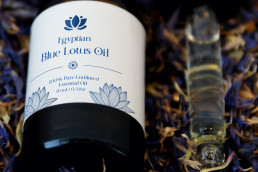
If you have landed here looking for the best blue lotus oil for skincare, you want a straight answer: which grade actually works on skin, how should it be diluted, and what will it genuinely do for your complexion. This article gives you that answer without marketing varnish. Blue lotus oil (*Nymphaea caerulea*) has a legitimate place in a considered skincare routine for its flavonoid content, its anti-inflammatory behaviour, and its gentle scent-led effect on the nervous system, which is itself a skin factor. It is not, however, a retinol replacement or a miracle serum, and choosing the wrong grade will waste your money.
Table of Contents
- What "Blue Lotus Oil for Skincare" Actually Means
- How Blue Lotus Oil Helps the Skin
- Soothing inflamed and reactive skin
- Supporting a healthy barrier
- A gentle effect on dullness
- The psychodermatological angle
- What to Look For in the Best Blue Lotus Oil for Skincare
- Extraction method disclosed
- Botanical name on the label
- Appropriate concentration and price
- Honest scent description
- Dark glass, batch numbers, shelf life stated
- How to Use Blue Lotus Oil for Skincare
- Dilution ranges
- Carrier oil choice
- Step-by-step evening routine
- Frequency
- What to Expect: Realistic Timeframes
- When Blue Lotus Oil Is Not the Right Choice
- Complementary Ingredients and Approaches
- Frequently Asked Questions
- Where to Go From Here
- Skincare-Grade Blue Lotus, Honestly Made
It is written and clinically reviewed by Antonio Breshears, ND, CCA, a Bastyr-trained naturopathic doctor and certified clinical aromatherapist. For the broader botanical and chemical context behind the material discussed here, readers may find it useful to consult The Complete Guide to Blue Lotus Oil, which covers extraction, chemistry, and authenticity in full.
What “Blue Lotus Oil for Skincare” Actually Means
There is a vocabulary problem worth clearing up before anything else. When people say “blue lotus oil”, they usually mean one of three quite different products: a solvent-extracted absolute, a steam-distilled essential oil, or a supercritical CO2 extract. Each behaves differently on skin, and the most widely sold version, the absolute, is the one most relevant to skincare formulation when it is genuinely pure and properly diluted.
Absolutes are produced by washing fresh flowers with a food-grade solvent, typically hexane or ethanol, then carefully removing the solvent to leave a dense, deeply coloured aromatic material. Because three to five thousand flowers go into a single gram of absolute, the concentration of active compounds is high and the material is viscous, honeyed, and strongly scented. Used neat it would be wasteful and occasionally irritating; diluted into a carrier oil, it becomes a workable skincare ingredient.
Steam-distilled blue lotus essential oil exists but is rare, lower yielding, and generally reserved for therapeutic aromatherapy rather than topical skincare. Supercritical CO2 extracts sit between the two, preserving a broader spectrum of the plant’s chemistry without solvent residues. For skin-focused use, a high quality absolute or a CO2 extract is the sensible choice.
How Blue Lotus Oil Helps the Skin
The skincare case for blue lotus rests on its flavonoid profile and its anti-inflammatory behaviour rather than any single dramatic active. The oil contains apigenin, quercetin, and kaempferol, three flavonoids with well-documented antioxidant and soothing properties on mammalian skin. Alongside these sit the aporphine and nuciferine alkaloids, which contribute more to the oil’s scent-led relaxation effect than to any direct topical action, though the calming influence on the autonomic nervous system has a genuine, if indirect, bearing on skin that tends to flush, flare, or respond badly to stress.
Soothing inflamed and reactive skin
Apigenin in particular has been studied for its ability to calm low-grade cutaneous inflammation. For skin that tends toward redness, post-shave irritation, or reactivity to seasonal changes, a properly diluted blue lotus blend can reduce the visible and tactile hallmarks of inflammation within two to three weeks of consistent use. It is modestly effective rather than dramatic, and it works best as part of a minimal, gentle routine rather than layered over active acids or retinoids.
Supporting a healthy barrier
Blue lotus absolute is always diluted in a carrier oil for skincare, and the carrier choice does a great deal of the heavy lifting here. In jojoba, which closely resembles human sebum, or in squalane, which is non-comedogenic and biomimetic, the blend becomes a barrier-supportive treatment oil. The flavonoids support antioxidant defence; the lipid carrier restores the thin film that dry or over-exfoliated skin has lost.
A gentle effect on dullness
Antioxidant flavonoids mop up free radicals generated by sun exposure, pollution, and ordinary daily oxidative stress. Over weeks rather than days, this shows up as slightly brighter, more even-toned skin. Anyone promising radiant transformation in seventy-two hours is selling you a feeling, not a result.
The psychodermatological angle
Skin responds to the nervous system. Chronic stress raises cortisol, which in turn impairs barrier repair, encourages breakouts, and accelerates visible ageing. A drop of blue lotus oil used in an evening face ritual engages the olfactory-limbic pathway, nudging the body toward parasympathetic dominance. This is not marketing language; it is simply how scent works on the autonomic nervous system. For many users, the ritual itself is half the benefit.
What to Look For in the Best Blue Lotus Oil for Skincare
Choosing well matters more here than with most oils, because the combination of high price point and complex supply chain has attracted a great many adulterated products. The best blue lotus oil for skincare tends to share a consistent set of markers.
Extraction method disclosed
A legitimate supplier will tell you plainly whether the product is an absolute, a steam distillate, or a CO2 extract. Vagueness here is a warning sign. For skincare, a clearly labelled absolute or CO2 extract is appropriate.
Botanical name on the label
*Nymphaea caerulea* should be stated explicitly. If the label only says “blue lotus” without the Latin binomial, you cannot verify what species you are receiving. *Nelumbo nucifera*, for instance, is a different plant sold under overlapping common names and should not be substituted without disclosure.
Appropriate concentration and price
True blue lotus absolute is expensive. If the retail price is implausibly low, the product is almost certainly a synthetic reconstitution or a heavily diluted blend sold as though it were neat material. A genuine absolute is typically offered either as a small quantity of neat material or as a pre-diluted skincare oil at one to three percent in a clearly named carrier.
Honest scent description
The real oil has a cooler floral-aquatic top, a deep honeyed-floral heart, and a balsamic, faintly smoky base. Descriptions promising only a “fresh, light floral” are frequently describing a fragrance oil, not a true absolute.
Dark glass, batch numbers, shelf life stated
Quality absolutes are sold in dark glass with batch numbers and a realistic shelf life of three to four years when stored cool and dark. A product with none of these markers is likely to be either mass-produced reconstitution or poorly stored stock.
How to Use Blue Lotus Oil for Skincare
The practical protocol is straightforward, and the main error most people make is using too much. This is a high-concentration material where a little genuinely goes a long way.
Dilution ranges
For facial skincare, one to two percent is the sensible range, which works out to roughly one to two drops of absolute per five millilitres of carrier oil. For body use, two to three percent is acceptable. For targeted application (a small inflamed area or a pulse-point ritual), three percent is the upper limit worth exploring. Diluting above these ranges does not improve results; it increases the chance of sensitisation and wastes expensive material.
Carrier oil choice
For oily, combination, or acne-prone skin, jojoba is the default. It mimics human sebum, does not clog, and remains stable for months. For dry or mature skin, squalane is an excellent choice, as is a blend of jojoba with a smaller percentage of rosehip for its vitamin A content. For very sensitive skin, fractionated coconut oil is bland, stable, and unlikely to irritate, though it is less nourishing than the alternatives.
Step-by-step evening routine
After cleansing and any water-based serums, warm three to four drops of your diluted blue lotus blend between clean fingertips. Press gently into the skin rather than rubbing. Spend a few seconds inhaling what remains on the hands. Finish with a moisturiser if your skin typically needs one on top of a facial oil. Mornings are possible but most users find evenings more useful, both for skincare reasons and because the scent encourages a calmer shift into the night.
Frequency
Nightly use is reasonable for most skin types once tolerance is established. For sensitive or reactive skin, start with two or three evenings a week for the first fortnight, then increase as tolerated. Patch testing on the inner forearm for forty-eight hours before full-face application is a sensible precaution, especially for skin with a history of reactions to botanical ingredients.
What to Expect: Realistic Timeframes
Honest expectations are a favour to yourself. A well-chosen blue lotus skincare oil will usually produce observable change across three horizons.
In the first one to two weeks, most users notice skin that feels softer, less tight after cleansing, and calmer in the evening. This is primarily the carrier oil doing its barrier-supportive work, aided by the soothing flavonoids.
Between weeks three and six, redness, reactivity, and diffuse low-grade inflammation tend to reduce for those who experience them. Skin tone evens out slightly. Texture improves modestly. This is a flattering rather than transformative improvement, and it depends on the rest of the routine being sensible.
Beyond eight weeks, the antioxidant contribution becomes cumulative rather than striking. Skin ages more slowly in the presence of consistent topical antioxidant support, but you will not see this as a dramatic before-and-after. You will see it, over years, as skin that looks closer to its biological age than its chronological one.
If you are looking for rapid pigmentation correction, deep wrinkle reduction, or active acne clearing, blue lotus oil is not your primary tool. Those outcomes belong to retinoids, targeted acids, and clinical treatments. Blue lotus works alongside, not instead of, the evidence-led workhorses of dermatology.
When Blue Lotus Oil Is Not the Right Choice
There are situations where this oil should be left on the shelf, regardless of how well marketed it is.
Pregnancy and breastfeeding are standard contraindications for blue lotus oil, driven by caution around its alkaloid content rather than definitive harm data. Until more research exists, the sensible advice is to avoid topical use during these periods.
Active, acute skin conditions (cystic acne flares, acute eczema, rosacea during a flare) generally require clinical treatment, not a botanical oil. Blue lotus may be a reasonable supportive ingredient once the condition is stable, but it should not be the front line.
Known sensitivity to floral absolutes, jasmine, or rose absolutes, is a reasonable reason to patch test very carefully, because cross-reactivity among heavy floral absolutes is not uncommon.
If you are taking dopaminergic medications, monoamine oxidase inhibitors, or strong sedatives, the topical dose relevant to skincare is very unlikely to interact meaningfully, but the combined use of topical and inhaled blue lotus through the day is worth flagging to your prescriber.
Finally, if the product you are considering is cheap, vaguely labelled, or described in suspiciously universal terms (“fragrance oil suitable for all uses”), the right choice is not to use it at all.
Complementary Ingredients and Approaches
Blue lotus oil earns its place in a considered routine, not a crowded one. A few ingredients pair particularly well.
Niacinamide serum at five percent, applied before the oil on clean damp skin, pairs well for tone, barrier function, and oil regulation. Gentle chemical exfoliation, used two or three evenings a week and never on the same night as a strong acid routine, benefits from the soothing oil afterwards. A well-formulated broad-spectrum sunscreen in the morning is the single most important skincare decision anyone makes; no facial oil, however lovely, replaces it.
Among essential oils, frankincense, helichrysum, and Roman chamomile work harmoniously with blue lotus in low-dilution facial blends, though there is rarely a reason to stack multiple absolutes into one product. Simplicity almost always outperforms complexity in skincare formulation.
On the lifestyle side, the things that most reliably change how skin looks are unglamorous: consistent sleep, hydration, a diet with enough protein and colour, reduced alcohol, and stress that is actively managed rather than endured. A nightly ritual that includes blue lotus oil can contribute to the last of these by giving the nervous system a reliable cue to downshift.
Frequently Asked Questions
Is blue lotus absolute safe to use on the face?
Yes, at appropriate dilution. One to two percent in a suitable carrier oil is the standard facial range. Neat application is neither necessary nor advisable. Patch test first if you have sensitive skin.
Can blue lotus oil help with acne?
It can contribute to calmer skin and reduced post-inflammatory redness, but it is not an acne treatment. For active, inflammatory acne, use evidence-led actives (salicylic acid, benzoyl peroxide, retinoids, or prescription options) and consider blue lotus as a supportive, soothing ingredient once the skin is stable.
What is the best carrier oil for blue lotus in skincare?
Jojoba for most skin types, squalane for dry or mature skin, and fractionated coconut oil for very reactive or sensitive skin. A blend of jojoba and rosehip works well for combination skin that wants a little extra brightening support.
Will blue lotus oil clog pores?
The absolute itself, used at one to two percent, is not considered comedogenic. The carrier oil does most of the determining here. Jojoba and squalane are low on the comedogenicity scale; coconut oil (unfractionated) is higher and is worth avoiding for acne-prone skin.
How should I store my blue lotus skincare oil?
In dark glass, away from sunlight, at a stable cool room temperature. Avoid bathroom cabinets, which swing in heat and humidity. A properly stored absolute lasts three to four years; diluted facial blends should be used within six to twelve months for freshness.
Can I use blue lotus oil in the morning under sunscreen?
Yes, provided the dilution is appropriate and you allow the oil to absorb before applying sunscreen. Many users prefer evenings because the scent supports winding down, but there is no skincare reason against morning use.
How do I know I have bought a genuine product?
Look for the botanical name *Nymphaea caerulea*, disclosed extraction method, a realistic price, a batch number, and a described scent that matches the honeyed, slightly balsamic character of the real material. Reputable suppliers tend to be transparent about sourcing and testing.
Is there a difference between blue lotus absolute and blue lotus essential oil for skin?
Yes, though for skincare the absolute is the more common and more suitable material because of its concentration of flavonoids and its stability in carrier oil blends. A true steam-distilled essential oil is rare and more commonly used in pure aromatherapy.
Can blue lotus oil replace my retinol?
No. Retinoids address cell turnover, collagen production, and photoageing through mechanisms that blue lotus oil does not share. The two can coexist in a routine, used on alternate evenings, but they are not interchangeable.
How many drops should I use on my face?
Three to four drops of a one to two percent blend, pressed into clean skin after serums, is enough for the entire face and neck. More is not better; it simply sits on the surface.
Where to Go From Here
Choosing the best blue lotus oil for skincare comes down to three judgements: pick a properly extracted and clearly labelled material, dilute it sensibly, and set realistic expectations about what it can and cannot do. Used that way, it is a genuinely rewarding addition to a considered routine, particularly for skin that runs reactive or stressed. For the wider botanical, chemical, and safety context that sits behind this article, The Complete Guide to Blue Lotus Oil is the natural next read, covering extraction methods, authenticity markers, and the full profile of the oil in depth.

Antonio Breshears
Antonio Breshears is a renowned expert in holistic medicine and beauty, with over 25 years of research experience dedicated to uncovering the secrets of nature's most powerful remedies. Holding a degree in Naturopathic Medicine, Antonio's passion for healing and well-being has driven him to explore the intricate connections between mind, body, and spirit.
Over the years, Antonio has become a respected authority in the field, helping countless individuals discover the transformative power of plant-based therapies, including essential oils, herbs, and natural supplements. He has authored numerous articles and publications, sharing his wealth of knowledge with a global audience seeking to improve their overall health and well-being.
Antonio's expertise extends to the realm of beauty, where he has developed innovative, all-natural skincare solutions that harness the potency of botanical ingredients. His formulations embody his deep understanding of the healing properties found in nature, providing holistic alternatives for those seeking a more balanced approach to self-care.
With his extensive background and dedication to the field, Antonio Breshears is a trusted voice and guiding light in the world of holistic medicine and beauty. Through his work at Pure Blue Lotus Oil, Antonio continues to inspire and educate, empowering others to unlock the true potential of nature's gifts for a healthier, more radiant life.