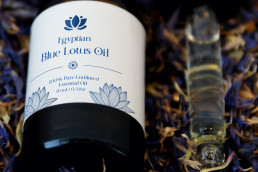
If you are hunting for blue lotus oil in Brighton, whether you live in Kemptown, work in the North Laine, or you are visiting for the weekend and fancy browsing the Lanes for something interesting, this guide walks you through what is realistically available in the city, what to ask before you buy, and how to tell a genuine bottle from the many diluted versions that tend to circulate in busy high street markets. Brighton has a strong apothecary and wellness culture, so the raw material is here, you just need to know what you are looking at.
Table of Contents
- What "Blue Lotus Oil" Actually Means in a Brighton Shop
- Where to Look: The Four Main Districts
- The Lanes
- North Laine
- Kemptown
- Hove
- What to Ask Before You Buy
- "Is this an absolute, an essential oil, or a CO2 extract?"
- "Is it pre-diluted in a carrier?"
- "Where was it sourced?"
- "Can I smell it?"
- Realistic Price Expectations in Brighton
- Red Flags to Watch For
- No batch or origin information
- The word "fragrance" or "perfume oil" in the small print
- Stock that looks like it has been on the shelf for years
- Claims that the oil "cures" or "treats" anything
- Buying Online Versus Buying in Person
- How to Use What You Buy
- Safety Notes for Brighton Buyers
- Frequently Asked Questions
- Where to Go From Here
- Skip the Market Stalls
It is written and clinically reviewed by Antonio Breshears, ND, CCA, a Bastyr-trained naturopathic doctor and certified clinical aromatherapist. For a broader grounding in the botany, chemistry, extraction methods and safety profile of this oil, the complete guide to blue lotus oil gives you the background you will need before walking into any shop and asking informed questions.
What “Blue Lotus Oil” Actually Means in a Brighton Shop
Before you set foot in a single shop, it helps to get one thing straight. The botanical you are looking for is Nymphaea caerulea, the Egyptian blue water lily, and it is not technically a lotus at all. True blue lotus oil comes in one of three forms: a solvent-extracted absolute (by far the most common and the most aromatically complete), a steam-distilled essential oil (rare and usually lighter in character), or a supercritical CO2 extract (premium, clean, expensive). Because it takes roughly 3,000 to 5,000 flowers to produce a single gram of absolute, the raw material is inherently costly.
This matters when you are shopping in Brighton because the city has plenty of outlets that sell “blue lotus oil” at prices that simply cannot reflect that kind of sourcing. A 10 ml bottle for under twenty pounds on a market stall is almost certainly a fragrance oil, a jojoba dilution (sometimes as low as one or two percent actual absolute), or in some cases a synthetic floral accord with no botanical content at all. None of those are scams exactly, they just are not what most people mean when they say blue lotus oil, and they will not deliver the subtle calming, mood-softening effect that the genuine material is known for.
Where to Look: The Four Main Districts
Brighton’s retail geography for anything herbal, botanical, or esoteric clusters into four broad areas, and each has a different character worth knowing.
The Lanes
The narrow tangle of streets between North Street and the seafront is where you will find most of the city’s dedicated apothecaries, crystal shops, and incense-and-oil boutiques. This is the most likely area to find something labelled as blue lotus oil, though quality varies enormously. Look for shops that specialise in essential oils and aromatherapy rather than those selling a bit of everything alongside dreamcatchers and tarot decks. The serious apothecaries will have a visible range of other premium absolutes (jasmine, tuberose, rose) and will be able to tell you the extraction method and country of origin without having to check a label.
North Laine
Slightly more bohemian and less tourist-focused than the Lanes proper, the North Laine around Gardner Street, Kensington Gardens and Sydney Street is home to several wellbeing-oriented independents, vegan and organic shops, and a couple of dedicated herbalists. Prices here tend to be more realistic, and staff are more likely to actually use the products themselves. It is the neighbourhood where you are most likely to find a small, owner-run shop carrying genuine absolute at a fair (which is to say, not cheap) price.
Kemptown
Kemptown has a quieter, more residential character and fewer dedicated oil shops, but it does have some excellent independent pharmacies and one or two herbalists who will special-order specific oils for regular customers. If you live in Brighton and want an ongoing supply relationship rather than a one-off purchase, Kemptown is worth a conversation.
Hove
Hove is quieter still, with a handful of health food shops along Church Road and Blatchington Road that stock essential oils from established UK aromatherapy suppliers. You are less likely to find blue lotus absolute specifically on the shelf in Hove, but these shops often work with reputable wholesale suppliers and can order it in.
What to Ask Before You Buy
A good rule of thumb: if the person behind the counter cannot answer the following questions without consulting a label or looking confused, you are not in the right shop for this particular purchase.
“Is this an absolute, an essential oil, or a CO2 extract?”
Any of the three can be genuine blue lotus oil. The answer tells you what extraction method was used and sets your expectations for colour, viscosity and scent. Absolutes tend to be richer and slightly thicker; steam distillates are lighter and paler; CO2 extracts are usually somewhere in between and very clean in profile. A seller who says “it is just blue lotus oil” without further detail probably does not know the supply chain.
“Is it pre-diluted in a carrier?”
Many shops sell blue lotus as a pre-blended oil, typically in jojoba or fractionated coconut, at anywhere from 3 to 20 percent absolute. This is perfectly legitimate and often sensible for beginners, but it should be clearly labelled and the price should reflect the dilution. A 10 ml “blue lotus oil” at a low price is almost always a dilution, and that is fine as long as you know what you are paying for.
“Where was it sourced?”
Egypt remains the most common origin, with some Thai and Sri Lankan material also on the market (though the Thai product is more often the related Nymphaea nouchali rather than true caerulea). A knowledgeable seller will name the country without hesitation.
“Can I smell it?”
Any shop selling genuine absolute will let you smell a tester. Real blue lotus opens with a cool, slightly aquatic floral top note, moves into a deep honeyed floral heart with hints of green tea and hay, and settles into a balsamic, faintly smoky base. If what you smell is one-dimensional, overtly sweet, or reminds you of a shampoo aisle, it is almost certainly fragrance-grade rather than botanical.
Realistic Price Expectations in Brighton
For genuine Egyptian blue lotus absolute, undiluted, expect to pay somewhere between £30 and £60 per millilitre in a Brighton apothecary, which typically translates to £45 to £90 for a 1.5 ml or 2 ml bottle, and considerably more for 5 ml. Pre-diluted blends at 5 to 10 percent in jojoba will typically run £20 to £45 for a 10 ml bottle, depending on the carrier quality and the brand’s positioning. Anything cheaper than this is either heavily diluted below 5 percent, a fragrance oil, or a synthetic. Anything dramatically more expensive is usually either a CO2 extract (legitimate premium pricing) or a boutique brand charging for packaging and positioning rather than botanical content.
These prices reflect the genuine cost of raw material, and there is no way around them. When you do the arithmetic (5,000 flowers per gram, hand-harvested, solvent-extracted, then shipped and repackaged), even the higher end of that range is not unreasonable.
Red Flags to Watch For
Some warning signs that apply specifically to the kind of shop you will encounter in Brighton’s busier tourist areas.
No batch or origin information
A legitimate product will have, at minimum, a lot number and a statement of botanical name and country of origin on the label. If the bottle just says “Blue Lotus Oil” in decorative script with no further detail, treat it with caution.
The word “fragrance” or “perfume oil” in the small print
Fragrance oils are cosmetic-grade synthetic or semi-synthetic blends designed to smell like something. They have their place in candle-making and soap, but they contain no botanical actives and will not deliver any of the effects associated with the genuine absolute. Read the small print carefully.
Stock that looks like it has been on the shelf for years
Blue lotus absolute properly stored in dark glass at a cool temperature keeps for three to four years without much degradation, but a bottle that has been sitting in a sunny shop window or under bright spotlights for eighteen months will have lost a meaningful portion of its aromatic and therapeutic character. A dusty bottle in a bright window is a poor buy regardless of the price.
Claims that the oil “cures” or “treats” anything
Under UK cosmetic and medicinal product regulations, genuine aromatherapy retailers are careful about the claims they make. A shop making overt medical claims about any essential oil, blue lotus included, is either cutting corners regulatorily or does not know the material well. Neither is a good sign.
Buying Online Versus Buying in Person
Brighton’s in-person offering is genuinely good, particularly in the North Laine and the better parts of the Lanes, but it is worth being realistic about the trade-offs.
Buying in person lets you smell the oil before you commit, ask questions of someone who (hopefully) knows the product, and support a local independent. It is also useful if you are new to blue lotus and want to handle a few different bottles to develop a sense of what genuine material smells like. The downside is that Brighton’s shop rents are substantial, and this is reflected in retail prices, so you will generally pay a premium compared to buying online directly from a specialist producer.
Buying online from a dedicated blue lotus specialist gives you access to a fresher supply chain, more transparent sourcing documentation, and often a better price per millilitre. The downside is the obvious one: you cannot smell it first, and you are relying on the producer’s reputation and return policy. If you are already familiar with the aroma and just want a reliable resupply, online direct is hard to beat for the quality-to-price ratio.
Many Brighton residents end up doing a combination: a first purchase in person to calibrate their nose and ask questions, then ongoing purchases online once they have settled on a preferred style (absolute versus dilution, Egyptian versus Thai, absolute versus CO2).
How to Use What You Buy
Once you have a bottle of genuine blue lotus oil back at home in Brighton, a few practical notes on getting the best from it. For diffuser use, two to four drops in a standard room diffuser is plenty; the scent is subtle and easily overwhelmed if you add too much. For topical application, the safe dilution range is one to two percent for the face (roughly one drop of absolute per teaspoon of carrier), two to three percent for the body, and up to three percent for targeted application on a small area. For a ritual anointing of the temples, wrists, or the nape of the neck, a pre-blended 5 to 10 percent oil in jojoba is ideal and removes the need to dilute fresh each time.
The oil is best thought of as gently parasympathetic rather than strongly sedative. It will not put you to sleep the way a pharmaceutical might, but used consistently in an evening wind-down routine, most people find it helpfully softens the edge of a busy mind. The effect is modest and cumulative rather than dramatic; expect to notice the difference over a week or two of regular use rather than the first evening.
Safety Notes for Brighton Buyers
Blue lotus is generally well tolerated at topical and aromatic dilutions, but a few cautions genuinely apply. Avoid use in pregnancy and while breastfeeding, where the evidence is insufficient to recommend it. Use caution if you are taking dopaminergic medications (including some Parkinson’s treatments), MAOIs, or heavy sedatives, as the aporphine and nuciferine content have measurable though modest activity at dopamine and serotonin receptors. Do not ingest the oil; the internal safety profile is not well established, and oral use of essential oils generally requires clinical supervision. As with any new botanical, a small patch test on the inner forearm before wider topical use is sensible.
One thing worth noting specifically for buyers in Brighton: blue lotus is not legally restricted in the UK, unlike in Russia, Poland, Latvia, or the US state of Louisiana, and its regulatory status in Australia is complex. You can buy and own it freely here, but if you are travelling internationally with a bottle, check the law at your destination before you pack.
Frequently Asked Questions
Is blue lotus oil legal to buy in Brighton?
Yes. Blue lotus oil (Nymphaea caerulea) is not a controlled substance in the UK and is sold openly as an aromatherapy product and perfumery material. There is no licensing requirement for purchase, and no age restriction specific to this oil.
What is the most reliable way to tell if blue lotus oil is genuine?
The scent is the clearest indicator to a trained nose. Genuine absolute has a complex three-stage profile: cool aquatic-floral top, honeyed floral heart with green tea notes, and a balsamic-smoky base. Flat, one-dimensional, or overtly sweet aromas are hallmarks of fragrance-grade or heavily diluted material. Beyond scent, look for clear labelling of extraction method, country of origin, and batch number.
Which Brighton neighbourhood has the best selection?
The North Laine tends to offer the best combination of genuine product, knowledgeable staff, and realistic pricing. The Lanes have more shops overall but greater variance in quality. Hove and Kemptown are better for ongoing supply relationships via local independents than for browsing on the day.
How much should I expect to pay for a genuine bottle?
For undiluted Egyptian absolute, roughly £30 to £60 per millilitre. For a pre-diluted blend at 5 to 10 percent in jojoba, £20 to £45 for a 10 ml bottle. Anything substantially cheaper is almost certainly a fragrance oil or a very heavy dilution.
Can I buy blue lotus oil at Brighton’s larger health food chains?
Occasionally, but most national chains stock it irregularly if at all, and when they do it tends to be a pre-diluted blend from a mainstream aromatherapy brand. The independent apothecaries in the Lanes and North Laine are a better bet for range and knowledge.
Is blue lotus oil safe to use on my face?
Yes, at appropriate dilution. A one to two percent dilution in a facial-suitable carrier such as jojoba or rosehip is well tolerated by most skin types. Always patch test first on the inner forearm for 24 hours before applying to the face.
Will blue lotus oil help me sleep?
It is best described as gently calming rather than strongly sedative. Used consistently in an evening routine (diffused or applied diluted to temples and wrists), most people find it helps soften the transition to sleep. Those expecting a dramatic sedative effect will probably be disappointed; those looking for a subtle, cumulative calming ritual tend to be pleased.
Can I use it if I am on antidepressants?
Blue lotus alkaloids have modest activity at serotonin and dopamine receptors, so if you are on MAOIs, SSRIs, or dopaminergic medications, it is worth a conversation with your prescriber before using it regularly. Aromatic (diffused) use is generally less of a concern than topical, and topical is less of a concern than ingestion (which is not recommended in any case).
How long does a bottle last?
Properly stored in dark glass in a cool, dark place, genuine blue lotus absolute retains its character for three to four years. At typical use rates (a few drops in a diffuser a few times a week, plus occasional topical use), a 2 ml bottle of undiluted absolute will comfortably last a casual user six months or more.
Should I buy online instead?
If you are new to the oil and want to smell before you commit, buy in person first in Brighton. Once you know what genuine material smells like and have settled on your preferred style, buying online directly from a specialist tends to offer better value and fresher stock.
Where to Go From Here
If you want to read more about the botany, chemistry, and clinical character of the oil before you buy, the complete guide to blue lotus oil covers the ground in depth. If you have already found a bottle in Brighton and are wondering how best to use it, that same guide includes protocols for diffusion, topical use, and ritual application. Brighton is a genuinely good city to shop for botanicals, but as with any premium raw material, the difference between a good bottle and a disappointing one comes down to knowing what questions to ask and trusting your nose.

Antonio Breshears
Antonio Breshears is a renowned expert in holistic medicine and beauty, with over 25 years of research experience dedicated to uncovering the secrets of nature's most powerful remedies. Holding a degree in Naturopathic Medicine, Antonio's passion for healing and well-being has driven him to explore the intricate connections between mind, body, and spirit.
Over the years, Antonio has become a respected authority in the field, helping countless individuals discover the transformative power of plant-based therapies, including essential oils, herbs, and natural supplements. He has authored numerous articles and publications, sharing his wealth of knowledge with a global audience seeking to improve their overall health and well-being.
Antonio's expertise extends to the realm of beauty, where he has developed innovative, all-natural skincare solutions that harness the potency of botanical ingredients. His formulations embody his deep understanding of the healing properties found in nature, providing holistic alternatives for those seeking a more balanced approach to self-care.
With his extensive background and dedication to the field, Antonio Breshears is a trusted voice and guiding light in the world of holistic medicine and beauty. Through his work at Pure Blue Lotus Oil, Antonio continues to inspire and educate, empowering others to unlock the true potential of nature's gifts for a healthier, more radiant life.