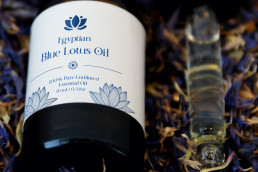
If you have been searching for blue lotus oil in Chicago, this guide will save you a great deal of time. The honest picture is that very few brick-and-mortar shops in the city stock genuine Egyptian Nymphaea caerulea absolute, and the bottles you do find on Milwaukee Avenue or in River North apothecaries vary enormously in quality, dilution, and provenance. This article covers what to look for, what to avoid, which Chicago neighbourhoods are worth searching, and how to verify a bottle is the real thing before you spend money on it.
Table of Contents
- What You Are Actually Looking For
- The Chicago Retail Landscape
- Independent Apothecaries and Herb Shops
- Metaphysical and Spiritual Shops
- Health Food Stores and Whole Foods
- Specialist Perfumery
- Why Online Often Beats Local for This Particular Oil
- How to Verify a Bottle Is Genuine
- Practical Use Once You Have a Genuine Bottle
- What to Avoid in the Chicago Market
- Safety Notes Specific to Topical and Diffuser Use
- Frequently Asked Questions
- Where to Go From Here
- Genuine Egyptian Blue Lotus, Delivered to Chicago
It is written and clinically reviewed by Antonio Breshears, ND, CCA, a Bastyr-trained naturopathic doctor and certified clinical aromatherapist. For broader context on what this oil actually is and how it behaves, readers may also want to consult the complete guide to blue lotus oil, which covers chemistry, extraction methods, and clinical use in considerably more depth.
What You Are Actually Looking For
Before walking into any Chicago shop, it helps to be precise about what blue lotus oil actually is, because the term is used loosely in the wellness market and that looseness is exactly what allows poor products to be sold at premium prices. Genuine blue lotus oil is an extract of Nymphaea caerulea, the Egyptian blue water lily, and it almost always arrives in one of three forms: a solvent-extracted absolute (the most common), a true steam-distilled essential oil (rare and very expensive), or a supercritical CO2 extract (premium, clean, increasingly available).
The absolute is thick, deeply coloured, and intensely floral with a honeyed, slightly smoky base. It takes between 3,000 and 5,000 flowers to produce a single gram of absolute, which is the underlying reason that genuine product is never inexpensive. If you find a 10ml bottle of “blue lotus essential oil” in a Wicker Park gift shop priced at twenty dollars, you are almost certainly looking at a fragrance dilution in jojoba or fractionated coconut oil, or worse, a synthetic accord designed to smell vaguely floral. Neither of those will produce the parasympathetic, gently euphoric effect that the genuine extract is sought for.
The Chicago Retail Landscape
Chicago has a healthy independent apothecary and metaphysical-shop scene, but blue lotus oil is a specialist product even within that world. Here is an honest survey of where you might encounter it and what to expect from each category.
Independent Apothecaries and Herb Shops
Merz Apothecary in Lincoln Square is one of the city’s longest-standing botanical retailers and carries an extensive essential oil range. They occasionally stock blue lotus, though more often as a diluted perfume oil than a neat absolute. Worth asking specifically: is this an absolute or a fragrance dilution, what is the carrier if any, and what is the country of origin. Staff there are knowledgeable and will give you a straight answer.
Smaller herb shops in Andersonville, Logan Square, and Bucktown sometimes carry blue lotus, particularly those with a strong tarot, ritual, or witchcraft customer base where the flower has cultural resonance. Quality varies dramatically. Some are sourcing from reputable suppliers; others buy on price from the nearest distributor and have little idea what is actually in the bottle.
Metaphysical and Spiritual Shops
The metaphysical shops along Milwaukee Avenue, in Wicker Park, and around Pilsen frequently stock blue lotus in some form. The product is often dried flowers (for tea or smoking blends) rather than oil, and when oil is sold it is typically a low-strength dilution intended as an anointing or perfume oil. These products have their place in ritual practice, but if you want clinical-grade aromatherapy effect, this is not where you will find it.
Health Food Stores and Whole Foods
Whole Foods, Mariano’s, and the various independent health food stores across the city rarely carry true blue lotus oil. The mainstream essential oil brands they stock (Aura Cacia, Now Foods, Plant Therapy) generally do not include blue lotus in their core ranges because the cost of genuine material is prohibitive at supermarket price points. If you see “blue lotus” on a shelf at a health food store, read the label carefully; it is almost always a blend or a diluted version.
Specialist Perfumery
A few of Chicago’s niche perfumeries and natural perfume ateliers do work with blue lotus absolute as a raw material. They will not generally sell it neat in retail bottles, but if you have a relationship with a perfumer they may be able to source small quantities for you. This is the highest-quality route through traditional retail, but it is also the most relationship-dependent and the most expensive per millilitre.
Why Online Often Beats Local for This Particular Oil
For most aromatherapy oils I would happily send a Chicago patient to a good local apothecary. Blue lotus is genuinely different. The supply chain is narrow, the authentic material is expensive, and the shops most likely to stock it are also the shops most likely to be selling diluted or adulterated versions because the real thing does not move at the price points retail customers expect.
Buying directly from a specialist online retailer who works with Egyptian growers and publishes batch information solves several problems at once: you get traceable provenance, you usually get gas chromatography data on request, and you get the oil at a price reflective of its true production cost rather than inflated by retail markup. The trade-off is waiting two or three days for shipping rather than walking into a shop today.
How to Verify a Bottle Is Genuine
Whether you are buying in a Lincoln Park boutique or ordering online for delivery to your apartment in the Loop, the same checks apply. Use these as your verification checklist.
Botanical name on the label. The label should say Nymphaea caerulea. Not “blue lotus”, not “lotus oil”, not “Egyptian water lily blend”. Botanical specificity is the first sign that the seller knows what they are selling.
Country of origin. Egypt is the historical and primary source. Some material now comes from Sri Lanka and Thailand, and that material can be excellent, but it should be declared. A bottle with no origin information is a bottle with something to hide.
Extraction method. Solvent-extracted absolute, steam-distilled essential oil, or CO2 extract. If the label is silent on this, the seller does not know or does not want to tell you.
Price reality check. Genuine blue lotus absolute typically retails between $40 and $120 for 5ml, depending on extraction method and supplier. A 10ml bottle for $15 is not genuine; it is either heavily diluted or synthetic. A 30ml bottle for $200 might be real and beautifully sourced, or it might be overpriced for what it is. Use price as a sanity check in both directions.
Smell. Real blue lotus absolute opens with a cool, slightly aquatic floral note, develops into a deep honeyed heart, and settles into a balsamic, faintly smoky base. It is complex and shifts on the skin. Synthetic versions tend to smell one-dimensional, sweet, and somewhat plastic. If you can smell before buying, do.
Appearance. The absolute is dark amber to deep brown, sometimes with a slight greenish cast. It is viscous at room temperature and may need warming between the palms before it pours easily. A thin, pale liquid is not absolute; it is a dilution.
Practical Use Once You Have a Genuine Bottle
Assuming you have sourced something authentic, here is how Chicagoans typically use it. The oil is most often deployed in three contexts: evening wind-down, ritual or meditative practice, and skincare.
For evening use, two to four drops in a diffuser thirty to sixty minutes before bed is the standard protocol. Chicago winters being what they are, many people pair this with a warm bath or a slow yoga sequence. The effect is a gentle parasympathetic shift, a softening of mental chatter, rather than a heavy sedative drop. Expectations matter here; if you are looking for something that knocks you out, blue lotus is not the right choice and a clinical sleep evaluation might be.
For topical use, dilute to 1 to 2 percent in a carrier such as jojoba or sweet almond oil for facial application, and 2 to 3 percent for body use. A 1 percent dilution is roughly one drop per teaspoon of carrier. The oil pairs well on the skin with rose, sandalwood, and frankincense, and many of the better Chicago natural perfumers will create custom blends if you bring them a bottle of pure absolute.
For ritual or meditative use, a single drop on the wrists or behind the ears, or two drops in a diffuser during practice, is generally sufficient. More is not better with this oil; it has a cumulative quality and very small amounts are often more effective than larger ones.
What to Avoid in the Chicago Market
A few specific traps recur often enough in this city that they are worth naming directly.
“Blue lotus” roll-ons under $25. These are virtually always heavy dilutions in fractionated coconut oil with a small amount of (sometimes genuine, sometimes not) blue lotus absolute. They are fine as a perfume but will not deliver the aromatherapy effect that draws most buyers to the oil in the first place.
Bottles with no batch number or origin. Reputable suppliers track batches because their customers ask, and because regulatory standards require it. Absence of this information is a meaningful red flag.
Pop-up market stalls and street fairs. Chicago has a wonderful summer market scene, and many vendors are excellent, but blue lotus oil at a market stall is high-risk; the supply chain is opaque and the oil is often relabelled bulk material of unknown origin.
Anything sold as a “psychoactive” or “legal high”. Blue lotus has mild psychoactive properties, principally through aporphine and nuciferine alkaloids, but products marketed primarily on this basis tend to be either ineffective novelties or, occasionally, adulterated with other compounds entirely. Buy from suppliers who describe the oil in terms of aromatherapy, perfumery, and traditional use, not in terms of recreational effect.
Safety Notes Specific to Topical and Diffuser Use
A few standard cautions apply regardless of where in Chicago you bought your oil. Avoid use during pregnancy and breastfeeding. Use with caution if you take dopaminergic medications, MAOIs, or significant sedatives, because the alkaloid profile of blue lotus has activity at dopamine and serotonin receptors that may interact in unpredictable ways. Patch-test before any sustained topical use; floral absolutes occasionally cause sensitisation in people with very reactive skin.
If you have epilepsy, are recovering from substance use disorder involving sedatives, or take any medication where altered consciousness is a documented risk, talk to a clinician (ideally one familiar with botanical medicine) before regular use.
Frequently Asked Questions
Where can I buy blue lotus oil in Chicago today?
Merz Apothecary in Lincoln Square is the most reliable physical option, though stock varies. Smaller apothecaries in Andersonville, Logan Square, and Bucktown sometimes carry it. For genuine Egyptian absolute with verified provenance, ordering from a specialist online retailer is generally the more reliable route.
How much should genuine blue lotus oil cost in Chicago?
Expect to pay $40 to $120 for 5ml of genuine absolute, depending on extraction method and supplier. Anything significantly cheaper is almost certainly diluted or synthetic.
Is the blue lotus oil sold at metaphysical shops in Wicker Park genuine?
Sometimes, but most often these shops carry diluted perfume oils or anointing oils rather than neat absolute. Ask specifically whether it is the absolute, what the carrier is, and what the country of origin is. If staff cannot answer, treat the bottle as a fragrance product rather than an aromatherapy one.
Can I buy blue lotus oil at Whole Foods or Mariano’s?
Generally no. The mainstream essential oil brands stocked at these stores rarely include blue lotus because the cost of genuine material is too high for supermarket price points.
What does real blue lotus oil smell like?
It opens cool and floral-aquatic, develops a deep honeyed heart, and settles into a balsamic, faintly smoky base. It shifts on the skin over an hour or two. Synthetic versions smell sweet and one-dimensional and do not develop in the same way.
Is blue lotus oil legal in Illinois?
Yes. Blue lotus is unrestricted in Illinois and across most of the United States. The notable exception is the state of Louisiana, where it is restricted. Illinois residents can buy and use it freely.
How long does a bottle last?
Stored properly in dark glass, in a cool dark place, a bottle of absolute will hold its character for three to four years. Heat and light degrade it faster, so do not leave it on a sunny windowsill in a Lincoln Park bay window.
Should I buy locally to support Chicago businesses, or order online for better quality?
If you find a local supplier you trust who can answer the verification questions above, buying locally is excellent. For most buyers, however, the specialist online supply chain produces more consistent quality at fairer prices. There is no shame in either route; the question is which one delivers a genuine product.
Can I use blue lotus oil in a diffuser in a small Chicago apartment?
Yes, and this is one of its best applications. Two to four drops in a small ultrasonic diffuser is appropriate for a studio or one-bedroom. The oil is potent and a little goes a long way; resist the urge to use more.
What should I do if I think I bought a fake?
Compare the smell to descriptions of genuine absolute, check the appearance against expected viscosity and colour, and contact the seller with specific questions about origin and extraction. Reputable sellers will provide answers; opaque ones will not, and that itself tells you what you need to know.
Where to Go From Here
If you have done the verification work and have a bottle in hand, the next step is learning to use it well. The full chemistry, the safety profile, and the various clinical and traditional applications are covered in considerable depth in the complete guide to blue lotus oil. For Chicagoans specifically, my standing recommendation is the same as for any city with limited specialist retail: use a verified online source for the oil itself, and use your local apothecary network for the supporting carriers, blending oils, and rituals that turn a bottle of absolute into a regular practice.

Antonio Breshears
Antonio Breshears is a renowned expert in holistic medicine and beauty, with over 25 years of research experience dedicated to uncovering the secrets of nature's most powerful remedies. Holding a degree in Naturopathic Medicine, Antonio's passion for healing and well-being has driven him to explore the intricate connections between mind, body, and spirit.
Over the years, Antonio has become a respected authority in the field, helping countless individuals discover the transformative power of plant-based therapies, including essential oils, herbs, and natural supplements. He has authored numerous articles and publications, sharing his wealth of knowledge with a global audience seeking to improve their overall health and well-being.
Antonio's expertise extends to the realm of beauty, where he has developed innovative, all-natural skincare solutions that harness the potency of botanical ingredients. His formulations embody his deep understanding of the healing properties found in nature, providing holistic alternatives for those seeking a more balanced approach to self-care.
With his extensive background and dedication to the field, Antonio Breshears is a trusted voice and guiding light in the world of holistic medicine and beauty. Through his work at Pure Blue Lotus Oil, Antonio continues to inspire and educate, empowering others to unlock the true potential of nature's gifts for a healthier, more radiant life.