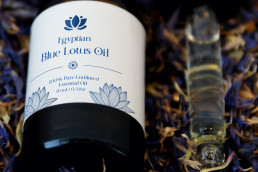
Breathwork facilitators occupy an unusual clinical space, holding people through states that are simultaneously physiological, emotional, and for many participants, frankly mystical. If you are guiding conscious connected breathing, holotropic sessions, Wim Hof protocols, or gentler somatic breath classes, you have likely already noticed that scent shapes the room as much as music does. This article is a practical guide to using blue lotus oil breathwork facilitators can actually rely on in session: how to dilute it, where to apply it, how it interacts with altered states, and where its real limits lie.
Table of Contents
- Why Blue Lotus Oil Has a Place in Breathwork
- What the Chemistry Actually Does in Session
- Where Blue Lotus Fits in a Session Arc
- Arrival and Grounding
- Anointing at the Threshold
- Integration and Closing
- Practical Protocols for Facilitators
- Diffusion Protocol
- Anointing Blend
- Personal Facilitator Use
- Post-Session Integration Oils
- Safety Considerations Specific to Breathwork
- When Blue Lotus Is Not the Right Choice
- Sourcing, Storage, and Professional Standards
- Realistic Expectations for You and Your Participants
- Frequently Asked Questions
- Where to Go From Here
- Stock Your Session Space
It is written and clinically reviewed by Antonio Breshears, ND, CCA, a Bastyr-trained naturopathic doctor and certified clinical aromatherapist. If you are newer to the botany and chemistry of this flower, The Complete Guide to Blue Lotus Oil covers the foundational material this article assumes you already know.
Why Blue Lotus Oil Has a Place in Breathwork
Breathwork is, at its most basic, a nervous-system practice. You are asking a participant to shift, often rapidly, between sympathetic activation and parasympathetic release. Scent is one of the most direct tools you have to support that shift, because olfaction is the only sense that bypasses the thalamus and routes straight into the limbic system. A well-chosen aroma can settle a room in under a minute, signal the opening and closing of a session without a single word, and anchor a participant back into their body when dissociation threatens to pull them away.
Blue lotus, Nymphaea caerulea, earns its place in this toolkit for three reasons. First, its scent is genuinely unusual: a cool floral-aquatic opening that settles into a deep honeyed heart and a quietly balsamic base. Participants rarely associate it with anything from ordinary life, which makes it useful as a threshold marker. Second, its chemistry is mildly parasympathomimetic without being sedating. The aporphine and nuciferine alkaloids, together with apigenin and other flavonoids, nudge the nervous system towards receptivity rather than sleep, which is exactly what most breathwork modalities call for. Third, the oil holds its ground in a room. It is not shy, but it does not dominate the way strong mints or heavy resins can.
None of this makes blue lotus a shortcut to any particular state. It is a support, not a driver. Used thoughtfully, it helps people arrive, deepen, and return.
What the Chemistry Actually Does in Session
It is worth being precise about mechanism, because breathwork participants frequently ask, and a clear, modest answer builds far more trust than mystique.
The two most-cited alkaloids in blue lotus are aporphine, a weak dopamine agonist, and nuciferine, a weak dopamine antagonist with some serotonergic activity at 5-HT2A and 5-HT2C receptors. In an inhaled oil at session-appropriate dilutions, the systemic dose of these alkaloids is small. What participants are primarily responding to is the olfactory-limbic pathway: the aroma itself cueing parasympathetic tone, reducing vigilance, and creating the subjective impression of “softening”. The flavonoids, apigenin especially, have documented affinity for central benzodiazepine receptor sites, which may contribute to the gentle anxiolytic quality people report.
In plain terms: you are not dosing your participants with a psychoactive botanical. You are using an aromatic that their nervous systems read as safe, floral, slightly unfamiliar, and calming. That is the correct framing to offer if anyone asks.
Where Blue Lotus Fits in a Session Arc
Most breathwork sessions, regardless of modality, follow a recognisable arc: arrival and grounding, activation, peak or plateau, integration, and closing. Blue lotus can serve in several of these phases, but it is most useful at the bookends.
Arrival and Grounding
A single drop on a tissue passed around the circle, or two to four drops in a diffuser running quietly before participants enter, sets an immediate tonal marker. The aroma is unfamiliar enough to interrupt the everyday mind without being jarring. I find it works particularly well in the ten minutes before a session, when people are still settling their phones, their bladders, and their expectations.
Anointing at the Threshold
Many facilitators offer a brief anointing, usually on the wrists, the third eye, or the sternum, as participants move onto their mats. A 2 to 3 percent dilution in a neutral carrier (jojoba holds up well, fractionated coconut is cleaner if allergies are a concern) gives a lingering scent without overwhelming the person beside them. This is the single most common way facilitators use blue lotus, and in my experience it is the highest-leverage application.
Integration and Closing
After the active breathing phase, when participants are lying quietly and processing, a second pass of scent (a fresh tissue, a light mist of a hydrosol blend, or a refreshed diffuser) helps mark the transition back into ordinary consciousness. Blue lotus is particularly well suited here because its base notes linger as people sit up, wrap themselves in blankets, and begin to share.
What I generally do not recommend is introducing the oil during peak activation, particularly in modalities like holotropic or rebirthing breathwork where participants are in genuinely altered states. Novel sensory input at that stage can be destabilising rather than supportive.
Practical Protocols for Facilitators
The following are starting points, not prescriptions. Adjust based on room size, ventilation, group size, and the sensitivity of your cohort.
Diffusion Protocol
For a studio of up to roughly thirty square metres with eight to twelve participants, 2 to 4 drops in an ultrasonic diffuser, started fifteen minutes before arrival and turned off as the active breathing begins, is usually enough. Running a diffuser during fast-paced breathing is rarely a good idea: the scent load can become too much for participants already in heightened states, and a small number of people will find any strong aromatic nauseating once they are deep in the work. If you want scent present during the active phase, a single drop on a tissue placed near the facilitator’s seat is a subtler option.
Anointing Blend
A reliable anointing blend for group work is 2 percent blue lotus in jojoba, pre-mixed in a 10 ml roller. That gives roughly 6 drops of essential oil per 10 ml of carrier. For more sensitive groups or first-time participants, drop to 1 percent (3 drops per 10 ml). Offer the anointing as an invitation, never apply without explicit consent, and keep a plain carrier oil on hand for anyone who prefers it.
Personal Facilitator Use
Many facilitators wear a small amount of blue lotus themselves before and during a session, partly as a personal grounding practice and partly because it gives participants a consistent scent anchor associated with the holder of the space. A single drop on the sternum, diluted in a drop of carrier, is typically sufficient. If you lead several sessions in a week, rotating your personal-wear oils prevents olfactory fatigue, which is real and easy to underestimate.
Post-Session Integration Oils
For participants who want to extend integration at home, a 1 to 2 percent blue lotus roller for pulse-point use, or a very dilute pillow spray (one drop in a 30 ml spray bottle of hydrosol), gives them a sensory bridge back to the session without overexposure. Facilitators who resell oils to clients should make sure dilution, storage, and labelling meet the regulatory requirements in their jurisdiction.
Safety Considerations Specific to Breathwork
Breathwork populations include people you would not normally meet in a standard aromatherapy consultation, and a few cautions are worth being explicit about.
Pregnancy. Blue lotus is traditionally avoided in pregnancy, and while the inhaled dose in a group session is small, a pregnant participant should be offered an unscented alternative or given the choice to decline anointing. Do not apply topically.
Medication interactions. Participants on dopaminergic medications (Parkinson’s treatment, certain antipsychotics), MAOIs, or heavy sedatives should be cautious with concentrated exposure. For most group diffusion at session-appropriate levels this is not a practical concern, but it is worth asking on intake forms and keeping the option of an unscented space available.
Asthma and respiratory sensitivity. Intense breathing patterns can provoke bronchial reactivity in sensitive individuals, and strong aromatics can compound that. If you have asthmatic participants, keep diffusion light or avoid it entirely during active phases, and make sure windows can be opened.
Migraine-prone participants. A proportion of migraineurs are scent-triggered, and blue lotus, despite being relatively gentle, is not exempt. Ask on intake.
Allergies and skin reactivity. Blue lotus absolute is a solvent-extracted product, and while reactions are uncommon, they do happen. Patch-test new participants before anointing, or offer diffusion only.
Legal status. Blue lotus is restricted or regulated in several jurisdictions including Russia, Poland, Latvia, the US state of Louisiana, and in a more complex way in Australia. If you travel to facilitate, check before you pack a bottle.
When Blue Lotus Is Not the Right Choice
There are sessions and populations where I would choose a different aromatic. Trauma-focused breathwork with participants who have significant histories often benefits from simpler, more neutral scents (a single grounding oil like vetiver or a quiet conifer), because novel aromas can become unexpectedly evocative and destabilising. Somatic experiencing sessions, where the entire point is staying inside a narrow window of tolerance, may be better served by minimal scent. And for children’s breath classes, where they exist, I avoid blue lotus entirely in favour of gentler, better-studied options.
If you are running sessions aimed at genuine cognitive performance or alertness, blue lotus is the wrong direction: its signature is softening, not sharpening. Rosemary, peppermint, or eucalyptus would serve you better there.
Sourcing, Storage, and Professional Standards
Facilitators are, whether they realise it or not, making a public endorsement every time they anoint a participant. That carries some responsibility around sourcing.
Blue lotus absolute requires roughly 3,000 to 5,000 flowers per gram of finished product, which is why genuine material is never cheap. If the price looks too good, the product is almost certainly adulterated, often with synthetic fragrance compounds sitting in a neutral carrier. For session use, insist on a supplier who can provide the botanical source, the extraction method (solvent absolute, steam-distilled essential oil, or supercritical CO2), and a GC-MS analysis if you are using the oil in a professional context.
Store the oil in dark glass, in a cool, dark cupboard, away from heat sources. A well-cared-for absolute keeps its aromatic integrity for three to four years. Decant smaller working quantities into a session bottle rather than opening the main stock at every class; oxygen exposure is the main enemy of aromatic longevity.
Realistic Expectations for You and Your Participants
It is tempting, particularly in the more spiritually framed corners of the breathwork world, to make large claims about what blue lotus will do in a session. Resist this. The honest picture is that participants in a well-run session with thoughtfully chosen aromatics report feeling more settled on arrival, more present during integration, and more connected to the memory of the session afterwards. Some report distinctly vivid imagery during active phases, though whether to credit the oil or the hyperventilation is impossible to disentangle.
What blue lotus will not do is produce a psychedelic experience, replace skilled facilitation, or rescue a poorly held session. It is a thoughtful addition to a craft you already know how to practise, not a substitute for any part of that craft.
Frequently Asked Questions
Can blue lotus oil cause an altered state on its own during breathwork?
No, not at session-appropriate doses. The altered states participants experience are driven by the breathing pattern itself. Blue lotus contributes a parasympathetic, receptive quality through the olfactory-limbic pathway, but it is not psychoactive in any meaningful sense when inhaled at these levels.
What dilution should I use for group anointing?
A 2 percent dilution in jojoba or fractionated coconut oil, which is roughly 6 drops per 10 ml, works well for most adult groups. Drop to 1 percent for first-time participants, sensitive cohorts, or workshops where people will be spending extended time in close proximity.
Should I diffuse blue lotus during active breathing or only at the start and end?
I recommend diffusing during arrival and integration rather than during active breathing. Strong aromatics during peak activation can be destabilising, and some participants become transiently nauseated in altered states when scent load is high.
Is it safe to anoint pregnant participants?
Blue lotus is traditionally avoided in pregnancy, so offer pregnant participants an unscented alternative or a plain carrier oil. The inhaled dose from ambient diffusion is small, but do not apply topically.
How do I know I am buying a genuine oil and not a synthetic blend?
Ask for botanical source, extraction method, and ideally a GC-MS analysis. Price is a useful secondary indicator: genuine blue lotus absolute requires thousands of flowers per gram, so suspiciously cheap material is almost certainly adulterated.
Can I wear blue lotus myself as the facilitator during sessions?
Yes, and many facilitators do. A single diluted drop on the sternum is usually enough. If you lead several sessions a week, rotate your personal-wear oils to avoid olfactory fatigue, which will quietly erode your sensitivity to the room.
What should I do if a participant has a strong reaction to the scent?
Move them to a more ventilated part of the room, offer water, and have a plain carrier oil on hand to wipe off any topical application. Most reactions are mild and resolve within minutes. Note the reaction on their intake file for future sessions.
Does blue lotus interact with any medications participants might be taking?
Caution is warranted with dopaminergic medications, MAOIs, and strong sedatives. At inhalation doses in group settings, the practical risk is low, but your intake form should ask about current medications, and participants on these classes should be given the choice to opt out of topical application.
Can I blend blue lotus with other oils for session use?
Yes, it blends beautifully with sandalwood, frankincense, rose, jasmine, and vetiver. Keep blends simple, two or three oils at most, and let blue lotus lead rather than be buried under heavier notes.
How long does an opened bottle last in professional use?
Stored in dark glass in a cool, dark cupboard, a blue lotus absolute keeps its aromatic character for three to four years. Decant working quantities for session use so the main stock is opened less frequently.
Where to Go From Here
If this is the first piece you have read on this oil, the complete guide to blue lotus oil will fill in the botanical, chemical, and historical background this article has assumed. For facilitators building a professional practice around breathwork and somatic work, my recommendation is to spend a month using the oil on yourself, in your own breathing practice, before you introduce it into groups. The feel of it in your nervous system is the best possible training for how to hold it in someone else’s.

Antonio Breshears
Antonio Breshears is a renowned expert in holistic medicine and beauty, with over 25 years of research experience dedicated to uncovering the secrets of nature's most powerful remedies. Holding a degree in Naturopathic Medicine, Antonio's passion for healing and well-being has driven him to explore the intricate connections between mind, body, and spirit.
Over the years, Antonio has become a respected authority in the field, helping countless individuals discover the transformative power of plant-based therapies, including essential oils, herbs, and natural supplements. He has authored numerous articles and publications, sharing his wealth of knowledge with a global audience seeking to improve their overall health and well-being.
Antonio's expertise extends to the realm of beauty, where he has developed innovative, all-natural skincare solutions that harness the potency of botanical ingredients. His formulations embody his deep understanding of the healing properties found in nature, providing holistic alternatives for those seeking a more balanced approach to self-care.
With his extensive background and dedication to the field, Antonio Breshears is a trusted voice and guiding light in the world of holistic medicine and beauty. Through his work at Pure Blue Lotus Oil, Antonio continues to inspire and educate, empowering others to unlock the true potential of nature's gifts for a healthier, more radiant life.