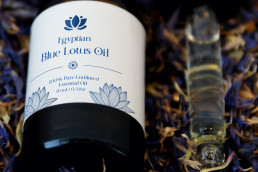
If you live in France and want to buy authentic Egyptian blue lotus oil (Nymphaea caerulea), you are facing a market that is quietly crowded with mislabelled products, synthetic fragrance oils sold as “huile essentielle de lotus bleu”, and a handful of genuinely good suppliers who ship into France cleanly. This guide explains the legal position in France, what the authentic material actually costs in euros, how to read a French-language label without being fooled, and where to buy blue lotus oil in France with reasonable confidence.
Table of Contents
- The Legal Status of Blue Lotus Oil in France
- Why the French Market Is Particularly Full of Fakes
- How to Read a French Blue Lotus Label
- The INCI and Botanical Name
- Absolute, Essential Oil, or CO2
- Dilution Disclosure
- Realistic Pricing in Euros
- Where to Buy Blue Lotus Oil in France
- Specialist Online Retailers Shipping Into France
- French Aromatherapy Houses
- Perfumery Supply Houses
- What to Avoid
- What to Ask Before You Buy
- Using Blue Lotus Oil Safely in the French Climate and Context
- A Note on French Customs and EU Imports
- Frequently Asked Questions
- Where to Go From Here
- Authentic Blue Lotus, Shipped to France
It is written and clinically reviewed by Antonio Breshears, ND, CCA, a Bastyr-trained naturopathic doctor and certified clinical aromatherapist. For the broader context on chemistry, extraction methods, and safe use, readers may find it useful to pair this regional guide with the complete guide to blue lotus oil, which covers the background material this article assumes.
The Legal Status of Blue Lotus Oil in France
Nymphaea caerulea, the Egyptian blue water lily from which the oil and absolute are produced, is not a controlled substance in France. It is not listed on the French schedules of narcotic or psychotropic substances, and it is not restricted under the cosmetic regulations that govern what can be sold for topical use in the European Union. This distinguishes France from a small group of jurisdictions (notably Russia, Poland, Latvia, and the US state of Louisiana) where the plant or its preparations are restricted or banned outright.
In practice this means French consumers can legally import, possess, and use blue lotus oil for aromatherapy, skincare formulation, and personal ritual. What you cannot legally do is sell it with medicinal claims (no claim to treat, cure, or prevent any condition) without going through the complex French and European authorisation routes for medicines. Reputable sellers in France therefore describe the oil in cosmetic, aromatic, or “usage externe” terms, which is correct and compliant.
One caveat worth naming: some French retailers are cautious about selling any Nymphaea caerulea preparation for ingestion or for use in food or drink. This caution is sensible. The oil and absolute are concentrated aromatic materials intended for diffusion and dilute topical application, not for oral consumption, and there is no established food-grade supply chain for the material at retail level in France.
Why the French Market Is Particularly Full of Fakes
France has a long, proud tradition of perfumery and aromatherapy. Grasse remains one of the great centres of the global fragrance trade, and French consumers are generally well educated about essential oils. Paradoxically, this sophistication is exactly why the blue lotus market in France is so full of misleading products: the demand is real, the botanical is genuinely scarce (three to five thousand flowers yield roughly one gram of absolute), and synthetic “lotus accords” are widely available to fragrance houses at a fraction of the price.
The result is a market in which a bottle labelled “huile essentielle de lotus bleu”, “huile parfumée lotus”, or “fragrance lotus bleu” might contain any of the following: a synthetic perfumer’s accord built from benzyl salicylate, ionones and musks; a dilution of genuine absolute in jojoba or fractionated coconut oil (sometimes at 3 to 10 percent, sometimes honestly labelled, sometimes not); a blend of cheaper florals (ylang-ylang, magnolia, lotus pink) tinted blue with colourants; or, occasionally, the real thing at a fair price.
Reading the French label carefully is therefore the single most valuable skill when shopping domestically.
How to Read a French Blue Lotus Label
The INCI and Botanical Name
Authentic blue lotus material will list Nymphaea caerulea flower extract or Nymphaea caerulea absolute in the INCI (International Nomenclature of Cosmetic Ingredients) list. If the INCI reads “parfum” or “fragrance” without a botanical name, you are almost certainly looking at a synthetic accord. If it reads “Nelumbo nucifera”, that is sacred lotus (pink or white Indian lotus), which is a different plant with different chemistry and a different scent profile.
Absolute, Essential Oil, or CO2
Most genuine French-market blue lotus is sold as an absolute (absolue de lotus bleu), produced by solvent extraction. True steam-distilled essential oil (huile essentielle in the strict French regulatory sense) is extremely rare and correspondingly expensive. Supercritical CO2 extract is the premium option, sometimes labelled extrait CO2. A bottle sold as “huile essentielle de lotus bleu” at under 30 euros for 5 ml should be treated with scepticism: the economics simply do not support it at that price.
Dilution Disclosure
Many reputable French sellers offer the absolute pre-diluted in jojoba (jojoba) or fractionated coconut oil (coco fractionnée) at 5, 10, or 20 percent. This is a legitimate, useful product and is often the right purchase for beginners. The dilution must be clearly stated on the label. If a product is suspiciously cheap and does not disclose dilution, assume it is heavily diluted or synthetic.
Realistic Pricing in Euros
To calibrate expectations, here is what genuine material costs on the French market in 2024 to 2025:
- Undiluted Egyptian absolute: 80 to 180 euros per 1 ml, 350 to 700 euros per 5 ml, depending on vintage and producer
- 10 percent dilution in jojoba: 25 to 50 euros per 10 ml
- 5 percent dilution in jojoba: 15 to 30 euros per 10 ml
- CO2 extract (premium): typically 30 to 50 percent more than equivalent absolute
Prices significantly below these ranges should prompt questions. Blue lotus absolute is one of the more expensive aromatic materials in the world by weight, alongside rose otto, orris, and boronia. The economics are not going to change because a boutique in the 11th arrondissement has a summer sale.
Where to Buy Blue Lotus Oil in France
Specialist Online Retailers Shipping Into France
The most reliable route for most French buyers is a specialist online retailer who deals specifically in blue lotus. This tends to beat general aromatherapy shops on quality because the seller’s entire reputation rests on the material being authentic. Delivery into metropolitan France from European and UK specialists is typically three to seven working days, with customs handled at the retailer’s end for EU sellers. Post-Brexit, UK sellers shipping into France may trigger VAT at import; reputable sellers disclose this clearly at checkout.
French Aromatherapy Houses
Several established French aromatherapy houses occasionally carry blue lotus absolute. Their advantage is domestic shipping and French-language customer service. Their disadvantage is that blue lotus is rarely a headline product for them, and stock can be inconsistent. When buying from a general aromatherapy house, ask directly for the country of origin of the flowers (Egypt is the gold standard, with some material coming from Thailand or India which is typically Nymphaea stellata or Nelumbo, not caerulea), the extraction method, and the batch date.
Perfumery Supply Houses
Grasse-linked perfumery suppliers sometimes offer blue lotus absolute in small quantities to independent perfumers and formulators. The quality is often excellent, but the packaging is bulk-oriented (10 ml up to 100 ml glass bottles) and the minimum order values can be high. This is the right route for someone formulating seriously, not for a first-time buyer.
What to Avoid
Generalist online marketplaces (the usual suspects, whose names need no repeating) are the single worst place to buy blue lotus oil in France. The rate of synthetic, mislabelled, or adulterated product on these platforms is extraordinarily high, and the review systems are easily manipulated. Esoteric or “spiritual” boutiques that sell crystals, incense, and candles alongside a 12 ml bottle of “huile de lotus bleu” at 15 euros are almost always selling fragrance oil, not absolute. Holiday souvenirs from Egyptian bazaars, sold as “pure blue lotus oil”, are essentially never genuine; the authentic material would cost more per millilitre than most tourists would pay for a full bottle.
What to Ask Before You Buy
A reputable seller in the French market, or selling into France, should be able to answer the following without hesitation:
- What is the botanical name on the certificate of analysis? (Answer must be Nymphaea caerulea.)
- What country were the flowers grown and harvested in? (Egypt, ideally the Nile delta region.)
- What extraction method was used? (Solvent for absolute, steam for essential oil, CO2 for extract.)
- Is there a GC-MS (gas chromatography mass spectrometry) analysis available? (Serious sellers have one.)
- If the product is diluted, at what percentage and in which carrier?
- What is the batch number and bottling date?
A seller who cannot or will not answer these questions is not one you want to buy from. A seller who answers them cleanly, with documentation, is almost certainly selling the real thing.
Using Blue Lotus Oil Safely in the French Climate and Context
France covers a wide range of climates, from the Mediterranean south to the temperate Atlantic and the continental east. Blue lotus absolute is fairly stable across these conditions, but a few practical notes apply. In southern France during summer, storing the bottle in a cool, dark cupboard (not on a sunny windowsill in Aix or Montpellier) meaningfully extends shelf life. The absolute will thicken or partially solidify at lower temperatures, which is normal; warming the bottle briefly in the hand restores fluidity.
For topical use, standard dilution guidelines apply: 1 to 2 percent on the face, 2 to 3 percent on the body, up to 3 percent for targeted application. For diffusion, two to four drops in a water diffuser is sufficient for a standard French salon or bedroom. The material is avoided in pregnancy and breastfeeding, and caution is warranted for anyone on dopaminergic medication, MAOIs, or heavy sedatives, given the oil’s mild interaction potential with these pathways.
A Note on French Customs and EU Imports
For buyers ordering from outside the EU (principally from UK, US, or Swiss specialists), French customs treats blue lotus oil as a standard cosmetic or aromatic material. VAT at 20 percent applies to the declared value plus shipping, and for orders above 150 euros customs duties may also apply. Reputable non-EU sellers will either handle this through a delivered-duty-paid arrangement or will be transparent about the likely additional cost. Unreliable sellers sometimes under-declare the value on customs forms, which is illegal and can cause packages to be seized.
For intra-EU orders (from Germany, the Netherlands, Italy, Spain), no customs apply and VAT is typically included in the listed price.
Frequently Asked Questions
Is blue lotus oil legal in France?
Yes. Nymphaea caerulea is not a controlled substance in France and is legal to buy, possess, and use for aromatherapy and topical cosmetic purposes. It cannot be sold with medicinal claims without medicine authorisation.
What is the French term for blue lotus oil?
The most accurate French terms are absolue de lotus bleu (blue lotus absolute) or extrait de lotus bleu (blue lotus extract). “Huile essentielle de lotus bleu” is commonly used but technically refers only to steam-distilled material, which is rare. Always check the INCI for Nymphaea caerulea.
How much should I expect to pay for authentic blue lotus oil in France?
Genuine undiluted Egyptian absolute costs 80 to 180 euros per millilitre. A 10 percent dilution in jojoba typically costs 25 to 50 euros per 10 ml. Prices significantly below these figures should prompt questions about authenticity.
Can I buy blue lotus oil in a French pharmacy?
Rarely. French pharmacies occasionally stock well-known essential oils (lavender, tea tree, eucalyptus), but blue lotus is too niche and too expensive for most pharmacy ranges. A specialist online retailer or aromatherapy house is a better route.
Is the blue lotus oil sold on large marketplaces authentic?
The overwhelming majority is not. The rate of synthetic, mislabelled, or heavily adulterated product on generalist marketplaces is extremely high, and authenticity cannot be verified from the listing. Specialist retailers with GC-MS documentation are strongly preferred.
Will I pay customs duties if I order from the UK?
Since Brexit, UK-to-France orders are subject to import VAT at 20 percent, and to customs duties on orders above 150 euros. Reputable UK sellers either handle this at checkout (delivered duty paid) or disclose it clearly.
Can blue lotus oil be used in food or drink in France?
No. The absolute and essential oil are concentrated aromatic materials for diffusion and dilute topical use. There is no established food-grade supply chain at retail level, and the material is not appropriate for ingestion.
How should I store blue lotus oil in a warm Mediterranean climate?
Keep the bottle in a cool, dark cupboard away from direct sunlight and heat. In Provence or the Côte d’Azur summer, avoid leaving the bottle in a bathroom that heats up or on a windowsill. Properly stored in dark glass, the absolute keeps for three to four years.
What is the difference between blue lotus and pink lotus in French aromatherapy?
Blue lotus (Nymphaea caerulea, lotus bleu) and pink lotus (Nelumbo nucifera, lotus rose or lotus sacré) are different plants with different scent profiles and different chemistry. Pink lotus is heavier, sweeter, and more honeyed; blue lotus is cooler, more aquatic, with a smoky-balsamic base. Check the botanical name on the label.
Can I make my own blends with blue lotus absolute in France?
Yes, for personal use this is entirely legal and is one of the most rewarding ways to use the material. Standard aromatherapy dilution guidelines apply (1 to 3 percent in a carrier oil, depending on application area). For selling finished cosmetic products in France you must comply with the EU Cosmetic Regulation, which requires a safety assessment and product information file.
Where to Go From Here
If this is your first bottle, a 5 to 10 percent dilution in jojoba from a specialist retailer is the sensible starting point. It lets you learn the scent, test your own skin tolerance, and begin formulating at realistic cost before committing to undiluted absolute. Once you know what genuine material smells and feels like, the undiluted absolute becomes a worthwhile investment for serious formulation work or personal ritual. For broader background on chemistry, extraction, and safe use across all applications, the complete guide to blue lotus oil is the natural next read.

Antonio Breshears
Antonio Breshears is a renowned expert in holistic medicine and beauty, with over 25 years of research experience dedicated to uncovering the secrets of nature's most powerful remedies. Holding a degree in Naturopathic Medicine, Antonio's passion for healing and well-being has driven him to explore the intricate connections between mind, body, and spirit.
Over the years, Antonio has become a respected authority in the field, helping countless individuals discover the transformative power of plant-based therapies, including essential oils, herbs, and natural supplements. He has authored numerous articles and publications, sharing his wealth of knowledge with a global audience seeking to improve their overall health and well-being.
Antonio's expertise extends to the realm of beauty, where he has developed innovative, all-natural skincare solutions that harness the potency of botanical ingredients. His formulations embody his deep understanding of the healing properties found in nature, providing holistic alternatives for those seeking a more balanced approach to self-care.
With his extensive background and dedication to the field, Antonio Breshears is a trusted voice and guiding light in the world of holistic medicine and beauty. Through his work at Pure Blue Lotus Oil, Antonio continues to inspire and educate, empowering others to unlock the true potential of nature's gifts for a healthier, more radiant life.