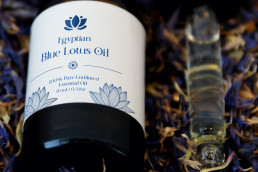
A blue lotus linen mist is one of the quietest luxuries you can make at home: a light aromatic spray that settles onto bedding, pillowcases, curtains and upholstery, releasing a soft honeyed-floral breath as you turn down the covers. This recipe produces roughly 100 ml of a well-balanced mist built around Egyptian blue lotus absolute, designed for evening use on natural fabrics. It is aimed at anyone who wants to bring a sense of ritual to the end of the day without the cloying sweetness of commercial room sprays.
Table of Contents
- What You Will Need
- Equipment
- Ingredients
- Why This Formulation Works
- Step-by-Step Instructions
- How to Use Your Linen Mist
- Storage and Shelf Life
- Variations
- For Sensitive Skin Contact
- For a Richer, More Sensual Profile
- For a Brighter Morning Linen Spray
- Alcohol-Based Version
- Common Mistakes to Avoid
- Frequently Asked Questions
- Where to Go From Here
- Start With Genuine Blue Lotus
It is written and clinically reviewed by Antonio Breshears, ND, CCA, a Bastyr-trained naturopathic doctor and certified clinical aromatherapist. If you want the broader context for how blue lotus behaves in aromatic preparations, the material science and the safety parameters, begin with the complete guide to blue lotus oil and return here when you are ready to formulate.
What You Will Need
Getting the equipment right before you begin saves frustration. Mists are simple, but they punish sloppy preparation because you notice every imperfection every time you spray.
Equipment
- One 100 ml amber or cobalt glass spray bottle with a fine-mist atomiser (plastic degrades with repeated oil contact; glass is non-negotiable for anything containing absolutes)
- A small glass beaker or measuring cylinder, 100 ml capacity
- A glass stirring rod or clean stainless teaspoon
- A small funnel (optional but helpful)
- A 0.1 gram digital scale if you prefer to weigh rather than count drops
- A label and waterproof marker
Ingredients
- 15 ml of solubiliser (polysorbate 20 is the standard; alternatively a high-proof perfumer’s alcohol at 190 proof or above)
- 80 ml of distilled water or pure rose hydrosol
- 20 drops of pure blue lotus absolute (approximately 1 ml)
- 10 drops of lavender essential oil (true lavender, Lavandula angustifolia)
- 5 drops of sandalwood essential oil (Australian or Indian)
- 3 drops of bergamot FCF essential oil (furocoumarin-free, to avoid any concern about fabric staining near skin)
Why This Formulation Works
A linen mist is not a perfume and not a room spray; it sits between the two. The concentration needs to be high enough that you can detect it as you turn back the covers but low enough that it does not overwhelm a closed bedroom overnight. This recipe lands at roughly 1.8 percent aromatic content, which is the sweet spot for bedding: perceptible at close range, quiet at a metre’s distance.
The solubiliser is the part people most often skip, and it is the part that determines whether the finished mist behaves or misbehaves. Essential oils and absolutes do not dissolve in water; without a solubiliser they float as droplets, stain linen unpredictably, and clog the atomiser within days. Polysorbate 20 is food-grade, odourless, and emulsifies oils cleanly at a ratio of roughly 1 part solubiliser to 1 part oil. High-proof alcohol works similarly, produces a drier finish and dries faster on fabric, but carries a faint spirit note for the first minute after spraying.
The scent architecture is built around blue lotus as the heart note, with lavender providing a soft herbal lift, sandalwood supplying a grounded base that helps the fragrance cling to natural fibres, and a whisper of bergamot FCF brightening the top. The choice of FCF bergamot matters: regular bergamot contains furocoumarins, which can photosensitise skin and occasionally mark fabrics in sunlight. On linen that will see daylight, FCF is the sensible default.
Step-by-Step Instructions
- Prepare your workspace. Work on a clean surface, ideally over a tray that catches spills. Blue lotus absolute is viscous and staining; a drop on a light carpet is a problem. Have your bottle, beaker and ingredients laid out before you begin.
- Combine the oils with the solubiliser first. Pour 15 ml of polysorbate 20 (or high-proof alcohol) into the beaker. Add the 20 drops of blue lotus absolute, 10 drops of lavender, 5 drops of sandalwood and 3 drops of bergamot FCF. Stir gently for a full minute. The mixture should become uniformly cloudy then clarify slightly as the oils bind to the solubiliser.
- Add the water slowly. Pour the 80 ml of distilled water or rose hydrosol into the beaker in a steady stream while stirring. The mixture will turn translucent milky and then, as it integrates, clear to a very pale golden tint. If it remains cloudy or separates within a minute, add another 2 to 3 ml of solubiliser and stir again.
- Transfer to the spray bottle. Using the funnel, decant the finished mist into your 100 ml glass bottle. Leave roughly 5 mm of airspace at the top to allow the atomiser tube to seat correctly.
- Fit the atomiser and test. Screw the sprayer firmly in place and test on a piece of scrap cotton or a paper towel. The mist should come out as a fine even cloud, not a concentrated stream. Pump three or four times initially to prime the mechanism.
- Label and date the bottle. Write the name, date of making, and the note “shake before use” clearly. Dated bottles earn their keep six months down the line when you are trying to remember if the batch is still fresh.
How to Use Your Linen Mist
Hold the bottle roughly 30 centimetres from the fabric and spray in a sweeping motion across pillowcases, duvet covers and top sheets about twenty minutes before you intend to get into bed. Two to three pumps per pillow is sufficient; more is not better and can leave fabrics feeling faintly damp. The twenty minute gap lets any residual moisture evaporate and allows the top notes to soften into the more settled heart.
Shake the bottle briefly before each use. Even with a solubiliser, a light separation over time is normal and is corrected instantly by a few seconds of agitation. The mist also works beautifully on curtains at the end of a long day, on the shoulders of a dressing gown hanging on the back of a door, or lightly across a reading chair before an evening’s quiet.
Avoid spraying directly onto silk, unlined velvet, or any fabric with a water-sensitive dye. For those, mist the inside of a pillowcase or sheet rather than the visible surface. Patch-test any fabric you are uncertain about by spraying a small area on an inconspicuous edge and leaving it for twenty-four hours.
Storage and Shelf Life
Stored in dark glass away from direct sunlight and kept below about 22 degrees Celsius, this mist will hold its character for approximately 6 months. A bedroom wardrobe or bedside drawer is ideal. If you used rose hydrosol instead of distilled water, reduce the expected shelf life to 3 to 4 months because hydrosols carry a small microbial load that distilled water does not. For extended life you can add 0.5 ml of a broad-spectrum natural preservative such as Leucidal Liquid; this pushes the water-based version reliably past six months.
Discard the mist if you notice any cloudiness that does not clear on shaking, any visible particles or films, or a sour or off note in the fragrance. These are signs of microbial growth, not quality ageing.
Variations
For Sensitive Skin Contact
If you tend to press your face directly into freshly misted pillowcases, reduce the total drop count by half (10 drops blue lotus, 5 drops lavender, 3 drops sandalwood, 2 drops bergamot FCF) and keep the solubiliser at 15 ml. This yields a very gentle mist at roughly 0.9 percent aromatic content, well within the range considered safe for overnight skin contact on non-broken skin for most adults.
For a Richer, More Sensual Profile
Replace the sandalwood with 5 drops of vetiver and add 2 drops of jasmine absolute alongside the blue lotus. The result is a denser, more indolic base that suits cooler months and heavier bedding. This variation is not for everyone; vetiver is polarising and will dominate if you go heavier than suggested.
For a Brighter Morning Linen Spray
For linen cupboards and daytime bedding refreshing, swap the sandalwood for 5 drops of petitgrain and add 3 extra drops of bergamot FCF. Keep the blue lotus at 20 drops so it remains the signature. This version reads as clean and lifted rather than contemplative.
Alcohol-Based Version
Replace polysorbate 20 with 20 ml of perfumer’s alcohol (190 proof or above) and reduce the water to 75 ml. The alcohol-based mist dries faster, feels crisper on fabric, and keeps longer (approaching 12 months) but carries a brief spirit note in the first ten seconds after spraying.
Common Mistakes to Avoid
The most frequent failure is skipping the solubiliser and shaking hopefully. Water and oil do not compromise, no matter how vigorously you agitate the bottle. Oil droplets will land on linen and leave small halo marks as they dry. Use a solubiliser or use alcohol; there is no third option.
A second common error is using tap water, which contains minerals and chlorine that accelerate microbial growth and can flatten the fragrance. Distilled water is inexpensive and worth the small trouble of buying a bottle.
Overdosing the blue lotus is another trap. Absolutes are concentrated; 20 drops in 100 ml is already generous. Doubling the dose produces a heavier, less refined scent and can push the mist into cloying territory, particularly in a warm closed bedroom.
Finally, do not decant into plastic. Plastic atomisers degrade when repeatedly exposed to essential oils and absolutes; within weeks you will notice the spray mechanism weakening and a faint plasticky note entering the fragrance. Glass bottles with inert plastic or metal atomiser heads are the correct choice.
Frequently Asked Questions
Can I use this mist on my skin?
It is formulated for fabric, not skin. The dilution is appropriate for indirect skin contact through bedding, but direct spraying onto skin is not recommended because the solubiliser and higher water ratio do not provide the emolliency skin needs. For a skin-safe product, a blue lotus facial mist or body oil is the right format.
Will blue lotus absolute stain my sheets?
When properly solubilised and diluted as described, the mist should not stain white or light-coloured natural fabrics. However, always test on an inconspicuous area first, and avoid spraying direct droplets onto silk or delicate dyed fabrics. The orange-gold tint of the absolute is very dilute at this concentration and evaporates cleanly when emulsified.
How often can I apply the mist?
Nightly use is fine for most adults on most bedding. If you are someone who washes pillowcases weekly, apply every night; if you go longer between washes, every second night prevents fragrance build-up.
Can I use this mist during pregnancy?
Blue lotus absolute is generally avoided during pregnancy and breastfeeding as a precautionary measure. For pregnant users who still want an aromatic linen mist, a simple lavender and chamomile version at 1 percent dilution is a safer alternative.
Why does my mist separate between uses?
A very small amount of separation is normal and is resolved by a brief shake. Persistent heavy separation means your solubiliser ratio is too low; add 2 to 3 ml more and stir thoroughly. If the mixture goes milky and will not clear, it usually means the ratio of oil to solubiliser exceeded roughly 1 to 1; add more solubiliser to rebalance.
Can I use hydrosol instead of distilled water?
Yes, and it can be beautiful. Rose, neroli and chamomile hydrosols all pair well with blue lotus. Just reduce the expected shelf life by roughly half, because hydrosols carry residual plant material that supports microbial growth more readily than distilled water.
Is it safe around pets?
Avoid misting bedding shared with cats. Cats lack certain liver enzymes needed to metabolise some essential oil constituents, and even dilute repeated exposure can accumulate. Dogs tolerate lavender and sandalwood at these dilutions in most cases, but it is sensible to mist the far side of the bed rather than directly over a sleeping dog.
What if I do not have a 0.1 gram scale?
Drop counting is perfectly adequate for this recipe. Essential oil droppers produce reasonably consistent drops, and the recipe is not so tightly calibrated that a drop or two either way will change the outcome. Reserve the scale for perfumery work where precision matters more.
Can I make a smaller batch?
Yes. Halve every ingredient and use a 50 ml bottle instead. Smaller batches are sensible for first attempts so you can adjust the scent profile before committing to a larger volume.
How do I know if my blue lotus absolute is pure?
Pure blue lotus absolute is deep orange-gold to amber, thick and slow-moving at room temperature, and carries a layered honeyed-floral profile with cooler aquatic top notes and a soft balsamic base. Overly thin, pale or sharply perfumed samples are usually diluted or reconstituted. Source from a vendor who specifies extraction method, origin and batch testing.
Where to Go From Here
A linen mist is often the first home formulation people attempt because it forgives small errors and delivers immediate pleasure. Once this recipe is working well for you, the same principles (solubiliser, dilution arithmetic, scent architecture) scale directly into body oils, room sprays, pillow mists and ritual anointing oils. If you want to go deeper into the material itself, its chemistry, its origins and the evidence for its effects, the complete guide to blue lotus oil is the reference to keep open. The craft rewards careful attention; the fragrance repays it every night you turn down the covers.

Antonio Breshears
Antonio Breshears is a renowned expert in holistic medicine and beauty, with over 25 years of research experience dedicated to uncovering the secrets of nature's most powerful remedies. Holding a degree in Naturopathic Medicine, Antonio's passion for healing and well-being has driven him to explore the intricate connections between mind, body, and spirit.
Over the years, Antonio has become a respected authority in the field, helping countless individuals discover the transformative power of plant-based therapies, including essential oils, herbs, and natural supplements. He has authored numerous articles and publications, sharing his wealth of knowledge with a global audience seeking to improve their overall health and well-being.
Antonio's expertise extends to the realm of beauty, where he has developed innovative, all-natural skincare solutions that harness the potency of botanical ingredients. His formulations embody his deep understanding of the healing properties found in nature, providing holistic alternatives for those seeking a more balanced approach to self-care.
With his extensive background and dedication to the field, Antonio Breshears is a trusted voice and guiding light in the world of holistic medicine and beauty. Through his work at Pure Blue Lotus Oil, Antonio continues to inspire and educate, empowering others to unlock the true potential of nature's gifts for a healthier, more radiant life.