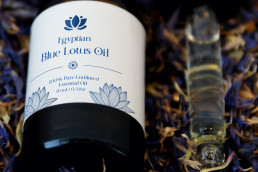
If you are searching for blue lotus oil in Manchester, this guide walks through what is actually available across the city, from the independent apothecaries of the Northern Quarter to the herbal shops of Chinatown and Rusholme, and explains how to tell a properly extracted Nymphaea caerulea absolute from the diluted perfume oil that tends to fill gaps in the market. It is written for people who want the real thing and want to understand what they are paying for.
Table of Contents
- Is Blue Lotus Oil Easy to Find in Manchester?
- Understanding What You Are Actually Buying
- The Northern Quarter: Where Most Manchester Buyers Start
- Independent Apothecaries and Crystal Shops
- Afflecks
- Chinatown, Rusholme and the Herbal Dispensaries
- Arndale Market and the Weekend Stalls
- Ordering Online to a Manchester Address
- How to Verify Authenticity Before You Pay
- Realistic Price Expectations in Manchester
- When a Local Purchase Is the Right Choice
- Storing Your Oil Once You Get It Home
- Frequently Asked Questions
- Where to Go From Here
- Delivered Next Day to Manchester
It is written and clinically reviewed by Antonio Breshears, ND, CCA, a Bastyr-trained naturopathic doctor and certified clinical aromatherapist. For a broader grounding in the botany, chemistry and safe use of this oil before you buy, the complete guide to blue lotus oil is the most useful companion to this city-specific buying article.
Is Blue Lotus Oil Easy to Find in Manchester?
Manchester is better served for niche aromatics than most UK cities outside London. The city has a strong independent retail scene, a large student and wellness population, several well-stocked herbal dispensaries, and enough perfumery and ritual-focused shops to make blue lotus oil findable if you know where to look. What you will not find, realistically, is a high-street chain that stocks a genuine, undiluted Nymphaea caerulea absolute. Holland and Barrett, Boots and Neal’s Yard on King Street do not carry it as a standard line, and when adjacent products appear under names like “lotus blossom” or “sacred lotus”, they are almost always pink or white lotus (a different species entirely) or a synthetic fragrance blend.
The genuine oil in Manchester lives in three places: small independent apothecaries, specialist online sellers who ship to the city quickly, and the occasional market stall at the Northern Quarter or Afflecks. Each route has its own trade-offs, and the rest of this guide works through them in order of how reliable they tend to be.
Understanding What You Are Actually Buying
Before walking into any shop in Manchester, it helps to know the three forms blue lotus oil commonly takes so you can recognise what you are being sold.
The first is a solvent-extracted absolute, which is by far the most common true form of blue lotus oil worldwide. It is deep amber to dark brown, viscous at room temperature, and smells of honeyed florals with a cool water-lily top note and a balsamic base. Three to five thousand flowers are required to produce a single gram, which is why legitimate absolute is expensive. In Manchester independents, expect roughly £35 to £60 for 1ml, or £80 to £150 for 5ml, depending on grade and dilution.
The second is a steam-distilled essential oil, which is rare, much paler, and thinner in body. Almost no Manchester retailer stocks the true distilled form because global supply is tiny.
The third, and the one you should be wary of, is a pre-diluted perfume oil: a small amount of absolute (or sometimes a synthetic aroma chemical) carried in jojoba, fractionated coconut or DPG. These are sold at £8 to £20 for 10ml and are perfectly legitimate products in their own right, but they are not what someone buying “blue lotus oil” for aromatherapy, ritual or skincare generally means. The bottle should tell you the dilution percentage; if it does not, ask.
The Northern Quarter: Where Most Manchester Buyers Start
The Northern Quarter, roughly the triangle between Piccadilly Gardens, Ancoats and Stevenson Square, is the most reliable neighbourhood in the city for independent apothecary and ritual goods. The area has historically concentrated the sort of small, owner-run shops that carry single-flower absolutes.
Independent Apothecaries and Crystal Shops
Several shops around Oldham Street, Tib Street and Thomas Street stock essential oils and absolutes aimed at the witchcraft, ritual and energy-work market rather than the mainstream aromatherapy market. This is actually good news for blue lotus buyers, because ritual suppliers tend to source the authentic absolute (it is specifically associated with Egyptian ceremonial use, meditation and lucid dream practice, all of which drive demand among their customers).
When you visit, ask three questions before buying: is this the true Nymphaea caerulea, is it an absolute or a dilution, and what is the percentage if it is diluted. A knowledgeable owner will answer all three without hesitation. If the response is vague or defensive, walk away and try elsewhere. Authenticity shows in the paperwork: a reputable seller should be able to show you, or at least describe, the country of origin (almost always Egypt or, increasingly, Thailand and Sri Lanka), the extraction method, and ideally a recent GC-MS certificate of analysis.
Afflecks
Afflecks, the indoor emporium on Church Street, houses a rotating cast of small independent sellers across four floors. At any given time there are usually two or three stalls selling essential oils, tarot supplies and ritual goods. Quality varies dramatically stall to stall. Some sellers carry genuine small-batch Egyptian absolute in 1ml vials at fair prices; others sell perfume-grade blends under ambiguous labelling. This is the kind of place where your ability to read a label and ask sharp questions directly affects what you walk out with.
Chinatown, Rusholme and the Herbal Dispensaries
Manchester’s Chinese herbal shops on Faulkner Street, George Street and Nicholas Street occasionally stock lotus-derived products, but these are almost always Nelumbo nucifera (pink or sacred lotus), which is a genuinely different plant used in traditional Chinese medicine. The seeds, stamens and petals of Nelumbo are valuable in their own right, but they are not blue lotus, and the oil extracted from them has a different chemistry and a different aromatic profile. If you specifically want Nymphaea caerulea, these shops are unlikely to help despite their impressive range.
Rusholme’s Curry Mile and the Indian and Middle Eastern shops along Wilmslow Road sometimes carry attars and perfume oils labelled “lotus” or “blue lotus”, typically in small ornate bottles. These can be lovely products for anointing and fragrance use, but they are almost universally dilutions in a sandalwood or paraffin base, and the blue lotus content is small. They are not suitable for aromatherapy dosing or for anyone wanting to know exactly what percentage of active material they are applying.
Arndale Market and the Weekend Stalls
The weekend makers’ markets that rotate through Piccadilly Gardens, Stevenson Square and occasionally Spinningfields bring independent perfumers and herbalists into the city on an irregular schedule. Some of the most interesting blue lotus oil I have seen in Manchester has come from these stalls, particularly from small Egyptian and Sudanese traders who import directly. The catch is predictability: the right stall might be there one Saturday and absent the next.
If you are committed to finding blue lotus oil at a market rather than a fixed shop, it is worth checking Manchester Makers Market, Levenshulme Market (which leans more food-focused but hosts occasional botanical sellers), and the Cathedral Gardens events calendar. Expect to pay cash, expect to pay less than apothecary prices, and expect to carry more responsibility for verifying what you are buying.
Ordering Online to a Manchester Address
For most Manchester buyers, ordering online from a specialist supplier and having it delivered to M1, M4, M14, M20 or wherever you are is the most reliable route. Next-day delivery is widely available, return policies are clearer, and you can see GC-MS analysis, extraction method and origin documented on the product page before you pay.
The advantages of buying online are straightforward: you get a documented chain of provenance, you can compare the same oil across suppliers, and you can read the methodology rather than relying on a counter conversation. The disadvantage is that you cannot smell before you buy, which matters with blue lotus absolute more than with most oils because the aroma tells you a great deal about the extraction quality.
If you are new to the oil and want to smell it before committing to a full bottle, a sensible compromise is to buy a 1ml sample from a Northern Quarter apothecary first, decide whether the scent profile suits you, and then order a 5ml or 10ml bottle online from a supplier whose documentation you trust. That sequence avoids the two failure modes, paying shop prices for a product you cannot evaluate, and ordering a larger bottle online of an oil you end up not liking.
How to Verify Authenticity Before You Pay
Whichever route you choose in Manchester, the verification checklist is the same. Any shop or website selling genuine blue lotus absolute should be able to provide, or at least clearly state, the following:
- Botanical name: Nymphaea caerulea, not Nelumbo nucifera, not simply “lotus”.
- Country of origin: Egypt is classical, but good absolute now also comes from Thailand, Sri Lanka and parts of India.
- Extraction method: solvent extraction (absolute), steam distillation (true essential oil, rare) or supercritical CO2 (premium, increasingly available).
- Dilution status: is this neat absolute, or is it pre-diluted in a carrier, and if so at what percentage.
- GC-MS or equivalent analysis: reputable suppliers test for aporphine and nuciferine alkaloids and for common adulterants.
- Appearance and scent: dark amber to brown, viscous, honeyed-floral with a cool top and balsamic base. A pale, thin, uniformly sweet “lotus” oil is almost certainly synthetic or heavily diluted.
If you are paying apothecary prices (over £30 for 1ml) you have every right to ask for this information, and a good Manchester seller will not be offended by the questions. Sellers who push back on authenticity questions are telling you something useful about what they are selling.
Realistic Price Expectations in Manchester
Prices in Manchester track the national range but tilt slightly lower than central London independents and slightly higher than purely online specialists. As a rough guide:
- 1ml genuine absolute in a Northern Quarter apothecary: £35 to £55.
- 5ml genuine absolute: £90 to £150.
- 10ml pre-diluted perfume oil (genuine absolute in a carrier, legitimate product): £15 to £30.
- 10ml “blue lotus” oil at under £10: almost certainly synthetic fragrance or a fractional dilution, fine for scenting a drawer but not for aromatherapy.
Paying less than these ranges for something claiming to be genuine absolute is a red flag. Paying considerably more is not automatically a sign of higher quality either; boutique pricing in Manchester sometimes reflects the shop’s rent rather than the oil’s grade.
When a Local Purchase Is the Right Choice
There are three situations where I would suggest buying locally in Manchester rather than online. First, if you have never smelled blue lotus absolute before and want to know whether the profile suits you. Second, if you are buying for a ritual or ceremonial purpose on a specific date and cannot wait for delivery. Third, if you want to support the independent apothecary scene that keeps unusual oils available in the city at all, which is a legitimate reason in its own right.
For ongoing use, for skincare formulation at precise dilutions, or for anyone building a considered aromatherapy practice, an online specialist with proper documentation is almost always the better route. The oil arrives the next day anywhere in Greater Manchester, the paperwork is clear, and you can replenish at a consistent quality.
Storing Your Oil Once You Get It Home
A brief practical note, because Manchester’s climate, humid, cool, fluctuating, is actually kinder to essential oils than a southern English summer. Store your blue lotus absolute in its original dark glass bottle, in a drawer or cupboard away from direct sunlight, ideally at temperatures between 10 and 20 degrees Celsius. A bathroom cabinet is the worst location because of the humidity swings; a bedroom chest of drawers or a kitchen cupboard away from the hob is ideal. Properly stored, an absolute keeps its full aromatic quality for three to four years.
Frequently Asked Questions
Does Holland and Barrett on Market Street sell blue lotus oil?
Not as a standard line. Holland and Barrett’s essential oil range focuses on common aromatherapy oils (lavender, tea tree, peppermint, frankincense) and does not typically stock Nymphaea caerulea. Occasionally a “lotus” blend appears in their fragrance oil range, but these are synthetic or heavily diluted perfume products rather than genuine absolute.
Can I buy blue lotus oil at Neal’s Yard Remedies on King Street?
Neal’s Yard carries a strong aromatherapy range but does not stock blue lotus absolute as a regular line. Staff are generally knowledgeable and can advise on alternatives if blue lotus is unavailable, but for the specific oil you will need to look at independents or online specialists.
Are the blue lotus oils sold at Afflecks genuine?
It varies by stall. Some Afflecks traders carry genuine small-batch Egyptian absolute; others sell perfume-grade dilutions or synthetic blends. The checklist in this guide, botanical name, origin, extraction method, dilution status, applies fully at Afflecks. A confident, specific answer to those questions suggests a reliable seller.
Is the lotus oil at Chinese herbal shops in Chinatown the same thing?
No. Chinese herbal shops generally carry products from Nelumbo nucifera, the pink or sacred lotus, which is a different plant with different chemistry. It is a valuable herb in its own right, but the aromatherapeutic and ritual profile of Nymphaea caerulea (Egyptian blue lotus) is distinct.
What should I pay for 5ml of genuine blue lotus absolute in Manchester?
Somewhere between £90 and £150 is the honest range. Substantially less than this suggests dilution or synthetic content. Substantially more may reflect boutique pricing rather than superior grade.
Can I get same-day delivery in Manchester if I order online?
Same-day is uncommon for specialist oils, but next-day delivery to Manchester postcodes is widely available from UK-based suppliers. If you are on a deadline, order before midday on a weekday.
Is it legal to buy blue lotus oil in the UK?
Yes. Blue lotus is legal to buy, sell and possess in the United Kingdom, including in Manchester. Restrictions exist in certain other jurisdictions (Russia, Poland, Latvia, the US state of Louisiana), but not in the UK.
Will the oil I buy in Manchester smell the same as what I would get online?
If both are genuine Nymphaea caerulea absolute from comparable origins, yes, with small batch-to-batch variation. The scent should have a cool floral-aquatic top, a honeyed floral heart and a balsamic base. A uniformly sweet, one-dimensional “lotus” scent is a sign of synthetic or heavily diluted product regardless of where it was bought.
Can I use blue lotus oil bought in Manchester during pregnancy?
No. Blue lotus oil is avoided in pregnancy and breastfeeding regardless of where it was purchased. The alkaloid content makes it unsuitable during these periods.
What if the Manchester shop cannot tell me the country of origin or extraction method?
Walk away and try another supplier. Any seller charging apothecary prices should be able to answer basic provenance questions. Inability or unwillingness to do so suggests either a product you cannot verify or a seller who has not bothered to ask their own supplier, neither of which is a good sign.
Where to Go From Here
If you are approaching blue lotus oil for the first time, I would suggest starting with a 1ml sample from a Northern Quarter apothecary to establish whether the scent profile suits you, then reading the complete guide to blue lotus oil for the botanical, chemical and safety grounding you will need before using it seriously. Manchester is a good city to buy this oil in if you know what you are looking for; it is a frustrating city if you do not, because the gap between genuine absolute and synthetic “lotus” perfume is wide and the labelling does not always help. Slow down, ask the three questions, and the good sellers will reveal themselves quickly.

Antonio Breshears
Antonio Breshears is a renowned expert in holistic medicine and beauty, with over 25 years of research experience dedicated to uncovering the secrets of nature's most powerful remedies. Holding a degree in Naturopathic Medicine, Antonio's passion for healing and well-being has driven him to explore the intricate connections between mind, body, and spirit.
Over the years, Antonio has become a respected authority in the field, helping countless individuals discover the transformative power of plant-based therapies, including essential oils, herbs, and natural supplements. He has authored numerous articles and publications, sharing his wealth of knowledge with a global audience seeking to improve their overall health and well-being.
Antonio's expertise extends to the realm of beauty, where he has developed innovative, all-natural skincare solutions that harness the potency of botanical ingredients. His formulations embody his deep understanding of the healing properties found in nature, providing holistic alternatives for those seeking a more balanced approach to self-care.
With his extensive background and dedication to the field, Antonio Breshears is a trusted voice and guiding light in the world of holistic medicine and beauty. Through his work at Pure Blue Lotus Oil, Antonio continues to inspire and educate, empowering others to unlock the true potential of nature's gifts for a healthier, more radiant life.