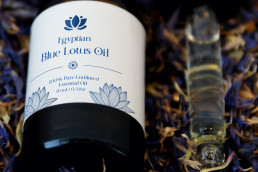
If you are searching for blue lotus oil in Miami, you are likely looking in one of three places: a Wynwood apothecary, a botanica in Little Havana, or a wellness boutique in Coconut Grove or South Beach. The good news is that Miami is one of the better US cities for sourcing botanicals, given its position as a port for South American and African imports. The less good news is that the same trade flows that bring genuine material also bring a great deal of adulteration. This guide explains where blue lotus oil typically surfaces in Miami, what to ask before you buy, and how to tell a real bottle of Nymphaea caerulea from a synthetic fragrance dressed up in amber glass.
Table of Contents
- Why Miami Is a Mixed Bag for Botanical Sourcing
- Neighbourhoods Where Blue Lotus Oil Surfaces
- Wynwood and the Design District
- Little Havana and Allapattah Botanicas
- South Beach and Coconut Grove
- Doral, Aventura, and Online Distribution
- What to Ask Before You Buy Blue Lotus Oil in Miami
- How to Tell Real Blue Lotus Oil from a Synthetic
- What Genuine Blue Lotus Oil Costs in Miami
- Climate Considerations Specific to Miami
- When Buying Locally Makes Sense, and When It Does Not
- Realistic Expectations Once You Have the Bottle
- Frequently Asked Questions
- Where to Go From Here
- Skip the Guesswork, Order Direct
It is written and clinically reviewed by Antonio Breshears, ND, CCA, a Bastyr-trained naturopathic doctor and certified clinical aromatherapist. For background on the oil itself, its chemistry, and how genuine extracts behave, readers may also wish to consult The Complete Guide to Blue Lotus Oil, which serves as the master reference for everything that follows.
Why Miami Is a Mixed Bag for Botanical Sourcing
Miami sits at an unusual crossroads. The city’s importers handle large volumes of essential oils, resins, and absolutes from Egypt, India, Madagascar, and across South America. That means real blue lotus absolute genuinely passes through the port. It also means that diluted, blended, and outright counterfeit material moves through the same channels, often arriving in unmarked drums and getting rebottled by smaller operations before reaching shop shelves.
The result is that two bottles labelled “blue lotus oil” sitting side by side in a South Beach boutique can have wildly different contents. One might be a genuine solvent-extracted absolute from the Nile delta, retailing at the price such material commands. The other might be jojoba oil with a few drops of synthetic lily fragrance, sold for a fraction of what real material costs but still at a premium that suggests authenticity. Without some basic knowledge of what to look for, the consumer has no way to tell.
This is not a Miami-specific problem; it happens in every major US city. But Miami’s volume of botanical trade, combined with its strong wellness retail scene, means the problem shows up here more often than in less commercially active markets.
Neighbourhoods Where Blue Lotus Oil Surfaces
Wynwood and the Design District
Wynwood’s apothecaries and wellness boutiques tend to stock higher-end essential oils, and a handful carry blue lotus absolute. Prices here are typically honest, meaning the genuine material is priced like genuine material (in the range of forty to ninety dollars for a small 2 to 5 ml bottle). The risk in Wynwood is less about counterfeits and more about poorly stored stock: bottles sitting in warm shop windows degrade quickly, and absolutes in particular lose their characteristic top-note brightness within months of heat exposure.
Little Havana and Allapattah Botanicas
Botanicas serving Caribbean and Latin American spiritual traditions occasionally stock blue lotus oil, often labelled in Spanish (aceite de loto azul). The provenance here is variable. Some botanicas source from genuine importers and the material is real, if sometimes pre-diluted in a carrier oil. Others stock fragrance oils intended for ritual use that contain no actual lotus extract at all and are not marketed to. The price point usually tells you which you are looking at: if the bottle costs less than fifteen dollars, it is almost certainly a fragrance oil rather than an absolute.
South Beach and Coconut Grove
The wellness retail scene along Lincoln Road and in the Grove tends to focus on familiar essential oils (lavender, frankincense, eucalyptus) and stocks blue lotus less consistently. When it does appear here, it is often as part of a pre-blended product (a sleep blend, a meditation roller, a perfume oil) rather than as a standalone absolute. These blends can be lovely, but the lotus content is typically a fraction of a percent, and the therapeutic profile is dominated by whatever else is in the formula.
Doral, Aventura, and Online Distribution
A significant amount of blue lotus oil sold to Miami residents never passes through a brick-and-mortar shop at all. It arrives by courier from online retailers, some of whom warehouse in Doral or Aventura for fast regional shipping. This is, in fact, where most genuine material is now bought, both because the selection is broader and because reputable online sellers are typically more transparent about sourcing, extraction method, and batch documentation than physical shops.
What to Ask Before You Buy Blue Lotus Oil in Miami
Whether you are standing in a Wynwood apothecary or messaging an online vendor based in South Florida, the same five questions sort genuine sellers from those who are guessing or worse.
1. What is the botanical name? The answer should be Nymphaea caerulea. If the seller cannot produce the Latin binomial, or offers something different (lotus species belong to Nelumbo, which is a different plant entirely), the material is either mislabelled or not what it claims to be.
2. What extraction method was used? Genuine blue lotus oil is almost always a solvent-extracted absolute (most common), occasionally a supercritical CO2 extract (premium), and very rarely a true steam-distilled essential oil (which gives much lower yields and costs accordingly). If the seller does not know, walk away.
3. Is this a pure absolute or pre-diluted? Many shops sell blue lotus pre-diluted in jojoba or fractionated coconut oil, typically at 5 to 10 percent. This is not dishonest if disclosed, and it can be perfectly useful for direct skin application, but you should be paying accordingly. A 10 percent dilution should cost roughly a tenth of what the pure absolute costs per millilitre.
4. Where is it from, and do you have a GC-MS report? Genuine blue lotus typically comes from Egypt, with smaller quantities from India and Sri Lanka. Reputable suppliers can produce a gas chromatography mass spectrometry analysis showing the alkaloid and flavonoid profile. Smaller shops will not have this in-house, but should be able to request it from their importer if asked.
5. How is it stored, and when was the bottle filled? Absolutes degrade with heat and light. A bottle that has been sitting in a sunny shop window for a year is no longer the same product it was when it arrived. Ask when the current stock came in, and prefer dark glass kept in a cool location.
How to Tell Real Blue Lotus Oil from a Synthetic
You can do a great deal of authentication with your nose and a tissue, before you ever spend money. Genuine blue lotus absolute has a very specific scent profile: a cooler, slightly aquatic-floral top note, opening into a deep, honeyed, almost wine-like floral heart, and finishing on a balsamic-smoky, slightly resinous base. The whole impression is unmistakably warm and contemplative, never sharp, never candy-sweet, and never reminiscent of a soap aisle.
Synthetic “blue lotus” fragrance oils, by contrast, tend to be one-dimensional. They smell pleasantly floral on first sniff but flatten out almost immediately, with no evolution from top to base. They often carry a slightly chemical or alcohol-like sharpness underneath the floral note, particularly as they dry down on a tissue strip.
A second test: place a single drop on a strip of unbleached paper or a coffee filter. Genuine absolute will leave a slight oily, slightly yellow-brown ring. The fragrance will continue to evolve over several hours, with the base notes becoming more pronounced as the lighter compounds evaporate. A synthetic will dry to a clean spot with little colour, and the scent will remain essentially the same throughout, eventually fading without the deep, smoky-honeyed dry-down of the real material.
A third test, if the seller permits it: look at the oil itself. Genuine blue lotus absolute is viscous, often quite thick at room temperature, and ranges in colour from deep amber to dark reddish-brown. A thin, water-clear or very pale yellow liquid sold as “blue lotus oil” is almost certainly either heavily diluted or not the genuine extract at all.
What Genuine Blue Lotus Oil Costs in Miami
Pricing is the single most reliable counterfeit detector. Real blue lotus absolute requires roughly three thousand to five thousand flowers per gram of finished material. The labour, growing conditions, and processing involved mean that genuine pure absolute simply cannot be sold cheaply.
As a rough guide for Miami in current market conditions:
- 1 ml of pure absolute: roughly twenty-five to forty-five dollars
- 2 to 3 ml of pure absolute: roughly forty-five to eighty-five dollars
- 5 ml of pure absolute: roughly ninety to one hundred and sixty dollars
- 10 ml of 10 percent dilution in jojoba: roughly twenty-five to forty-five dollars
If a Miami shop is selling 15 ml of “pure blue lotus oil” for nineteen dollars, the maths simply does not work. That bottle contains either a heavily diluted product, a synthetic fragrance, or a different botanical entirely. Honest dilutions are fine, but they should be priced and labelled as such.
Climate Considerations Specific to Miami
Miami’s heat and humidity are genuinely hard on absolutes. Even a perfectly genuine bottle of blue lotus oil will degrade noticeably if it sits in a hot car for an afternoon, or lives on a bathroom shelf where the temperature climbs into the eighties most of the year. Once you have your bottle home, the single most useful storage decision is to keep it in the refrigerator, or at minimum in the coolest interior cupboard you have, away from any window.
Properly stored in dark glass, kept cool and dark, a quality absolute will hold its character for three to four years. Stored on an open shelf in a Miami apartment without air conditioning, the same bottle may lose its characteristic top notes within six to twelve months. Refrigeration genuinely doubles or triples the useful life of the oil, and there is no downside other than letting it warm to room temperature briefly before use so it pours easily.
When Buying Locally Makes Sense, and When It Does Not
The argument for buying blue lotus oil in person in Miami is straightforward: you can smell it before you commit, ask the shopkeeper questions in real time, and avoid shipping delays. The argument against is that physical shops carry small quantities, often have limited turnover, and may not be able to produce documentation about sourcing or testing.
If you are new to blue lotus oil and want to be certain that what you are smelling matches the description before you spend a meaningful sum, an in-person visit to a reputable Wynwood or Coconut Grove apothecary is genuinely useful. If you have used the oil before and know what you want, online ordering from a transparent supplier with documentation is usually the better route, both for selection and for storage quality (most reputable online sellers ship from climate-controlled warehouses, which is more than can be said for many shop windows).
Realistic Expectations Once You Have the Bottle
It is worth saying plainly: even genuine blue lotus oil is a modestly acting botanical, not a dramatic one. The scent is genuinely lovely and the aromatic effect on mood is reasonably well-attested, but it is not a strong sedative, not a hallucinogen, and not a substitute for clinical care if you are dealing with a serious anxiety, sleep, or mood condition.
Used aromatically (a few drops in a diffuser, or properly diluted on the skin), most people describe a quiet softening of mental chatter, a sense of grounded calm, and a gentle deepening of sleep when used in the evening. These effects are real but subtle. If you are expecting something dramatic, you will be disappointed regardless of how genuine your bottle is.
Frequently Asked Questions
Where is the best place to buy blue lotus oil in Miami?
Reputable Wynwood and Coconut Grove apothecaries are the most reliable physical options, but many Miami residents now buy from transparent online specialists who can provide sourcing documentation and ship from climate-controlled storage. Both routes can yield genuine material if you ask the right questions.
Is blue lotus oil legal to buy in Miami?
Yes. Blue lotus is legal to buy and possess in Florida. The notable US exception is the state of Louisiana, which restricts certain uses. There are no Florida-specific restrictions for personal aromatic use.
How can I tell if a bottle of blue lotus oil is genuine?
Check the botanical name (it should be Nymphaea caerulea), the extraction method (most commonly solvent-extracted absolute), the price (genuine material is not cheap), and the scent profile (deep, honeyed, slightly smoky, evolving over hours rather than fading quickly).
Why are Miami prices so variable?
Some shops sell genuine pure absolute, others sell pre-diluted versions, and some sell synthetic fragrance oils labelled as blue lotus. The price differences usually reflect what is actually in the bottle. Honest dilutions are fine if disclosed and priced accordingly.
Should I buy blue lotus oil from a botanica?
Some botanicas stock genuine material, others stock ritual fragrance oils with little or no actual lotus extract. If you go this route, ask the same questions you would ask any vendor: botanical name, extraction method, country of origin, and price per millilitre.
Does Miami’s climate damage blue lotus oil?
Yes, heat and humidity accelerate degradation of absolutes. Once you have your bottle home, store it in the refrigerator or in your coolest interior cupboard, away from windows. Properly stored, a quality absolute lasts three to four years.
Can I find blue lotus oil at typical Miami health food stores?
Occasionally, but it is uncommon. Most mainstream health food chains stock the more familiar essential oils and do not carry blue lotus consistently. Specialist apothecaries and online suppliers are more reliable sources.
What is a fair price for a small bottle of blue lotus oil in Miami?
For pure absolute, expect twenty-five to forty-five dollars per millilitre. A 5 ml bottle of pure absolute typically falls between ninety and one hundred and sixty dollars. Pre-diluted versions (commonly 10 percent in jojoba) cost considerably less, which is fair if the dilution is disclosed.
Is it better to buy blue lotus oil online or in person?
Both can work. In-person buying lets you smell the oil before committing and ask questions in real time. Online buying typically offers broader selection, better documentation, and climate-controlled storage. New buyers often benefit from one in-person visit followed by online reordering once they know what they want.
Does blue lotus oil need to be refrigerated in Miami?
It does not strictly require refrigeration, but in Miami’s climate refrigeration genuinely extends shelf life and preserves the top notes. The only consideration is to let the oil warm briefly to room temperature before use so it pours easily.
Where to Go From Here
If you have read this far, you now have the basic toolkit to buy blue lotus oil in Miami without being misled: ask for the botanical name and extraction method, expect honest pricing, smell before you buy when you can, and store the bottle properly once it is yours. For the broader picture, including chemistry, safety, and clinical context, The Complete Guide to Blue Lotus Oil is the most thorough single reference on the site, and should be the next read for anyone planning to use the oil regularly.

Antonio Breshears
Antonio Breshears is a renowned expert in holistic medicine and beauty, with over 25 years of research experience dedicated to uncovering the secrets of nature's most powerful remedies. Holding a degree in Naturopathic Medicine, Antonio's passion for healing and well-being has driven him to explore the intricate connections between mind, body, and spirit.
Over the years, Antonio has become a respected authority in the field, helping countless individuals discover the transformative power of plant-based therapies, including essential oils, herbs, and natural supplements. He has authored numerous articles and publications, sharing his wealth of knowledge with a global audience seeking to improve their overall health and well-being.
Antonio's expertise extends to the realm of beauty, where he has developed innovative, all-natural skincare solutions that harness the potency of botanical ingredients. His formulations embody his deep understanding of the healing properties found in nature, providing holistic alternatives for those seeking a more balanced approach to self-care.
With his extensive background and dedication to the field, Antonio Breshears is a trusted voice and guiding light in the world of holistic medicine and beauty. Through his work at Pure Blue Lotus Oil, Antonio continues to inspire and educate, empowering others to unlock the true potential of nature's gifts for a healthier, more radiant life.