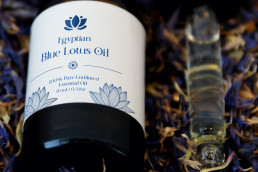
If you are searching for blue lotus oil in South Africa, you will find a small number of local stockists, a larger number of imported listings on Takealot and Amazon.co.za, and a surprising amount of product that does not match its label. This guide explains what genuine blue lotus oil actually is, what it legitimately costs to import into South Africa, and how to separate real Nymphaea caerulea from the blends and misrepresentations that dominate the local market.
Table of Contents
- What Blue Lotus Oil Actually Is (And Why the Label Matters in South Africa)
- The Honest Economics of Importing Blue Lotus Oil to South Africa
- Where South African Buyers Actually Shop
- Local Stockists and Apothecaries
- Takealot and Amazon.co.za
- Direct International Order
- How to Verify You Are Buying Real Blue Lotus Oil
- Legal and Regulatory Status in South Africa
- What to Expect When You Open the Bottle
- When Buying Pre-Diluted Is Actually the Right Choice
- Common South African Buying Mistakes
- Frequently Asked Questions
- Where to Go From Here
- Buy Genuine Blue Lotus Oil
It is written and clinically reviewed by Antonio Breshears, ND, CCA, a Bastyr-trained naturopathic doctor and certified clinical aromatherapist. For foundational reading on the oil itself, its chemistry and its uses, see the complete guide to blue lotus oil, which covers material this article assumes you already understand at a basic level.
What Blue Lotus Oil Actually Is (And Why the Label Matters in South Africa)
Genuine blue lotus oil is an aromatic extract of Nymphaea caerulea, the Egyptian blue water lily. True to the botany, it is not a lotus at all but a water lily, and the distinction matters when you are reading labels on South African shelves because “lotus” is used loosely across a range of unrelated products. Nelumbo nucifera (the sacred pink lotus of India) is botanically different, chemically different, and smells different. If a bottle simply says “lotus oil” without a Latin binomial, you cannot tell what you are buying.
The extract itself comes in three practical forms. Solvent-extracted absolute is the most common and the most aromatically complete, carrying the honeyed, slightly smoky depth that blue lotus is known for. Steam-distilled essential oil is genuinely rare because of how much plant material is required (between 3,000 and 5,000 flowers per gram), and when it appears at a reasonable price it is almost never authentic. Supercritical CO2 extract is the premium option, clean and solvent-free, and correspondingly expensive.
On South African listings, the terminology is often used interchangeably or incorrectly. A R180 bottle of “blue lotus essential oil” on a marketplace listing is, almost without exception, a fragrance oil or a heavily diluted blend in jojoba or fractionated coconut oil. That is not automatically a scam; diluted products have a legitimate role. It does become a problem when the listing implies the bottle contains neat absolute and charges accordingly.
The Honest Economics of Importing Blue Lotus Oil to South Africa
To understand pricing, you have to start at the source. Blue lotus is cultivated primarily in Egypt, with smaller volumes from Thailand and Sri Lanka. The flowers are harvested by hand at dawn, processed quickly because they wilt, and the yield per kilogram of fresh flowers is tiny. A reputable Egyptian absolute lands in the European or American wholesale market at roughly 40 to 90 US dollars per millilitre, depending on batch, supplier and certification.
By the time that oil reaches a South African consumer, it has travelled through international freight, paid import duty and VAT at 15 percent, and passed through at least one margin. A genuine 5 ml bottle of pure blue lotus absolute should realistically retail in South Africa somewhere in the range of R1,800 to R4,500, with premium CO2 extracts sitting at the upper end. A 10 ml bottle priced at R250 is not a bargain; it is a signal that something is wrong with the product description.
This is the single most useful frame when shopping for blue lotus oil south Africa-side: if the price seems too good, it almost certainly is, and what you are actually buying is either a fragrance oil (a synthetic aromatic composition), a pre-diluted blend (real absolute at perhaps 2 to 5 percent in a carrier), or a mislabelled product entirely.
Where South African Buyers Actually Shop
Local Stockists and Apothecaries
A handful of South African apothecaries and aromatherapy suppliers carry blue lotus absolute as a specialist item, typically in Johannesburg, Cape Town and the KwaZulu-Natal coast. These suppliers are usually small, and stock is intermittent because they import in small batches. The advantages of buying locally are straightforward: no customs surprises, rand pricing, and a real person you can ask questions of. The disadvantage is that the smallest local markup stacks on top of all the upstream margins, so local retail tends to sit at the top of the honest price range.
When you find a local stockist, ask three questions before you buy. First, what is the botanical name on the batch certificate. Second, what extraction method was used. Third, whether they can show you a GC-MS (gas chromatography mass spectrometry) report for the current batch. A genuine specialist will answer all three without hesitation; an unsure supplier is selling something they have not verified themselves.
Takealot and Amazon.co.za
Both marketplaces list blue lotus products in significant numbers. The quality distribution is broad. On Takealot, you will find legitimate international brands alongside opportunistic listings from third-party sellers whose supply chain is opaque. On Amazon.co.za, you are typically looking at imports with additional margin, and the listings often reproduce copy from the US or UK Amazon pages without verifying that the product actually ships to South Africa reliably.
The marketplace pattern to watch for is volume pricing that defies the upstream economics. A 30 ml “pure blue lotus essential oil” for R320 is not a pure product; the maths does not work. It may still be pleasant and usable as a fragrance, but it is not what a therapeutic protocol calls for.
Direct International Order
For buyers who want genuine absolute or CO2 extract at the best available price point, ordering directly from a reputable international supplier is often the most reliable route. You will pay import VAT and possibly duty on arrival, and you should budget for a two to three week transit window. The advantages are transparent sourcing, proper certificates, and a price that reflects the actual cost of the oil rather than a cascade of local margins. Pure Blue Lotus Oil ships internationally to South Africa; other reputable suppliers operate from the United States, the United Kingdom and Germany.
How to Verify You Are Buying Real Blue Lotus Oil
Authentication is not complicated once you know what to check. There are five signals, and a genuine product will usually satisfy all five while an imitation will fail on at least two or three.
The Latin name on the label. Nymphaea caerulea should appear explicitly. “Blue lotus”, “Egyptian lotus” and similar common names are not sufficient on their own because they are used for several unrelated plants in the wider aromatic trade.
The extraction method stated. Legitimate producers state whether the oil is a solvent-extracted absolute, a steam-distilled essential oil, or a CO2 extract. Ambiguous language (“natural extract”, “pure lotus oil”) is usually a sign that the producer does not want to commit to a specific claim.
The price bracket. As covered above, if a 5 ml bottle is priced below roughly R1,500 in South Africa and is described as pure absolute, the description and the product are not consistent.
The scent profile. Real blue lotus absolute opens with a cooler floral-aquatic top, settles into a deep honeyed-floral heart, and finishes on a balsamic, slightly smoky base. It is not a bright, simple, obvious floral like rose or jasmine; it has a complexity that takes a few minutes to develop on a smelling strip. A flat, sweet, perfume-like impression that does not evolve is typical of fragrance oil.
The batch documentation. A reputable supplier either publishes or will send on request a GC-MS report, a certificate of analysis, or at minimum an origin statement. If a supplier cannot produce any of these, they are either selling an unverified product or one they know would not pass scrutiny.
Legal and Regulatory Status in South Africa
Blue lotus is legal to buy, sell and possess in South Africa. Unlike in Russia, Poland, Latvia, and the US state of Louisiana, where specific restrictions apply, South Africa places no scheduled-substance controls on Nymphaea caerulea or its extracts. You can import it personally, order it domestically, and use it topically or in aromatherapy without regulatory concern.
That said, South African cosmetic regulations still apply to any product making therapeutic claims. If a local seller markets blue lotus oil as curing a specific condition, that crosses into medicines regulation and the claim (rather than the oil itself) becomes the problem. For personal use, none of this affects you; for reference, it simply means South African sellers tend to be cautious about the language they use, which is appropriate.
What to Expect When You Open the Bottle
A genuine blue lotus absolute at room temperature is viscous, sometimes semi-solid in the South African winter, particularly in Gauteng or the Free State where overnight temperatures drop. Warming the bottle gently in your hands or in a bowl of warm water restores flowability. The colour ranges from deep amber to a greenish-brown depending on batch and extraction; it is not blue, and any bottle containing a vivid blue liquid is almost certainly coloured fragrance oil.
For practical use, pure absolute is typically diluted before skin application. Standard working ranges are 1 to 2 percent for facial blends, 2 to 3 percent for body oils, up to 3 percent for targeted use on small areas, and 2 to 4 drops in a diffuser for inhalation. Diluting your own absolute in jojoba or fractionated coconut oil gives you the most flexibility and the best value per millilitre of active material.
When Buying Pre-Diluted Is Actually the Right Choice
Not everyone needs neat absolute. If you are new to blue lotus, uncertain about whether the scent suits you, or simply want a convenient rollerball for daily use, a reputable pre-diluted blend is a sensible starting point. The key word is reputable: a 10 ml rollerball that honestly states “2 percent blue lotus absolute in jojoba” is a legitimate product at a legitimate price (typically R350 to R650 in South Africa). A 10 ml rollerball claiming to be “pure blue lotus essential oil” at the same price point is not.
Pre-diluted blends are also worth considering if you are pregnant, breastfeeding or living with a condition where neat-oil handling would be risky. In those cases, please note that blue lotus is not recommended at all in pregnancy and breastfeeding, and caution applies alongside dopaminergic medications, MAOIs and heavy sedatives. A pre-diluted blend does not change those contraindications; it simply removes the handling risk for people who are using the oil appropriately.
Common South African Buying Mistakes
Three mistakes come up repeatedly in enquiries from South African readers. The first is assuming that a higher price on a marketplace listing automatically signals a better product. It does not. Some of the worst fragrance-oil listings are deliberately priced high to imply quality.
The second is buying based on the bottle colour shown in the product photograph. Blue lotus absolute is not blue. If the photograph shows a vivid blue liquid, either the photograph is stock imagery that does not represent the actual product, or the actual product contains added colourant, which no reputable producer would use.
The third is neglecting the carrier-oil question on pre-diluted products. A rollerball diluted in mineral oil, synthetic fragrance base, or unspecified “carrier oil” is a different product from one diluted in organic jojoba or fractionated coconut. Ask. Reputable sellers answer readily.
Frequently Asked Questions
Is blue lotus oil legal in South Africa?
Yes. There are no scheduled-substance restrictions on Nymphaea caerulea in South Africa. You can buy, import, possess and use it freely for personal aromatherapy or topical use.
What is a fair price for a genuine 5 ml bottle of blue lotus absolute in South Africa?
Roughly R1,800 to R4,500 depending on extraction method, supplier and certification. CO2 extracts sit at the upper end. Anything substantially cheaper and labelled as pure is misdescribed.
Can I buy blue lotus oil on Takealot?
Yes, but quality varies widely. Check the Latin name, the extraction method, the price against realistic upstream costs, and look for any form of batch documentation. Most Takealot listings priced under R500 for larger volumes are fragrance oils or heavily diluted blends rather than pure absolute.
Why is the oil I received not blue?
Because genuine blue lotus absolute is amber to greenish-brown. The flowers are blue; the extract is not. A vivid blue liquid indicates added colourant or a synthetic fragrance oil.
Does SARS charge duty on imported blue lotus oil?
VAT at 15 percent applies to imported goods over the de minimis threshold. Duty on essential oils and aromatic extracts depends on the tariff code the shipper uses and is typically modest. Budget an extra 15 to 20 percent on top of the invoice value as a reasonable planning estimate.
How long does blue lotus oil last once I buy it?
Approximately 3 to 4 years for absolute stored in dark glass in a cool, dark location. South African heat is the enemy: avoid leaving the bottle in a car, on a sunny windowsill, or in an uninsulated bathroom cupboard during summer.
Are the “blue lotus” products at local wellness chains genuine?
Usually they are pre-diluted blends or fragrance-based products marketed for their scent rather than aromatherapeutic activity. Some are honestly labelled as such; others lean on ambiguous language. Read the ingredient list and look for the Latin binomial.
Is it cheaper to buy blue lotus oil from international suppliers than locally?
Often yes, even after import VAT, because you skip the local margin. The trade-off is a longer wait and the one-off effort of dealing with the import process. For pure absolute in 5 ml or 10 ml quantities, international direct order is usually the better value.
Can I use blue lotus oil directly on my skin?
Pure absolute should be diluted before skin application. Standard dilutions are 1 to 2 percent for face, 2 to 3 percent for body, and up to 3 percent for small targeted areas. Undiluted application is not recommended.
Where can I get a GC-MS report for the oil I bought?
From the supplier. A reputable seller will either publish the current batch report on their website or email it on request. If the request is met with evasion, treat that as a quality signal and reconsider the purchase.
Where to Go From Here
If you are still early in your research on blue lotus, the next sensible read is the complete guide to blue lotus oil, which covers chemistry, uses, safety and application in more depth than a geographic buying guide can. If you are ready to buy and want a product with verifiable sourcing, a published extraction method, and batch documentation available on request, the option below ships to South Africa directly.

Antonio Breshears
Antonio Breshears is a renowned expert in holistic medicine and beauty, with over 25 years of research experience dedicated to uncovering the secrets of nature's most powerful remedies. Holding a degree in Naturopathic Medicine, Antonio's passion for healing and well-being has driven him to explore the intricate connections between mind, body, and spirit.
Over the years, Antonio has become a respected authority in the field, helping countless individuals discover the transformative power of plant-based therapies, including essential oils, herbs, and natural supplements. He has authored numerous articles and publications, sharing his wealth of knowledge with a global audience seeking to improve their overall health and well-being.
Antonio's expertise extends to the realm of beauty, where he has developed innovative, all-natural skincare solutions that harness the potency of botanical ingredients. His formulations embody his deep understanding of the healing properties found in nature, providing holistic alternatives for those seeking a more balanced approach to self-care.
With his extensive background and dedication to the field, Antonio Breshears is a trusted voice and guiding light in the world of holistic medicine and beauty. Through his work at Pure Blue Lotus Oil, Antonio continues to inspire and educate, empowering others to unlock the true potential of nature's gifts for a healthier, more radiant life.