The spiritual benefits of blue lotus essential oil are among the most written-about and the most inconsistently presented dimensions of the oil’s use. Writers oscillate between breathless mystical claims and dismissive reductions to chemistry. This article takes a middle path: acknowledging what the oil genuinely contributes to spiritual and contemplative practice, being honest about where language outruns evidence, and offering practical guidance for users who want to integrate blue lotus into their own practice, whatever tradition or non-tradition they come from.
Table of Contents
- What "Spiritual Benefits" Actually Means Here
- The Genuine Contributions
- Threshold Marking
- Parasympathetic Settlement
- Softening of Emotional Guarding
- Ritual Continuity Across Practice Sessions
- Practices and Traditions That Use Blue Lotus
- Ancient Egyptian Tradition
- Contemporary Western Contemplative Practice
- Tantra and Subtle-Body Practice
- Shamanic and Plant-Spirit Practices
- Buddhist and Buddhist-Adjacent Practice
- Secular Contemplative Practice
- Symbolic and Metaphorical Associations
- What Blue Lotus Oil Is Not
- How to Bring Blue Lotus Into Your Practice
- Frequently Asked Questions
- Where to Go From Here
- For Practice That Deserves Its Aromatic
It is written and clinically reviewed by Antonio Breshears, ND, CCA, a Bastyr-trained naturopathic doctor and certified clinical aromatherapist. For the specific meditation and yoga practice applications, our pillar on blue lotus oil in meditation and yoga practice is the main technical reference; for the historical and cultural context, our history pillar.
What “Spiritual Benefits” Actually Means Here
The phrase “spiritual benefits” covers a wider range of experiences than single articles usually acknowledge. For one person it means feeling connected to a particular religious or philosophical tradition; for another, a sense of the sacred without any specific theology; for a third, an aesthetic-contemplative appreciation of beauty, depth, and silence; for a fourth, the recovery of attention and awareness that contemplative practice develops over time. Blue lotus has something to contribute across all of these, in roughly the same basic way but experienced differently depending on the framework the user brings.
This article therefore does not assume any particular spiritual framework. The contributions described below are the ones that show up across traditions and across users with different underlying beliefs, because they rest on the oil’s combined chemical and aromatic-conditioning effects rather than on any specific metaphysical claim.
The Genuine Contributions
What blue lotus oil actually does that supports spiritual and contemplative practice, named honestly.
Threshold Marking
One of the oldest and most universally useful functions of scented oil in spiritual practice is marking the threshold between ordinary time and practice time. The anointing ritual, whether drawn from ancient Egyptian tradition, Biblical practice, Hindu puja, or contemporary personal ritual, establishes that the next stretch of time is different from what precedes and follows it. Blue lotus is particularly well-suited to this function because its scent is distinctive, rich, and long-lasting enough to sustain through a practice session and a little beyond.
The threshold-marking contribution is neither mystical nor trivial. It uses the olfactory-limbic pathway (a hard-wired feature of the human nervous system) to condition a particular aromatic presence to mean “now we are in practice mode”, and over weeks of consistent use that conditioning becomes reliable. The same brain mechanism that lets a particular piece of music take you instantly to a memory lets a particular scent take you instantly to the state of your contemplative practice.
Parasympathetic Settlement
Most spiritual practice requires some degree of parasympathetic dominance: settled breath, lowered heart rate, reduced muscle tension, a quieting of the default mental chatter. These are the physiological conditions for sustained attention, contemplation, or prayer. Blue lotus supports them through the olfactory-limbic, GABAergic, and stress-reduction pathways covered in our chemistry pillar. The practice can then do its own work without fighting against an unsettled body and mind.
This is the same mechanism that contributes to the oil’s value for sleep and anxiety, applied in a different context. The nervous-system state that supports contemplative practice is closely related to the nervous-system state that supports healthy sleep; the overlap is why users who develop a blue lotus contemplative practice often report improved sleep as a secondary benefit, and users who start with blue lotus for sleep often find themselves more able to sit contemplatively.
Softening of Emotional Guarding
A particular and valued contribution: blue lotus has a quality some users describe as “opening the heart”, “softening the chest”, or “thawing defences”. Physiologically, this is the reduction of chronic emotional constriction that accumulates through stress, trauma, and the ordinary demands of adult life. For contemplative practice, particularly practices involving compassion, prayer, grief work, or emotional-spiritual exploration, this softening can make accessible what otherwise remains guarded.
Worth noting: for some users carrying substantial unresolved material, this softening can bring difficult content to surface. The oil is an opener, not a container; appropriate support (therapy, a teacher, trusted community) should be in place before using blue lotus intensively for depth-oriented practice.
Ritual Continuity Across Practice Sessions
A sustained contemplative practice over months and years develops its own texture: the ordinary sittings, the difficult ones, the luminous ones. An aromatic element provides a through-line across these variations, a sensory constant that remains the same while the interior experience changes. Over time, this constant becomes a reliable companion: the scent of blue lotus comes to carry the accumulated weight of the whole practice.
This is part of why long-term practitioners often develop particular attachments to specific aromatics. The scent is not sacred in itself; it becomes sacred through the practice it has accompanied. Blue lotus, because of its particular chemical and aromatic character, is well-suited to carry this kind of long accumulation.
Practices and Traditions That Use Blue Lotus
A brief survey of the frameworks within which blue lotus has been used, with appropriate caveats about what is historically attested and what is contemporary adaptation.
Ancient Egyptian Tradition
The oldest and best-attested spiritual use. Blue lotus was central to the Egyptian religious imagination (as covered in our history pillar), associated with the god Nefertem, with creation cosmology, with funerary practice, and with the broader ritual tradition of anointing. Contemporary users drawing on this tradition typically incorporate the oil into sun-greeting rituals (honouring the flower’s association with the daily rising of the sun), contemplative practice at dawn or dusk (the flower’s opening and closing times), and meditative work with themes of transformation and renewal.
The Egyptian tradition is most legitimately used by practitioners who make themselves aware of its historical context rather than treating it as decorative borrowing.
Contemporary Western Contemplative Practice
A broad category encompassing centering prayer, contemplative sits in secular mindfulness frameworks, self-led meditation practices, yoga-adjacent contemplative work, and the hybrid practices of users drawing on multiple traditions. Blue lotus integrates well here because its contribution is primarily at the physiological and conditioning level rather than requiring specific theological alignment.
The typical pattern is anointing wrists or the temples before sitting, diffusing during the session, and allowing the residual scent to carry into the period after practice.
Tantra and Subtle-Body Practice
Contemporary tantra (distinguished carefully from the serious classical traditions, which are far more involved than their contemporary appropriation) often incorporates blue lotus for heart-centre work, intimate-ritual practice, and breathwork involving emotional opening. The oil’s softening quality is what supports this work.
Users coming from traditional tantric frameworks have their own established protocols; users approaching from contemporary spiritual-but-not-religious positions often benefit from less stringent structure, with the oil simply supporting whatever heart-centred practice they are developing.
Shamanic and Plant-Spirit Practices
Blue lotus appears in some contemporary shamanic practice as an ally for dream-work, vision-seeking, and journey practice (typically drumming, movement, or breathwork-induced rather than entheogenic). The oneirogenic property covered in our dream recall article is the basis for much of this use.
Worth being particularly careful about the gap between contemporary practices self-identifying as “shamanic” and traditional indigenous shamanic traditions, which have their own complex cultural contexts. Respectful contemporary practice can use blue lotus without claiming false continuity with indigenous frameworks.
Buddhist and Buddhist-Adjacent Practice
Buddhism’s own flower of association is the sacred lotus (Nelumbo nucifera) rather than the Egyptian blue lotus. Contemporary Buddhist practitioners who use blue lotus typically do so as a general contemplative support rather than as a specifically Buddhist element; the oil helps with the nervous-system conditions for practice without claiming Buddhist endorsement.
Secular Contemplative Practice
Users with no religious framework at all find the oil genuinely useful as an aid to reflection, attention, and the kind of daily interiority that any thinking life benefits from. The spiritual dimension here is more philosophical than theological: the cultivation of attention, the recovery of presence, the practice of stillness. Blue lotus supports these without requiring any particular metaphysical commitment.
Symbolic and Metaphorical Associations
The symbolic resonance of blue lotus is worth acknowledging even when the chemistry and evidence-based aspects are the main focus, because symbolic associations affect the user’s experience in meaningful ways.
The flower’s pattern of rising from the muddy water to bloom cleanly at the surface has been read across cultures as a symbol of transformation, of the rising of consciousness from the unconscious, of purity emerging from difficulty, of rebirth and renewal. These symbolic readings are not scientific claims; they are interpretive frames that have given the flower its cultural depth. A user who approaches blue lotus aware of these symbolic associations brings them into the experience, and the experience is coloured accordingly.
This is not “merely” psychological. The symbolic meaning a user attaches to a ritual object is part of what the ritual object does in their practice. A meaningfully held symbol has real effects on attention, emotion, and the trajectory of a contemplative sit, not because of magical action but because that is how human meaning-making works. Blue lotus carries several thousand years of symbolic accumulation, and users can draw on that accumulation if they choose to.
What Blue Lotus Oil Is Not
Appropriate honesty about claims that outrun the evidence.
Blue lotus is not an entheogen in the aromatic form. Traditional preparations of the whole flower in wine infusion, at substantially higher doses than aromatic use, may produce stronger effects on consciousness, and some contemporary practitioners pursue these preparations; the aromatic oil at normal doses produces a gentle parasympathetic settling and emotional softening rather than a classical entheogenic experience.
Blue lotus does not bestow spiritual progress independent of practice. No substance or ritual object does. The oil supports the conditions for practice; the practice itself is what produces whatever fruits practice produces. Users expecting to inhale their way to enlightenment will find the oil useful for sleep and unsatisfying for that particular aspiration.
Blue lotus is not a substitute for qualified teachers, community, or the lineages that spiritual traditions have developed for good reasons. Contemplative practice tends to benefit from structure and accountability; the oil is a support within structure, not an alternative to it.
Blue lotus does not have demonstrated effects on chakras, auras, energy bodies, or other subtle anatomical frameworks. Users who hold these frameworks may experience the oil as working through such systems, and that experience is legitimate within the framework; the oil’s observable effects do not require such frameworks to be real in any literal sense.
How to Bring Blue Lotus Into Your Practice
The practical pattern that works for most users, regardless of specific tradition.
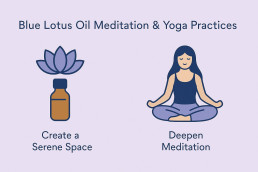
Begin with a single window. Rather than trying to use the oil throughout the day, start with one specific practice window (morning reflection, evening contemplative sit, a weekly extended practice). Develop the scent-to-state association in that one context before expanding.
Anoint deliberately. A small amount of a properly diluted oil (2 percent blue lotus in jojoba in a rollerball) applied to pulse points at the start of practice is substantially more meaningful than a large amount applied casually. The ritual quality matters.
Use a consistent formulation. Varying your blue lotus product from one session to the next weakens the scent-to-state conditioning. Pick a reliable bottle (or a reliable blend if using blue lotus with complementary oils) and stay with it for several months before considering changes.
Complement the oil with other conditioning elements. A consistent time of day, a consistent location, a consistent posture, a consistent opening and closing gesture: all of these compound with the aromatic element to build a more robust practice infrastructure. The oil is one layer, not the whole practice.
Be patient with the timescale. The full benefit develops over three to six months of consistent use. The first week is mostly novelty; the second month is usually where the conditioning starts to establish; the six-month practitioner has a substantially different relationship with the scent than the first-month user.
Notice what it is and is not doing. Periodically (once every two or three months), pause the oil for three to five days and notice what shifts. This prevents the “so integrated I cannot tell what it is contributing” problem and keeps your practice clear-eyed about the oil’s actual role.
Frequently Asked Questions
What are the spiritual benefits of blue lotus essential oil?
Threshold marking between ordinary time and practice time, parasympathetic settlement that supports sustained attention, softening of chronic emotional guarding, and ritual continuity across practice sessions over months and years. The benefits rest on olfactory-limbic conditioning and nervous-system regulation rather than on metaphysical claims.
Is blue lotus oil sacred?
It carries several thousand years of sacred-tradition association, particularly in ancient Egyptian religion. Whether the oil is sacred in itself or becomes sacred through the practice it accompanies depends on one’s framework. For practical purposes, treating the oil with the care and attention appropriate to a ritual object tends to produce the richer experience.
Can blue lotus oil help me meditate?
Yes, through the physiological and conditioning mechanisms discussed in our meditation and yoga practice pillar. The oil supports the conditions for practice; the practice itself is still the main event.
Does blue lotus oil open the third eye?
The “third eye” is a metaphor from certain yogic and metaphysical frameworks for the intuitive or visionary faculty. Blue lotus does not literally open an anatomical third eye. Within the metaphorical framework, the oil’s calming and opening effects may be experienced as supporting intuitive perception; outside that framework, the effects are the same but described differently.
Is blue lotus oil mentioned in the Bible?
Not specifically. Various aromatic oils are mentioned in biblical anointing and ritual practice (frankincense, myrrh, spikenard, and others), but blue lotus as such does not appear in the canonical texts.
Can I use blue lotus oil during prayer?
Yes, within any tradition that uses aromatic elements in prayer practice (which is most of them). The oil supports the settling and focusing that prayer benefits from. Appropriateness depends on the specific tradition; consult your tradition’s guidance if this is a concern.
Does blue lotus oil help with kundalini or chakra work?
Within the frameworks that include these concepts, practitioners sometimes use blue lotus for heart and throat chakra work or as a general subtle-body support. The oil’s observable effects (calming, opening, threshold-marking) are the same whether interpreted through these frameworks or through other contemplative languages.
Can blue lotus oil induce mystical experiences?
Not reliably. The aromatic oil at normal doses supports the nervous-system conditions that can allow mystical or peak experiences to occur in practice, but does not directly cause them. Mystical experiences remain what they have always been: rare, unscheduled, and not reliably produced by any particular technique or substance.
Is it appropriate for non-religious people to use blue lotus oil?
Yes. The oil’s contributions to contemplative practice do not require religious commitment. Secular contemplative practitioners, philosophers, and anyone who values reflection and attention can use the oil on entirely non-religious grounds.
Can blue lotus oil connect me to ancient Egyptian spirituality?
It can support a user’s own contemporary engagement with Egyptian spiritual themes, drawing on the historical continuity of the plant in that tradition. Whether such engagement is “connection” in a literal sense depends on the user’s metaphysical framework; the aromatic and symbolic continuity is real, the metaphysical claim is beyond what the oil itself can establish.
Where to Go From Here
For the specific meditation and yoga practice applications, our pillar on meditation and yoga practice. For the history and cultural context, our history and cultural significance pillar. For the related metaphysical framework article, metaphysical benefits. For the chemistry that underpins the physiological effects, the chemical composition and therapeutic properties pillar. For the broader introduction, the complete guide. Everything on this site is hosted at Pure Blue Lotus Oil.

Antonio Breshears
Antonio Breshears is a renowned expert in holistic medicine and beauty, with over 25 years of research experience dedicated to uncovering the secrets of nature's most powerful remedies. Holding a degree in Naturopathic Medicine, Antonio's passion for healing and well-being has driven him to explore the intricate connections between mind, body, and spirit.
Over the years, Antonio has become a respected authority in the field, helping countless individuals discover the transformative power of plant-based therapies, including essential oils, herbs, and natural supplements. He has authored numerous articles and publications, sharing his wealth of knowledge with a global audience seeking to improve their overall health and well-being.
Antonio's expertise extends to the realm of beauty, where he has developed innovative, all-natural skincare solutions that harness the potency of botanical ingredients. His formulations embody his deep understanding of the healing properties found in nature, providing holistic alternatives for those seeking a more balanced approach to self-care.
With his extensive background and dedication to the field, Antonio Breshears is a trusted voice and guiding light in the world of holistic medicine and beauty. Through his work at Pure Blue Lotus Oil, Antonio continues to inspire and educate, empowering others to unlock the true potential of nature's gifts for a healthier, more radiant life.