If you have been researching blue lotus and keep running into two very different products, an aromatic oil sold for diffusion and topical use, and a wine or tincture sold for sipping, you are not imagining the confusion. They share a botanical source, Nymphaea caerulea, but they are prepared differently, act on the body through different routes, and carry different safety and legal considerations. This article compares blue lotus oil vs wine in plain terms so you can decide which preparation, if either, makes sense for what you actually want.
Table of Contents
- What Each Preparation Actually Is
- Blue Lotus Oil
- Blue Lotus Wine
- The Chemistry Side by Side
- What Each One Actually Feels Like
- The Experience of Blue Lotus Oil
- The Experience of Blue Lotus Wine
- Safety: Where the Two Diverge Sharply
- Safety of the Oil
- Safety of the Wine
- Legality: An Often Overlooked Factor
- Which Preparation Suits Which Purpose
- Choose the Oil If
- Consider the Wine Only If
- Avoid Both If
- Realistic Expectations from Each
- Cost, Sourcing, and Practical Considerations
- Frequently Asked Questions
- Where to Go From Here
- Choose the Safer, Versatile Tradition
It is written and clinically reviewed by Antonio Breshears, ND, CCA, a Bastyr-trained naturopathic doctor and certified clinical aromatherapist. For broader background on the oil itself, see The Complete Guide to Blue Lotus Oil, which sits as the parent reference for this and other comparison articles.
What Each Preparation Actually Is
Blue lotus oil and blue lotus wine are not different strengths of the same thing. They are different products entirely, made through different processes, with different active compounds reaching the body through different routes.
Blue Lotus Oil
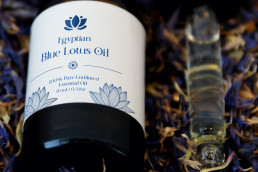
Blue lotus oil, in the form most commonly sold, is an absolute. It is produced by solvent extraction of the dried flowers, yielding a thick, deeply aromatic substance that contains the volatile aromatic molecules of the plant alongside some of its heavier constituents. Roughly three to five thousand flowers go into a single gram of absolute, which gives some sense of why it is expensive and why a little goes a long way. Less commonly you will encounter true steam-distilled essential oil or a supercritical CO2 extract; these are rarer and tend to command higher prices.
The oil is intended for inhalation, diffusion, and dilute topical application. It is not designed to be swallowed. Its primary route of action is olfactory, meaning the aromatic molecules reach the limbic system through the nose, and dermal, meaning small lipophilic compounds cross the skin barrier when properly diluted in a carrier.
Blue Lotus Wine
Blue lotus wine is something quite different. It is a maceration: dried blue lotus flowers steeped in wine, traditionally for several weeks, sometimes longer. The alcohol acts as a solvent, drawing the alkaloids (notably aporphine and nuciferine) and some of the flavonoids out of the plant material into the wine. The final product is sipped in small quantities for its mild psychoactive and relaxing effects, traditions that trace back at least as far as ancient Egyptian funerary and ceremonial use, though modern reconstructions are largely just that, reconstructions.
Blue lotus wine is taken orally. Its primary route of action is through the gut, into the bloodstream, and from there to the central nervous system. Alcohol itself is part of the experience, which is a critical point we will return to.
The Chemistry Side by Side
Both preparations draw from the same plant, but extraction method dictates which compounds dominate the final product, and that in turn dictates what each one does.
The aromatic oil is rich in volatile aromatic compounds: the molecules responsible for the cool, honeyed, faintly aquatic and balsamic scent profile. It also contains varying amounts of flavonoids such as apigenin, quercetin, and kaempferol, which carry mild calming and anti-inflammatory activity. Alkaloid content in a steam-distilled oil is minimal because alkaloids are not particularly volatile; absolutes contain more, but still in quantities that act primarily through scent and skin rather than through systemic dosing.
Blue lotus wine, by contrast, concentrates the alkaloids efficiently. Aporphine acts as a weak dopamine agonist, contributing to a gentle sense of pleasure and calm; nuciferine acts as a weak dopamine antagonist with serotonergic activity (5-HT2A and 5-HT2C), which appears to underlie the subtle dreamy quality some users describe. Because the wine delivers these compounds into the bloodstream, the effects are felt systemically, not just through scent. They are also amplified, or at least coloured, by the alcohol carrier itself.
So the short version: the oil is principally an aromatic and topical preparation acting through scent, skin, and mood; the wine is an ingested preparation acting systemically through alkaloid and alcohol pharmacology together.
What Each One Actually Feels Like
People expect, reasonably, that two products from the same flower will produce similar experiences. They do not.
The Experience of Blue Lotus Oil
Blue lotus oil is, at its strongest, gently shifting. Inhaled from a diffuser or a personal inhaler, or applied diluted to pulse points, it tends to produce a quiet downshift: a softening of mental chatter, an easing of shoulder and jaw tension, a slight warming of mood. It is not a strong sedative. It will not knock anyone out. It works best as part of a deliberate ritual: a wind-down routine, a meditation cue, a transition from work to rest. Effects build over weeks of consistent use rather than landing dramatically on the first try.
Topically, in a properly diluted facial or body application, the oil contributes an antioxidant and mildly anti-inflammatory action alongside its aromatic mood effect. Skin benefits and emotional benefits accrue together because the same flavonoids that calm the nervous system also calm reactive skin.
The Experience of Blue Lotus Wine
Blue lotus wine, taken in a small glass, produces a noticeably different experience. Users typically report a warm, mildly euphoric relaxation, sometimes with a soft dreamy quality that comes on within twenty to forty minutes and lasts a couple of hours. The intensity depends heavily on the strength of the maceration, the dose, the user’s tolerance to alcohol, and whether food is in the stomach.
It is important to be honest: a great deal of what people describe as the wine’s effect is the alcohol. A glass of any wine produces relaxation. Adding macerated blue lotus modifies the character of that relaxation, lending it a slightly more introspective, dreamier quality, but it does not transform the experience into something exotic or visionary. People expecting a powerful psychedelic will be disappointed. People expecting a pleasant, slightly more contemplative version of a glass of wine before bed are closer to the mark.
Safety: Where the Two Diverge Sharply
This is the section where the choice between blue lotus oil vs wine becomes genuinely consequential, because the safety profiles are not interchangeable.
Safety of the Oil
Used as intended (diffused, inhaled, or applied to skin in a 1 to 3 percent dilution depending on the area), the oil is well tolerated by most adults. The main cautions are straightforward: avoid in pregnancy and breastfeeding, patch test before topical use to rule out sensitivity, exercise caution if you are taking dopaminergic medications, MAOIs, or strong sedatives, and do not ingest it. The oil is not a food product and was never formulated to pass through the gut.
Safety of the Wine
Blue lotus wine carries the safety profile of alcohol plus the safety profile of orally ingested blue lotus alkaloids, and the two compound rather than cancel out. That means everything that makes alcohol risky (impaired judgement and coordination, interactions with most CNS-active medications, contraindication in pregnancy and breastfeeding, problems for anyone with liver disease or a history of substance dependency, and the additive depressant effect with sedatives) applies to the wine. On top of that, the alkaloids interact with dopaminergic and serotonergic systems, which means the wine is genuinely contraindicated alongside MAOIs, SSRIs in some cases, antipsychotics, Parkinson’s medications, and any other compound that modulates these pathways.
Quality control is also a real issue. Commercial blue lotus wines vary enormously in alkaloid content, the wine base, and the integrity of the maceration. Some are essentially flavoured wines with negligible plant content; others are strong enough to produce noticeable effects from a small glass. Without standardisation, you cannot be sure what you are taking.
Legality: An Often Overlooked Factor
Both preparations exist in regulatory grey zones, but the wine attracts more scrutiny because it is consumed orally and combined with alcohol.
Blue lotus itself (the plant) is restricted or banned in several jurisdictions including Russia, Poland, Latvia, the US state of Louisiana, and faces regulatory complexity in Australia. In other places it is legal but unregulated, which means it can be sold but with limited oversight on quality or labelling.
Blue lotus oil for aromatherapy use sits relatively comfortably in most markets where the plant itself is permitted, because it is sold as a fragrance or topical product rather than for ingestion. Blue lotus wine occupies a more uncertain position: it is a flavoured alcoholic beverage containing a plant with known psychoactive activity, which raises questions about food safety classification, alcohol licensing, and import rules. In some countries it is sold openly; in others it is functionally unavailable. Always check your local regulations before purchasing or importing either product.
Which Preparation Suits Which Purpose
The honest comparison of blue lotus oil vs wine comes down to what you actually want from the plant.
Choose the Oil If
- You want a daily or near-daily ritual for stress, sleep wind-down, or meditation support.
- You want skincare benefits alongside aromatic ones.
- You prefer a non-alcoholic, non-ingested approach.
- You are sensitive to alcohol or avoid it for health, religious, or recovery reasons.
- You want a product with a long shelf life (3 to 4 years stored properly) and predictable consistency from bottle to bottle.
- You want something safe to use most days without cumulative concerns about alcohol intake.
Consider the Wine Only If
- You are specifically interested in the historical or ceremonial dimension of blue lotus consumption.
- You already drink wine occasionally and are simply curious about a herbally infused version.
- You have no contraindicating medications or health conditions.
- You can source from a maker whose process and quality you trust.
- You understand that the experience is closer to “interesting wine” than to anything dramatic.
Avoid Both If
- You are pregnant or breastfeeding.
- You take MAOIs, dopaminergic medications, antipsychotics, or strong sedatives without first speaking to your prescriber.
- You have a history of alcohol dependency (the wine specifically).
- You live in a jurisdiction where the plant is restricted.
Realistic Expectations from Each
One of the kindest things any honest writer can do is keep expectations grounded.
The oil is modestly effective. Used consistently as part of a wind-down routine, it can take the edge off mild evening anxiety, support better sleep onset, and lend a pleasant atmospheric quality to meditation or self-care rituals. It is not a treatment for clinical anxiety, insomnia, or depression. People who expect dramatic effects from a single application are often disappointed; those who incorporate it into a sustained practice tend to value it.
The wine is, similarly, modestly effective. Most users describe a pleasant, slightly dreamy enhancement of the relaxation a normal glass of wine provides. It is not a recreational psychedelic, it is not a sleep aid in any reliable clinical sense, and it is not a substitute for managing real anxiety or insomnia properly. Treated as an occasional ceremonial drink, it can be a nice ritual; treated as a nightly habit, it inherits all the problems of a nightly wine habit plus the alkaloid load.
Cost, Sourcing, and Practical Considerations
Blue lotus oil, particularly genuine absolute or CO2 extract, is expensive per millilitre, but a 5 ml bottle used a few drops at a time will last most people six months or longer. Cost per use, calculated honestly, is reasonable. Storage is simple: dark glass, cool cupboard, away from direct light, and the oil holds its character for three to four years.
Blue lotus wine is cheaper per millilitre but much more is consumed per use, and once a bottle is opened it ages on a normal wine timeline (days to a couple of weeks at most before quality drops). Cost per session can be similar or higher than the oil. Sourcing is also harder; legitimate, well-made blue lotus wines are relatively rare, and the market is dotted with weak or misrepresented products.
Frequently Asked Questions
Can I make blue lotus wine using blue lotus oil?
No, and this is a common dangerous assumption. Aromatherapy oils are not formulated for ingestion. Blue lotus wine is made by macerating dried whole flowers, not by adding oil to wine. Adding essential or absolute oil to a beverage is unsafe and will not produce the same effect as a proper maceration.
Which one is stronger?
The wine produces a more noticeable acute effect because it delivers alkaloids systemically and combines them with alcohol. The oil produces a subtler, more cumulative effect. “Stronger” depends on what you are measuring; per session, the wine is more felt; per long-term wellbeing benefit, the oil is the more sustainable tool.
Can I use both?
In principle, yes, on different occasions and not simultaneously. Diffusing the oil during the day for a calm working atmosphere and reserving the wine for an occasional evening ritual is a reasonable separation. Combining them in the same hour is unnecessary and stacks effects without obvious benefit.
Will the wine make me hallucinate?
No. Reports of strong visionary effects from blue lotus wine are largely overblown. Most users describe gentle relaxation with a slightly dreamy quality, not visual hallucinations or anything resembling a classical psychedelic experience.
Is the oil safer than the wine?
For most people, yes. The oil is used externally or aromatically, has no alcohol content, and avoids the systemic alkaloid load and pharmacological interactions that the wine carries. The wine carries every risk of alcohol consumption plus the additional alkaloid considerations.
Can I drink blue lotus tea instead?
Blue lotus tea is a third option: dried flowers steeped in hot water. It delivers some alkaloids and flavonoids without alcohol, producing a mild relaxing effect generally weaker than the wine. It is a reasonable middle ground for those who want an ingested form without alcohol, though the same medication-interaction cautions still apply.
Does the oil contain alcohol?
No. Pure blue lotus absolute, essential oil, or CO2 extract contains no alcohol. Solvent traces from the absolute extraction process are minimal and removed during refinement. The product is neither a beverage nor an alcohol-containing tincture.
Which is better for sleep?
For sustainable nightly use, the oil. Diffused thirty to sixty minutes before bed or applied as a diluted rollerball at the wrists and chest, it integrates into a calming bedtime routine without alcohol’s well-documented disruption of sleep architecture. The wine may produce faster sleep onset on a given night but, like all alcohol, tends to fragment the second half of the night and is not advisable as a regular sleep aid.
Can I use the oil during pregnancy if I avoid the wine?
Both are best avoided during pregnancy and breastfeeding. The oil’s alkaloid and flavonoid profile, while less concentrated than the wine’s, has not been adequately studied in pregnancy, and standard aromatherapy practice errs on the side of avoidance.
What if I just want to try blue lotus once?
If you are simply curious, the oil is the lower-risk first encounter. A small bottle of properly sourced absolute, used in a diffuser or a diluted rollerball, lets you assess your response to the plant aromatically and topically without committing to alcohol consumption or systemic alkaloid exposure. If after a thoughtful trial of the oil you remain interested in the historical wine tradition, you will at least know how your body responds to the plant before adding alcohol to the equation.
Where to Go From Here
If you came to this comparison wondering whether blue lotus wine might be a better, stronger, or more “authentic” version of the oil, the honest answer is that they are different tools serving different purposes, and the oil is the more practical, safer, and more versatile of the two for almost everyone. The wine has its place as an occasional, carefully sourced ceremonial drink for adults who can use alcohol responsibly; the oil has a much wider range of daily applications across mood support, sleep ritual, meditation, and skincare. For a fuller picture of what the oil itself can and cannot do, the parent reference at The Complete Guide to Blue Lotus Oil is the natural next read.

Antonio Breshears
Antonio Breshears is a renowned expert in holistic medicine and beauty, with over 25 years of research experience dedicated to uncovering the secrets of nature's most powerful remedies. Holding a degree in Naturopathic Medicine, Antonio's passion for healing and well-being has driven him to explore the intricate connections between mind, body, and spirit.
Over the years, Antonio has become a respected authority in the field, helping countless individuals discover the transformative power of plant-based therapies, including essential oils, herbs, and natural supplements. He has authored numerous articles and publications, sharing his wealth of knowledge with a global audience seeking to improve their overall health and well-being.
Antonio's expertise extends to the realm of beauty, where he has developed innovative, all-natural skincare solutions that harness the potency of botanical ingredients. His formulations embody his deep understanding of the healing properties found in nature, providing holistic alternatives for those seeking a more balanced approach to self-care.
With his extensive background and dedication to the field, Antonio Breshears is a trusted voice and guiding light in the world of holistic medicine and beauty. Through his work at Pure Blue Lotus Oil, Antonio continues to inspire and educate, empowering others to unlock the true potential of nature's gifts for a healthier, more radiant life.