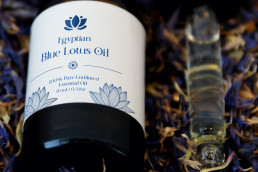
They share a colour in the name and not much else. If you have been comparing blue lotus vs blue tansy and wondering whether they are interchangeable, alternatives, or simply two oils that happen to sit on the same shelf in a pretty bottle, the short answer is that they belong to different botanical families, have different active chemistry, smell nothing alike, and solve quite different problems. This article walks through the comparison in the way a clinician would, so you can decide which one (if either) belongs in your routine.
Table of Contents
- The Quick Answer
- Botany and Source: Water Lily vs Mediterranean Daisy
- Chemistry: Where the Real Differences Live
- Blue Lotus
- Blue Tansy
- Scent Profile: They Smell Nothing Alike
- What Each Oil Actually Does Well
- Blue Lotus Oil: Mood, Sleep, Sensuality, Skin Luxury
- Blue Tansy Oil: Redness, Itch, Blemishes, Reactive Skin
- Safety: Different Profiles, Different Cautions
- Price and Sourcing Honesty
- How to Decide Which One You Need
- Practical Protocols at a Glance
- For Sleep and Emotional Calm (Blue Lotus)
- For Red, Reactive Skin (Blue Tansy)
- For Cystic or Inflamed Blemishes (Blue Tansy)
- For Mature Skin Rituals (Blue Lotus)
- Realistic Timeframes
- When Neither Is the Right Tool
- Complementary Pairings
- Frequently Asked Questions
- Where to Go From Here
- Genuine Blue Lotus, Not a Substitute
It is written and clinically reviewed by Antonio Breshears, ND, CCA, a Bastyr-trained naturopathic doctor and certified clinical aromatherapist. For the broader context on the oil in question, the Complete Guide to Blue Lotus Oil covers history, chemistry and safety in depth; this article sits alongside it as a focused comparison piece.
The Quick Answer
Blue lotus oil (Nymphaea caerulea) is an Egyptian water lily absolute, extracted from thousands of flowers, prized for its effect on mood, sleep onset and emotional tone via its alkaloid and flavonoid content. It is a dark, honeyed, balsamic floral with a cooler opening note; it is used primarily for the nervous system and for skincare in the luxury, anti-ageing register.
Blue tansy oil (Tanacetum annuum) is a Moroccan yellow daisy-like herb whose steam-distilled oil turns a striking indigo blue because of a compound called chamazulene that forms during distillation. It smells sweet, herbaceous, apple-like and slightly camphoraceous. It is used primarily as a topical anti-inflammatory for reactive, irritated or blemish-prone skin, and as a calming, somewhat sedative aroma.
In other words: if you are chasing calm, sleep, or a ceremonial-feeling floral for the skin, blue lotus is the more interesting answer. If you are chasing redness, itch, blemishes or reactive skin, blue tansy is the more evidence-aligned choice. They are not substitutes for each other. They are allies in different arenas.
Botany and Source: Water Lily vs Mediterranean Daisy
Blue lotus is Nymphaea caerulea, a tropical water lily native to the Nile and now cultivated across Egypt, India, Sri Lanka and Thailand. Each flower opens only during the day, and the absolute is produced by solvent extraction of somewhere between three and five thousand flowers per gram of finished oil. That is why it is expensive, and why true steam-distilled essential oil is rare; most of what is sold commercially is an absolute.
Blue tansy, despite the name, is not tansy (Tanacetum vulgare), which is a different and far more toxic plant. True blue tansy is Tanacetum annuum, a Moroccan annual daisy. It is steam distilled from the flowering tops, and yields a deep ink-blue oil because distillation converts matricin into chamazulene, the same azulene pigment found in German chamomile. The supply is modest but not nearly as constrained as blue lotus, and the oil is priced accordingly: premium but not ceremonial.
Chemistry: Where the Real Differences Live
Blue Lotus
The interest in blue lotus is primarily alkaloidal and flavonoidal. The flower contains aporphine (a weak dopaminergic compound), nuciferine (a mild dopamine antagonist and serotonin 5-HT2A/2C modulator), along with flavonoids including apigenin, quercetin and kaempferol. Apigenin in particular has well-characterised affinity for central benzodiazepine receptors, which helps explain the quiet, anxiolytic feeling the oil produces when inhaled or applied over pulse points. This is not sedative chemistry in the pharmaceutical sense; it is a modest nudge towards parasympathetic dominance.
Blue Tansy
Blue tansy’s headline constituents are chamazulene (the blue pigment, a potent anti-inflammatory), sabinene, beta-myrcene, beta-pinene and camphor. Chamazulene is the reason the oil calms red, itchy, reactive skin so reliably: it suppresses several inflammatory pathways topically. The camphor content, though modest, contributes to the cooling sensation on skin and to the oil’s slight respiratory quality when diffused. There are essentially no alkaloids and no benzodiazepine-receptor-active flavonoids worth noting.
So: blue lotus works (modestly) on the central nervous system through aroma and transdermal absorption of its actives. Blue tansy works (more reliably) on the skin through topical anti-inflammatory chemistry. This is the most important distinction of the comparison, and it flows from the botany itself.
Scent Profile: They Smell Nothing Alike
Anyone expecting the two oils to smell similar because they share a colour descriptor is in for a surprise.
Blue lotus opens cool, green and faintly aquatic, then settles into a deep, honeyed, slightly spicy floral with a balsamic, almost smoky base. It is a night-time scent, a temple scent, a close-to-the-skin scent. People either love it immediately or need three or four exposures to understand it.
Blue tansy smells sweet, herbaceous and fruity, with a distinct green-apple note layered over camphoraceous chamomile. It is brighter, fresher, more daytime. It is instantly likeable by most people and blends beautifully with citrus, lavender and chamomile.
If you blended them together in equal parts, you would get a strange, muddy result. They are not natural blending partners, though each pairs wonderfully with its own allies.
What Each Oil Actually Does Well
Blue Lotus Oil: Mood, Sleep, Sensuality, Skin Luxury
Blue lotus has a reasonably well-attested place in the following uses:
- Pre-sleep wind-down. Two to four drops in a diffuser thirty to sixty minutes before bed, or one to two drops diluted on the inner wrists and behind the ears, can meaningfully shorten sleep latency in people whose problem is racing thoughts rather than severe insomnia.
- Anxious evenings and emotional reset. The olfactory-limbic response is fast; inhalation from the bottle or a personal inhaler produces a quieting effect within minutes for many users.
- Intimacy and sensuality. The oil has a long folk association with erotic receptivity, and the combination of parasympathetic calming plus a beautiful honeyed scent does tend to support that in practice.
- Mature, dry or stressed skin. At 1 to 2 percent dilution in a facial oil, it supports a smooth, plumped, well-rested appearance, largely through the antioxidant flavonoid content and the cosmetic quality of the absolute itself.
Blue Tansy Oil: Redness, Itch, Blemishes, Reactive Skin
Blue tansy’s wheelhouse is almost entirely dermatological, with a secondary calming effect by aroma:
- Redness and reactive skin. A 0.5 to 1 percent dilution in a light facial oil (jojoba or squalane works well) applied to flushed, rosacea-prone or wind-burned skin reduces visible redness within days.
- Itch and inflammation. Bug bites, contact dermatitis, mild eczema flares respond to spot application at 1 to 2 percent.
- Blemishes. Not as strongly antibacterial as tea tree, but much calmer for inflamed cystic spots; a 1 percent spot dilution reduces angry redness overnight.
- Calming aroma for respiratory and nervous tension. Diffused alongside lavender or Roman chamomile, it makes a gentle, sweet, non-floral calming blend. The effect is less pronounced than blue lotus on mood specifically, but the aroma is friendlier to a wider audience.
Safety: Different Profiles, Different Cautions
Both oils are generally well tolerated, but the cautions differ in important ways.
Blue Lotus
Avoid in pregnancy and breastfeeding. Use caution alongside MAOIs, strong dopaminergic or dopamine-blocking medications, and heavy sedatives; the alkaloid content is modest but worth respecting if you are on psychiatric medication. The oil is not considered phototoxic. Standard dilutions are 1 to 2 percent on the face, 2 to 3 percent on the body. There are regulatory restrictions in Russia, Poland, Latvia, the US state of Louisiana and some complexity in Australia, though none of this applies to most European or UK users.
Blue Tansy
Also avoid in pregnancy and breastfeeding, largely because of the camphor content and a general caution with Tanacetum species. Not phototoxic. Not sensitising for most users, but people with known Asteraceae (daisy family) allergy (ragweed, chamomile, chrysanthemum) should patch test first. The oil is stable once distilled but can discolour (lose some blue) when exposed to heat, light or oxygen; keep it tightly closed in a cool dark place. Dilutions of 0.5 to 1 percent for facial use and 1 to 3 percent for body or spot treatment are standard.
Crucially, blue tansy is safe and appropriate in topical formulations for children over two (at 0.25 to 0.5 percent) for things like itchy bug bites. Blue lotus is not typically used on children because the psychoactive-adjacent chemistry has not been well studied in paediatric contexts.
Price and Sourcing Honesty
Both are genuinely expensive oils, and both have significant adulteration problems in the retail market.
Blue lotus is one of the most frequently faked oils on the market. Because three to five thousand flowers are required for a gram of absolute, anything priced like a commodity is almost certainly synthetic fragrance oil dissolved in jojoba, or a “blue lotus-scented” blend. Authentic absolute is thick, dark amber to brown (not blue), and deeply aromatic at a pinprick dose.
Blue tansy is commonly adulterated with yarrow (Achillea millefolium), which is cheaper and also contains chamazulene, or blended with German chamomile. True Moroccan blue tansy should be a deep, clear indigo-to-royal blue, with the characteristic sweet-herbaceous apple note and no turpentine-like aggression. Expect to pay upwards of forty to sixty pounds for a few millilitres of the genuine article.
If a seller lists both as “the same” or recommends one as a substitute for the other at a lower price, that is a sign of either ignorance or marketing, and neither is a good sign.
How to Decide Which One You Need
Here is the decision framework I use with clients when they ask about blue lotus vs blue tansy:
Choose blue lotus if: your goal is emotional, nervous-system-related, or ceremonial; if you struggle with sleep onset, evening anxiety, or post-work decompression; if you are drawn to a deep, honeyed, meditative scent; if you want a luxury facial oil for mature or stressed skin; if the ritual and symbolism of the oil matter to you.
Choose blue tansy if: your goal is specifically dermatological; if you have reactive, red, itchy, rosacea-prone or blemish-prone skin; if you want a gentle calming aroma that is family-friendly and non-floral; if you need a topical anti-inflammatory that is gentler than something like wintergreen or camphor alone.
Choose both if: you want a well-rounded nervous system and skin kit. They work in different registers and don’t duplicate each other’s benefits. I would not blend them in the same formula, but I would happily recommend both in a thoughtful apothecary.
Practical Protocols at a Glance
For Sleep and Emotional Calm (Blue Lotus)
Two to four drops in a diffuser forty-five minutes before bed. Or one to two drops blended into half a teaspoon of jojoba, applied to the inner wrists, chest and behind the ears. Use nightly for two to three weeks to gauge the pattern of response.
For Red, Reactive Skin (Blue Tansy)
Dilute to 0.5 to 1 percent in a light carrier (squalane, jojoba or rosehip). One to two drops of the diluted blend pressed gently into cleansed skin morning and night. Expect visible reduction in redness within five to seven days of consistent use.
For Cystic or Inflamed Blemishes (Blue Tansy)
1 percent dilution, applied with a cotton bud only to the spot, twice daily. Do not apply to broken skin neat.
For Mature Skin Rituals (Blue Lotus)
1 to 2 percent in a facial oil, used as the final step of an evening routine. The scent alone is part of the therapy.
Realistic Timeframes
For blue lotus, emotional and mood effects are immediate on inhalation, and sleep effects typically consolidate over one to two weeks of consistent use. Skin effects are slower; expect two to three months for the flavonoid antioxidant work to show as improved tone.
For blue tansy, topical anti-inflammatory effects can be visible within hours for an acute flare (a bug bite, a flushed cheek) and within five to fourteen days for a pattern like chronic redness. Blemish healing is accelerated by two to three days compared with doing nothing.
Neither oil is magic. Both are genuinely useful within realistic expectations.
When Neither Is the Right Tool
If you have clinical depression, major anxiety disorder, or persistent insomnia, blue lotus is a pleasant adjunct, not a treatment. See a clinician. If you have severe rosacea, eczema or acne vulgaris that is cystic and scarring, blue tansy is a soothing adjunct, not a replacement for dermatological care. And if you are pregnant or breastfeeding, neither oil is appropriate; look at safer botanicals such as Roman chamomile or lavender under professional guidance.
Complementary Pairings
Blue lotus blends beautifully with sandalwood, frankincense, rose, jasmine, vanilla and patchouli, in a meditative or sensual register. Blue tansy blends beautifully with lavender, Roman chamomile, helichrysum, cedarwood and soft citrus, in a dermatological or soothing register. The two do not naturally blend with each other, and there is no particular reason to force them.
Frequently Asked Questions
Is blue lotus oil blue?
No. Genuine blue lotus absolute is dark amber to brown. If the oil in your bottle is bright blue, it is either blue tansy, a synthetic colourant, or a blue-tansy-containing blend mislabelled as blue lotus.
Is blue tansy the same as German chamomile?
No, but they share the chamazulene pigment and some of the anti-inflammatory profile. German chamomile is herbaceous and medicinal; blue tansy is sweeter and fruitier. They are interchangeable for some skincare uses.
Can I use blue tansy for sleep like blue lotus?
Blue tansy has a mild calming aroma, but it is not alkaloid-active in the way blue lotus is. For sleep onset specifically, blue lotus is the better-targeted oil. Blue tansy in a diffuser is pleasant but not sleep-specific.
Can I use blue lotus on reactive, red skin?
It is neutral to mildly supportive at most. For acute redness, rosacea or inflamed skin, blue tansy is the more effective topical choice by a wide margin.
Which is more expensive?
Blue lotus absolute is usually more expensive per millilitre than blue tansy, because of the sheer number of flowers required. Both are premium-priced oils; suspiciously cheap versions of either are almost certainly adulterated.
Can I blend them together?
Technically yes, but the scent profiles clash and they address different mechanisms. There is little clinical reason to combine them. Use each in its own formula.
Are they both safe in pregnancy?
Neither is recommended during pregnancy or breastfeeding. Blue lotus because of its alkaloid content; blue tansy because of camphor and general caution with the Tanacetum genus.
Does blue tansy stain skin or fabric?
At topical dilutions (1 percent or less) it rarely stains skin noticeably, but neat or highly concentrated blue tansy can leave a blue-green tint on light fabric. Be careful with bedding and towels.
Which is better for anxiety?
Blue lotus, clearly. The apigenin content acts on central benzodiazepine receptors and the alkaloids shift nervous system tone. Blue tansy is pleasant but not specifically anxiolytic.
Can I use blue tansy on children?
Yes, cautiously, for children over two, at 0.25 to 0.5 percent for things like itchy bites or mild skin irritation. Blue lotus is not typically recommended for children.
Where to Go From Here
If you have arrived here comparing the two oils because you are trying to build a focused apothecary rather than a collection of pretty bottles, the useful next step is to decide which problem you are actually solving. For nervous system and sleep, blue lotus is the answer; start with the Complete Guide to Blue Lotus Oil to understand chemistry, sourcing and safe use in more detail. For reactive skin, a good blue tansy dilution alongside a boring but excellent jojoba or squalane is a sensible project for the next month. The two oils can coexist on the same shelf; they rarely belong in the same bottle.

Antonio Breshears
Antonio Breshears is a renowned expert in holistic medicine and beauty, with over 25 years of research experience dedicated to uncovering the secrets of nature's most powerful remedies. Holding a degree in Naturopathic Medicine, Antonio's passion for healing and well-being has driven him to explore the intricate connections between mind, body, and spirit.
Over the years, Antonio has become a respected authority in the field, helping countless individuals discover the transformative power of plant-based therapies, including essential oils, herbs, and natural supplements. He has authored numerous articles and publications, sharing his wealth of knowledge with a global audience seeking to improve their overall health and well-being.
Antonio's expertise extends to the realm of beauty, where he has developed innovative, all-natural skincare solutions that harness the potency of botanical ingredients. His formulations embody his deep understanding of the healing properties found in nature, providing holistic alternatives for those seeking a more balanced approach to self-care.
With his extensive background and dedication to the field, Antonio Breshears is a trusted voice and guiding light in the world of holistic medicine and beauty. Through his work at Pure Blue Lotus Oil, Antonio continues to inspire and educate, empowering others to unlock the true potential of nature's gifts for a healthier, more radiant life.