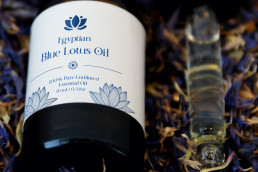
If you are weighing blue lotus vs jasmine, you are almost certainly looking at two of the most evocative florals in aromatherapy and trying to decide which one belongs on your nightstand, in your diffuser, or layered into a perfume. They share a certain sensual, meditative reputation, but chemically and experientially they are very different oils, and the right choice depends on what you actually want the oil to do.
Table of Contents
- What You Are Actually Comparing
- Scent Profile: How They Actually Smell
- Blue Lotus
- Jasmine
- Chemistry and What It Means for Effect
- Blue Lotus Chemistry
- Jasmine Chemistry
- Mood and Use Cases Compared
- Dilution and How to Use Each
- Blue Lotus Dilutions
- Jasmine Dilutions
- Safety Considerations
- Cost, Sourcing, and Value
- Which One Should You Actually Buy?
- Frequently Asked Questions
- Where to Go From Here
- Bring Blue Lotus Into Your Ritual
It is written and clinically reviewed by Antonio Breshears, ND, CCA, a Bastyr-trained naturopathic doctor and certified clinical aromatherapist. For a broader grounding in the oil discussed throughout this article, see The Complete Guide to Blue Lotus Oil, which covers chemistry, sourcing, and use in more depth.
What You Are Actually Comparing
The first thing worth naming clearly: blue lotus and jasmine are not taxonomic cousins. Blue lotus is Nymphaea caerulea, an Egyptian water lily (despite the “lotus” name) that has been associated with ritual, sleep, and altered states since the time of the pharaohs. Jasmine in aromatherapy usually means one of two species, Jasminum grandiflorum (the softer, fruitier Spanish jasmine) or Jasminum sambac (the greener, more indolic Arabian jasmine), both climbing shrubs from entirely different plant families.
Both are typically sold as absolutes rather than steam-distilled essential oils, because their delicate aromatic molecules do not survive high-temperature distillation well. This matters, because it shapes how the oils smell, how they are used, and how they interact with skin. Steam-distilled versions of both exist but are rarer and considerably more expensive.
Scent Profile: How They Actually Smell
This is where the clearest difference lies, and where most people make their decision.
Blue Lotus
Blue lotus has a cooler, more aquatic-floral top note that gives way to a deep, honeyed, slightly boozy heart and then a soft balsamic, faintly smoky base. There is something unmistakably watery about it, a quality that makes people describe it as “dreamlike” or “underwater”. It is floral, but not in an obvious garden-flower way; it feels older, stranger, more contemplative. On skin it stays close, warming slowly rather than projecting.
Jasmine
Jasmine is warmer, sweeter, and far more unapologetically floral. Jasminum grandiflorum leans fruity and tea-like, almost apricot at the top, while Jasminum sambac carries a greener, more indolic character, that slightly animalic, overripe note that gives jasmine its reputation for being sensual to the point of narcotic. Jasmine projects. It announces itself. It fills a room.
If you put the two on a blotter side by side, blue lotus feels introspective and jasmine feels outward-facing. That single distinction is probably the most reliable guide to choosing between them.
Chemistry and What It Means for Effect
Scent is not the only difference. The chemistry of these two oils points in different directions, and the effects people report line up with the chemistry in a reasonably consistent way.
Blue Lotus Chemistry
Blue lotus absolute contains a small but interesting cast of alkaloids, principally aporphine (a weak dopamine agonist) and nuciferine (a weak dopamine antagonist with 5-HT2A/2C serotonin activity), alongside flavonoids such as apigenin, quercetin, and kaempferol. Apigenin is particularly relevant because it binds centrally at benzodiazepine receptors, which is part of why blue lotus is described as gently anxiolytic rather than stimulating. The overall profile is one of parasympathetic coaxing: a slowing down, a softening of alertness, a shift toward reverie. It is not a strong sedative, and anyone expecting it to knock them out will be disappointed, but it reliably takes the edge off.
Jasmine Chemistry
Jasmine absolute is dominated by benzyl acetate, benzyl benzoate, linalool, methyl jasmonate, indole, and a family of esters and alcohols that together create its characteristic heavy-floral-with-a-feral-edge signature. Linalool is mildly calming and well studied. Indole, present in small amounts, gives jasmine its narcotic depth. Methyl jasmonate is a plant signalling molecule with some research attention around mood. Jasmine’s reputation in aromatherapy has always been as an uplifting floral rather than a sedative one; multiple small studies have associated jasmine inhalation with increased alertness, mild euphoria, and a subjective sense of confidence. It is often described as an antidepressant-type effect rather than a sleep aid.
So when people ask which oil is “more relaxing”, the honest answer is: they relax you differently. Blue lotus soothes you toward stillness. Jasmine lifts you out of a low mood. Both can be part of a wind-down ritual, but they are pointing at different emotional states.
Mood and Use Cases Compared
Working clinically, these are the patterns I see most often when clients are trying to decide between the two.
Reach for blue lotus when:
- You want to quiet mental chatter before bed or meditation
- You have a low-grade, chronic anxious hum that you want to dial down
- You want a grounding, introspective scent for ritual or journaling
- You need help transitioning from work-mode to rest-mode in the evening
- You want something dreamy and slightly strange rather than pretty
Reach for jasmine when:
- You are looking for a mood-lifting, mildly euphoric scent rather than a calming one
- You want something overtly sensual for intimacy or perfumery
- You are navigating low mood, flatness, or emotional withdrawal
- You want a confidence-boosting floral before going out
- You want a classic, projecting fragrance with a long history in romance
There is genuine overlap. Both oils appear in bedtime rituals, both feature in romantic blends, and both have histories tied to temple and devotional use. But if you imagine the emotional weather of each, blue lotus is the quiet hour just before sleep, and jasmine is the warm, slightly electric hour before something begins.
Dilution and How to Use Each
Because both are absolutes, both are aromatically potent and should be diluted generously. A little goes a very long way, and overdosing either one tips the scent from beautiful to cloying almost instantly.
Blue Lotus Dilutions
- Face: 1 to 2 percent in a good carrier (jojoba, squalane)
- Body and pulse points: 2 to 3 percent
- Targeted or ritual use: up to 3 percent
- Diffuser: 2 to 4 drops in a room diffuser
Jasmine Dilutions
Jasmine is generally used at similar or slightly lower concentrations because its scent projects more. For perfumery, 1 to 2 percent is often plenty; for a pulse-point roller, 2 percent is the usual ceiling. In a diffuser, 1 to 3 drops is enough, and it will scent an entire room.
Both absolutes benefit from being blended rather than worn neat. Blue lotus pairs beautifully with sandalwood, frankincense, vetiver, and rose. Jasmine sits naturally with ylang ylang, neroli, bergamot, and sandalwood. If you want to use both, blue lotus works well as a base-heart anchor and jasmine as a heart-top accent, rather than stacking them as equals, since jasmine will otherwise dominate.
Safety Considerations
Neither oil is particularly dangerous in normal aromatherapy use, but each has its cautions.
Blue Lotus
Blue lotus should be avoided in pregnancy and breastfeeding, and used with caution alongside dopaminergic medications, MAOIs, and heavy sedatives, because of its alkaloid content. It has regulatory complexity in a few places: it is restricted in Russia, Poland, Latvia, the US state of Louisiana, and sits in a grey area in Australia. In normal topical and diffused use at recommended dilutions it is very well tolerated, with skin sensitisation being rare.
Jasmine
Jasmine absolute is generally considered safe at low dilutions but is sometimes flagged as one to avoid in pregnancy, particularly the later stages, because of traditional associations with stimulating uterine activity (the evidence is thin but the caution is standard). Skin sensitisation can occur, particularly with Jasminum sambac, which is more indolic. Patch testing before a full application is a sensible habit with any absolute.
Both oils are extracted with solvents when produced as absolutes, and trace solvent residues are possible. A reputable supplier will test for these and publish results. This is worth asking about regardless of which oil you are buying.
Cost, Sourcing, and Value
Both are expensive florals, but they are expensive for different reasons. Blue lotus absolute requires somewhere between three and five thousand flowers per gram, all hand-harvested in a narrow window when the flowers open. Jasmine is traditionally hand-picked before dawn, when its scent molecules peak, and it takes roughly eight thousand flowers to make a single gram of absolute. Neither is a volume oil; both reward careful sourcing.
Price alone is a poor guide to quality. What matters more is transparency: single-origin sourcing, batch testing, honest disclosure of extraction method, and a supplier that can tell you the crop year. If a seller cannot answer those questions, the price, high or low, is not telling you anything useful.
In terms of value per drop, both oils are used so sparingly that even a small bottle lasts a surprisingly long time. A 5ml bottle of either, used at appropriate dilutions, can easily provide months of daily rituals.
Which One Should You Actually Buy?
If I had to reduce the choice to one line: buy blue lotus if you want to come down, and buy jasmine if you want to come alive. If your nervous system runs hot, if you lie awake with a busy mind, if you want something contemplative for meditation or sleep, blue lotus is the better match. If you are navigating low mood, flatness, or a period where you feel emotionally muted, and you want a floral that brings warmth and a sense of being switched back on, jasmine is the more useful oil.
There is no rule against owning both, and many people do. They occupy different corners of the emotional landscape and rarely compete once you understand what each is for. The mistake is expecting jasmine to sedate you or expecting blue lotus to lift you out of a depressive flat spell; each will do its own job well and the other’s job poorly.
Frequently Asked Questions
Is blue lotus or jasmine more relaxing?
Blue lotus is more relaxing in the sedative, quieting sense. Jasmine is calming in the sense of lifting a low mood, but it tends toward alertness and mild euphoria rather than drowsiness. If your goal is sleep, blue lotus is the more direct match.
Can I use blue lotus and jasmine together?
Yes, and they can make a beautiful pairing, but jasmine is much louder than blue lotus and will usually dominate the blend. Use jasmine sparingly (one part to three or four parts blue lotus is a reasonable starting ratio) so that the deeper, cooler character of blue lotus still has room to breathe.
Which one is better for perfumery?
Jasmine has a longer and richer tradition in fine perfumery and projects more strongly on skin, which makes it a natural choice. Blue lotus is better suited to niche, contemplative, or meditation-leaning compositions where its watery, honeyed strangeness is the point rather than a distraction.
Are they both safe to diffuse around children and pets?
Neither oil is a first choice around small children, and both should be kept well away from cats in particular (cats cannot metabolise many essential oil constituents efficiently). For adults in a ventilated room, brief, low-dose diffusion of either oil is generally fine. If pets share the space, diffuse only when they can leave the room freely and keep sessions short.
Which oil is better for sleep?
Blue lotus is the clearer match for sleep support. Its apigenin content and parasympathetic-leaning profile make it useful in an evening wind-down. Jasmine can be pleasant at bedtime if you simply enjoy the scent, but it is not a sedative and some people find it slightly stimulating.
Is jasmine safe during pregnancy?
Jasmine is traditionally avoided in pregnancy, particularly in the first and third trimesters, because of historical associations with uterine stimulation. The evidence is limited, but the caution is standard. Blue lotus is also avoided in pregnancy. If you are pregnant and want to use florals aromatically, speak with a qualified aromatherapist or midwife first.
Why are both oils absolutes rather than essential oils?
The aromatic molecules in both blue lotus and jasmine flowers are too delicate to survive steam distillation in reasonable yields. Solvent extraction produces an absolute that captures the full scent profile, though it does introduce trace solvent residues that a reputable supplier will test for. True steam-distilled versions of both exist but are rare and noticeably different in scent.
Can I use either oil neat on skin?
No. Both are potent absolutes and should always be diluted in a carrier oil before skin application. Neat use increases the risk of sensitisation and is wasteful, as the scent actually develops better when diluted.
How long does each oil last once opened?
Stored properly in dark glass, cool and dark, a good blue lotus absolute holds well for three to four years. Jasmine absolute has a similar shelf life, sometimes longer, as some of its constituents mellow rather than degrade with age. Oxidation is the enemy for both; keep bottles closed and avoid heat and direct light.
Which is better value for a first-time buyer?
If you are buying one floral absolute to see whether you enjoy this category of oil, jasmine is the more accessible starting point, because its scent is more familiar and it blends forgivingly. Blue lotus rewards a bit more patience; its profile is unusual and can take a few encounters to fully appreciate. Neither is wasted money if sourced well.
Where to Go From Here
If you have read this far and you are leaning toward blue lotus, the most useful next step is to understand exactly what you are buying and why quality varies so much. The Complete Guide to Blue Lotus Oil covers sourcing, extraction, chemistry, and ritual use in considerably more depth than this comparison allows. If you are leaning toward jasmine, the same principles around provenance, extraction honesty, and careful dilution apply; find a supplier who will show you their testing and tell you the crop year, and you will be well served.
Whichever you choose, treat the oil as the start of a ritual rather than a quick fix. Both of these florals have been used by humans for thousands of years precisely because they reward attention.

Antonio Breshears
Antonio Breshears is a renowned expert in holistic medicine and beauty, with over 25 years of research experience dedicated to uncovering the secrets of nature's most powerful remedies. Holding a degree in Naturopathic Medicine, Antonio's passion for healing and well-being has driven him to explore the intricate connections between mind, body, and spirit.
Over the years, Antonio has become a respected authority in the field, helping countless individuals discover the transformative power of plant-based therapies, including essential oils, herbs, and natural supplements. He has authored numerous articles and publications, sharing his wealth of knowledge with a global audience seeking to improve their overall health and well-being.
Antonio's expertise extends to the realm of beauty, where he has developed innovative, all-natural skincare solutions that harness the potency of botanical ingredients. His formulations embody his deep understanding of the healing properties found in nature, providing holistic alternatives for those seeking a more balanced approach to self-care.
With his extensive background and dedication to the field, Antonio Breshears is a trusted voice and guiding light in the world of holistic medicine and beauty. Through his work at Pure Blue Lotus Oil, Antonio continues to inspire and educate, empowering others to unlock the true potential of nature's gifts for a healthier, more radiant life.