If you have been researching natural alternatives for anxiety, tension, or the kind of evening restlessness that makes winding down feel impossible, you have likely encountered both blue lotus and kava. They are often mentioned in the same breath as traditional calming botanicals, but they are genuinely different plants doing genuinely different things. This article compares blue lotus vs kava across mechanism, form, effect, safety, and practical use, so you can decide which (if either) suits what you are trying to address.
Table of Contents
- The Short Answer First
- What Each Plant Actually Is
- Blue Lotus (Nymphaea Caerulea)
- Kava (Piper Methysticum)
- The Mechanism Comparison
- How Blue Lotus Oil Acts
- How Kava Acts
- Effect Profiles Compared Honestly
- Form and Route: Why This Matters
- Safety: The Honest Comparison
- Blue Lotus Oil Safety
- Kava Safety
- When Blue Lotus Oil Is the Better Choice
- When Kava Is the Better Choice
- Can You Use Both?
- Practical Protocols
- Blue Lotus Oil Evening Protocol
- Kava Beginner Protocol
- What to Expect: Realistic Timeframes
- When Neither Is the Right Answer
- Complementary Approaches
- Frequently Asked Questions
- Where to Go From Here
- A Gentler Path to Calm
It is written and clinically reviewed by Antonio Breshears, ND, CCA, a Bastyr-trained naturopathic doctor and certified clinical aromatherapist. For broader context on the oil itself, including chemistry, history, and safety, see the complete guide to blue lotus oil, which serves as the reference pillar for everything discussed here.
The Short Answer First
Blue lotus oil and kava are not really competitors; they are complementary botanicals with different strengths and different risks. Blue lotus, used aromatically as an essential oil or absolute, is a gentle mood-softening and tension-releasing botanical that works largely through olfactory and topical pathways. Kava, taken internally as a beverage or extract, is a substantially stronger anxiolytic that acts systemically on GABA pathways, with a real clinical evidence base for generalised anxiety but also a real history of safety concerns around liver stress.
If you want something light, sensory, and safe to use most evenings without much thought, blue lotus oil is the better fit. If you have diagnosable anxiety that is not responding to gentler approaches and you want something with more pharmacological weight, kava (taken responsibly, with attention to form and liver health) has more muscle. They can also be combined, which we will come to.
What Each Plant Actually Is
Blue Lotus (Nymphaea Caerulea)
Blue lotus is the Egyptian blue water lily, native to the Nile and cultivated for millennia across north and east Africa. The flowers contain two principal alkaloids, aporphine (a weak dopamine agonist) and nuciferine (a weak dopamine antagonist with serotonergic activity at 5-HT2A and 5-HT2C receptors), alongside flavonoids such as apigenin, quercetin, and kaempferol. Apigenin in particular binds at the central benzodiazepine receptor site, which is the mechanism behind its gentle anxiolytic feel.
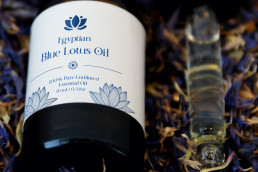
The oil on this site is an absolute, a solvent-extracted aromatic concentrate derived from roughly three to five thousand flowers per gram. It is used topically (diluted) or aromatically (diffused). It is not a tincture, not a beverage, and not intended for ingestion.
Kava (Piper Methysticum)
Kava is a pepper-family shrub native to the South Pacific, cultivated across Fiji, Vanuatu, Tonga, and Hawaii for several thousand years. Its root is traditionally prepared as a water-based beverage used ceremonially and socially. The active compounds are kavalactones, a group of around six to eighteen lipophilic molecules (kavain, dihydrokavain, methysticin, yangonin, and others) that act primarily on GABA-A receptors, with additional effects on monoamine oxidase-B, sodium and calcium channels, and dopamine reuptake.
Kava is taken internally. The traditional preparation is a cold-water extract of the root. Modern forms include standardised extracts in capsules, tinctures, and instant powders. It is emphatically not used as an essential oil or a topical aromatic.
The Mechanism Comparison
Understanding how each plant works clarifies why their effects feel so different.
How Blue Lotus Oil Acts
When you inhale blue lotus, aromatic molecules bind to olfactory receptors and trigger signalling through the limbic system, particularly the amygdala and hippocampus, which modulate emotional tone and arousal. This is why the effect is fast (seconds to minutes) but also relatively modest. You do not feel sedated; you feel fractionally softer, warmer, less braced.
Topically, the flavonoids and small alkaloid fraction appear to cross skin in limited quantities and contribute to local relaxation when applied over tense areas (shoulders, jaw, lower abdomen). The effect is real but gentle; think of it as a parasympathetic nudge rather than a pharmacological lever.
How Kava Acts
Kavalactones, once absorbed through the gut, cross the blood-brain barrier and bind allosterically to GABA-A receptors, enhancing the inhibitory effect of GABA throughout the central nervous system. This is the same broad family of receptors targeted by benzodiazepines, though kava binds at a different site and without producing tolerance or withdrawal in the same way. The result is systemic anxiolysis and muscle relaxation that is genuinely noticeable within thirty to sixty minutes, usually for two to four hours.
Because kava acts systemically, it affects reaction time, coordination, and alertness in ways blue lotus oil simply does not.
Effect Profiles Compared Honestly
Set expectations around what each actually feels like.
Blue lotus oil: a gentle settling of the nervous system, a softening of mental chatter, a faintly dreamy quality when used in higher aromatic doses before sleep. Not sedating. Not mood-altering in any dramatic sense. Users often describe it as “taking the edge off” or “making the evening feel slower”. It is subtle enough that sceptical first-time users sometimes miss the effect entirely; seasoned users come to rely on it for ritual and transition.
Kava: a clear, noticeable relaxation of muscles (especially the jaw and shoulders) and a measurable reduction in anxious thought patterns. At higher doses, mild euphoria, reduced social inhibition, and a pleasant heaviness in the limbs. Traditional kava drinkers describe it as making the mind clear while the body relaxes, which is an unusual combination. The effects are unmistakable. You know you have taken kava.
This difference in intensity is the single most important thing to understand when weighing blue lotus vs kava. They are not on the same scale.
Form and Route: Why This Matters
Blue lotus oil is aromatic and topical. You diffuse it, you dilute it for skin, you inhale from the bottle. This route is fundamentally low-risk because systemic absorption is limited and the active dose is small.
Kava is oral. You drink it, capsule it, or tincture it. Everything you take enters the liver via first-pass metabolism, which is where both the effect and the safety considerations live.
This difference in route shapes almost everything that follows, from how quickly each works to what can go wrong.
Safety: The Honest Comparison
Blue Lotus Oil Safety
Blue lotus essential oil and absolute, used aromatically or at appropriate topical dilutions (one to three percent depending on area), has a benign safety profile for most adults. Standard aromatherapy cautions apply: avoid during pregnancy and breastfeeding, patch test before first topical use, exercise caution if you take dopaminergic medications, MAOIs, or heavy sedatives. Regulatory note: blue lotus is restricted in Russia, Poland, Latvia, the US state of Louisiana, and is regulatorily complex in Australia, though these restrictions primarily concern oral preparations rather than topical aromatherapy use.
Skin sensitisation is rare but possible. Beyond that, there is no meaningful hepatic concern, no dependency potential, and no impairment of cognitive or motor function at normal use.
Kava Safety
Kava has a genuinely complicated safety picture. Traditional water-based preparations of noble kava cultivars have a centuries-long safety record in Pacific cultures. However, several European cases of severe liver toxicity in the early 2000s, mostly associated with acetone or ethanol-extracted products, non-noble cultivars, or aerial plant parts rather than root, led to bans and restrictions across Germany, Switzerland, France, the UK (historically), Canada, and elsewhere. Some of these restrictions have since been loosened as the picture clarified.
The consensus now is that water-extracted noble kava root, used in moderation, in otherwise healthy adults, not combined with alcohol or hepatotoxic drugs, carries low but non-zero liver risk. Long-term heavy use also produces a reversible dry, scaly skin condition known as kava dermopathy. Kava should not be used with alcohol, benzodiazepines, certain SSRIs, or in people with liver disease, and should not be combined with driving or operating machinery.
This is not a plant to use casually without understanding what you are taking.
When Blue Lotus Oil Is the Better Choice
Choose blue lotus oil when:
- You want a daily or near-daily calming ritual without pharmacological weight
- Your concern is mild to moderate tension, sleep onset, or evening wind-down
- You value the sensory, aromatic, and ritual aspects of plant medicine
- You have any concern about liver health or take medications with hepatic considerations
- You need to stay mentally and physically alert (driving, working, parenting)
- You want to layer a botanical into skincare, massage, or meditation
For typical stressed-but-functional adults looking for an elegant evening tool, blue lotus oil is the sensible first option.
When Kava Is the Better Choice
Choose kava when:
- You have diagnosable generalised anxiety disorder and want a non-prescription option with clinical evidence
- You are dealing with acute, situational anxiety (public speaking, travel, a specific event) where a stronger, time-limited effect is wanted
- You want a social, ceremonial alternative to alcohol
- You are willing to take responsibility for sourcing (noble cultivar, water extraction, reputable supplier) and use (no alcohol, moderate frequency, not daily for extended periods)
- Your liver function is healthy and you are not on medications with hepatic interactions
Kava is a more serious tool. It rewards respect and punishes casualness.
Can You Use Both?
Yes, and in fact they layer intelligently because they act through different pathways and routes.
A common combination: a kava beverage forty-five minutes before bed for its GABAergic effect, alongside a blue lotus oil diffuser blend or topical rollerball for the sensory and ritual layer. The kava does the pharmacological work; the blue lotus does the atmospheric work. Users often find the combination more coherent than either alone, because the aromatic ritual gives the chemical effect a container to land in.
The usual cautions apply if you combine. Do not add alcohol, do not drive, do not layer further sedatives without medical input.
Practical Protocols
Blue Lotus Oil Evening Protocol
For an evening unwind, add two to four drops of blue lotus oil to a diffuser thirty to sixty minutes before bed. Alternatively, dilute the oil at two to three percent in jojoba or fractionated coconut oil and apply to pulse points, the nape of the neck, and the solar plexus. Allow five to ten minutes of quiet breathing. Over two to three weeks of consistent use, most people notice a measurable shift in evening arousal.
Kava Beginner Protocol
Start with a traditional water-based preparation of noble kava root, around one to two heaped tablespoons of ground root kneaded through muslin in cold water for ten minutes. Drink on an empty stomach. Expect effects within thirty minutes. Do not exceed three preparations in one evening. Limit frequency to one or two evenings per week initially. Avoid alcohol entirely on kava days.
What to Expect: Realistic Timeframes
Blue lotus oil produces noticeable aromatic effect within minutes but the full benefit as a mood and sleep support tends to emerge over two to three weeks of regular use as the ritual becomes established and the nervous system learns the cue.
Kava, by contrast, produces acute effect the first time you take it (assuming the preparation is sound and the dose adequate). There is no build-up period. Conversely, there is no equivalent “ritual compounding” benefit either; kava is what it is each time you take it.
When Neither Is the Right Answer
Both plants have limits. If you are dealing with panic disorder, severe depression, PTSD, bipolar illness, or suicidal ideation, neither blue lotus oil nor kava is a substitute for qualified clinical care. They can have a supporting role alongside professional treatment, but framing either as a primary intervention for serious mental health conditions is a mistake.
Equally, if your anxiety is being driven by thyroid dysfunction, chronic under-sleep, caffeine excess, blood sugar instability, or unaddressed trauma, no botanical is going to resolve the underlying driver. Address what is actually wrong.
Complementary Approaches
Whichever you choose, the usual foundations matter more than most botanicals. Consistent sleep timing, morning daylight exposure, regular physical movement, reduced afternoon caffeine, and something resembling a wind-down routine before bed will produce larger effects on anxiety and sleep quality than any plant taken in isolation. Blue lotus oil and kava both work better inside a reasonable lifestyle; neither rescues one that is not.
Frequently Asked Questions
Is blue lotus oil as strong as kava?
No. Kava is substantially stronger as an anxiolytic. Blue lotus oil is gentler, subtler, and acts largely through aromatic and topical pathways rather than systemic pharmacology.
Can I take blue lotus oil internally like kava?
No. The essential oil and absolute sold for aromatherapy are not formulated or intended for ingestion. Blue lotus is sometimes consumed internally as a tea or tincture from dried flowers, which is a different preparation entirely.
Is kava legal where I live?
Kava regulation varies by country and has changed repeatedly. It is legal in most of the US, Australia, New Zealand, and much of Europe, though some countries restrict extract forms or require prescriptions. Check your local regulation before purchasing.
Which is better for sleep?
Kava has a stronger acute effect on sleep onset because of its GABAergic action. Blue lotus oil is better suited to establishing an evening ritual that shifts the nervous system toward parasympathetic dominance over time. For a specific bad night, kava; for ongoing sleep hygiene, blue lotus oil.
Can I combine blue lotus oil and kava on the same evening?
Yes, they layer intelligently because they act through different mechanisms. Do not add alcohol or other sedatives, and do not drive.
Does blue lotus oil affect the liver?
There is no meaningful evidence of hepatic concern with aromatic or topical use of blue lotus oil at normal doses. This is a key advantage over kava for anyone with liver considerations.
Will either show up on a drug test?
Standard workplace drug panels test for specific substances (cannabinoids, opiates, amphetamines, cocaine, PCP) and neither blue lotus alkaloids nor kavalactones are on these panels. However, specialty or forensic testing can detect kavalactones if specifically sought.
Which has more traditional use history?
Both have several thousand years of documented use. Blue lotus in ancient Egyptian religious and medicinal practice; kava in Pacific Islander ceremonial, social, and medicinal culture.
Is blue lotus safer than kava?
For aromatic and topical use, yes, with a substantially wider safety margin. For oral use of either plant, the comparison becomes closer, though kava’s liver considerations remain the main point of difference.
Which should I try first?
For most people asking this question, blue lotus oil is the sensible starting point because the safety profile is benign, the effect is easy to layer into daily life, and if it turns out to be enough, you do not need the stronger tool.
Where to Go From Here
If you are leaning toward blue lotus oil as the right fit, the complete guide to blue lotus oil covers chemistry, extraction methods, sourcing, and use cases in depth. If you are leaning toward kava, take the time to research noble cultivars, reputable suppliers, and water-extraction protocols before purchasing; it is a plant that rewards careful handling. For many people, the answer turns out to be blue lotus oil for the daily ritual and kava held in reserve for the harder evenings, which is a reasonable and flexible approach to traditional calming botanicals.

Antonio Breshears
Antonio Breshears is a renowned expert in holistic medicine and beauty, with over 25 years of research experience dedicated to uncovering the secrets of nature's most powerful remedies. Holding a degree in Naturopathic Medicine, Antonio's passion for healing and well-being has driven him to explore the intricate connections between mind, body, and spirit.
Over the years, Antonio has become a respected authority in the field, helping countless individuals discover the transformative power of plant-based therapies, including essential oils, herbs, and natural supplements. He has authored numerous articles and publications, sharing his wealth of knowledge with a global audience seeking to improve their overall health and well-being.
Antonio's expertise extends to the realm of beauty, where he has developed innovative, all-natural skincare solutions that harness the potency of botanical ingredients. His formulations embody his deep understanding of the healing properties found in nature, providing holistic alternatives for those seeking a more balanced approach to self-care.
With his extensive background and dedication to the field, Antonio Breshears is a trusted voice and guiding light in the world of holistic medicine and beauty. Through his work at Pure Blue Lotus Oil, Antonio continues to inspire and educate, empowering others to unlock the true potential of nature's gifts for a healthier, more radiant life.