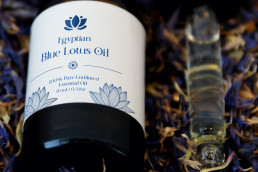
Blue lotus vs lavender is one of the most common comparisons I am asked about, and for good reason: both are marketed for calm, sleep and emotional balance, both carry centuries of ritual history, and both sit on many aromatherapy shelves with vague promises attached. They are, however, genuinely different oils with different chemistry, different effects, and different ideal uses. This article is for anyone trying to decide which one belongs in their routine, or whether both do.
Table of Contents
- Two Different Oils Doing Two Different Jobs
- Chemistry: What Each Oil Actually Contains
- Lavender's Chemical Profile
- Blue Lotus's Chemical Profile
- Scent: The Most Obvious Difference
- Effects: What Each Oil Actually Does
- Lavender's Effect Profile
- Blue Lotus's Effect Profile
- When to Choose Lavender
- When to Choose Blue Lotus
- Safety: Where the Two Oils Diverge Sharply
- Practical Protocol: Using Them Separately or Together
- Using Lavender Alone
- Using Blue Lotus Alone
- Using Them Together
- What to Expect: Realistic Timeframes
- When Neither Oil Is the Right Choice
- Complementary Approaches
- Frequently Asked Questions
- Where to Go From Here
- Experience the Blue Lotus Difference
It is written and clinically reviewed by Antonio Breshears, ND, CCA, a Bastyr-trained naturopathic doctor and certified clinical aromatherapist. For broader context on the oil being compared here, readers may find it useful to pair this article with The Complete Guide to Blue Lotus Oil, which covers chemistry, sourcing and safety in more depth.
Two Different Oils Doing Two Different Jobs
Before we get into the specifics, it helps to set out the honest framing. Lavender (Lavandula angustifolia) is the most studied essential oil in the Western aromatherapy canon, with decades of clinical trials behind it, a well-characterised chemistry dominated by linalool and linalyl acetate, and a reasonably predictable effect on the nervous system. Blue lotus (Nymphaea caerulea) is a quieter, rarer, more complex material, produced typically as an absolute rather than a true essential oil, carrying alkaloids and flavonoids alongside its aromatic molecules, and working on the mind in a way that is more subtle, more emotive, and less immediately sedating.
Put simply: lavender is the dependable generalist, the oil you reach for when you want reliable calm. Blue lotus is the specialist, the oil you reach for when you want introspective quiet, dream work, or a sensory ritual that carries genuine emotional depth. Neither replaces the other. They answer different questions.
Chemistry: What Each Oil Actually Contains
Lavender’s Chemical Profile
True lavender essential oil is dominated by two compounds: linalool (typically 25 to 45 percent) and linalyl acetate (typically 25 to 45 percent), with smaller quantities of terpinen-4-ol, lavandulyl acetate, beta-caryophyllene and various minor monoterpenes. These molecules are comparatively well understood. Linalool interacts with GABA-A receptors and voltage-gated calcium channels, producing mild anxiolytic and sedative effects both through inhalation and through skin absorption. Linalyl acetate appears to contribute analgesic and antispasmodic activity. The combined effect is a genuine, measurable, modestly sedating profile that is reasonably consistent across good-quality batches.
Blue Lotus’s Chemical Profile
Blue lotus is chemically more interesting and less uniform. Alongside aromatic compounds, a properly extracted blue lotus absolute contains aporphine (a weak dopamine agonist), nuciferine (a weak dopamine antagonist with 5-HT2A and 5-HT2C serotonin activity), and flavonoids including apigenin (which binds central benzodiazepine receptors), quercetin and kaempferol. The aromatic fraction itself tends toward cool floral-aquatic top notes, a honeyed-floral heart, and a balsamic, faintly smoky base.
The practical upshot: blue lotus does not act on the nervous system in the simple “GABA-nudge” way that lavender does. Its effects are mediated through a more complex mix of dopaminergic, serotonergic and benzodiazepine-adjacent pathways, which is why users describe the experience as more dreamlike, more mood-shifting, and less straightforwardly sedative than lavender.
Scent: The Most Obvious Difference
If you smell both oils side by side, the difference is immediate. Lavender is green, herbaceous, camphorous at the top, softening into a fresh floral heart. It reads as clean, familiar, almost medicinal. Many people have strong associations with it already, either positive (bedtime, spa treatments, grandmother’s linen cupboard) or negative (clinical, over-used, suffocatingly sweet in poor-quality products).
Blue lotus opens cooler and more aquatic, like a water lily actually smells when you bend over a pond, then deepens into a rich honeyed-floral middle, and finishes on a warm, resinous, faintly smoky base. It is complex enough that most people find something new in it on second and third inhalation. It does not smell like perfume-counter florals, and it does not smell like lavender. It smells like its own thing, which is part of why it appears so often in ritual, meditation and ceremonial contexts rather than in linen sprays.
Effects: What Each Oil Actually Does
Lavender’s Effect Profile
Lavender’s clinical evidence is the strongest of any essential oil. It has been shown, across multiple randomised trials, to reduce state anxiety, improve sleep onset, lower perceived stress, and modestly reduce blood pressure and heart rate during acute stress. The effect is real but not dramatic: you will not fall asleep from smelling lavender the way you might from a benzodiazepine. You will, reliably, feel a slight softening of arousal within ten to twenty minutes of exposure. That predictability is its virtue.
Lavender is also useful topically for minor burns and insect bites, where it appears to reduce inflammation and support tissue healing. It is the aromatherapy default for a reason.
Blue Lotus’s Effect Profile
Blue lotus is different. It is not a strong sedative. It is not going to knock you out. What it tends to do, in the dose ranges used in aromatherapy (a few drops diffused, a properly diluted roller applied to pulse points), is produce a quiet shift in mood: a slight lift, a slight softening, a slight loosening of the grip that analytical thinking has on the mind. Users often describe it as “settling” rather than “sedating”, and as supportive of introspective states, creative work, meditation and pre-sleep reverie rather than as a knockout.
In dream work specifically, blue lotus has a reasonably well-attested reputation for making dreams more vivid, more memorable and sometimes more lucid. This is consistent with its serotonergic chemistry. Lavender does not do this. If your goal is deeper, more memorable dreams, the two oils are not interchangeable.
When to Choose Lavender
Choose lavender when you want reliable, evidence-backed, predictable calm. Specifically:
- You are new to aromatherapy and want a safe, well-studied starting point.
- Your primary goal is faster sleep onset or reduced night-time arousal.
- You are treating acute situational anxiety (before a presentation, a flight, a medical procedure).
- You want an oil that blends easily with many other oils without dominating the formula.
- You need something cost-effective for frequent, daily use.
- You want topical first-aid utility for minor burns, bites and small skin irritations.
- You are pregnant or breastfeeding (lavender is generally considered safe in moderation; blue lotus is not recommended).
When to Choose Blue Lotus
Choose blue lotus when you want something more specific, more textured, and more emotionally resonant. Specifically:
- Your goal is meditative quiet or introspective depth rather than simple relaxation.
- You are interested in dream enhancement, lucid dreaming, or pre-sleep ritual rather than just falling asleep faster.
- You want a scent that does not smell like a spa or a hotel toiletry, and that carries genuine ceremonial weight.
- You are building a personal ritual (morning meditation, evening wind-down, creative work, intimacy) and want the scent itself to be part of the practice.
- Lavender has stopped working for you or you have developed scent fatigue from it.
- You want mild, gentle mood support without the slightly flattening quality that some users find in lavender.
Safety: Where the Two Oils Diverge Sharply
Lavender’s safety profile is straightforward. It is one of the few essential oils considered safe for neat application in small amounts (a dab on an insect bite), safe in pregnancy in normal aromatherapy doses, and safe for children over a certain age at appropriate dilutions. The main caveats are potential skin sensitisation in a small minority of users and a theoretical endocrine concern in prepubescent boys that remains contested in the literature.
Blue lotus requires more care. It should be avoided in pregnancy and breastfeeding on a precautionary basis given its alkaloid content. Caution is warranted for anyone on dopaminergic medications (for Parkinson’s, restless legs, certain psychiatric conditions), MAOIs, or strong sedatives, because the alkaloid activity could theoretically interact. It is legally restricted in a small number of jurisdictions, including Russia, Poland, Latvia and the US state of Louisiana, and faces regulatory complexity in Australia. Standard aromatherapy dilutions (1 to 2 percent on the face, 2 to 3 percent on the body, a few drops in a diffuser) are well tolerated by healthy adults, but it is not the casual, use-it-on-anyone oil that lavender is.
Practical Protocol: Using Them Separately or Together
Using Lavender Alone
For sleep: 3 to 4 drops in a diffuser in the bedroom, started 30 minutes before you intend to sleep, run on an intermittent setting so the scent does not saturate. For acute anxiety: 1 to 2 drops on a tissue, inhaled for 2 to 3 minutes with slow breathing. For topical use: diluted to 2 to 3 percent in a carrier (roughly 12 to 18 drops per 30ml), applied to wrists, temples or the nape of the neck.
Using Blue Lotus Alone
For ritual or meditation: 2 to 4 drops in a diffuser, ideally in a small, enclosed space, started a few minutes before the practice begins. For dream work: a properly diluted roller (2 to 3 percent) applied to temples, the third-eye point and pulse points around 30 to 45 minutes before sleep. For skincare integration: 1 to 2 percent in a facial oil, layered into an evening routine where the scent itself becomes part of the wind-down.
Using Them Together
Blended thoughtfully, lavender and blue lotus complement each other rather than competing. Lavender brings its green-herbaceous brightness to the top of the scent, blue lotus anchors the heart and base with depth and honeyed complexity. A simple evening blend might be 2 drops lavender with 2 drops blue lotus in a diffuser, which gives you both the reliable GABA-adjacent calm of lavender and the introspective texture of blue lotus. In a roller, a 1 percent lavender plus 1 percent blue lotus formula in jojoba is a beautifully balanced pre-sleep application.
What to Expect: Realistic Timeframes
With lavender, most users notice an effect within their first or second use: a slight slowing of breath, a softening of shoulders, faster transition into sleep. This is the oil’s strength. Results are immediate and replicable.
With blue lotus, the picture is more varied. Some users describe a clear mood-shift on first inhalation; others find the oil takes a few sessions before they “land” with it, particularly if they are new to complex florals or used to simpler, sharper scents. The dream-enhancement effect, where present, tends to show up within the first three to seven nights of consistent use. The emotional and ritual benefits build over weeks of practice rather than arriving in a single dramatic session.
When Neither Oil Is the Right Choice
Both oils are supportive tools, not substitutes for clinical care. If you are dealing with severe insomnia that has persisted for more than a few weeks, clinical anxiety or panic disorder, depressive symptoms that are interfering with functioning, or any condition that warrants medical evaluation, neither lavender nor blue lotus should be your primary intervention. They can sit alongside proper treatment; they cannot replace it.
Similarly, if you have a known sensitivity to florals, a history of contact dermatitis from aromatic materials, or a medication regimen that raises interaction concerns, the sensible move is to speak with a clinician (ideally one who understands both pharmacology and aromatherapy) before adding either oil to your routine.
Complementary Approaches
Neither oil works in isolation. Sleep hygiene (consistent bedtime, cool dark room, no screens in the final hour), breath practices (slow nasal breathing, extended exhalation), and basic lifestyle factors (caffeine timing, evening light exposure, unresolved stress) all matter more than which oil is in your diffuser. The oils are amplifiers of a good routine, not replacements for one.
If anxiety is the primary concern, consider pairing lavender with roman chamomile or bergamot. If ritual depth is the primary concern, consider pairing blue lotus with frankincense, sandalwood or rose. These are natural companions in both chemistry and scent, and they extend the character of the base oil rather than masking it.
Frequently Asked Questions
Is blue lotus stronger than lavender?
Not in the simple sedative sense. Lavender is more reliably and more quickly calming. Blue lotus is more complex in its effects on mood, dreams and introspective states, but it does not produce a stronger “knock-out” effect. They are strong at different things.
Can I use blue lotus and lavender together?
Yes, and they blend beautifully. Lavender’s herbaceous top notes complement blue lotus’s honeyed, balsamic base. A 1:1 blend in a diffuser or a roller is a common and effective pre-sleep or meditation formula.
Which is better for sleep?
Lavender has more clinical evidence for faster sleep onset and is the more predictable choice if your only goal is “fall asleep sooner”. Blue lotus is the better choice if your goal is richer dream life, more meaningful pre-sleep ritual, or quieter mental texture as you drift off.
Which is better for anxiety?
For acute, situational anxiety, lavender is better studied and more immediately effective. For the kind of low-grade, background anxiety that benefits from ritual and introspection rather than suppression, blue lotus can be genuinely useful. Many people benefit from having both on hand.
Is lavender safer than blue lotus?
Generally, yes. Lavender has a broader safety profile, is considered acceptable in pregnancy in normal aromatherapy doses, and has fewer interaction concerns. Blue lotus is well tolerated by healthy adults at standard dilutions but requires more caution with certain medications and is not recommended in pregnancy or breastfeeding.
Why is blue lotus so much more expensive?
Because it takes 3,000 to 5,000 flowers to produce a single gram of absolute, because the plant is cultivated in a narrow set of regions, and because demand has outpaced supply for years. Lavender, by contrast, is cultivated at industrial scale across multiple continents.
Can I substitute blue lotus for lavender in a recipe?
Sometimes, but not always. In a sleep blend aimed at fast onset, lavender is usually the better choice. In a meditation or ritual blend, blue lotus brings something lavender cannot. In a skincare formula, both work, but the scent character will be very different.
Does blue lotus smell anything like lavender?
No. Lavender is green, herbaceous and fresh. Blue lotus is aquatic, honeyed, floral and faintly smoky. If you are used to lavender, blue lotus will smell unfamiliar at first; most users find it grows on them substantially within a few uses.
Which one should I buy first?
If you are building a first aromatherapy kit for general calm and sleep, start with lavender. If you already have lavender and want something with more depth, emotional texture and ritual quality, add blue lotus. If you are specifically interested in dream work, meditation or introspective practices, start with blue lotus and add lavender later.
How long does each oil last once opened?
Good-quality lavender keeps for 2 to 3 years in dark glass stored cool and dark. Blue lotus absolute, properly stored, keeps for 3 to 4 years. Both degrade faster with heat, light and frequent air exposure.
Where to Go From Here
The honest answer to blue lotus vs lavender is that they are not really competitors. Lavender is the reliable, evidence-backed default for generalised calm and sleep; blue lotus is the specialist for ritual, dream work and emotional depth. A well-stocked aromatherapy shelf has room for both, and most serious users end up with both in rotation. For a fuller picture of the oil covered here, including sourcing, chemistry, extraction and safety, see The Complete Guide to Blue Lotus Oil.

Antonio Breshears
Antonio Breshears is a renowned expert in holistic medicine and beauty, with over 25 years of research experience dedicated to uncovering the secrets of nature's most powerful remedies. Holding a degree in Naturopathic Medicine, Antonio's passion for healing and well-being has driven him to explore the intricate connections between mind, body, and spirit.
Over the years, Antonio has become a respected authority in the field, helping countless individuals discover the transformative power of plant-based therapies, including essential oils, herbs, and natural supplements. He has authored numerous articles and publications, sharing his wealth of knowledge with a global audience seeking to improve their overall health and well-being.
Antonio's expertise extends to the realm of beauty, where he has developed innovative, all-natural skincare solutions that harness the potency of botanical ingredients. His formulations embody his deep understanding of the healing properties found in nature, providing holistic alternatives for those seeking a more balanced approach to self-care.
With his extensive background and dedication to the field, Antonio Breshears is a trusted voice and guiding light in the world of holistic medicine and beauty. Through his work at Pure Blue Lotus Oil, Antonio continues to inspire and educate, empowering others to unlock the true potential of nature's gifts for a healthier, more radiant life.