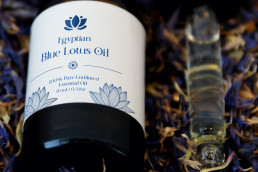
If you have found yourself weighing blue lotus vs neroli, you are almost certainly choosing between two of the most genuinely beautiful florals in the aromatherapy cabinet. Both are expensive. Both have a reputation for calming the nervous system. Both sit comfortably in natural perfumery. But they are not interchangeable, and the differences matter more than most comparison articles admit. This guide walks through scent, chemistry, clinical effects, skincare use, price, and the kind of person each oil actually suits.
Table of Contents
- What Each Oil Actually Is
- Chemistry: Where the Differences Begin
- Scent Profile Compared
- Neroli
- Blue Lotus Absolute
- How Each Oil Affects Mood and Nervous System
- Neroli for Anxiety and Acute Stress
- Blue Lotus for Diffuse Tension and Pre-Sleep Wind-Down
- Skincare: Where They Actually Differ
- Neroli in Skincare
- Blue Lotus Absolute in Skincare
- Price and Adulteration
- How to Use Each Oil
- Neroli Protocols
- Blue Lotus Protocols
- When Each Oil Is Not the Right Choice
- Which Should You Actually Buy?
- Frequently Asked Questions
- Where to Go From Here
- Experience the Real Thing
It is written and clinically reviewed by Antonio Breshears, ND, CCA, a Bastyr-trained naturopathic doctor and certified clinical aromatherapist. If you want a broader grounding before drilling into this comparison, the complete guide to blue lotus oil covers chemistry, extraction, and safe use in depth, and is a useful companion read.
What Each Oil Actually Is
Neroli essential oil is steam-distilled from the freshly picked blossoms of the bitter orange tree, Citrus aurantium var. amara. It takes roughly one tonne of hand-harvested blossoms to produce a single kilogram of oil, which is partly why it is one of the most expensive citrus-family oils on the market. The scent is unmistakable to anyone who has stood under an orange tree in flower: bright, honeyed, softly green, with a cool metallic edge and a faintly bitter finish that keeps it from becoming saccharine.
Blue lotus oil is, in practice, almost always an absolute rather than a true essential oil. It is produced by solvent extraction from the flowers of Nymphaea caerulea, the Egyptian blue water lily, with roughly 3,000 to 5,000 flowers required per gram of finished absolute. A rarer steam-distilled true essential oil exists but is produced in tiny volumes. Supercritical CO2 extraction sits between the two in terms of purity and yield. The scent is quite different from neroli: cooler and more aquatic at the top, deeply honeyed and floral at the heart, with a balsamic, faintly smoky dry-down.
So the first honest thing to say is that these are chemically and botanically unrelated plants, produced by different extraction methods, and they smell like it. The “both are expensive florals that help you relax” framing is accurate but lazy.
Chemistry: Where the Differences Begin
Neroli’s character is driven by a combination of monoterpene alcohols (linalool, alpha-terpineol, nerolidol), esters (linalyl acetate, neryl acetate), and small amounts of methyl anthranilate which contributes its distinctive cool, slightly grape-like floral note. This is a fairly classical essential oil composition, and much of neroli’s calming effect in clinical studies has been attributed to linalool and linalyl acetate, both of which have well-documented anxiolytic activity in animal and small human trials.
Blue lotus absolute has a more unusual profile. Alongside fatty acids and waxes typical of solvent extractions, it contains aporphine alkaloids (including nuciferine and small amounts of apomorphine-related compounds) and a flavonoid fraction dominated by apigenin, quercetin, and kaempferol. Apigenin in particular binds the central benzodiazepine receptor site, which gives blue lotus a mechanism of action that is genuinely distinct from neroli’s terpene-driven chemistry. Whether enough of these constituents penetrate via inhalation or skin application to exert a systemic effect is debated and almost certainly dose-dependent, but the underlying chemistry is more complex than neroli’s.
The practical upshot: neroli works primarily through the olfactory-limbic pathway and via volatile terpenes that are readily absorbed and rapidly cleared. Blue lotus absolute works partly through the same olfactory route, but also carries a heavier, less volatile alkaloid and flavonoid fraction that contributes to its distinctive staying power on skin and its reputation as a subtly altering oil rather than simply a relaxing one.
Scent Profile Compared
Neroli
Top notes are bright, citrus-floral, and immediately recognisable. There is a cool, slightly green quality that reads as “fresh” rather than “heady”. The heart is classically floral, honeyed, with a touch of indole that prevents it from becoming purely pretty. The dry-down is clean, short by floral standards, and fades to a soft, slightly powdery residue within a few hours on skin.
Blue Lotus Absolute
Top notes are cooler, more aquatic, with a faint green-metallic quality that some people read as cucumber or wet stone. The heart is where the oil really lives: a deep, honeyed, almost waxy floral with tropical and slightly fruity facets. The dry-down is balsamic and long, with a faint smoky-resinous character that persists on skin and fabric for many hours. It is a more introspective scent. Neroli is the sunlit courtyard; blue lotus is the temple at dusk.
If you are choosing on scent alone, the question is whether you want a brightening, uplifting floral (neroli) or a grounding, meditative one (blue lotus). Both are beautiful. They are not substitutes.
How Each Oil Affects Mood and Nervous System
Neroli for Anxiety and Acute Stress
Neroli has the stronger body of clinical evidence behind it for acute anxiety reduction, particularly in pre-procedural settings such as pre-operative anxiety, cardiac catheterisation, and labour. Several small randomised trials have shown measurable reductions in anxiety scores and, in some studies, in blood pressure and heart rate with short inhalation protocols. The effect is fast, typically within minutes, and reliable. If your primary need is “calm me down before a meeting or a medical appointment”, neroli is the more evidence-backed tool.
Blue Lotus for Diffuse Tension and Pre-Sleep Wind-Down
Blue lotus has a different phenomenology. Users and practitioners consistently describe it as subtly euphoric or softly dissociative rather than straightforwardly sedative. It does not knock you out the way lavender, vetiver, or a strong sleep blend can, but it seems to soften the edges of rumination, slow the internal pace, and produce a parasympathetic drift that suits evening ritual, meditation, and pre-sleep rather than acute anxiety management. It is not a strong sedative and should not be sold as one. It is better understood as a mood-modulating floral with a meditative character.
So for the anxious patient who needs reliable, fast, well-evidenced acute relief, neroli wins. For the person seeking a contemplative, grounding oil to support evening wind-down, ritual, or a longer introspective practice, blue lotus is the more interesting choice.
Skincare: Where They Actually Differ
Neroli in Skincare
Neroli has a long, well-deserved reputation in skincare for mature, sensitive, and reactive skin. It is generally well tolerated at one to two percent in facial formulations, has mild astringent and regenerative properties, and is a classical ingredient in fine facial oils aimed at uneven tone, fine lines, and dull or congested complexions. Because it is volatile, it leaves relatively little residue and does not weigh down a formula.
Blue Lotus Absolute in Skincare
Blue lotus absolute is heavier and more persistent on skin. Its flavonoid content, particularly apigenin and quercetin, gives it a genuine antioxidant profile, and traditional Egyptian cosmetic use focused on mature skin, hyperpigmentation, and the kind of slow, ritualistic facial oiling that was part of elite beauty practice. It sits beautifully in richer night-time serums, rollerballs over pulse points, and blends where you want the scent to linger. Because it is an absolute, it carries more non-volatile residue than a steam-distilled oil and is best used in leave-on formulations at one to two percent for the face.
The honest contrast: neroli is the more versatile everyday skincare oil, particularly for sensitive or reactive skin. Blue lotus is the more luxurious, slower, more ritualistic choice, and it has stronger scent persistence.
Price and Adulteration
Both oils are expensive and both are heavily adulterated in the wider market. Neroli is frequently cut with petitgrain (distilled from the leaves of the same tree and much cheaper), with synthetic linalool and linalyl acetate, or with orange blossom absolute, which is a related but distinct product. Blue lotus is even more commonly adulterated, often with synthetic fragrance compounds on a fractionated coconut base, or with unrelated floral absolutes coloured to match expectations. Genuine Egyptian blue lotus absolute has no blue colour in the oil itself, despite the flower’s name.
In terms of raw cost per millilitre at genuine quality, prices are broadly comparable, with both sitting firmly in the luxury tier. Neroli has a slightly more developed supply chain and is easier to verify through GC-MS testing because its expected profile is well characterised. Blue lotus requires a more specialised supplier and more careful sourcing because fraud is so widespread.
How to Use Each Oil
Neroli Protocols
- Acute anxiety: two to three drops on a tissue or personal inhaler, slow breathing for three to five minutes. Effect within ten minutes.
- Facial oil: one percent in jojoba or squalane (roughly nine drops per 30 ml), applied to clean damp skin, morning or evening.
- Bath: four drops dispersed in a tablespoon of carrier oil or full-fat milk before adding to the water.
Blue Lotus Protocols
- Evening wind-down: two to four drops in a diffuser for twenty to thirty minutes before bed.
- Meditation anointing: three percent in jojoba applied to temples, wrists, and the space between the brows.
- Night-time facial oil: one to two percent in a richer carrier such as jojoba with a small amount of rosehip or squalane.
Both oils blend well with one another, incidentally. A small amount of neroli can brighten the heavier dry-down of blue lotus, and a trace of blue lotus can give neroli a more mysterious, longer-lasting finish.
When Each Oil Is Not the Right Choice
Neroli is not the right choice if you are looking for a deeply grounding, meditative scent. It is too bright and too volatile for that role. It is also not the best value if you need a large volume for diffusing rather than personal application; cheaper citrus oils will do the brightening work at a fraction of the cost.
Blue lotus is not the right choice for acute anxiety management, for anyone who needs a reliably fast calming effect with a solid evidence base, or for daytime skincare where a bright, fresh finish is wanted. It is also contraindicated in pregnancy and breastfeeding, should be used with caution alongside dopaminergic medications and MAOIs, and should not be combined with heavy sedatives. Neroli has a more permissive safety profile, though it too is typically avoided in the first trimester of pregnancy as a precaution.
Which Should You Actually Buy?
If you have to choose only one, the answer depends on what you actually want the oil to do.
Choose neroli if: you want a well-evidenced, fast-acting acute anxiety tool, a bright uplifting scent for daytime, a versatile addition to skincare for sensitive or mature skin, and something with a more permissive safety profile.
Choose blue lotus if: you want a ritual and meditation oil, a scent that lingers and rewards slow attention, a night-time facial oil with serious traditional pedigree, or a distinctive perfumery base note. You accept that the evidence base is smaller and the effect is more phenomenological than clinical.
Buy both if: you genuinely love florals, you blend your own perfumes or skincare, and you want the full spectrum from bright morning citrus-floral (neroli) to deep contemplative evening floral (blue lotus). They are complementary rather than competing tools, and they work well together in skilled hands.
Frequently Asked Questions
Is blue lotus stronger than neroli?
“Stronger” is the wrong word. Neroli has a more documented acute anxiolytic effect. Blue lotus has a more distinctive, lingering, mood-modulating character. They operate through partially different mechanisms and serve different purposes.
Can I use blue lotus and neroli together?
Yes, and they blend beautifully. A small amount of neroli brightens blue lotus’s heavier heart and dry-down, while blue lotus gives neroli more depth and longevity. Start with roughly four parts blue lotus to one part neroli and adjust to taste.
Which is better for sleep?
Neither is a strong sedative. Blue lotus suits pre-sleep wind-down and ritual better because of its heavier, more grounding character. For genuine sleep induction, lavender, vetiver, or Roman chamomile have stronger sedative profiles.
Which is better for skin?
Neroli for sensitive, reactive, or daytime use. Blue lotus for night-time, mature skin, or when you want a ritualistic facial oil with longer-lasting scent and genuine antioxidant flavonoid content.
Is neroli safer than blue lotus?
Neroli has a more permissive safety profile, particularly outside pregnancy. Blue lotus has more specific cautions around pregnancy, breastfeeding, dopaminergic medications, MAOIs, and heavy sedatives. Both should be dermally diluted.
Why is blue lotus so much more expensive by weight in some shops?
Because yields are extraordinarily low (3,000 to 5,000 flowers per gram of absolute), sourcing is concentrated in Egypt, and genuine material is scarce. Suspiciously cheap blue lotus is almost always adulterated or synthetic.
Does neroli have the alkaloids that blue lotus has?
No. Neroli is a terpene-dominant essential oil with no meaningful alkaloid content. Blue lotus’s aporphine alkaloids and apigenin-rich flavonoid fraction are unique to its chemistry and give it its distinctive phenomenology.
Which smells better?
That is entirely personal. Neroli reads as bright, fresh, and sunlit. Blue lotus reads as deep, honeyed, and contemplative. Most people who appreciate fine florals eventually want both.
Can I substitute one for the other in a recipe?
Not cleanly. The scent profiles differ enough that the character of the finished blend will change significantly. You can sometimes swap at low percentages in background roles, but not in feature positions.
Which is better for perfumery?
Both are classical perfumery ingredients. Neroli is a top to middle note in traditional fougeres, colognes, and light florals. Blue lotus is a heart to base note in orientals, chypres, and meditative or esoteric blends. Serious perfumers keep both in the organ.
Where to Go From Here
If this comparison has helped clarify what you actually want blue lotus to do, the next useful step is grounding yourself in its full chemistry, extraction methods, and safe use. The complete guide to blue lotus oil covers that territory properly and will save you from the adulterated material that floods this category. If you were leaning towards neroli for acute anxiety support, that is a legitimate and well-evidenced choice, and you should look for a reputable single-source supplier with current GC-MS testing. If you were leaning towards blue lotus for ritual, meditation, or luxury skincare, make absolutely sure you are buying from a source that can verify genuine Nymphaea caerulea origin.

Antonio Breshears
Antonio Breshears is a renowned expert in holistic medicine and beauty, with over 25 years of research experience dedicated to uncovering the secrets of nature's most powerful remedies. Holding a degree in Naturopathic Medicine, Antonio's passion for healing and well-being has driven him to explore the intricate connections between mind, body, and spirit.
Over the years, Antonio has become a respected authority in the field, helping countless individuals discover the transformative power of plant-based therapies, including essential oils, herbs, and natural supplements. He has authored numerous articles and publications, sharing his wealth of knowledge with a global audience seeking to improve their overall health and well-being.
Antonio's expertise extends to the realm of beauty, where he has developed innovative, all-natural skincare solutions that harness the potency of botanical ingredients. His formulations embody his deep understanding of the healing properties found in nature, providing holistic alternatives for those seeking a more balanced approach to self-care.
With his extensive background and dedication to the field, Antonio Breshears is a trusted voice and guiding light in the world of holistic medicine and beauty. Through his work at Pure Blue Lotus Oil, Antonio continues to inspire and educate, empowering others to unlock the true potential of nature's gifts for a healthier, more radiant life.