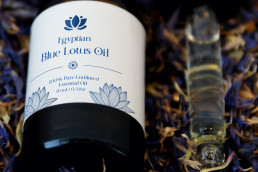
If you are trying to decide between blue lotus oil and pink lotus oil, the first thing worth knowing is that they are not, botanically speaking, the same plant at all. They come from different genera, sit in different plant families, and behave quite differently both on the skin and in the nervous system. This article compares blue lotus vs pink lotus from a clinical aromatherapist’s perspective: chemistry, scent, effects, price, best uses, and where each one genuinely earns its place.
Table of Contents
- Two Different Plants Sharing One Common Name
- Scent: Where the Difference Is Most Obvious
- Blue Lotus Absolute
- Pink Lotus Absolute
- Chemistry and Effect on the Nervous System
- Price, Rarity, and What You Are Paying For
- Best Uses: Where Each One Shines
- Blue Lotus Oil Is the Better Choice When
- Pink Lotus Oil Is the Better Choice When
- How to Use Each Oil: Practical Protocol
- Blue Lotus Oil
- Pink Lotus Oil
- Safety: Both Require the Same Caution
- White Lotus: A Brief Note
- Which One Should You Buy First?
- What to Expect: Realistic Timeframes
- When Neither Oil Is the Right Choice
- Complementary Approaches
- Frequently Asked Questions
- Where to Go From Here
- Try Blue Lotus for Yourself
It is written and clinically reviewed by Antonio Breshears, ND, CCA, a Bastyr-trained naturopathic doctor and certified clinical aromatherapist. For readers who want broader context on the oil itself, the complete guide to blue lotus oil covers extraction, chemistry, and use in far more depth than a comparison article can.
Two Different Plants Sharing One Common Name
The word “lotus” in perfumery is genuinely confusing because it has been stretched across multiple unrelated species. What sellers call blue lotus is almost always Nymphaea caerulea, the Egyptian blue water lily, a member of the Nymphaeaceae family. What is sold as pink lotus is Nelumbo nucifera, the sacred Indian lotus, a member of the Nelumbonaceae family. Despite their superficial resemblance (both float on water, both have large showy flowers, both appear in religious iconography), they are not closely related. Think of them as plants that converged on a similar lifestyle rather than siblings.
This matters because the chemistry diverges sharply. Nymphaea caerulea contains aporphine and nuciferine alkaloids along with flavonoids like apigenin, quercetin, and kaempferol. Nelumbo nucifera contains a different alkaloid profile (including neferine and liensinine from the embryo, though the flower itself has its own set), along with a fatty, wax-rich aromatic profile that is very distinct on the nose.
In short: the marketing may lump them together as “lotus oils”, but they are chemically and olfactorily different products, and they are not interchangeable.
Scent: Where the Difference Is Most Obvious
If you smelled blue lotus and pink lotus absolutes side by side (a useful exercise, if you ever get the chance), you would notice the difference within seconds.
Blue Lotus Absolute
Blue lotus opens with a cool, aquatic, almost green floral character. There is a slight spiciness underneath, and a distinctive honeyed-balsamic heart that develops as it warms on the skin. The dry-down is deep, slightly smoky, and unmistakably resinous. It has a quality that perfumers describe as meditative or hypnotic, more mysterious than conventionally pretty.
Pink Lotus Absolute
Pink lotus is warmer, softer, and in my experience far more conventionally floral. It sits somewhere between rose, magnolia, and a faint hay-like warmth, with a creamy, slightly waxy undertone. It is easier to wear in the conventional sense: most people find it immediately pleasant in the way they would find a good rose or jasmine oil pleasant. It is less strange, less mystical, more openly beautiful.
For perfumery, pink lotus plays well in floral bouquets and soft oriental compositions. Blue lotus is more often used as a distinctive heart note or a meditative solo ingredient where its unusual character is the point.
Chemistry and Effect on the Nervous System
This is where blue lotus earns its reputation as more than a perfume ingredient. The aporphine alkaloid profile in Nymphaea caerulea has weak dopaminergic activity, and nuciferine has documented 5-HT2A/2C activity and weak dopamine-antagonist behaviour. Combined with flavonoids like apigenin (which binds central benzodiazepine receptors), the oil has a reasonably well-attested calming profile when used aromatically. Modest rather than dramatic, but genuinely felt by most users.
Pink lotus, by contrast, has less documented central-nervous-system activity in its aromatic form. That is not to say it does nothing: floral aromatics generally have a soothing effect through the olfactory-limbic pathway, and pink lotus is no exception. But the specific alkaloid-driven calming profile associated with blue lotus is not really the story with pink lotus. Pink lotus is more emotionally pleasant than neurochemically active.
If you are choosing between the two because you want a calming effect on anxiety, racing thoughts, or evening tension, blue lotus is the more evidence-supported choice. If you are choosing because you want a warm floral note that simply smells beautiful, pink lotus is the more straightforward pick.
Price, Rarity, and What You Are Paying For
Both oils are expensive because both require enormous quantities of flowers to produce a small amount of absolute. Blue lotus typically requires 3,000 to 5,000 flowers per gram of absolute. Pink lotus is similarly labour-intensive, though pink lotus is more widely cultivated in India and Southeast Asia for religious and culinary purposes, which gives it a slightly larger supply chain.
In practice, pink lotus absolute often costs slightly less than blue lotus absolute at comparable quality levels, though high-grade pink lotus can absolutely match or exceed blue lotus pricing. Both are firmly in the luxury-ingredient category, and both are heavily adulterated in the low end of the market. A 10 ml bottle of “pure lotus oil” selling for fifteen pounds is a synthetic fragrance or a highly diluted product regardless of which colour it claims to be.
Best Uses: Where Each One Shines
Blue Lotus Oil Is the Better Choice When
You are using the oil primarily for its effect on mood, sleep, or meditation practice. The calming profile of blue lotus has a depth that pink lotus does not match. I recommend it for evening diffusion, pre-meditation ritual, anxiety-adjacent tension, and for people who want an oil that does something rather than just smells nice. It is also the better choice for readers drawn to the Egyptian symbolic and spiritual tradition specifically, since Nymphaea caerulea is the actual blue lotus of pharaonic imagery.
Pink Lotus Oil Is the Better Choice When
You are building a perfume, a facial serum where scent is a priority, or a skincare blend where you want an immediately pleasant, broadly appealing floral note. Pink lotus is easier to wear in public, mixes more straightforwardly with roses and other florals, and has a softer, sweeter character that suits more conventional formulations. It is also the better choice for readers drawn to the Indian and Buddhist symbolic tradition, where Nelumbo nucifera (the sacred lotus) carries the cultural weight.
How to Use Each Oil: Practical Protocol
Blue Lotus Oil
For emotional support, diffuse 2 to 4 drops in a water diffuser in the evening, or dilute to 2 to 3 percent in a roller bottle with jojoba oil for pulse-point application. For skincare, 1 to 2 percent in a facial serum. For meditation, a single drop on the wrists or sternum is often enough.
Pink Lotus Oil
For perfumery, 1 to 5 percent of the total fragrance accord, depending on role. For skincare, 0.5 to 1.5 percent is typical, since it is potent and a little goes a long way. Pink lotus layers beautifully with rose otto, sandalwood, and vanilla absolute. It is less commonly used for diffusion (its scent carries less dramatically in vapour than blue lotus) but works well in personal inhalers.
Safety: Both Require the Same Caution
Neither oil should be used during pregnancy or breastfeeding without professional guidance. Both should be avoided or used cautiously by people taking dopaminergic medications, heavy sedatives, or MAOIs, and blue lotus in particular warrants more caution here because of its alkaloid profile. Always patch test before broader application, dilute appropriately, and store in dark glass in a cool, dark location. Shelf life for both absolutes is typically three to four years when stored properly.
If you have a complex medication regimen or a significant health condition, talk to a practitioner who understands aromatic medicine before adding either oil to a daily practice.
White Lotus: A Brief Note
You will occasionally see white lotus absolute advertised alongside blue and pink. White lotus is usually Nelumbo nucifera in a white cultivar rather than a separate species, and it sits closer to pink lotus than to blue lotus both chemically and olfactorily. Some suppliers distinguish white lotus from pink; many use the terms almost interchangeably. For the purposes of this article, treat white lotus as a variant of pink lotus rather than a third distinct option.
Which One Should You Buy First?
If you have never owned either and you are trying to pick one as a starting point, the honest answer depends on what you are trying to do.
For most readers who arrive at this question through an interest in wellness, meditation, sleep, or emotional regulation, blue lotus is the one to try first. Its effects are more distinct, its character more unusual, and its clinical profile better documented. You will either love it and keep it in rotation, or find it too mysterious-smelling for your taste (some people do), and in either case you will have learned something specific about your own preferences.
For readers who are primarily perfume-curious, who already work with rose or jasmine absolutes, or who want a floral ingredient that integrates easily into existing blends, pink lotus is the easier starting point. It plays nicely with other materials, its scent is more immediately appealing, and it will not surprise you.
Many experienced aromatherapists end up owning both, because they do genuinely different jobs. But if you have to start with one, choose based on whether you want the oil to work on your nervous system or simply to smell beautiful on your skin.
What to Expect: Realistic Timeframes
With blue lotus oil, the aromatic effect on mood is usually noticeable within minutes of inhalation and fades over thirty to ninety minutes. For cumulative effects on sleep quality or baseline anxiety, most users report noticing a difference after one to two weeks of consistent evening use. It is modest and supportive rather than dramatic and transformative.
With pink lotus oil, the timeframe is different because the expectation is different. You are usually evaluating whether you like the scent and whether it integrates well into your formulations, which is a matter of minutes to hours rather than weeks. Pink lotus does not really have a cumulative-effect story the way blue lotus does.
When Neither Oil Is the Right Choice
If you are seeking a pharmacologically significant intervention for moderate or severe anxiety, depression, or insomnia, neither oil is a substitute for clinical care. Both are supportive tools that work at the margins. They can genuinely help a mildly stressful evening feel softer, or a meditation practice feel deeper, but they are not replacements for therapy, for appropriate medication, or for addressing underlying lifestyle drivers of poor sleep and chronic stress.
If your budget is tight, there are less expensive aromatic options that deliver similar (though not identical) calming effects. Lavender, Roman chamomile, and bergamot all have reasonably well-documented anxiolytic profiles and cost a fraction of blue lotus. If you are drawn to blue lotus specifically for its symbolic or ritual significance, that is a legitimate reason to pay the premium. If you are drawn purely to its calming effect, cheaper alternatives may serve you equally well.
Complementary Approaches
Blue lotus works well alongside lavender, frankincense, vetiver, and sandalwood for evening blends. Pink lotus pairs beautifully with rose otto, jasmine sambac, neroli, and vanilla absolute for floral or perfumery work. Both benefit from being used as part of a broader routine rather than as isolated interventions: a diffuser blend at bedtime means more when it is paired with reduced screen time, a dim room, and a regular sleep schedule. The oils are supportive of good habits, not replacements for them.
Frequently Asked Questions
Are blue lotus and pink lotus the same plant?
No. Blue lotus is Nymphaea caerulea, the Egyptian blue water lily, in the Nymphaeaceae family. Pink lotus is Nelumbo nucifera, the sacred Indian lotus, in the Nelumbonaceae family. They are not closely related botanically.
Which smells better, blue lotus or pink lotus?
It depends on what you mean by better. Pink lotus is more immediately pleasant and conventionally floral. Blue lotus is more unusual, meditative, and complex. For broad appeal, pink wins; for distinctive character, blue wins.
Which one is more relaxing?
Blue lotus has a more documented calming effect through its alkaloid and flavonoid profile. Pink lotus is pleasant and emotionally soothing but does not have the same neurochemical story.
Which is more expensive?
Both are expensive luxury absolutes. Pink lotus is often slightly cheaper at equivalent quality, though high-grade pink lotus can cost as much or more than blue lotus. Neither is inexpensive.
Can I substitute one for the other in a recipe?
Not really, unless you are substituting purely on cost and the scent shift is acceptable to you. They smell different and behave differently. A recipe formulated around pink lotus will not feel the same with blue lotus, and vice versa.
Is pink lotus safer than blue lotus?
Both require similar aromatic-safety precautions (patch testing, dilution, avoidance in pregnancy). Blue lotus warrants slightly more caution around dopaminergic medications because of its alkaloid content. For most healthy adults using either oil aromatically at appropriate dilutions, both have a reasonably good safety profile.
Which one is used in traditional Egyptian iconography?
Blue lotus. The blue flowers seen in pharaonic tomb paintings and temple reliefs are Nymphaea caerulea. Pink lotus is associated with Indian and Buddhist iconography instead.
Can I blend blue lotus and pink lotus together?
Yes, and the result can be beautiful: the warmth of pink lotus softens the mysterious depth of blue lotus, and the combination is more emotionally complex than either alone. Start with a 50-50 ratio and adjust from there.
What about white lotus?
White lotus is usually a white cultivar of Nelumbo nucifera, so it sits closer to pink lotus than to blue lotus in both chemistry and scent. Treat it as a variant of pink lotus rather than a separate category.
If I only buy one, which should it be?
If you want the oil to work on your nervous system (sleep, anxiety, meditation), buy blue lotus. If you want a beautiful floral ingredient for perfumery or skincare, buy pink lotus. Most experienced users eventually own both.
Where to Go From Here
If blue lotus is the one you are leaning toward after reading this, the complete guide to blue lotus oil will take you deeper into extraction methods, chemistry, safety, and application protocols than a comparison article sensibly can. If you are still undecided, the best single piece of advice I can offer is to buy a small quantity of each from a reputable supplier and smell them yourself. Scent is personal, and no amount of written comparison replaces the experience of opening two bottles side by side and letting your own nose decide.

Antonio Breshears
Antonio Breshears is a renowned expert in holistic medicine and beauty, with over 25 years of research experience dedicated to uncovering the secrets of nature's most powerful remedies. Holding a degree in Naturopathic Medicine, Antonio's passion for healing and well-being has driven him to explore the intricate connections between mind, body, and spirit.
Over the years, Antonio has become a respected authority in the field, helping countless individuals discover the transformative power of plant-based therapies, including essential oils, herbs, and natural supplements. He has authored numerous articles and publications, sharing his wealth of knowledge with a global audience seeking to improve their overall health and well-being.
Antonio's expertise extends to the realm of beauty, where he has developed innovative, all-natural skincare solutions that harness the potency of botanical ingredients. His formulations embody his deep understanding of the healing properties found in nature, providing holistic alternatives for those seeking a more balanced approach to self-care.
With his extensive background and dedication to the field, Antonio Breshears is a trusted voice and guiding light in the world of holistic medicine and beauty. Through his work at Pure Blue Lotus Oil, Antonio continues to inspire and educate, empowering others to unlock the true potential of nature's gifts for a healthier, more radiant life.