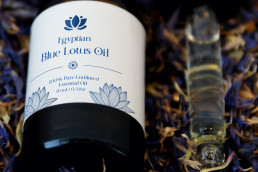
If you have been researching botanical oils for mood, meditation, or skincare, you have almost certainly run into both blue lotus and sacred lotus, and you have probably noticed that vendors use the names loosely, sometimes interchangeably, and sometimes incorrectly. They are not the same plant. They are not even in the same genus. This article lays out the blue lotus vs sacred lotus comparison in honest detail, covering botany, chemistry, scent, psychoactive character, skincare use, ritual context, and the scenarios where each oil is genuinely the better choice.
Table of Contents
- The Core Confusion: Two Different Plants, One Shared Word
- Botany and Geography
- Blue Lotus (Nymphaea caerulea)
- Sacred Lotus (Nelumbo nucifera)
- Chemistry: Where the Oils Genuinely Differ
- Blue Lotus Chemistry
- Sacred Lotus Chemistry
- Scent: The Practical Test
- Psychoactive Character: Honest Comparison
- Skincare: Different Strengths
- Blue Lotus for Skin
- Sacred Lotus for Skin
- Ritual and Meditation Context
- Price and Authenticity
- When Blue Lotus Is the Better Choice
- When Sacred Lotus Is the Better Choice
- Can You Use Both Together?
- Safety: Largely Similar, One Key Difference
- Frequently Asked Questions
- Where to Go From Here
- Experience True Egyptian Blue Lotus
It is written and clinically reviewed by Antonio Breshears, ND, CCA, a Bastyr-trained naturopathic doctor and certified clinical aromatherapist. For the broader context on one half of this comparison, see The Complete Guide to Blue Lotus Oil, which covers extraction, chemistry, and clinical use in much greater depth than this piece allows.
The Core Confusion: Two Different Plants, One Shared Word
The word “lotus” in English has become a catch-all label for several beautiful aquatic flowers that, botanically speaking, belong to different families entirely. The two most commonly confused are Nymphaea caerulea, the Egyptian blue water lily, usually sold as blue lotus, and Nelumbo nucifera, the true sacred lotus of India and East Asia, often sold as pink lotus, white lotus, or simply lotus absolute.
Despite the shared marketing name, these plants are separated by tens of millions of years of evolution. Nymphaea belongs to the Nymphaeaceae family (the water lilies proper), while Nelumbo sits in Nelumbonaceae, which is genetically closer to plane trees and proteas than it is to water lilies. The confusion exists because both plants grow in water, produce large showy flowers on tall stalks, and feature heavily in ancient religious iconography. The similarities end there.
This matters because the essential oils and absolutes pressed from these two flowers smell different, contain different active constituents, produce different subjective effects, and suit different purposes. Confusing them will not harm you, but it will almost certainly leave you disappointed with a product that does not do what you hoped it would.
Botany and Geography
Blue Lotus (Nymphaea caerulea)
The Egyptian blue water lily is native to the Nile valley and parts of East Africa. Its flowers open at dawn with pale sky-blue petals radiating from a yellow centre, close by mid-afternoon, and float on the water rather than rising above it. The plant was sacred to the ancient Egyptians, depicted in tomb paintings, carved into temple columns, and associated with solar rebirth, the god Nefertem, and ritual banquets where dried blooms were steeped in wine.
The flowers are small to medium in size, roughly 10 to 15 centimetres across, and a single gram of absolute requires between 3,000 and 5,000 flowers to produce. This is part of why genuine blue lotus absolute is expensive and why the market is full of diluted or fraudulent material.
Sacred Lotus (Nelumbo nucifera)
The sacred lotus is native to a vast range stretching from India through Southeast Asia, China, and into parts of Australia and the Russian Far East. Its flowers rise on stalks held above the water, typically pink, white, or cream, and can reach 25 to 30 centimetres across. The plant is deeply embedded in Hindu, Buddhist, and Jain traditions, where it symbolises spiritual unfolding, purity emerging from muddy water, and the seat of enlightenment. The Buddha is often depicted on a lotus throne; that throne is a Nelumbo, not a Nymphaea.
Sacred lotus is also an agricultural crop across much of Asia. Its rhizomes, seeds, and leaves are eaten, its petals are used in cooking and tea, and its absolute is a well-established ingredient in high-end perfumery and Ayurvedic preparations.
Chemistry: Where the Oils Genuinely Differ
The chemical fingerprint of each oil is what drives its aroma, its skin behaviour, and its psychoactive character. This is where the two plants separate most clearly.
Blue Lotus Chemistry
Blue lotus absolute contains a distinctive set of alkaloids, principally aporphine and nuciferine, along with a range of flavonoids including apigenin, quercetin, and kaempferol. Aporphine is a weak dopamine agonist, which is why traditional preparations are associated with gentle euphoria and mild mood lift. Nuciferine has a more complex profile, acting as a weak dopamine antagonist and touching serotonin 5-HT2A and 5-HT2C receptors. Apigenin binds at the central benzodiazepine receptor, which is the mechanism behind its mild calming effect.
In aromatherapy practice, what this means is that blue lotus tends to produce a quietly serene, slightly dreamy, parasympathetic shift. It is not a strong sedative and it is not an obvious stimulant. It is something more subtle: a softening of mental edge that many users find conducive to meditation, intimacy, and evening wind-down.
Sacred Lotus Chemistry
Sacred lotus (Nelumbo nucifera) also contains nuciferine, and in fact nuciferine was first isolated from Nelumbo before it was identified in Nymphaea. The sacred lotus absolute contains a different dominant alkaloid profile including neferine (unique to Nelumbo), liensinine, and isoliensinine, along with its own set of flavonoids. The aromatic profile is driven by constituents such as 1,4-dimethoxybenzene, linalool, and various terpene alcohols.
Pharmacologically, sacred lotus preparations (mostly studied as whole-plant extracts rather than absolutes) show mild antioxidant, cardioprotective, and anxiolytic activity. The aroma itself is where sacred lotus earns its place: a warm, creamy, honeyed floral with powdery and slightly green undertones, more obviously “floral perfume” than blue lotus and less aquatic.
Scent: The Practical Test
If you put the two oils side by side on smelling strips, the differences become immediate.
Blue lotus absolute opens with a cooler, almost aquatic top note, then settles into a deep honeyed-floral heart, and finishes on a balsamic, slightly smoky base. There is a quality of shadow to it, something that reads as dusk rather than midday. It does not smell like a typical floral. It smells like a memory of a floral, which is part of why it works so well in meditation and intimate contexts.
Sacred lotus absolute (pink or white) is warmer, creamier, and more straightforwardly floral. The honeyed quality is there but it is brighter, more daytime, with a powdery softness and a slight green edge on the opening. It sits comfortably in perfumery as a middle-to-base note and blends easily with rose, jasmine, sandalwood, and frankincense. Pink lotus tends to be slightly richer and sweeter; white lotus is paler and more ethereal.
Neither is better; they do different work. If you want mood-shifting subtlety with a mystical undertone, blue lotus is the choice. If you want a luminous floral heart in a perfume blend or a lifted, opening quality in meditation work, sacred lotus is often the better fit.
Psychoactive Character: Honest Comparison
Blue lotus has a reputation, largely accurate but often overstated, as a mildly psychoactive plant. Historically it was steeped in wine by the ancient Egyptians, and the combination of alcohol and its alkaloids produced a recognisable mood-altering effect. As an essential oil or absolute used aromatically, the effect is far gentler: a quiet softening of anxiety, a sense of parasympathetic ease, and for some people a light euphoric lift. It is not intoxicating when inhaled or used topically at sensible dilutions.
Sacred lotus is not typically described as psychoactive in the same way. Its traditional use is ceremonial and meditative rather than euphoric, and its chemistry supports a mild calming and anxiolytic effect rather than anything dreamlike. Most people who use sacred lotus absolute describe it as uplifting, centring, and opening rather than sedating or altering.
To put it simply: blue lotus shifts mood more noticeably, sacred lotus shifts atmosphere more noticeably. If you want to feel something, blue lotus is the answer. If you want the room and your breath to feel something, sacred lotus may serve you better.
Skincare: Different Strengths
Blue Lotus for Skin
Blue lotus absolute brings the flavonoid trio of apigenin, quercetin, and kaempferol to skincare formulations. These are well-documented antioxidants with anti-inflammatory activity, and in practice the oil suits reactive, mature, or stressed skin particularly well. It blends beautifully into facial serums at 1 to 2 percent dilution in jojoba or squalane, and it carries a quietly luxurious scent that lingers on warm skin. It is not primarily a brightening or clarifying oil; it is a calming, evening-out, restorative oil.
Sacred Lotus for Skin
Sacred lotus absolute is traditionally associated with hydration, elasticity, and an almost silky finish on skin. Ayurvedic formulations use lotus for pitta-calming, cooling skincare, particularly for heat-reactive or sun-stressed complexions. Its aroma is arguably more “classically luxurious” in a spa context, which is why you see it so often in premium face oils. At the same 1 to 2 percent dilution, it performs well in serums and balms, and it plays especially nicely alongside rose, frankincense, and sandalwood.
If pressed to choose, I would reach for blue lotus when the skin concern is inflammation, reactivity, or sensitivity, and sacred lotus when the concern is dullness, dehydration, or the desire for a more classical floral luxury in the finished product.
Ritual and Meditation Context
Both oils have deep ceremonial pedigrees, but they occupy different symbolic territories.
Blue lotus, tied to ancient Egyptian solar and rebirth imagery, carries connotations of dream, vision, liminal states, and evening ritual. It pairs naturally with frankincense, myrrh, and sandalwood in work focused on introspection, sleep, or sacred intimacy. Its chemistry supports this: the gentle parasympathetic shift and mild mood lift make it a fitting companion for inward-facing practice.
Sacred lotus, central to Hindu and Buddhist iconography, carries connotations of awakening, clarity, and the unfolding of consciousness. It pairs naturally with jasmine, rose, and sandalwood in work focused on devotional practice, heart-opening, or morning meditation. Its brighter, more luminous scent supports a rising, opening quality rather than a deepening one.
Neither tradition is inherently superior. They are different doorways, and you may find one more naturally suited to your own practice than the other.
Price and Authenticity
Both absolutes are expensive because both require enormous quantities of flowers per gram of finished oil. Blue lotus tends to be the pricier of the two at any given grade, partly because its supply chain is narrower (Egypt, parts of Sri Lanka and Thailand for cultivated stock) and partly because demand has risen sharply in the last decade.
Adulteration is a problem in both categories. Cheap “blue lotus oil” sold for the price of a cup of coffee is almost never the real thing; it is usually synthetic fragrance dissolved in a carrier, sometimes with a drop of actual absolute for plausibility. The same applies to sacred lotus, though the fraud is slightly less common because the name carries less mystique in English-speaking markets.
When buying either, look for the full botanical name, country of origin, extraction method, and ideally a GC-MS report. A reputable seller will tell you whether you are buying a pure absolute, a CO2 extract, or a dilution in jojoba, and they will state it clearly.
When Blue Lotus Is the Better Choice
- You want a mild, tangible shift in mood toward calm and ease.
- You are building an evening, intimate, or meditative blend.
- Your skincare goals centre on reactivity, redness, or mature-skin support.
- You are drawn to the Egyptian ritual lineage and dusk-coloured floral profiles.
- You want a scent that sits somewhere between floral and aquatic, with smoky depth.
When Sacred Lotus Is the Better Choice
- You want a brighter, more classical floral heart in a perfume blend.
- You are building a morning, devotional, or heart-opening practice.
- Your skincare goals centre on hydration, cooling, or luxurious finish.
- You are drawn to Hindu or Buddhist symbolism and lifted, opening scent profiles.
- You want an absolute that blends predictably with rose, jasmine, and sandalwood.
Can You Use Both Together?
Yes, and the combination can be genuinely beautiful. Blue lotus provides depth, shadow, and mood-shifting subtlety; sacred lotus provides brightness, luminosity, and classical floral structure. Used together at roughly equal proportions in a carrier, they produce a floral accord that is neither one nor the other but a third thing entirely: warm, dimensional, and unmistakably “lotus” in a way that neither oil quite achieves alone.
A sensible starting point for a blended facial serum would be 0.5 percent blue lotus absolute and 0.5 percent sacred lotus absolute in jojoba, totalling 1 percent floral load. For a perfume, the proportions depend on the supporting notes, but the two oils rarely clash.
Safety: Largely Similar, One Key Difference
Both oils are generally well tolerated at sensible aromatherapy dilutions (1 to 2 percent for face, 2 to 3 percent for body, a few drops in a diffuser). Both should be avoided during pregnancy and breastfeeding out of caution, since neither has a robust safety dataset in those populations.
The main difference is that blue lotus, because of its aporphine and nuciferine content, warrants more care for anyone taking dopaminergic medications, MAOIs, or heavy sedatives, where additive effects are theoretically possible. Sacred lotus, while also containing alkaloids, is less commonly flagged in this context, though sensible caution applies to anyone on complex medication regimens.
Neither oil is legal to sell or possess everywhere. Blue lotus faces restrictions in Russia, Poland, Latvia, and the US state of Louisiana, with additional regulatory complexity in Australia. Sacred lotus is generally unrestricted but it is worth checking local rules if you are importing.
Frequently Asked Questions
Is blue lotus the same as sacred lotus?
No. Blue lotus is Nymphaea caerulea, an Egyptian water lily. Sacred lotus is Nelumbo nucifera, a separate species native to India and East Asia. They belong to different botanical families and produce different oils with different chemistry, aroma, and effect.
Which one smells better?
Neither is objectively better; they are different. Blue lotus is deeper, more aquatic, with smoky and honeyed facets and a dusk-like quality. Sacred lotus is brighter, creamier, more classically floral, with powdery and slightly green edges. Most perfumers and aromatherapists keep both because they do different work.
Which is more psychoactive?
Blue lotus has the stronger psychoactive reputation, driven by its aporphine and nuciferine content and its historical use steeped in wine. As an essential oil used aromatically, the effect is gentle: a mild mood lift and parasympathetic softening rather than anything intoxicating. Sacred lotus is generally described as calming and uplifting rather than mood-altering.
Can I use them interchangeably in a recipe?
Not really. They smell noticeably different and they will change the character of a blend. If a perfumer’s formula calls for pink lotus absolute and you substitute blue lotus, the result will be darker, smokier, and more shadowed. If you substitute sacred lotus in a blue-lotus-based meditation blend, the result will be brighter and less dreamy.
Which is better for anxiety?
Blue lotus has slightly more mechanistic support for anxiolytic action, thanks to apigenin’s binding at the central benzodiazepine receptor and the broader alkaloid profile. In practice, both oils can help with stress-related tension through the olfactory-limbic pathway, so the best choice often comes down to which scent you personally find most settling.
Which is better for skincare?
Blue lotus suits reactive, mature, or inflammation-prone skin because of its flavonoid antioxidants. Sacred lotus suits dehydrated, dull, or heat-stressed skin because of its cooling, hydrating reputation. Both work at 1 to 2 percent dilution in jojoba or squalane.
Why is blue lotus oil so much more expensive?
Blue lotus requires 3,000 to 5,000 flowers per gram of absolute, its supply chain is narrow (mostly Egypt, with some Sri Lankan and Thai cultivation), and demand has risen faster than production. Sacred lotus is grown as a commercial crop across much of Asia, so supply is broader and prices are generally lower at equivalent grades.
Is pink lotus the same as sacred lotus?
Yes. Pink lotus and white lotus are both Nelumbo nucifera, the sacred lotus; the colour refers to the petal shade of the specific cultivar used for extraction. Pink lotus absolute tends to be slightly richer and sweeter, white lotus slightly paler and more ethereal.
Can I combine blue lotus and sacred lotus in one blend?
Absolutely, and the combination often produces a more dimensional floral accord than either alone. A balanced starting point is equal parts of each at a total 1 percent floral load in a carrier oil.
Which one should I buy first?
If your interest is mood, meditation, intimacy, or sensitive-skin care, start with blue lotus. If your interest is perfumery, morning or devotional practice, or luxurious hydrating skincare, start with sacred lotus. If you are buying purely for the scent experience, try small quantities of both on smelling strips before committing to a full bottle.
Where to Go From Here
Blue lotus and sacred lotus are siblings in name only. They are two different plants, with two different chemistries, two different scent profiles, and two different traditional lineages. Choosing between them is not about which is “real” or “authentic”; both are real, both have genuine pedigrees, and both earn a place in a thoughtful aromatherapy or perfumery practice. The question is simply which one suits what you actually want to do.
If you want to go deeper into the blue lotus side of the comparison, including extraction methods, dilution protocols, and the full safety picture, the complete guide to blue lotus oil covers the ground in much greater depth than this piece allows. From there, you can make a clear-eyed decision about whether blue lotus, sacred lotus, or both deserve a shelf in your apothecary.

Antonio Breshears
Antonio Breshears is a renowned expert in holistic medicine and beauty, with over 25 years of research experience dedicated to uncovering the secrets of nature's most powerful remedies. Holding a degree in Naturopathic Medicine, Antonio's passion for healing and well-being has driven him to explore the intricate connections between mind, body, and spirit.
Over the years, Antonio has become a respected authority in the field, helping countless individuals discover the transformative power of plant-based therapies, including essential oils, herbs, and natural supplements. He has authored numerous articles and publications, sharing his wealth of knowledge with a global audience seeking to improve their overall health and well-being.
Antonio's expertise extends to the realm of beauty, where he has developed innovative, all-natural skincare solutions that harness the potency of botanical ingredients. His formulations embody his deep understanding of the healing properties found in nature, providing holistic alternatives for those seeking a more balanced approach to self-care.
With his extensive background and dedication to the field, Antonio Breshears is a trusted voice and guiding light in the world of holistic medicine and beauty. Through his work at Pure Blue Lotus Oil, Antonio continues to inspire and educate, empowering others to unlock the true potential of nature's gifts for a healthier, more radiant life.