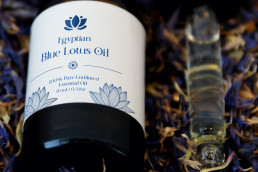
If you have found yourself weighing blue lotus vs sandalwood, you are likely looking for a single oil that can serve meditation, emotional settling, sensual practice, or nighttime ritual. Both have genuine claim to that territory, and both have been used in sacred contexts for thousands of years. They are, however, quite different plants with distinct chemistry, different scent architectures, and different strengths in practice. This article is for the reader who wants to choose deliberately rather than collect blindly.
Table of Contents
- Two Sacred Oils, Two Different Plants
- The Chemistry of Each Oil
- Blue Lotus
- Sandalwood
- Scent Comparison: Floral Complexity vs Woody Stillness
- Therapeutic Uses: Where Each Oil Excels
- Meditation and Contemplative Practice
- Sleep and Rest
- Skincare
- Sensual and Intimate Use
- Cost and Sourcing Realities
- Safety and Contraindications
- When to Choose Blue Lotus
- When to Choose Sandalwood
- Using Them Together
- Realistic Expectations for Both Oils
- Frequently Asked Questions
- Where to Go From Here
- Choose Authenticity, Choose Well
It is written and clinically reviewed by Antonio Breshears, ND, CCA, a Bastyr-trained naturopathic doctor and certified clinical aromatherapist. For broader context on blue lotus chemistry, sourcing, and safety, readers may find it useful to begin with The Complete Guide to Blue Lotus Oil before returning here for the direct comparison.
Two Sacred Oils, Two Different Plants
The first thing worth noting is that these oils come from entirely different parts of the botanical world. Blue lotus (Nymphaea caerulea) is an aquatic flower, an Egyptian water lily whose petals were pressed, infused, and perfumed into wine by the dynastic cultures of the Nile. Its aromatic material comes from the blossom itself, and it takes between three thousand and five thousand flowers to produce a single gram of absolute.
Sandalwood, by contrast, is a heartwood oil. The two species most relevant to therapeutic use are Santalum album (Indian or Mysore sandalwood) and Santalum spicatum (Australian sandalwood). The aromatic molecules sit inside the mature heartwood of the tree, which is felled, chipped, and steam-distilled to release its oil. A sandalwood tree must reach fifteen to thirty years of age before its heartwood is considered mature enough for quality distillation, which is why genuine Indian sandalwood has become one of the most expensive and regulated essential oils in the world.
So we are comparing a flower to a tree, a solvent-extracted absolute to a steam-distilled essential oil, and an ancient Egyptian ritual material to an ancient Indian and Ayurvedic one. Their overlap in reputation is largely why people ask about them together, but their chemistry tells two very different stories.
The Chemistry of Each Oil
Blue Lotus
Blue lotus absolute contains a modest but interesting alkaloid profile, principally aporphine (a weak dopaminergic agonist) and nuciferine (a weak dopaminergic antagonist with activity at 5-HT2A and 5-HT2C serotonin receptors). These alkaloids are present in small quantities but contribute to the oil’s subtly mood-shifting character. Alongside them sit flavonoids such as apigenin, quercetin, and kaempferol; apigenin is of particular interest because it binds the central benzodiazepine receptor site, which is one proposed mechanism for the oil’s gentle anxiolytic effect.
Aromatically, blue lotus is volatile, layered, and distinctly floral-aquatic at the top, deepening into honeyed florality in the heart, and settling into a soft balsamic-smoky base.
Sandalwood
Sandalwood’s therapeutic reputation rests on two sesquiterpenol compounds: alpha-santalol and beta-santalol. Together these should make up somewhere between seventy and ninety percent of a good Santalum album oil, with beta-santalol in particular associated with the scent quality that perfumers describe as creamy, woody, and lactonic. Santalols have been researched for their effects on skin (particularly inflammatory conditions and cellular regulation), for mild sedative and anxiolytic activity in preclinical work, and for their role as fixatives in perfumery.
The scent is dense, warm, woody, quietly sweet, and remarkably persistent. It does not shift in layers the way blue lotus does; sandalwood’s character is more continuous, like a single deep note held steadily.
Scent Comparison: Floral Complexity vs Woody Stillness
This is where the two oils diverge most dramatically, and where personal preference tends to decide the matter.
Blue lotus is an oil of movement. Open the bottle and you get a cool, almost aquatic green floral top note within the first minute. Over the next ten to twenty minutes this softens into a deep, honeyed, slightly narcotic floral heart. An hour later you are left with a balsamic, faintly smoky, powdery base. It is an absolute, so it contains the heavier waxes and resins that create that tenacious dry-down. Wearers describe it as shifting throughout the day.
Sandalwood is an oil of stillness. It does not really have a top note in the conventional sense; it opens warm, woody, creamy, and quietly sweet, and it stays that way for hours, gradually softening in intensity but not really transforming. Good Indian sandalwood has a milky, almost lactonic quality that feels rounded and full. Australian sandalwood is drier, slightly resinous, and a touch more astringent.
If you are drawn to florals, powdery softness, or scents that evolve on the skin, blue lotus will feel more alive. If you are drawn to grounding, continuity, and a single sustained mood, sandalwood will feel more anchored.
Therapeutic Uses: Where Each Oil Excels
Meditation and Contemplative Practice
Both oils have long histories in ritual and meditative use, but they serve different temperaments.
Sandalwood has been the meditation oil of choice across Ayurvedic, Buddhist, and Hindu traditions for millennia, specifically because its steady, grounding scent quietens mental chatter without producing sedation. It supports sustained concentration. It is the oil you want if your practice is one of focused attention, mantra, or seated stillness, and you need the mind to settle into a single state for an extended period.
Blue lotus is more appropriate for contemplative practices that involve imagery, emotional processing, or shifts in awareness. The subtle alkaloid effects and the shifting scent structure mean it tends to open rather than focus. It suits dreamwork, visualisation, somatic practices, and evening winding-down rituals rather than morning meditation.
Sleep and Rest
Neither oil is a strong sedative, and anyone promising either as a sleeping pill replacement is overselling. That said, both can support a nighttime routine.
Blue lotus has the stronger claim to sleep-onset support because of its apigenin content and its gentle parasympathetic nudge. Used in a diffuser at two to four drops forty-five minutes before bed, or in a 2 percent body dilution rubbed into the wrists and chest, it can soften mental activity in a way that makes the transition to sleep easier. It is most effective for people whose sleep problem is restlessness or overthinking rather than physiological insomnia.
Sandalwood’s sleep value is more about mood continuity than sedation. It calms without drowsiness. It suits people who want a grounding pre-bed ritual rather than a pharmacologically active one. Many find it works well alongside blue lotus rather than instead of it.
Skincare
Sandalwood has the more established skincare profile. Santalols have been studied for their effects on inflammatory skin conditions, and sandalwood is a classical ingredient in Ayurvedic formulations for acne, eczema, and uneven tone. It is generally gentle, well tolerated, and suits mature skin particularly well because of its softening, slightly emollient quality.
Blue lotus is more recent to the skincare conversation but has earned genuine standing. Its flavonoid content provides antioxidant activity, and the oil is often used in facial formulations for dull, stressed, or reactive skin at 1 to 2 percent dilution. It is less targeted at specific skin conditions than sandalwood and more oriented toward general radiance and a sense of ritual luxury.
Sensual and Intimate Use
Both oils have reputations as aphrodisiacs, a word that deserves caution. Neither acts pharmacologically on libido in any dramatic way. What they do is set atmosphere, which matters more than many people acknowledge.
Blue lotus is the more explicitly aphrodisiac of the two in historical reference, with Egyptian iconography linking it to eroticism and pleasure. Its scent is lush, floral, and inviting in a way that reads as sensual to most wearers.
Sandalwood is warmer, earthier, and often described as grounding rather than arousing, though it is a near-universal base note in men’s fragrance specifically because it reads as warm skin. Its sensual quality is one of presence rather than provocation.
Cost and Sourcing Realities
Both oils are expensive, but for different reasons.
Blue lotus absolute is expensive because of yield: three to five thousand flowers per gram means the raw material cost is extraordinary before anything else. It also faces regulatory complexity in several jurisdictions (Russia, Poland, Latvia, the US state of Louisiana, and regulatory nuance in Australia), which affects supply chains. A one-millilitre bottle of genuine pure blue lotus absolute typically sits in the premium bracket.
Indian sandalwood (Santalum album) is expensive because of tree maturation time and historical over-harvesting. The species is CITES-listed, and authentic Mysore sandalwood is tightly regulated. Australian sandalwood (Santalum spicatum) is more affordable and more sustainably available, though aromatically different. Much of what is sold cheaply as sandalwood is either adulterated, from unrelated species, or synthetic recreations such as those based on the sandalore molecule. Buyer vigilance is essential with both oils.
Safety and Contraindications
Blue lotus is not recommended during pregnancy or breastfeeding, and caution is warranted for anyone on dopaminergic medication, MAOIs, or heavy sedatives due to the alkaloid content. Dermal dilutions of 1 to 2 percent for face and 2 to 3 percent for body are standard.
Sandalwood has a much more forgiving safety profile. It is generally regarded as safe during pregnancy at standard dilutions, though medical guidance is always appropriate. Dermal sensitisation is rare. Standard dilutions for facial use sit at 1 to 2 percent and body use at 2 to 3 percent.
Neither oil should be taken internally without qualified clinical supervision.
When to Choose Blue Lotus
Choose blue lotus when:
- You want a scent that evolves and shifts across the day
- Your emotional state is one of overthinking, restlessness, or unprocessed tension
- You are building an evening, dreamwork, or wind-down ritual
- You want the subtle alkaloid effects on mood and relaxation
- Floral character appeals to you aromatically
- You are drawn to Egyptian ritual and iconography
When to Choose Sandalwood
Choose sandalwood when:
- You want a scent that stays steady and grounding
- Your practice is seated meditation, focused attention, or mantra
- You are addressing a specific inflammatory skin concern
- You need something safe across a broader range of users (including pregnancy with appropriate guidance)
- Woody character appeals to you aromatically
- You are drawn to Ayurvedic and Buddhist ritual traditions
Using Them Together
This is often the most interesting answer. The two oils blend beautifully, and many classical and contemporary perfumers have used sandalwood as a base to anchor floral absolutes like blue lotus. A simple blend might be one drop of blue lotus to two drops of sandalwood in 10 ml of jojoba (approximately 1.5 percent total dilution) for a pulse-point oil that combines the emotional opening of blue lotus with the grounding continuity of sandalwood.
In a diffuser, two drops of blue lotus and three of sandalwood creates an evening atmosphere that is neither purely floral nor purely woody but something deeper. The sandalwood holds the scent space; the blue lotus gives it movement.
Realistic Expectations for Both Oils
It is worth being honest about what these oils do and do not do. Neither is a therapy in the clinical sense. Both are adjuncts: to ritual, to rest, to skincare, to atmosphere. If you are trying to manage clinical anxiety, serious insomnia, or a dermatological condition, essential oils sit alongside, not in place of, appropriate care.
Both oils are also subtle. People expecting a dramatic effect from inhalation or topical application are often underwhelmed initially. The value accrues through consistent use within a meaningful ritual framework. An oil used daily for three weeks will almost always teach you more than one sniffed once and set aside.
Frequently Asked Questions
Is blue lotus or sandalwood better for sleep?
Blue lotus has the slightly stronger pharmacological case for sleep onset due to its apigenin and alkaloid content, which support parasympathetic shift. Sandalwood is better for creating a calming pre-bed atmosphere without any sedative expectation. Many people use both together.
Which oil is safer during pregnancy?
Sandalwood is considered safer at standard dilutions during pregnancy, though any essential oil use in pregnancy should be discussed with a qualified practitioner. Blue lotus is not recommended during pregnancy or breastfeeding.
Can I blend blue lotus and sandalwood?
Yes, they blend exceptionally well. Sandalwood acts as a natural fixative for the volatile florals of blue lotus, extending wear time and depth. A 1:2 ratio of blue lotus to sandalwood is a good starting point.
Which is more expensive?
Genuine Mysore sandalwood (Santalum album) is often comparable to or slightly more expensive than blue lotus absolute per millilitre. Australian sandalwood is considerably more affordable. Blue lotus sits consistently in the premium bracket.
Can sandalwood replace blue lotus in a meditation practice?
It depends on the practice. For seated, focused meditation, sandalwood is arguably superior. For dreamwork, visualisation, or emotionally oriented practice, blue lotus is better suited. They serve different meditative registers.
Are there ethical concerns with sandalwood?
Yes, particularly with Indian sandalwood, which has historically been over-harvested. Always look for CITES-compliant sourcing for Santalum album. Australian sandalwood (Santalum spicatum) is generally more sustainable.
Which oil is better for skincare?
Sandalwood has the longer clinical track record for specific skin concerns, particularly inflammatory conditions. Blue lotus is excellent for general radiance, antioxidant support, and ritual facial work. Both can be used facially at 1 to 2 percent dilution.
Do both oils have aphrodisiac properties?
Both have historical reputations as aphrodisiacs, though neither acts pharmacologically in a dramatic way. Blue lotus is more explicitly associated with eroticism in its cultural history; sandalwood is more about warm, skin-like sensuality. Both contribute to atmosphere rather than libido directly.
How should I store these oils?
Both should be stored in dark glass, away from heat and direct light. Blue lotus absolute has a shelf life of three to four years stored properly. Sandalwood actually improves with age and can last ten years or more; it is one of the few essential oils that matures well.
Which oil should a beginner choose?
Sandalwood is generally the more forgiving starting point: broader safety profile, simpler scent, more widely applicable. Blue lotus rewards a reader who already understands what they are looking for emotionally or ritually.
Where to Go From Here
If you are new to blue lotus specifically, the complete guide covers chemistry, safety, sourcing, and use in detail. If you have decided blue lotus is the oil that suits your intentions, the next question becomes sourcing, because authenticity varies considerably across the market and the oil is too expensive to buy carelessly.

Antonio Breshears
Antonio Breshears is a renowned expert in holistic medicine and beauty, with over 25 years of research experience dedicated to uncovering the secrets of nature's most powerful remedies. Holding a degree in Naturopathic Medicine, Antonio's passion for healing and well-being has driven him to explore the intricate connections between mind, body, and spirit.
Over the years, Antonio has become a respected authority in the field, helping countless individuals discover the transformative power of plant-based therapies, including essential oils, herbs, and natural supplements. He has authored numerous articles and publications, sharing his wealth of knowledge with a global audience seeking to improve their overall health and well-being.
Antonio's expertise extends to the realm of beauty, where he has developed innovative, all-natural skincare solutions that harness the potency of botanical ingredients. His formulations embody his deep understanding of the healing properties found in nature, providing holistic alternatives for those seeking a more balanced approach to self-care.
With his extensive background and dedication to the field, Antonio Breshears is a trusted voice and guiding light in the world of holistic medicine and beauty. Through his work at Pure Blue Lotus Oil, Antonio continues to inspire and educate, empowering others to unlock the true potential of nature's gifts for a healthier, more radiant life.