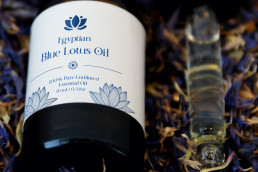
If you have landed here trying to decide between blue lotus and white lotus oil, you are in good company. The two are frequently sold side by side, often described in nearly identical language, and occasionally confused outright by suppliers who should know better. This article walks through the blue lotus vs white lotus comparison carefully: the botany, the chemistry, the scent, the traditional uses, and the practical question of which one belongs on your shelf for what purpose.
Table of Contents
- The Botanical Muddle: What "White Lotus" Actually Means
- Blue Lotus (Nymphaea Caerulea): A Brief Recap
- White Lotus (Nymphaea Lotus): The Closest Sibling
- Chemistry
- Scent
- Traditional Use
- White Lotus (Nelumbo Nucifera): A Different Family Entirely
- Side-by-Side: How They Compare in Practice
- Mood and Nervous System
- Skincare
- Scent and Perfumery
- Which Should You Choose?
- Choose Blue Lotus If...
- Choose Egyptian White Lotus If...
- Choose Sacred Lotus (Nelumbo) If...
- Choose All Three If...
- Common Pitfalls When Buying
- Can You Blend Blue and White Lotus?
- Safety Notes Common to All Three
- Frequently Asked Questions
- Where to Go From Here
- Begin With Egyptian Blue Lotus
It is written and clinically reviewed by Antonio Breshears, ND, CCA, a Bastyr-trained naturopathic doctor and certified clinical aromatherapist. For the broader context of blue lotus chemistry and ritual history, see The Complete Guide to Blue Lotus Oil, which serves as the master reference for this comparison series.
The Botanical Muddle: What “White Lotus” Actually Means
The first thing to understand is that “white lotus” is a commercial label, not a single species. Three distinct plants are sold under that name, and the differences matter a great deal.
The most historically significant is Nymphaea lotus, the Egyptian white water lily. This is the botanical sibling of blue lotus (Nymphaea caerulea), and the two grew together along the Nile in antiquity. Both appear in temple iconography, both feature in funerary texts, and both were used in perfumery and ritual. Chemically they are close relatives, sharing many of the same alkaloid and flavonoid constituents, though in slightly different ratios.
The second plant often sold as white lotus is Nelumbo nucifera, the sacred lotus of Asia, in its white-flowered form. This plant is not even in the same botanical family as blue lotus. It belongs to Nelumbonaceae rather than Nymphaeaceae, and while it shares the common name “lotus” and some of the same alkaloids (notably nuciferine), its chemistry and scent are distinct.
The third possibility, less common in aromatherapy but worth mentioning, is Nymphaea ampla or other white-flowered water lilies sometimes marketed under the same label. These are genuine Nymphaea cousins of blue lotus but with their own chemical signatures.
When a supplier sells you “white lotus oil” without specifying the Latin binomial, you genuinely do not know what you are getting. The first step in any honest blue lotus vs white lotus comparison is insisting on species-level clarity.
Blue Lotus (Nymphaea Caerulea): A Brief Recap
Blue lotus oil, as sold on reputable apothecary sites, is the absolute or essential oil of Nymphaea caerulea, the Egyptian blue water lily. Its chemistry centres on a small but pharmacologically interesting group of aporphine alkaloids, principally aporphine itself and nuciferine, supported by flavonoids including apigenin, quercetin, and kaempferol.
Aporphine has weak dopamine-agonist activity. Nuciferine acts as a weak dopamine antagonist with additional 5-HT2A and 5-HT2C serotonin receptor activity. Apigenin binds at central benzodiazepine receptors in a mild, non-sedating way. The overall effect, when the aroma is inhaled or the oil is applied diluted to the skin, is a subtle shift towards parasympathetic tone: calmer, more present, slightly euphoric without being sedating.
The scent is a cooler floral with aquatic and slightly green top notes, opening into a deep honeyed-floral heart, and settling on a balsamic, faintly smoky base. It is recognisably water-lily but with real depth.
White Lotus (Nymphaea Lotus): The Closest Sibling
When people ask about blue lotus vs white lotus in the Egyptian sense, they usually mean Nymphaea lotus. This is the honest apples-to-apples comparison, because both are Nile water lilies, both were used in pharaonic ritual, and both were extracted for perfume in antiquity.
Chemistry
White lotus (N. lotus) contains a similar suite of aporphine alkaloids to its blue cousin, including nuciferine and nornuciferine, alongside flavonoid glycosides. The alkaloid concentrations and ratios tend to differ somewhat, and the flavonoid profile leans a little more heavily towards kaempferol derivatives in some studies. The practical upshot is that the two oils produce broadly similar mood effects, with white lotus often described as slightly more grounding and less euphoric, and blue lotus as slightly more uplifting and dreamlike.
The honest caveat: rigorous head-to-head clinical comparisons do not exist. Most of what is said about the subjective differences comes from perfumers, aromatherapists, and traditional practitioners rather than controlled trials. Treat these distinctions as useful starting points, not settled science.
Scent
White lotus absolute is warmer and creamier than blue lotus. Where blue lotus has a cool, aquatic, slightly green edge, white lotus leans into honeyed, powdery, faintly vanillic territory. Perfumers often reach for white lotus when they want a soft, intimate floral heart note, and for blue lotus when they want something more mysterious, cooler, and with more lift.
Traditional Use
Both lotuses feature in Egyptian temple art and funerary papyri, but they played different symbolic roles. Blue lotus was associated with rebirth, the sun rising from primordial waters, and altered states used in ritual. White lotus was more commonly associated with fertility, nurture, and the moon. Whether these symbolic distinctions tracked genuine differences in how the plants were used pharmacologically is difficult to say from the available evidence.
White Lotus (Nelumbo Nucifera): A Different Family Entirely
If the “white lotus” you are considering is Nelumbo nucifera, the sacred lotus of Asia, you are looking at a genuinely different plant. It grows quite differently, its flower structure is distinct, and botanically it sits in its own family.
Nelumbo does share nuciferine with blue lotus, which is why some of the mood effects overlap. However, the overall scent profile is strikingly different. Sacred lotus absolute is heavier, spicier, sometimes almost incense-like, with far less of the aquatic coolness of Nymphaea species. It has a long history in Asian religious use, where it represents purity and spiritual unfolding, and in traditional Chinese medicine, where various parts of the plant (seed, leaf, root, embryo) are used for distinct purposes.
For aromatherapy, Nelumbo white lotus absolute is a legitimate and beautiful oil in its own right, but it should not be treated as interchangeable with either blue lotus or Egyptian white lotus. They are different plants doing different things.
Side-by-Side: How They Compare in Practice
Mood and Nervous System
All three (Egyptian blue lotus, Egyptian white lotus, and Asian sacred lotus) produce mild relaxation and mood-lifting effects when inhaled. The differences are subtle rather than dramatic:
- Blue lotus (N. caerulea) tends towards dreamy, mildly euphoric, slightly opening. Best for evening unwinding, meditation, and creative or reflective states.
- Egyptian white lotus (N. lotus) tends towards grounded, warm, nurturing. Often described as better for comfort, restoration, and gentle self-soothing.
- Sacred lotus (N. nucifera) tends towards contemplative, spacious, incense-adjacent. Often chosen for spiritual practice and deep meditation.
None of them is a strong sedative, none of them is a substitute for clinical care for serious anxiety or mood disorders, and none of them produces psychoactive effects comparable to pharmaceutical agents.
Skincare
On the skin, all three are gentle, anti-inflammatory, and suitable for mature or sensitive complexions when properly diluted. Blue lotus has the strongest flavonoid-driven antioxidant profile, which makes it a reasonable choice for skincare aimed at reducing visible signs of oxidative stress. Egyptian white lotus has a softer, more emollient quality in facial oils. Sacred lotus is less commonly used in skincare because of its stronger, heavier scent, which can overwhelm a delicate facial blend.
Scent and Perfumery
This is where the differences are most obvious:
- Blue lotus: cool, aquatic, honeyed-floral, slightly smoky base.
- Egyptian white lotus: warm, creamy, powdery, softly sweet.
- Sacred lotus: heavy, spicy, incense-like, meditative.
A perfumer choosing between them is choosing between three quite distinct olfactory signatures. A ritual practitioner choosing between them is choosing between three quite distinct moods.
Which Should You Choose?
Choose Blue Lotus If…
You want the most chemically and historically documented of the three for mood and meditative use. You are drawn to cooler, more ethereal florals. You want an oil with a well-attested place in Egyptian ritual and a growing modern evidence base. You are working with sleep onset, gentle anxiety, creative practice, or evening wind-down rituals.
Choose Egyptian White Lotus If…
You want a close sibling to blue lotus with a warmer, more nurturing character. You prefer honeyed, powdery florals to cooler ones. You are building a blend focused on comfort, grief, emotional restoration, or intimate ritual rather than dreamlike opening. You are curious about the Egyptian white lotus tradition specifically, which has received less attention than its blue counterpart but has its own genuine history.
Choose Sacred Lotus (Nelumbo) If…
Your practice is rooted in Asian traditions (Buddhist, Hindu, Taoist) where Nelumbo is the culturally resonant plant. You prefer heavier, incense-adjacent florals. You are working with contemplative practice where a weightier, more anchoring scent suits the intent. You want something clearly different from the Nymphaea family.
Choose All Three If…
You are a serious perfumer or aromatherapist building a complete lotus palette. The three oils genuinely complement rather than duplicate each other, and having all three available gives you a remarkable range of floral mood and character to work with.
Common Pitfalls When Buying
Because “white lotus” covers several plants, and because lotus oils are expensive to produce and easy to adulterate, buyer caution is more important here than with most aromatics. A few practical tests:
- Latin binomial on the label. If it is not there, ask. A supplier who cannot or will not specify the species is not worth your money.
- Price. Genuine lotus absolutes of any species are costly. Bargain prices usually indicate heavy dilution in a carrier, synthetic accord, or outright misidentification.
- Country of origin. Egyptian Nymphaea oils come from Egypt. Nelumbo oils come from India, China, or Southeast Asia. Origin mismatches are a red flag.
- Scent description. If the supplier’s description does not match the profile above, something is off.
Can You Blend Blue and White Lotus?
Yes, and the combination is genuinely beautiful. Blending Egyptian blue and Egyptian white lotus produces a complete Nile accord that captures both the cool and warm aspects of water-lily perfume. A roughly equal mix, diluted to 1 or 2 percent in a carrier like jojoba, makes a memorable pulse-point perfume. Adding a small touch of Nelumbo gives the blend weight and incense character, though it will dominate quickly if overdosed.
For a diffuser blend, 2 drops blue and 1 drop white in a small diffuser produces a layered floral atmosphere without either oil disappearing behind the other. Keep sessions to 30 to 45 minutes and then let the air clear.
Safety Notes Common to All Three
The safety profile of the three lotuses is broadly similar and generally reassuring, with a few consistent cautions:
- Avoid during pregnancy and breastfeeding. The alkaloid content, though small, is not well studied in these contexts.
- Use caution if you take dopaminergic medications, MAOIs, or heavy sedatives. The interactions are theoretical rather than documented but worth respecting.
- Dilute before skin contact. Standard dilutions are 1 to 2 percent for facial use, 2 to 3 percent for body, and 3 percent for targeted application.
- Patch test before first use. Floral absolutes are low-risk but not zero-risk for sensitisation.
Frequently Asked Questions
Is white lotus stronger than blue lotus?
No, neither is meaningfully stronger in any pharmacological sense. Both produce mild mood and relaxation effects, and the subjective differences are matters of character rather than potency. Blue lotus is often described as slightly more euphoric and dreamlike; Egyptian white lotus as slightly more grounding.
Are blue and white lotus the same plant in different colours?
No. They are separate species. Blue lotus is Nymphaea caerulea, and Egyptian white lotus is Nymphaea lotus. They are close botanical siblings but genetically, chemically, and historically distinct.
Is sacred lotus the same as white lotus?
Sometimes, confusingly, yes. Sacred lotus (Nelumbo nucifera) in its white-flowered form is sometimes sold as white lotus. However, it is in a completely different botanical family from the Nymphaea lotuses. Always check the Latin binomial.
Which lotus is best for sleep?
Blue lotus is the most commonly recommended for sleep onset because of its calming, mildly sedating character. Egyptian white lotus also supports unwinding but with a warmer, less dreamlike quality. Sacred lotus is less commonly chosen for sleep because of its heavier, more incense-like scent.
Which lotus is best for skincare?
Blue lotus has the strongest antioxidant flavonoid profile and is the most commonly used in facial oils. Egyptian white lotus is a lovely gentle addition to mature skin blends. Sacred lotus is rarely used in facial formulations because of its stronger scent.
Are lotus oils psychoactive?
Only in a very mild, subtle sense. They shift nervous system tone gently through olfactory-limbic pathways and, at higher systemic exposures, through weak effects on dopamine and serotonin receptors. They are not comparable to pharmaceutical psychoactive agents, and they do not produce intoxication in any normal use.
Can I use blue lotus and white lotus together?
Yes. The two Egyptian lotuses blend beautifully and produce a more complete floral accord than either alone. Start with roughly equal parts and adjust to your preference.
Why is lotus oil so expensive?
All lotus absolutes require enormous quantities of flowers per gram of oil (around 3,000 to 5,000 flowers per gram for blue lotus absolute, with similar intensity for white), and the harvest window is narrow. The cost reflects real scarcity, not markup.
Does white lotus contain nuciferine?
Yes, both Egyptian white lotus (N. lotus) and sacred lotus (N. nucifera) contain nuciferine, along with related aporphine alkaloids. The concentrations and ratios differ from blue lotus but the pharmacological family is the same.
How do I know my white lotus oil is genuine?
Check for the Latin binomial, verify country of origin against the species (Egypt for Nymphaea lotus, Asia for Nelumbo nucifera), expect a price in line with the real cost of production, and compare the scent against the descriptions above. Reputable suppliers will answer species and origin questions directly.
Where to Go From Here
If this comparison has helped you settle on blue lotus as the oil best suited to your practice, the next step is learning how to use it well: dilutions, blending partners, application routines, and realistic expectations. The complete guide to blue lotus oil covers that ground in full, including chemistry, sourcing, and the ritual history that makes this particular flower such an enduring presence in human practice.
If the comparison has pushed you towards white lotus, whether Egyptian or Asian, seek out a supplier who specifies the species plainly and matches origin to binomial. The blue lotus vs white lotus question is ultimately less about which is better and more about which matches the mood, intent, and tradition you are working with. All three are beautiful. None of them is a shortcut. Each one rewards careful, attentive use.

Antonio Breshears
Antonio Breshears is a renowned expert in holistic medicine and beauty, with over 25 years of research experience dedicated to uncovering the secrets of nature's most powerful remedies. Holding a degree in Naturopathic Medicine, Antonio's passion for healing and well-being has driven him to explore the intricate connections between mind, body, and spirit.
Over the years, Antonio has become a respected authority in the field, helping countless individuals discover the transformative power of plant-based therapies, including essential oils, herbs, and natural supplements. He has authored numerous articles and publications, sharing his wealth of knowledge with a global audience seeking to improve their overall health and well-being.
Antonio's expertise extends to the realm of beauty, where he has developed innovative, all-natural skincare solutions that harness the potency of botanical ingredients. His formulations embody his deep understanding of the healing properties found in nature, providing holistic alternatives for those seeking a more balanced approach to self-care.
With his extensive background and dedication to the field, Antonio Breshears is a trusted voice and guiding light in the world of holistic medicine and beauty. Through his work at Pure Blue Lotus Oil, Antonio continues to inspire and educate, empowering others to unlock the true potential of nature's gifts for a healthier, more radiant life.