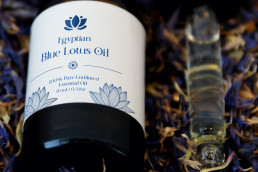
If you have ever stared at a bottle of blue lotus absolute wondering how many drops actually go into 10 ml of jojoba for a face serum, a pulse-point roller, or a body oil, this page is the working bench you need. Below is a full blue lotus oil dilution calculator, with the maths, the conversion tables, the safe percentages by application, and the sanity checks that keep a precious oil performing at its best rather than being wasted or overused.
Table of Contents
- Why Dilution Matters with Blue Lotus Oil
- The Core Formula
- Blue Lotus Oil Dilution Calculator: Quick Reference Table
- Choosing the Right Percentage for Your Purpose
- 1 percent: face, decolletage, children over two, pregnancy-adjacent use, daily wear
- 2 percent: body oils, massage blends, everyday use on limbs and torso
- 3 percent: targeted use, pulse-point rollers, acute emotional support
- 5 percent: acute, short-duration, very small areas
- 10 percent and above: perfumery only
- Converting Between Drops, Millilitres, and Grams
- Worked Recipes Using the Calculator
- Recipe one: sleep-support pulse roller, 10 ml
- Recipe two: facial serum, 30 ml
- Recipe three: body massage oil, 100 ml
- Recipe four: bath oil, 250 ml solubiliser-carrier base
- Recipe five: solid perfume, 10 g base
- Diffuser Use: Where the Calculator Does Not Apply
- Common Mistakes When Using a Dilution Calculator
- When Lower Dilutions Are the Right Call
- When a Dilution Calculator Is Not Enough
- Frequently Asked Questions
- Where to Go From Here
- Start With Oil Worth Measuring
It is written and clinically reviewed by Antonio Breshears, ND, CCA, a Bastyr-trained naturopathic doctor and certified clinical aromatherapist. For the wider context on carriers, chemistry, and clinical use, see The Complete Guide to Blue Lotus Oil, which this tool is designed to support.
Why Dilution Matters with Blue Lotus Oil
Blue lotus absolute is not a cheap oil casually splashed into formulations. Roughly 3,000 to 5,000 flowers go into a single gram, and the aromatic and therapeutic value sits in a very concentrated package. Using too little means the scent and the calming, parasympathetic effect never quite lands on the skin or in the air. Using too much wastes the oil, risks sensitisation on repeated exposure, and can actually flatten the aroma by overwhelming the top notes with heavy, honeyed base tones.
Dilution is therefore not a conservative habit imposed by caution; it is the method by which the oil performs correctly. A 2 percent body blend applied to warm skin smells and behaves quite differently from a 10 percent overdose that sits heavy, sticky, and slightly acrid. The calculator below gives you the numbers; this article explains how to apply them.
The Core Formula
Every dilution calculation rests on a single equation. Once you have it, everything else is arithmetic.
Drops of essential oil = (total carrier volume in ml) x (dilution percentage) x 0.2
The 0.2 multiplier comes from the industry-standard assumption that 1 ml of essential oil equals approximately 20 drops from a standard orifice reducer. That figure varies slightly with viscosity (blue lotus absolute is thicker than, say, lavender, so the drops can run a touch larger), but 20 drops per ml is the working figure used by clinical aromatherapists and cosmetic formulators worldwide.
Worked example: you want a 2 percent dilution in 30 ml of jojoba.
30 x 0.02 x 20 = 12 drops of blue lotus absolute.
That is the entire calculation. The rest of this article is about knowing which percentage to choose for which application.
Blue Lotus Oil Dilution Calculator: Quick Reference Table
The table below shows drop counts for blue lotus absolute at standard dilutions across the most common carrier volumes. Use this as your working reference.
| Carrier volume | 1% (face, sensitive skin) | 2% (body, general use) | 3% (targeted, pulse points) | 5% (acute, localised) |
|---|---|---|---|---|
| 5 ml | 1 drop | 2 drops | 3 drops | 5 drops |
| 10 ml (roller ball) | 2 drops | 4 drops | 6 drops | 10 drops |
| 15 ml | 3 drops | 6 drops | 9 drops | 15 drops |
| 30 ml (1 oz) | 6 drops | 12 drops | 18 drops | 30 drops |
| 50 ml | 10 drops | 20 drops | 30 drops | 50 drops |
| 100 ml | 20 drops | 40 drops | 60 drops | 100 drops |
| 250 ml (bath oil base) | 50 drops | 100 drops | 150 drops | n/a |
Round down rather than up when you are near a fractional drop count. With blue lotus in particular, slightly under the target percentage is almost always better than slightly over.
Choosing the Right Percentage for Your Purpose
1 percent: face, decolletage, children over two, pregnancy-adjacent use, daily wear
One percent is the professional default for facial application and for anyone with reactive or thin skin. At this strength the aroma sits quietly on the skin, the parasympathetic, soothing effect registers through repeated olfactory exposure, and there is enough margin that the oil can be worn daily without cumulative sensitisation. A 1 percent facial serum in jojoba or squalane is where most people should begin with blue lotus on skin.
Note that blue lotus is not recommended during pregnancy or breastfeeding regardless of dilution. The 1 percent figure refers to general sensitive-skin use, not pregnancy use.
2 percent: body oils, massage blends, everyday use on limbs and torso
Two percent is the standard for body application on intact, healthy adult skin. Full-body massage blends, post-bath body oils, and chest rubs for emotional support all sit comfortably at this percentage. The aroma has presence without dominance, and the oil lasts on skin long enough to work through the evening.
3 percent: targeted use, pulse-point rollers, acute emotional support
A 10 ml roller ball filled with jojoba and 6 drops of blue lotus absolute gives you a 3 percent pulse-point tool for wrists, temples, and the base of the throat. This is the right strength for a rescue-style application where you want the aroma to register within a minute or two of application, not slowly diffuse across the afternoon.
5 percent: acute, short-duration, very small areas
Five percent is the upper end for responsible use of blue lotus absolute on skin, and it is reserved for small, localised applications over short periods, a drop on the sternum before sleep, a dab at the nape of the neck during a difficult afternoon, or a perfume-style application behind the ears. Do not use 5 percent blends across large body areas or daily for weeks on end.
10 percent and above: perfumery only
Blends at 10 percent and above are perfume territory, dabbed on in tiny quantities from a small bottle onto pulse points. They are not body oils, massage oils, or skincare. If you are building a solid perfume or an oil-based scent, the calculator still applies, but the skin-contact footprint must shrink accordingly.
Converting Between Drops, Millilitres, and Grams
Because blue lotus absolute is dense and expensive, some formulators prefer to weigh it rather than count drops. The conversions below are practical working figures.
- 1 ml blue lotus absolute is approximately 20 drops.
- 1 ml blue lotus absolute weighs approximately 0.95 to 1.0 g depending on the batch and the carrier the absolute is pre-diluted into, if any.
- A 5 ml bottle of pure absolute contains roughly 100 drops.
- A 10 ml bottle contains roughly 200 drops.
If you are working from a pre-diluted blue lotus product (for example, 10 percent blue lotus in jojoba sold as a finished oil), you must divide your calculated drop count by the dilution factor. A 10 percent product used at a target body dilution of 2 percent means you are actually adding ten times the drops of finished product to reach the same aromatic load. Always check whether your bottle is pure absolute or a pre-diluted blend before running the calculator.
Worked Recipes Using the Calculator
Recipe one: sleep-support pulse roller, 10 ml
Target: 3 percent dilution. Calculation: 10 x 0.03 x 20 = 6 drops of blue lotus absolute. Fill a 10 ml glass roller ball with jojoba or fractionated coconut oil, add 6 drops of blue lotus, cap and invert to mix. Apply to wrists and the base of the skull thirty minutes before bed.
Recipe two: facial serum, 30 ml
Target: 1 percent dilution. Calculation: 30 x 0.01 x 20 = 6 drops of blue lotus absolute. Combine in 30 ml of squalane or a blend of jojoba and rosehip. Use three to five drops morning and evening after cleansing.
Recipe three: body massage oil, 100 ml
Target: 2 percent dilution. Calculation: 100 x 0.02 x 20 = 40 drops of blue lotus absolute. Combine in 100 ml of sweet almond oil or jojoba. Use for full-body massage or as a post-shower body oil on warm, slightly damp skin.
Recipe four: bath oil, 250 ml solubiliser-carrier base
Target: 1 percent dilution (note that bath use is particularly sensitive because the oil disperses across wet skin). Calculation: 250 x 0.01 x 20 = 50 drops. Dissolve into a proper bath dispersant such as polysorbate 20 or a pre-made solubiliser base before adding to bath water. Never drop neat absolute into a bath.
Recipe five: solid perfume, 10 g base
Target: 5 percent. Calculation: 10 x 0.05 x 20 = 10 drops. Warm 10 g of a beeswax and jojoba base (typically 1 part beeswax to 4 parts jojoba by weight), allow to cool slightly, stir in 10 drops of blue lotus absolute, pour into a small tin.
Diffuser Use: Where the Calculator Does Not Apply
The percentage-based calculator above is for skin-contact formulations. Diffuser use follows a different rule: two to four drops of blue lotus absolute in a standard 100 to 150 ml ultrasonic diffuser, run for fifteen to thirty minutes in a closed room. You are not calculating a dilution percentage; you are loading a volatile aromatic into a water reservoir. More is not better. Blue lotus has a heavy, honeyed character that goes cloying quickly in a diffuser if overdosed.
Common Mistakes When Using a Dilution Calculator
Three errors show up repeatedly.
First, counting drops from a poorly designed orifice reducer. Blue lotus absolute is thick, and some bottle droppers release uneven drops, especially if the bottle is cold. Always warm the bottle gently in your hands for a minute before dosing, and dispense slowly.
Second, assuming a pre-diluted product is pure absolute. If a 10 ml bottle is sold at 10 percent blue lotus in jojoba, then six drops of that product in a 10 ml roller ball gives you a final dilution of roughly 0.3 percent, not 3 percent. Know what you have before you calculate.
Third, scaling recipes linearly without re-checking total dilution. If you double a recipe, you double both the carrier and the essential oil drops; the percentage stays the same. If you keep the drop count but increase the carrier, the percentage drops. Simple arithmetic, but easy to miss when you are halfway through a blend.
When Lower Dilutions Are the Right Call
Several situations push you toward 0.5 to 1 percent rather than 2 percent or higher.
- Facial skin, especially around the eyes and on the neck.
- Children over two years of age (blue lotus is not generally recommended under two).
- Adults with reactive skin, eczema, or a history of fragrance sensitivity.
- Elderly skin, which is thinner and more permeable.
- Daily long-term use, where cumulative exposure adds up.
Remember that blue lotus oil is avoided entirely during pregnancy and breastfeeding, and used with caution alongside dopaminergic medications, MAOIs, and heavy sedatives. Dilution is not a substitute for these contraindications; a 1 percent dilution of a contraindicated oil is still contraindicated.
When a Dilution Calculator Is Not Enough
Numbers give you a starting point, not a finished product. Three things should always override the calculator.
A patch test, twenty-four hours on the inner forearm at your intended dilution, is the final arbiter of whether a blend is right for your skin. No calculation predicts individual reactivity.
Your nose is the second arbiter. If a 2 percent blend smells right to you, warm and honeyed without being cloying, it is probably working. If it smells flat, thin, or aggressive, the percentage or the carrier is wrong, regardless of what the maths says.
Clinical context is the third. If you are formulating for someone with a specific medication profile, health condition, or during a sensitive life stage, a dilution calculator is a starting point for a conversation with a qualified practitioner, not a substitute for one.
Frequently Asked Questions
How many drops of blue lotus oil are in 10 ml at 2 percent?
Four drops. The calculation is 10 x 0.02 x 20 = 4 drops of blue lotus absolute in 10 ml of carrier oil.
What is the safest dilution for facial use?
One percent. That means six drops of blue lotus absolute in 30 ml of a facial carrier such as jojoba, squalane, or rosehip. At one percent, daily use is generally well tolerated on adult facial skin, but patch test first.
Can I use blue lotus oil neat on skin?
No. Blue lotus absolute should always be diluted in a carrier before skin contact. Neat application risks sensitisation and wastes a precious oil without improving efficacy; the aromatic effect is about olfactory exposure and skin absorption of a properly formulated blend, not about concentration.
What is the standard drop-per-millilitre figure for blue lotus?
Twenty drops per millilitre is the working figure. It can vary slightly with the temperature and viscosity of the absolute, so warm the bottle gently and dispense slowly for consistent results.
Is a 3 percent pulse roller too strong for daily use?
For most adults, a 3 percent pulse roller used once or twice a day on small areas (wrists, temples, base of throat) is well tolerated. For very sensitive individuals or for use multiple times a day, drop to 2 percent.
How much blue lotus oil do I add to a bath?
Two to four drops, always pre-dissolved in a bath dispersant such as polysorbate 20 or a pre-made solubiliser base, or emulsified in a tablespoon of full-fat milk or a neutral carrier oil. Never add neat absolute to bath water; it will float as concentrated droplets on the surface.
Can I use a higher dilution if the oil is older and weaker?
No. An older, oxidised oil is more likely to cause skin reactions, not less. If your absolute has been open for longer than three to four years and smells noticeably off, replace it rather than compensate with higher doses.
How do I calculate dilution for a pre-diluted blue lotus product?
Divide your intended drop count by the pre-dilution factor. If your product is 10 percent blue lotus in jojoba and your target is 2 percent in 30 ml, you would need ten times the drops of finished product that you would of pure absolute, so 120 drops of the 10 percent product instead of 12 drops of pure.
What carrier works best for a blue lotus dilution?
Jojoba is the reliable default for body and face, squalane for face, sweet almond oil for body massage, and fractionated coconut oil for roller balls where viscosity and shelf stability matter. Avoid heavy, strongly scented carriers that compete with the blue lotus aroma.
Does the dilution calculator work for other essential oils too?
Yes, the formula is universal across essential oils and absolutes. The percentages, however, vary by oil. Some (cinnamon bark, oregano, clove) need much lower maximum dilutions because of their dermal hot-oil profile. Others (lavender, chamomile) tolerate the same ranges as blue lotus. Always check the specific safety profile for the oil you are using.
Where to Go From Here
Bookmark the calculator table at the top of this page; it answers most practical questions in a few seconds. When you are ready to go deeper into carriers, chemistry, and clinical application, The Complete Guide to Blue Lotus Oil is the wider reference this tool was built to serve. The maths gives you the drops; the practice gives you the blend that actually works on your skin, in your diffuser, and at the end of your day.

Antonio Breshears
Antonio Breshears is a renowned expert in holistic medicine and beauty, with over 25 years of research experience dedicated to uncovering the secrets of nature's most powerful remedies. Holding a degree in Naturopathic Medicine, Antonio's passion for healing and well-being has driven him to explore the intricate connections between mind, body, and spirit.
Over the years, Antonio has become a respected authority in the field, helping countless individuals discover the transformative power of plant-based therapies, including essential oils, herbs, and natural supplements. He has authored numerous articles and publications, sharing his wealth of knowledge with a global audience seeking to improve their overall health and well-being.
Antonio's expertise extends to the realm of beauty, where he has developed innovative, all-natural skincare solutions that harness the potency of botanical ingredients. His formulations embody his deep understanding of the healing properties found in nature, providing holistic alternatives for those seeking a more balanced approach to self-care.
With his extensive background and dedication to the field, Antonio Breshears is a trusted voice and guiding light in the world of holistic medicine and beauty. Through his work at Pure Blue Lotus Oil, Antonio continues to inspire and educate, empowering others to unlock the true potential of nature's gifts for a healthier, more radiant life.
Related Guides
COA Required for Cosmetic Batch Record Blue Lotus Oil: 2026
COA Required for Cosmetic Batch Record Blue Lotus Oil—what to verify: identity,…