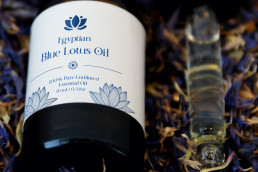
Stress is such a common experience that we have almost stopped noticing it. The tight shoulders at the desk, the shallow breathing in traffic, the tiny surge that arrives when the phone buzzes: these are all stress responses, triggered hundreds of times a day, often without registering consciously at all. Blue lotus oil will not change the circumstances producing that response. What it will do is help the body recover from stress faster, regulate better between episodes, and, used well, reduce the size of the response itself over time.
Table of Contents
This guide is written and clinically reviewed by Antonio Breshears, ND, CCA, a Bastyr-trained naturopathic doctor and certified clinical aromatherapist. It sits within our pillar on blue lotus oil health and wellness benefits.
Stress Versus Anxiety
It is worth drawing a short distinction between stress and anxiety, because the two overlap but respond to slightly different approaches.
Stress is the body’s response to an identifiable demand or pressure, external or internal. It is functional at low levels and becomes problematic when it accumulates or fails to resolve. Anxiety is the threat response operating without a specific threat, or at a level disproportionate to one. Both can become chronic, both respond to aromatic support, and the protocols for each overlap more than they differ. Our companion article on blue lotus oil for anxiety is the sibling reference.
How the Body Handles Stress
The physiology of stress runs through the HPA axis, the hypothalamic-pituitary-adrenal pathway. A perceived demand triggers a cascade that ends with the release of cortisol and adrenaline, raising heart rate, sharpening attention, and preparing the body for effort. In its designed form, this is brief: the demand passes, the cortisol clears, the system returns to baseline.
The modern difficulty is that the demands do not pass. The emails keep arriving, the deadlines stack, the news cycle churns. The HPA axis stays activated, cortisol levels stay elevated, and the body never completes the stress response. Over time, this produces the familiar cluster of consequences: poor sleep, compromised immunity, digestive disruption, mood volatility, and the slow erosion of the sense that life feels manageable.
The goal of working with blue lotus (and of any stress-management practice worth the name) is not to eliminate stress, which is neither possible nor desirable. It is to restore the rhythm of activation and recovery that the system was built for.
How Blue Lotus Oil Helps
Blue lotus supports the recovery half of the stress cycle, which is the half that modern life most consistently fails.
The alkaloid and flavonoid fractions together produce a mild quieting of sympathetic arousal, without the dulling effect of stronger sedatives. The olfactory-limbic pathway provides an immediate, seconds-long shift toward parasympathetic dominance on inhalation. And the deliberate act of pausing, inhaling, and breathing with intent is itself a powerful stress-completion technique. For the molecular picture, see our guide to blue lotus oil chemistry and therapeutic properties.
The Acute Stress Protocol
For a predictable stressor (a meeting, a presentation, a difficult conversation, a medical appointment), the protocol runs through three phases.
Before (ten to fifteen minutes prior). One drop of blue lotus on a personal inhaler or on a rollerball, inhaled with three slow breaths: four counts in, four hold, eight count exhale. Repeat twice. This pre-exposure establishes a baseline of parasympathetic tone that the stressor will then push against, rather than dominate.
During. If the situation permits, a single discreet inhalation mid-event, with a single long exhale. This is not about escaping the stressor. It is about keeping the recovery pathway open while the stressor is happening, so that completion is easier afterwards.
After (within ten minutes of the end). One to two drops in an inhaler or rollerball, four to five slow breaths with the extended exhale. This is the critical phase most people skip. Completing the stress response, rather than moving straight to the next demand, is what prevents accumulation. Blue lotus makes this pause deeply pleasant, which makes it more likely you will actually do it.
For the dilution maths on a rollerball or personal inhaler, our article on carrier oil pairings is the reference.
The Chronic Stress Protocol
Chronic stress demands a different, rhythmic approach. The principle is small, repeated interventions rather than occasional large ones.
The rhythm that works for most people: a morning aromatic cue while getting ready, a mid-morning pause, a post-lunch pause, a late-afternoon pause, and an evening wind-down. Each pause is two or three minutes. Each uses the same rollerball or diffuser. The ritual is deliberately simple; the goal is consistency, not complexity. Our guide to blue lotus oil diffuser techniques covers the equipment side.
After three to four weeks of this rhythm, most users describe a shift that is felt before it is articulated. The tightness in the shoulders is not gone, but it is no longer the default. The evening exhaustion is less complete. Sleep, often the first thing to improve, arrives more easily and stays more continuous. Our guides to blue lotus oil for sleep and blue lotus oil for insomnia cover that arm of the response in more detail.
Work Stress, Specifically
Work stress is the most common chronic-stress pattern in our practice enquiries. A rollerball containing blue lotus at 3 percent dilution in fractionated coconut oil, kept in the desk drawer, is the discreet standard. Two pauses during the working day, each ninety seconds of slow breathing with the oil at the wrists, produces substantial cumulative benefit over a working week. A small diffuser at the home workstation extends the same benefit for those working remotely.
The Recovery Phase
The phase most people skip, and the phase blue lotus supports most directly, is recovery.
After a long day, a difficult meeting, a family event, or any period of sustained demand, the body needs a deliberate return to parasympathetic dominance before it can fully restore. A twenty-minute recovery ritual (blue lotus diffusing, lying on a flat surface, slow breathing with the extended exhale) does more to reset the nervous system than several hours of casual relaxation. This is not indulgence. It is the completion that modern life rarely gives the body, and that the body needs in order to function well the following day. The same principle informs our pillar on blue lotus oil in meditation and yoga practice.
Blends for Stress
Blue lotus pairs well with several other stress-supportive oils.
- With bergamot, equal parts, for general daytime use. Bergamot has particularly good stress-reduction evidence in its own right, and its bright citrus lifts blue lotus’s heavier floral.
- With clary sage, 2:1 favouring the lotus, for stress that is hormonally mediated (pre-menstrual, perimenopausal, fluctuating cortisol patterns).
- With cedarwood, 2:1 favouring the lotus, for the evening wind-down. Cedarwood’s grounding woody note anchors blue lotus’s floral lift beautifully at the end of the day.
- With frankincense, 2:1 favouring the lotus, for meditation-integrated stress practice.
When Stress Becomes Something More
Stress that has continued long enough, or accumulated without recovery, can tip into burnout, depressive illness, or clinical anxiety. The boundary is not always easy to see from inside. Seek professional assessment where:
- Exhaustion does not resolve with rest.
- Cynicism, detachment, or loss of meaning have replaced earlier engagement.
- Physical symptoms (palpitations, headaches, digestive issues, recurrent infections) are persistent.
- Alcohol use or other coping behaviours have escalated.
- Low mood, hopelessness, or suicidal thoughts are present.
Blue lotus can play a supportive role in each of these, but it is a support, not a substitute for the wider response these situations need. Our articles on blue lotus oil for depression, blue lotus oil for grief, and blue lotus oil for trauma recovery cover related territory.
Safety
Blue lotus oil, used at appropriate dilutions and aromatic doses, has a long record of safe traditional use. It is avoided in pregnancy and breastfeeding, discussed with a prescriber before use alongside dopaminergic or serotonergic medications, and not for internal use in essential oil form. The full review is in our dedicated article on blue lotus oil safety, side effects and precautions.
Frequently Asked Questions
How quickly does blue lotus oil work for stress?
For acute stress, within a few breaths of inhalation paired with a slowed exhale. For chronic stress, expect a noticeable change in baseline within two to three weeks of consistent daily use, and a stable improvement by the end of the fourth week.
Can I use blue lotus oil at work?
Yes, and a desk-drawer rollerball at 3 percent dilution is the common format. Two ninety-second pauses during the working day produce substantial cumulative benefit, particularly when paired with conscious breathing.
How is stress different from anxiety, and does blue lotus treat both?
Stress is the response to an identifiable demand; anxiety is the threat response without a specific threat or out of proportion to one. The protocols overlap substantially, and blue lotus supports both. Where anxiety is the primary pattern, see our dedicated article for the specific protocol.
Can blue lotus oil help with chronic stress or burnout?
It can contribute to the recovery side of both, but chronic stress and burnout usually require broader changes (workload, sleep, exercise, and often professional support). Blue lotus is a consistent supportive practice within that wider response, not a substitute for it.
Is blue lotus oil safe for daily long-term use?
Yes. Aromatic and topical use at appropriate dilutions carries no known cumulative risk, and long-term daily use is how the olfactory conditioning effect is actually built. Rotate between methods (diffuser, rollerball, bath) rather than methods within oils, so the aromatic signal stays consistent.
Will blue lotus oil make me too relaxed to perform under pressure?
No. At normal aromatic doses, blue lotus produces a quieting rather than a sedation. Performance under pressure, in our practice experience, usually improves rather than declines with consistent use, because the background arousal that interferes with clear thinking reduces.
Can I combine blue lotus oil with caffeine?
Yes, without known interaction. Many users combine the two deliberately: caffeine for activation, blue lotus for the parasympathetic counterweight that keeps caffeine from tipping into jitters.
Does blue lotus oil help with physical symptoms of stress?
Indirectly, yes. By supporting parasympathetic recovery, blue lotus can ease tension headaches, digestive tightness, and shallow breathing, all of which tend to resolve as the underlying dysregulation settles. Persistent physical symptoms still warrant medical evaluation.
Is blue lotus oil safe during a high-stress pregnancy?
No. Blue lotus is avoided during pregnancy and breastfeeding as a matter of professional caution, regardless of the stress level. Safer aromatic options exist for pregnancy and should be discussed with a qualified practitioner.
How much blue lotus oil should I use for stress?
Two to four drops in an ultrasonic diffuser, a 3 percent dilution rollerball (roughly six drops per 10ml carrier) for portable use, or one drop on an inhaler or tissue for acute situations. Consistency at low doses beats occasional higher doses.
Where to Go From Here
For the closely related anxiety protocol, see our article on blue lotus oil for anxiety. Where stress has disrupted sleep, our guides to blue lotus oil for sleep and blue lotus oil for insomnia pick up the other end of the cycle. For the broader view of the oil, return to our complete guide to blue lotus oil, or visit the video library. Everything on this site is hosted at Pure Blue Lotus Oil.

Antonio Breshears
Antonio Breshears is a renowned expert in holistic medicine and beauty, with over 25 years of research experience dedicated to uncovering the secrets of nature's most powerful remedies. Holding a degree in Naturopathic Medicine, Antonio's passion for healing and well-being has driven him to explore the intricate connections between mind, body, and spirit.
Over the years, Antonio has become a respected authority in the field, helping countless individuals discover the transformative power of plant-based therapies, including essential oils, herbs, and natural supplements. He has authored numerous articles and publications, sharing his wealth of knowledge with a global audience seeking to improve their overall health and well-being.
Antonio's expertise extends to the realm of beauty, where he has developed innovative, all-natural skincare solutions that harness the potency of botanical ingredients. His formulations embody his deep understanding of the healing properties found in nature, providing holistic alternatives for those seeking a more balanced approach to self-care.
With his extensive background and dedication to the field, Antonio Breshears is a trusted voice and guiding light in the world of holistic medicine and beauty. Through his work at Pure Blue Lotus Oil, Antonio continues to inspire and educate, empowering others to unlock the true potential of nature's gifts for a healthier, more radiant life.