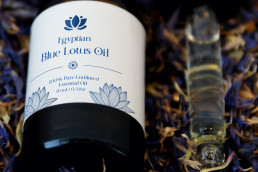
Blue lotus has an ancient and well-documented reputation as an aphrodisiac. Egyptian banquets in the pharaonic period featured blue lotus flowers floating in wine; the flower appears in tomb paintings associated with Nefertem and ritual intimacy; its mild euphoric and emotionally opening qualities were understood and valued across several centuries of Mediterranean culture. That reputation has substance, but the substance is subtler than the modern language of aphrodisiacs suggests. This article sets out what blue lotus actually does, and how to use it well in intimate practice.
Table of Contents
It is written and clinically reviewed by Antonio Breshears, ND, CCA, a Bastyr-trained naturopathic doctor and certified clinical aromatherapist. It sits within our pillar on blue lotus oil health and wellness benefits, with companion articles on blue lotus oil for women’s libido and for men’s libido.
What “Aphrodisiac” Actually Means
The word carries a lot of weight from older texts and popular culture, and most of it is inaccurate. No substance, herbal, aromatic, or pharmaceutical, produces desire reliably in the absence of the conditions that allow desire to exist in the first place. Those conditions are reasonably well understood now, and they are not primarily chemical. They are psychological, relational, and physiological in that order.
Desire requires:
- A nervous system that is not in a state of active stress or exhaustion.
- Sleep of reasonable quality.
- Mental presence, the capacity to actually be in the body and the moment.
- Some quality of emotional safety and connection, whether with a partner or with the self.
- A hormonal substrate that is within a functional range.
No aromatic, blue lotus included, creates these conditions from nothing. What a well-chosen aromatic can do is help the nervous system move toward them, particularly the first three, which are the conditions most commonly missing in contemporary life. Blue lotus is, in that framing, a legitimate support for intimacy. Calling it an aphrodisiac in the older sense overstates what any substance does.
The Ancient Context
Worth spending a little time with the tradition, because it shapes how the oil is still used.
Blue lotus features prominently in Egyptian tomb art, most famously in depictions of funerary banquets and ritual drinking. The flower was soaked in wine to release its alkaloids, producing a mild euphoric and emotionally opening drink used at banquets, religious ceremonies, and intimate occasions. The god Nefertem, associated both with the flower and with the scented oils of the body, was the deity of perfume and of the sensual, pleasurable aspects of life.
The tradition was not simply hedonistic. Blue lotus was associated with rebirth, with the opening of the heart, and with the dissolution of the ordinary boundaries of self that more contemplative Egyptian religious practice valued. Intimate use sat within a broader spiritual-sensory culture that we do not have a clean modern analogue for. Our pillar on blue lotus oil history and culture is the fuller reference for the Egyptian context.
The practical inheritance from this tradition is a particular understanding: blue lotus belongs to the moments when the ordinary pace of life gives way to something slower, more sensory, and more present. That is the context in which its aphrodisiac reputation belongs.
How Blue Lotus Actually Supports Intimacy
Four mechanisms converge.
First, the parasympathetic shift. Sexual response requires parasympathetic dominance. Arousal in the technical sense is a parasympathetic event (vasodilation, engorgement), and the emotional openness that accompanies it is also parasympathetic. Blue lotus shifts the nervous system in this direction quickly through the olfactory-limbic pathway. For the underlying pharmacology, our guide to blue lotus oil chemistry and therapeutic properties covers the detail.
Second, scent as conditioning. A consistent aromatic used in intimate contexts becomes a cue for those contexts, eliciting the associated state with increasing reliability over time. The long-standing ritual use of blue lotus in Egyptian intimate culture was almost certainly exploiting this principle, whether or not it was understood in those terms.
Third, mental presence. Many of the obstacles to intimacy in modern life are cognitive: the racing mind, the unfinished to-do list, the half-attention that is the default of our digital environment. Blue lotus reliably quiets this. The pause to inhale and breathe is itself a form of arriving.
Fourth, the sensuality of application. Topical oil application, particularly partnered application, is its own form of intimate practice. Blue lotus diluted for massage becomes both aromatic and tactile, engaging multiple senses and slowing the tempo of contact.
Ritual and Partnered Use
A practical ritual that draws on the tradition.
Prepare the space: warm room, dim or candle light, phones away or silenced. Diffuse blue lotus in the space for fifteen to twenty minutes before beginning. Two to three drops.
Prepare a blend for topical use: blue lotus at 2 to 3 percent in a sensual carrier oil (jojoba, sweet almond, or argan). A blend jar kept specifically for intimate use, stored away from the daily oils, preserves the scent association and deepens the conditioning effect over time. Our article on carrier oil pairings sets out the dilution maths.
Begin with unhurried attention. Apply the blend to the wrists, neck, and behind the ears of each partner. Breathe slowly for a minute or two together. Continue at the partners’ own pace. The oil is a supporting element throughout, not the event itself.
A variation: the blend used as a massage oil, with the massage itself as the practice rather than a prelude to something else. The Egyptian tradition made no strict distinction here, and in contemporary use, massage with blue lotus is often intimacy complete on its own terms.
Individual Use
For solo practice or self-intimacy, the principles are the same. A gentle topical application, attention to the breath, an unhurried pace. Blue lotus can be part of a sensual self-care ritual without a partner present, and often is.
For those working on their own relationship with sexuality (after illness, after difficult experience, during recovery from medication effects, or as a general practice of embodiment), blue lotus pairs well with the broader work. It is not a shortcut, but it is a pleasant and reliable companion to the patience that this work usually requires. Our companion articles on blue lotus oil for libido in women and for men take up the more specific protocols.
Blends for Intimate Practice
Three blends work particularly well.
- With rose (Rosa damascena), 2:1 favouring rose. The classic partnership. Rose carries the emotional openness, blue lotus carries the depth and the slowing.
- With ylang ylang, 2:1 favouring blue lotus. Ylang ylang has an old tradition as a sensual aromatic in Southeast Asian cultures and pairs well with blue lotus’s Mediterranean lineage.
- With jasmine (Jasminum grandiflorum or sambac), 3:1 favouring blue lotus. Jasmine is warm and slightly intoxicating; use sparingly to avoid the blend becoming heavy.
- With sandalwood, 2:1 favouring blue lotus. Sandalwood contributes a grounding woody base note and has its own quiet tradition in intimate and contemplative aromatics.
When It Isn’t Working
Blue lotus does not solve the underlying issues that most commonly block desire: chronic stress, sleep deprivation, relationship conflict, medication side effects, hormonal imbalance, or unaddressed history. If you are using blue lotus and finding it pleasant but not productive of the intimate life you want, the aromatic is not what is missing. The underlying conditions need their own attention.
Specifically, where desire has been absent for months to years, where sexual pain is present, or where medication effects are suspected, appropriate clinical assessment is the right step. For women, see our article on blue lotus oil for libido in women; for men, blue lotus oil for libido in men. Both go into the clinical-vs-aromatic distinction in more depth.
Safety
Blue lotus oil at appropriate dilutions for topical and aromatic use is well-tolerated. It is avoided in pregnancy and breastfeeding, and discussed with a prescriber before use alongside dopaminergic, serotonergic, or phosphodiesterase-5 inhibitor medications. Do not use blue lotus oil internally. Patch test any new blend before applying to sensitive areas of the body. The full safety review is in our article on blue lotus oil safety, side effects and precautions.
On the question of drinking blue lotus in wine, which the ancient tradition did use: this is not something we recommend. The alcohol in commercial wine changes the pharmacology of the alkaloid fraction, and modern blue lotus oil (the essential oil and absolute) is not formulated for ingestion. The aromatic and topical applications carry the tradition forward without the risks of oral use.
Frequently Asked Questions
Does blue lotus oil really work as an aphrodisiac?
Yes, in the sense that it genuinely supports the nervous-system conditions for desire. No, in the sense that it does not chemically produce desire where the underlying conditions are absent. The practical effect is real but indirect, and compounds over time through ritual use.
How do I use blue lotus oil for intimacy with a partner?
The standard protocol is a diffusion in the room for fifteen to twenty minutes before beginning, followed by a diluted topical blend (2 to 3 percent in a sensual carrier) applied to pulse points, used with slow breathing. Massage with the same blend is another common application.
Can I drink blue lotus in wine as the Egyptians did?
We do not recommend it. Modern blue lotus oils (essential oil or absolute) are not formulated for ingestion, and the interaction of alcohol with the alkaloid fraction changes the pharmacology in unpredictable ways. The aromatic and topical traditions carry the practice forward safely.
Does blue lotus oil increase libido?
Not in the direct sense that a hormonal or pharmacological intervention might. It supports the parasympathetic, emotional, and attention-based conditions that allow libido to be expressed. For persistent low libido, see our specific articles on women’s and men’s libido.
Is blue lotus oil safe to use topically before sex?
Yes, when properly diluted in a carrier oil. Avoid direct application to mucous membranes, the genitals, or any broken skin. Patch test any new blend first. Blue lotus is not a lubricant and should not be used as one.
Will blue lotus oil work if I’m on antidepressants?
The aromatic and topical support is compatible with SSRIs and most antidepressants. It does not reverse the sexual side effects some antidepressants produce, which are a known and often frustrating issue; if those are significant, discuss with your prescriber. Blue lotus can be a gentle support within a broader strategy.
Can blue lotus oil help with sexual performance issues?
Indirectly. Erectile difficulty, delayed arousal, or performance anxiety often involve substantial sympathetic nervous system activation, and blue lotus’s parasympathetic support can help. For structural or vascular causes of performance issues, appropriate medical evaluation is the right first step.
Is blue lotus oil safe to inhale during intimacy?
Yes. A diffused atmospheric presence during intimate time is the standard traditional use and is well-tolerated. Avoid concentrated direct inhalation (a bottle held close to the face) during physical exertion; diffusion at room level is the intended format.
How does blue lotus oil compare to other aphrodisiac oils?
Jasmine, ylang ylang, and rose are the traditional partners. Each contributes a slightly different quality: jasmine is warm and intoxicating, ylang ylang is sensual and slightly sweet, rose is emotionally open. Blue lotus carries the depth and slowing that the others, used alone, can lack. The blends discussed above are time-tested combinations.
Can I use blue lotus oil alone for solo practice?
Yes, and many users do. Sensual self-care, practices of embodiment, and solitary ritual have their own validity. The protocols in this article work with or without a partner present.
Where to Go From Here
For the specific libido protocols, see our articles on blue lotus oil for libido in women and for men. Where the underlying context is stress, sleep, or hormonal change, our pieces on stress relief, sleep and dreams, and menopause cover the supporting territory. For the broader Egyptian and historical background, our history and culture pillar expands the ritual context sketched here. Everything on this site is hosted at Pure Blue Lotus Oil.

Antonio Breshears
Antonio Breshears is a renowned expert in holistic medicine and beauty, with over 25 years of research experience dedicated to uncovering the secrets of nature's most powerful remedies. Holding a degree in Naturopathic Medicine, Antonio's passion for healing and well-being has driven him to explore the intricate connections between mind, body, and spirit.
Over the years, Antonio has become a respected authority in the field, helping countless individuals discover the transformative power of plant-based therapies, including essential oils, herbs, and natural supplements. He has authored numerous articles and publications, sharing his wealth of knowledge with a global audience seeking to improve their overall health and well-being.
Antonio's expertise extends to the realm of beauty, where he has developed innovative, all-natural skincare solutions that harness the potency of botanical ingredients. His formulations embody his deep understanding of the healing properties found in nature, providing holistic alternatives for those seeking a more balanced approach to self-care.
With his extensive background and dedication to the field, Antonio Breshears is a trusted voice and guiding light in the world of holistic medicine and beauty. Through his work at Pure Blue Lotus Oil, Antonio continues to inspire and educate, empowering others to unlock the true potential of nature's gifts for a healthier, more radiant life.