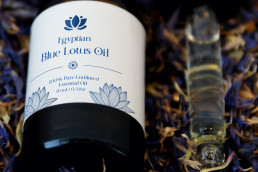
Hypnotherapists work in a liminal space where the nervous system’s willingness to soften determines almost everything that follows. Blue lotus oil hypnotherapists reach for is not a sedative in the pharmacological sense; it is a ritual and olfactory tool that helps clients drop the outer vigilance, settle into parasympathetic tone, and anchor the trance state to a specific sensory cue. This guide covers how to use Nymphaea caerulea absolute in a clinical hypnotherapy practice: induction support, resistance work, anchoring for post-hypnotic suggestion, safety, and realistic expectations.
Table of Contents
- What Blue Lotus Oil Actually Is (In Hypnotherapy Terms)
- How Blue Lotus Oil Helps With Hypnotherapeutic Work
- Parasympathetic pre-induction
- Olfactory anchoring
- Softening defended clients
- Integration and closing
- How to Use Blue Lotus Oil for Hypnotherapy: Practical Protocols
- Room preparation (pre-session)
- Personal inhaler (induction anchor)
- Rollerball for post-hypnotic use
- Dilutions summary
- What to Expect: Realistic Timeframes and Outcomes
- When Blue Lotus Oil Is NOT the Right Choice
- Complementary Approaches in Hypnotherapy Practice
- Sourcing and Practice Considerations
- Frequently Asked Questions
- Where to Go From Here
- Clinical-Grade Blue Lotus for Your Practice
It is written and clinically reviewed by Antonio Breshears, ND, CCA, a Bastyr-trained naturopathic doctor and certified clinical aromatherapist. For a broader grounding in the oil’s chemistry, sourcing, and therapeutic profile, see The Complete Guide to Blue Lotus Oil, which sits alongside this cluster as a master reference.
What Blue Lotus Oil Actually Is (In Hypnotherapy Terms)
Before integrating any botanical into a therapeutic modality, it is worth being precise about what the material is and what it is not. Blue lotus oil, in the form most hypnotherapists will work with, is a solvent-extracted absolute from the flowers of the Egyptian blue water lily, Nymphaea caerulea. It takes between 3,000 and 5,000 flowers to produce a single gram of absolute, which is why the material is expensive and why a single bottle lasts a long time in clinical use.
Chemically, the absolute contains trace aporphine and nuciferine alkaloids, along with a flavonoid profile that includes apigenin, quercetin, and kaempferol. Apigenin has documented activity at the central benzodiazepine receptor site, which is part of the mechanism by which the plant has been used in traditional Egyptian ritual practice to produce a gentle, reflective, dreamlike state. In aromatherapeutic use, where the alkaloids are present only in trace amounts and not ingested, the effect is subtler. You are working primarily with the olfactory-limbic pathway rather than systemic pharmacology.
This distinction matters for hypnotherapy. You are not drugging the client into compliance. You are offering a scent cue that the limbic system processes before conscious cognition catches up, and which tends to be read by the nervous system as safe, floral, warm, and faintly unfamiliar. That unfamiliarity is actually useful: a client’s default associations with lavender or frankincense may be contaminated by a thousand spa visits, whereas blue lotus tends to register as novel, which helps when you are trying to establish a fresh sensory anchor.
How Blue Lotus Oil Helps With Hypnotherapeutic Work
There are four distinct ways the oil earns its place in a hypnotherapy practice. Each operates on a different mechanism and each is worth separating clearly.
Parasympathetic pre-induction
The most straightforward application is pre-induction. A client who arrives from traffic, from work, from a difficult morning, is not ready for trance. Their sympathetic tone is elevated and their breathing is high in the chest. Three to four drops of blue lotus absolute in a cold-diffuser, started ten to fifteen minutes before the client enters the room, produces a scented environment that tends to lower respiratory rate and soften shoulder and jaw tension within the first few minutes of conversation. This is not sedation; it is permission to downshift.
Olfactory anchoring
Hypnotherapists already use anchoring routinely: a touch on the wrist, a specific word, a visual cue. Scent is an unusually durable anchor because olfactory memory is processed through the amygdala and hippocampus with minimal cortical filtering. A specific dilution of blue lotus, presented only during trance and associated with the deepening phase, can become a portable cue the client carries home on a handkerchief or rollerball. For smoking cessation, anxiety desensitisation, and performance work, this post-hypnotic sensory handle is clinically useful.
Softening defended clients
Some clients arrive with strong conscious resistance to suggestion. They have heard that hypnosis is about losing control and they have decided, quietly, not to cooperate. A scent with no cultural baggage gives the unconscious something to be curious about while the conscious mind is busy defending its position. Blue lotus’s slightly cooler, aquatic-floral top note followed by the honeyed heart tends to be disarming in a way that more familiar oils are not.
Integration and closing
The final minutes of a session, where you are bringing the client back to ordinary awareness and asking them to carry insight forward, benefit from a scent that marks the transition. A second, lighter exposure to the oil, perhaps from a personal inhaler, tells the nervous system that this is the stitching-together phase and creates a cue they can revisit later when practising self-hypnosis at home.
How to Use Blue Lotus Oil for Hypnotherapy: Practical Protocols
The following are working protocols used in clinical aromatherapy practice alongside hypnotherapy colleagues. Adjust to your room size, client sensitivities, and session length.
Room preparation (pre-session)
Use a cold-mist ultrasonic diffuser with 100 ml of water and 2 to 3 drops of blue lotus absolute. Run it for ten to fifteen minutes before the client arrives and turn it off as they enter. A saturated room is too much; you want a whisper of scent in the background, not a signature. If your room is larger than about 20 square metres, consider 4 drops. For smaller rooms, 2 is plenty.
Personal inhaler (induction anchor)
Blank aromatherapy inhalers with cotton wicks are available from clinical aromatherapy suppliers. Place 4 to 6 drops of blue lotus absolute on the wick, assemble, and label. Present the inhaler to the client at a specific, repeatable moment: for example, just as you begin the deepening phase. Ask them to take three slow breaths. Used consistently, this becomes a discrete anchor they can take home.
Rollerball for post-hypnotic use
A 10 ml glass rollerball with jojoba carrier and blue lotus at 2 to 3 percent dilution (approximately 12 to 18 drops in 10 ml) gives the client a tactile, portable anchor for pulse points. Instruct them to apply to the inner wrists before self-hypnosis practice or before situations where they want to rehearse the state induced in session. For smoking cessation specifically, a rollerball anchored during craving-resistance visualisation work tends to transfer well into real-world craving moments.
Dilutions summary
- Diffuser: 2 to 4 drops in 100 ml water, ten to fifteen minutes pre-session
- Personal inhaler: 4 to 6 drops on the wick
- Rollerball (wrist application): 2 to 3 percent in jojoba or fractionated coconut oil
- Never apply neat to skin; never ingest
What to Expect: Realistic Timeframes and Outcomes
Honest expectation-setting matters here, both for the practitioner and for client communication. Blue lotus oil is not going to produce somnambulistic trance in a resistant client. It is not a chemical shortcut and it is modestly effective rather than dramatic. What it will do, reliably:
In the first session, most clients notice the scent, find it unusual but pleasant, and report feeling “calmer” or “settled” within the first ten minutes of the environment being prepared. This is the parasympathetic effect and it is useful but unremarkable; many oils can produce this.
By the third or fourth session, if you have been using the inhaler consistently at the same phase, the anchor begins to establish itself. Clients report that the smell alone starts to produce a spontaneous soft-focus, lowered-shoulder response. This is classical conditioning plus the intrinsic olfactory effect, and this is where the clinical utility of blue lotus specifically, rather than any calming oil, starts to show. The novelty of the scent means it is not competing with a hundred prior associations.
For home use via rollerball or inhaler between sessions, expect the client to report genuine usefulness in roughly two out of three cases. Some clients simply do not respond to scent-based anchoring as strongly as others, and it is worth screening for this in intake. A simple question, “Do smells tend to bring back memories strongly for you?” identifies responders reasonably well.
When Blue Lotus Oil Is NOT the Right Choice
There are clients and circumstances where this oil should not be used, and a hypnotherapist should know them before integrating it into practice.
Pregnancy and breastfeeding. Blue lotus is avoided in pregnancy and lactation. Historical use patterns and the alkaloid profile do not support safety in these windows, and no hypnotherapist should expose a pregnant client to diffused blue lotus without discussing it first. Switch to a pregnancy-safe oil, such as a light citrus, for these clients.
Clients on dopaminergic medication, MAOIs, or strong sedatives. The aporphine and nuciferine content is present in absolute form, even if in trace amounts, and caution around these drug classes is appropriate. Inhalation exposure is low-risk, but if the client is medicated in any of these categories and sensitive, err toward a different oil or a heavily reduced diffuser concentration.
Known floral or solvent sensitivity. Some clients have a migraine trigger around heavy florals, and blue lotus, despite its aquatic top note, has a honeyed-floral heart that can provoke this. Always screen on intake.
Regulatory context. Blue lotus is restricted in Russia, Poland, Latvia, and the US state of Louisiana, and the regulatory picture in Australia is complex. If you are practising in those jurisdictions, verify the legal status of the absolute in your country before routine clinical use.
Client preference. If a client simply does not like the scent, do not use it. Aversion will undo any anchoring work and may actively associate the trance state with something unpleasant. A brief scent-test in the intake session, where you offer the open bottle at arm’s length for a two-second inhale, is good practice.
Complementary Approaches in Hypnotherapy Practice
Blue lotus is not the only olfactory tool worth knowing, and it is rarely the right single answer. A hypnotherapist integrating aromatherapy well tends to carry three or four oils and select based on client and goal.
For clients whose core issue is grief or emotional numbing, rose absolute tends to outperform blue lotus because of its heart-opening profile. For clients with acute panic, a small amount of neroli or petitgrain produces faster reduction in autonomic arousal. For performance anxiety and confidence work, bergamot or a bergamot-blue lotus combination can lift mood while still softening defences. Blue lotus’s niche is the reflective, dreamlike, soft-focus state, which is precisely what suits deepening, regression work, parts therapy, and integration.
Beyond aromatherapy, the usual hypnotherapeutic adjuncts apply: brief breath-pacing before induction, consistent room temperature, low and warm lighting, and a quiet outside environment. Scent is an addition to these, not a replacement.
Sourcing and Practice Considerations
Because blue lotus is expensive and commonly adulterated, sourcing matters more than for commodity oils. For a clinical practice you want absolute from a supplier who can tell you the origin (Egypt is the historical source), the extraction method (solvent absolute is most common; CO2 extracts are excellent if you can find them), and ideally show you a GC-MS report. Cheap “blue lotus oil” on general marketplaces is almost always a dilution, a fragrance oil, or a different species entirely. For clinical anchoring work, authenticity matters because you are building a conditioned response and you want the scent to be reproducible over years.
Shelf life for properly stored absolute is three to four years in dark glass kept cool and dark. For a typical hypnotherapy practice using 3 to 4 drops per session, a 5 ml bottle lasts a long time. Buy small, buy well, and replace before the scent profile shifts.
Frequently Asked Questions
Does blue lotus oil actually induce hypnotic trance on its own?
No. Inhaled blue lotus absolute does not produce trance pharmacologically. Its role in hypnotherapy is as a parasympathetic primer and as an olfactory anchor for conditioning. Trance induction remains the work of your verbal and relational technique.
How many drops should I put in the diffuser for a standard therapy room?
Two to four drops in 100 ml of water for a room of up to roughly 20 square metres. Run for ten to fifteen minutes before the client arrives and turn off on arrival. A lingering whisper of scent is the goal, not saturation.
Can I use blue lotus with clients who have a history of addiction?
Inhalation exposure does not present a meaningful dependency risk. The traditional psychoactive effects of blue lotus are associated with ingestion of prepared tinctures or wines, not aromatherapy. That said, for clients in recovery from substances where scent-based craving cues matter, discuss any new olfactory exposure with them in advance.
Is it safe to give a client a rollerball to take home?
Yes, provided you dilute to 2 to 3 percent in a skin-safe carrier such as jojoba or fractionated coconut oil, label it clearly with ingredients and usage instructions, and confirm no skin sensitivity. Instruct wrist and pulse-point application only, not face or mucous membranes.
Will the scent clash with other oils I use in the practice?
Blue lotus has a distinct cooler-floral profile that tends to layer cleanly with citrus, soft woods like sandalwood, and light herbaceous oils. It can compete with heavy florals like jasmine or ylang ylang if used simultaneously. For anchoring work specifically, keep blue lotus as a dedicated scent and do not blend it, so the conditioning remains clean.
How long does it take for an olfactory anchor to establish?
In most responders, three to four consistent pairings (that is, three to four sessions with the scent presented at the same phase) are sufficient to produce a noticeable conditioned response. Some clients need six or more. A minority, perhaps one in four, do not respond strongly to olfactory anchoring regardless of the oil used.
Can I use blue lotus oil with children in hypnotherapy?
Aromatherapy with children under twelve is a specialist area and dilutions are lower across the board. For paediatric hypnotherapy, very light diffusion only (1 drop in 100 ml), no direct inhalers, and always with parental consent and awareness. Many clinical aromatherapists prefer to avoid blue lotus in paediatric work and use gentler alternatives.
Is there a risk of sensitisation with repeated exposure?
Skin sensitisation is possible with any essential oil or absolute over time, which is why rollerball dilutions stay at 2 to 3 percent and application is limited to pulse points. Respiratory sensitisation from diffused exposure at clinical doses is rare but possible; if a client reports increasing headache or irritation over sessions, discontinue.
Does the oil expire, and how do I know?
Absolute stored in dark glass in a cool dark place is stable for three to four years. You will know it is past its best when the scent goes flat, loses the honeyed heart, or develops a slightly rancid edge. Replace at that point, particularly for anchoring work where scent consistency matters.
Can I charge more for sessions that incorporate aromatherapy?
That is a practice management question rather than a clinical one, but most practitioners simply fold the cost of materials into their standard fee. A 5 ml bottle of quality blue lotus absolute, used across perhaps 60 to 100 sessions, represents a small per-session material cost. What matters to clients is the perceived quality and calm of the environment, and a well-curated scent profile contributes to that.
Where to Go From Here
For the broader chemistry, sourcing, and therapeutic profile of this material, return to The Complete Guide to Blue Lotus Oil. If you are building out an aromatherapy toolkit for your practice more generally, work through each oil you carry with the same discipline: know the chemistry, know the contraindications, know the realistic outcomes, and screen every client on intake. Hypnotherapy is already a subtle instrument, and the oils you bring into the room should be chosen with the same care you bring to your language.

Antonio Breshears
Antonio Breshears is a renowned expert in holistic medicine and beauty, with over 25 years of research experience dedicated to uncovering the secrets of nature's most powerful remedies. Holding a degree in Naturopathic Medicine, Antonio's passion for healing and well-being has driven him to explore the intricate connections between mind, body, and spirit.
Over the years, Antonio has become a respected authority in the field, helping countless individuals discover the transformative power of plant-based therapies, including essential oils, herbs, and natural supplements. He has authored numerous articles and publications, sharing his wealth of knowledge with a global audience seeking to improve their overall health and well-being.
Antonio's expertise extends to the realm of beauty, where he has developed innovative, all-natural skincare solutions that harness the potency of botanical ingredients. His formulations embody his deep understanding of the healing properties found in nature, providing holistic alternatives for those seeking a more balanced approach to self-care.
With his extensive background and dedication to the field, Antonio Breshears is a trusted voice and guiding light in the world of holistic medicine and beauty. Through his work at Pure Blue Lotus Oil, Antonio continues to inspire and educate, empowering others to unlock the true potential of nature's gifts for a healthier, more radiant life.