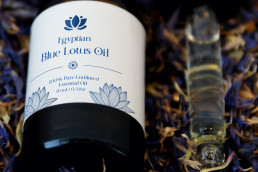
If you have just bought your first bottle of Egyptian blue lotus absolute and you want a structured way to use it, rather than the scattered dab-and-hope approach most people default to, this 30 day blue lotus ritual plan gives you a week-by-week framework. It covers evening use, morning use, bath and bodywork, and a short meditative practice, with specific dilutions, timings, and what to pay attention to along the way.
Table of Contents
- Why a Structured Plan Works Better Than Ad-Hoc Use
- What You Will Need Before You Start
- Week 1: Introduction and Evening Anchoring
- The Evening Protocol (Days 1 to 7)
- What to Log
- Week 2: Adding a Morning and a Body Ritual
- The Morning Cue (Days 8 to 14)
- The Body Rollerball (Days 8 to 14)
- Week 3: Deepening and Meditative Practice
- The Ten-Minute Sit (Days 15 to 21)
- Optional: A Weekly Bath (Day 17 or 19)
- Week 4: Integration and Personal Adaptation
- A Face Ritual (Optional, Days 22 to 30)
- Review and Recalibrate
- What to Realistically Expect
- Safety Notes Before You Start
- Quick-Reference Weekly Summary
- Frequently Asked Questions
- Where to Go From Here
- Begin Your Thirty Day Ritual
It is written and clinically reviewed by Antonio Breshears, ND, CCA, a Bastyr-trained naturopathic doctor and certified clinical aromatherapist. If you are new to the oil itself, read The Complete Guide to Blue Lotus Oil first, which covers chemistry, sourcing, and safety in more depth; this plan assumes you already have a basic bottle in hand and want to actually use it.
Why a Structured Plan Works Better Than Ad-Hoc Use
Blue lotus absolute is a subtle oil. Its effects build through repeated, associative use more than through any single dramatic exposure. This is how the olfactory-limbic pathway works: odours become paired with internal states over time, so a particular scent, encountered in a particular context, begins to reliably evoke that state. People who dab a bit on their wrist once a fortnight and wonder why nothing happens are fighting the actual mechanism. A 30 day ritual plan gives the oil enough repetitions, in consistent contexts, to establish those pairings.
Thirty days is also long enough to notice patterns that one or two sessions will never reveal. Shifts in sleep onset, morning mood, evening wind-down, and the felt sense of your skincare or body ritual all become visible over a month of consistent use. A week is too short to draw any real inference. Three days is essentially a novelty test.
None of this requires perfection. Missing a day or two does not undo the work. What matters is the overall rhythm.
What You Will Need Before You Start
To follow this plan you need a 3 or 5 ml bottle of pure blue lotus absolute or CO2 extract, a carrier oil you tolerate well on your skin (jojoba is the most versatile; sweet almond or fractionated coconut work fine), at least one 10 ml rollerball bottle, a small amber dropper bottle for a blended face oil, and access to a diffuser of some sort, whether a nebuliser, ultrasonic unit, or simply a porous stone or tissue on a bedside table.
A notebook, or any form of brief written log, makes the plan meaningfully more useful. You do not need to write essays. Two lines a day (one in the morning, one before bed) is enough to track sleep quality, mood on waking, and anything that stood out. Without some form of record the month blurs, and you will struggle to distinguish real changes from memory.
Week 1: Introduction and Evening Anchoring
The first week focuses entirely on the evening. Nothing else. This is deliberate. Blue lotus absolute is most useful as an evening and night-time oil for most people, and the easiest place to establish a reliable scent-state association is in the hour before bed.
The Evening Protocol (Days 1 to 7)
Roughly forty-five minutes to an hour before you intend to sleep, put 2 to 3 drops of blue lotus absolute into your diffuser, or onto a ceramic stone or folded tissue placed on your bedside table. If the absolute is particularly thick, warm the bottle in your hand for a minute first. Sit or lie somewhere comfortable, in lowered light, and do whatever you would normally do in the wind-down hour: read, stretch, have a conversation, listen to music. You are not meditating. You are simply letting the scent sit in the background of a calm environment.
The aim of week one is not to feel dramatically sedated. It is to establish the scent as a reliable cue that evening has begun and the day is closing. This is a Pavlovian process, and it does not require effort. It requires repetition.
What to Log
Each morning, note how long you think you took to fall asleep, how you felt on waking (fogged, reasonably clear, genuinely rested), and a one-word mood descriptor. That is it.
Week 2: Adding a Morning and a Body Ritual
In week two you keep the evening diffuser routine (2 to 3 drops, forty-five minutes before bed, every night) and layer in two new elements: a short morning practice, and a body oil or rollerball application.
The Morning Cue (Days 8 to 14)
In the morning, after whatever caffeine or water routine you already have, spend two minutes with the bottle open, breathing the scent slowly. Do not apply it to skin yet for this morning practice. Simply inhale. The point is to bracket the day: the same oil that signalled evening now also signals a deliberate pause at the start of the morning. Some people find this grounding; others find it too floral for morning and prefer to skip it. Both are fine. Try it for the week and decide.
The Body Rollerball (Days 8 to 14)
Prepare a 10 ml rollerball at roughly 2 percent dilution, which is 4 drops of blue lotus absolute in 10 ml of jojoba or fractionated coconut. Apply this to pulse points (inner wrists, the side of the neck just below the ear, over the sternum) once in the late afternoon or early evening, whenever the day starts to feel cluttered. This is a daytime anchor rather than a sleep aid. Many people describe a subtle softening of mental chatter after a few minutes, which is consistent with the apigenin content acting on central benzodiazepine sites and the aporphine alkaloid fraction contributing a faint warming-calm quality.
Keep expectations realistic. This is modestly effective rather than dramatic. If you are looking for something that feels like a pharmaceutical sedative, this oil will disappoint you, and no amount of reapplying will change that.
Week 3: Deepening and Meditative Practice
By the start of week three the scent should feel familiar. Your limbic system has now had fourteen or so evenings of pairing this particular aroma with a calm, lowered-light, end-of-day state. This is the point at which a short meditative or breathwork practice becomes genuinely useful, because the oil is already doing some of the psychological work before you sit down.
The Ten-Minute Sit (Days 15 to 21)
Continue the evening diffuser routine. After the diffuser has been running for ten minutes or so, sit upright somewhere comfortable, close your eyes, and spend ten minutes on slow nasal breathing, roughly five seconds in and six or seven seconds out. You do not need a technique more elaborate than this. The longer exhale gently biases the nervous system toward parasympathetic dominance, and the established scent cue compounds that effect.
If formal meditation is not your thing, substitute a body scan, a gratitude reflection, or simply lying still with a weighted blanket and the diffuser running. The point is ten minutes of deliberate stillness, not any particular contemplative tradition.
Optional: A Weekly Bath (Day 17 or 19)
Once in this week, run a warm bath, disperse 3 to 4 drops of blue lotus absolute into a tablespoon of full-fat milk or a teaspoon of jojoba first (essential oils do not disperse directly in water), then stir through the bath. Soak for twenty minutes in low light. This is a concentrated version of the evening ritual and tends to land deeper because the warmth, the stillness, and the scent reinforce each other.
Week 4: Integration and Personal Adaptation
The final week is less prescriptive. By now you have run the evening protocol nightly for three weeks, added a morning cue, used a body rollerball in the afternoons, and sat with a short breathwork practice. Week four is about keeping what worked, dropping what did not, and noticing what has actually shifted.
A Face Ritual (Optional, Days 22 to 30)
If your skin tolerates facial oils and you want to add a skincare dimension to the month, blend a small facial serum at 1 percent dilution: 3 drops of blue lotus absolute in 15 ml of jojoba. Use two or three drops on clean damp skin at night, pressed gently into the face and neck. This is low enough to be appropriate for most skin types, but do a small patch test on the inner forearm for 24 hours first if you have reactive skin.
Review and Recalibrate
Toward the end of week four, take fifteen minutes and read back through your brief daily log. Look for patterns rather than individual entries. Has sleep onset shortened? Have the mornings felt slightly less effortful? Has the evening wind-down become a genuine transition rather than a prolongation of the workday? These are the sorts of subtle changes a well-structured 30 day blue lotus ritual plan can produce. If the answer to all three is a clear no, the oil may simply not be your chemistry. That is a legitimate finding, and worth more than a vague sense that “something probably happened”.
What to Realistically Expect
Most people who complete this plan report three things. First, a shortened evening wind-down: the transition from day-mode to sleep-mode becomes faster and less negotiated, mostly through conditioning rather than any direct sedation. Second, a softer relationship with the evening itself; the scent becomes something the nervous system genuinely looks forward to. Third, a mild improvement in sleep quality, particularly in the first third of the night. The oil is not a strong sedative and will not knock you out. What it does, reasonably well, is lower the activation threshold for rest when the rest of your evening supports it.
What it will not do, within thirty days or thirty years, is resolve a significant sleep disorder, treat clinical anxiety or depression, or replace a considered conversation with a doctor about medication, thyroid function, iron status, or any of the other less glamorous drivers of poor sleep and low mood. If those drivers are present, the oil is a pleasant adjunct at best.
Safety Notes Before You Start
Blue lotus absolute is avoided in pregnancy and breastfeeding. If you are taking dopaminergic medications (for Parkinson’s disease, restless legs, or certain psychiatric conditions), MAOIs, or heavy sedatives, do not start this or any other blue lotus protocol without speaking to your prescribing clinician first. The alkaloid profile, though mild, is not inert, and combining it with drugs that act on the same systems is not something to guess at.
If you live in a jurisdiction with legal restrictions on Nymphaea caerulea (Russia, Poland, Latvia, the US state of Louisiana, and with regulatory complexity in Australia), check your local situation before ordering. Patch test on your inner forearm before any skin application. If you develop a rash, stop. If the scent produces headache rather than ease, this particular oil is not suited to your chemistry and no amount of persistence will change that.
Quick-Reference Weekly Summary
- Week 1: Evening diffuser only. 2 to 3 drops, 45 minutes before bed, every night. Log sleep onset and morning mood.
- Week 2: Keep the evening diffuser. Add a 2-minute morning inhalation and a 2 percent rollerball for afternoon pulse points.
- Week 3: Keep weeks 1 and 2. Add a 10-minute evening breathwork or stillness practice. One optional bath mid-week.
- Week 4: Keep what works. Add an optional 1 percent facial serum. Review your log and recalibrate.
Frequently Asked Questions
Can I start this plan if I have never used essential oils before?
Yes. The plan is deliberately gentle in week one precisely so that newcomers can build familiarity before layering in skin applications. Patch test before any topical use, and if you are unsure about a carrier oil, jojoba is the most universally tolerated.
What if I miss a few days?
Nothing dramatic. Pick up where you left off. The plan works through overall rhythm, not perfect adherence. If you miss more than a week, consider restarting from the beginning of that week rather than skipping ahead, since the scent-state associations need the repetition.
Can I use this plan for anxiety rather than sleep?
The afternoon rollerball in week two is the most directly relevant element for daytime anxiety, and the week three breathwork practice compounds that effect. Blue lotus is modestly anxiolytic rather than strongly so, and for clinical anxiety it should sit alongside, not replace, professional care.
How many drops should I actually use in the diffuser?
Two to three drops for most room sizes. Blue lotus absolute is concentrated and aromatically rich; more is not better and tends to become cloying. If the room is particularly large or well-ventilated, four drops is reasonable.
Can I apply the oil neat to my skin?
No. Always dilute in a carrier. Neat application of an absolute, over time, invites sensitisation, which is a form of skin reactivity that can become permanent. A 2 percent dilution for body use and 1 percent for facial use is the standard aromatherapy guidance.
Will I see results in week one?
Some people notice a shift in evening wind-down within three or four nights, largely through the novelty and ritual of the practice itself. The more interesting changes (subtle mood and sleep-quality effects) generally show up across weeks two and three, once the scent has been repeatedly paired with rest.
Can I combine blue lotus with other essential oils in the diffuser?
Yes, but for the first fortnight keep it to blue lotus alone so you can actually evaluate its effect. From week three onward, pairing with lavender, Roman chamomile, or sandalwood is reasonable and traditional. Citrus oils tend to clash with the floral profile.
What happens if I continue past 30 days?
Continued use is fine. Many people settle into the evening diffuser routine indefinitely. The rollerball and breathwork practices tend to be used more flexibly after the structured month, as tools rather than daily obligations. The oil itself, stored in dark glass somewhere cool, keeps for three to four years.
Can children or teenagers follow this plan?
This plan is written for adults. Aromatherapy for children and adolescents requires different dilutions, different safety considerations, and in most cases a qualified clinical aromatherapist rather than a self-directed plan from a website.
How do I know if the oil itself is real?
Genuine blue lotus absolute is expensive, because it takes roughly 3,000 to 5,000 flowers to produce a gram. If a bottle is suspiciously cheap, the product is almost certainly a synthetic fragrance oil or a heavily diluted version. The scent of the real oil is layered: a cooler floral-aquatic top, a deep honeyed-floral heart, and a balsamic, slightly smoky base. Synthetic imitations tend to smell flat and one-dimensional by comparison.
Where to Go From Here
If you have not already, read The Complete Guide to Blue Lotus Oil for a deeper account of the botany, chemistry, and clinical context behind the oil. That guide sits as the foundational reference for everything covered in this plan and answers the broader questions a structured ritual does not have room to address. If at the end of the thirty days you find that the oil genuinely belongs in your life, it may be time to think about a second bottle, either a backup of the same absolute or a supercritical CO2 extract for variation. Good oils, used thoughtfully, tend to become quiet fixtures rather than novelties.

Antonio Breshears
Antonio Breshears is a renowned expert in holistic medicine and beauty, with over 25 years of research experience dedicated to uncovering the secrets of nature's most powerful remedies. Holding a degree in Naturopathic Medicine, Antonio's passion for healing and well-being has driven him to explore the intricate connections between mind, body, and spirit.
Over the years, Antonio has become a respected authority in the field, helping countless individuals discover the transformative power of plant-based therapies, including essential oils, herbs, and natural supplements. He has authored numerous articles and publications, sharing his wealth of knowledge with a global audience seeking to improve their overall health and well-being.
Antonio's expertise extends to the realm of beauty, where he has developed innovative, all-natural skincare solutions that harness the potency of botanical ingredients. His formulations embody his deep understanding of the healing properties found in nature, providing holistic alternatives for those seeking a more balanced approach to self-care.
With his extensive background and dedication to the field, Antonio Breshears is a trusted voice and guiding light in the world of holistic medicine and beauty. Through his work at Pure Blue Lotus Oil, Antonio continues to inspire and educate, empowering others to unlock the true potential of nature's gifts for a healthier, more radiant life.