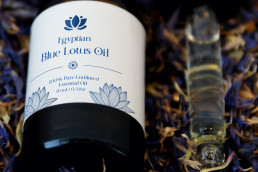
This blue lotus oil glossary is a plain-English reference for the terms you will encounter when researching, buying and using Nymphaea caerulea. It covers the botany, the chemistry, the extraction methods, the blending vocabulary and the safety language, so that whether you are reading a product listing, a research paper or another article on this site, you can translate the jargon into something useful.
Table of Contents
- How to Use This Glossary
- A
- Absolute
- Adulteration
- Alkaloid
- Anchoring (olfactory)
- Aporphine
- Apigenin
- Aromatherapy
- B
- Base note
- Benzodiazepine receptor
- C
- Carrier oil
- Chemotype
- CO2 extraction (supercritical)
- Cold pressing
- D
- Dilution
- Diffusion
- Dopaminergic
- E
- Essential oil (true)
- Ethanol extraction
- F
- Flavonoid
- Fixative
- G
- GC/MS (Gas Chromatography-Mass Spectrometry)
- H
- Heart note (middle note)
- Hexane
- HydroSol
- I
- Indolic
- Inhalation
- J
- Jojoba
- K
- Kaempferol
- L
- Limbic system
- Lotus (true vs water lily)
- M
- MAOI (monoamine oxidase inhibitor)
- Middle note
- N
- Nuciferine
- Nymphaea caerulea
- O
- Olfactory bulb
- Organoleptic
- P
- Parasympathetic
- Patch test
- Phototoxicity
- Q
- Quercetin
- R
- Resinoid
- S
- Sedative (mild)
- Serotonergic
- Solvent extraction
- Steam distillation
- Supercritical CO2
- T
- Top note
- Tenacity
- U
- Ultrasonic diffuser
- V
- Volatility
- W
- Water lily
- Y-Z
- Yield
- Frequently Asked Questions
- Where to Go From Here
- Bring the Vocabulary to Life
It is written and clinically reviewed by Antonio Breshears, ND, CCA, a Bastyr-trained naturopathic doctor and certified clinical aromatherapist. For broader context on how these terms fit together in practice, see The Complete Guide to Blue Lotus Oil, which functions as the master reference this glossary supports.
How to Use This Glossary
Entries are organised alphabetically, with related terms grouped where it makes sense (for example, the different extraction methods sit together under their letters, but also reference one another). Each entry is short enough to read quickly but long enough to be genuinely useful; where a term is specifically relevant to blue lotus, that relevance is called out. Where a term is borrowed from mainstream aromatherapy or botany, the definition is general but written with blue lotus in mind.
If you are scanning for a specific word, use your browser’s find function (Ctrl+F or Cmd+F). If you are reading through, you will notice the entries build on one another, which is deliberate: the vocabulary of essential oils is interlocking, and understanding one term often depends on another.
A
Absolute
A highly concentrated aromatic extract produced using a solvent (most often hexane or ethanol) rather than steam. Most genuine blue lotus oil on the market is, strictly speaking, a blue lotus absolute, because the delicate aromatic compounds in Nymphaea caerulea do not survive steam distillation well. Absolutes are thicker, darker and more tenacious in scent than true essential oils.
Adulteration
The practice of extending or replacing a genuine aromatic extract with cheaper materials: synthetic fragrance compounds, carrier oils, or unrelated botanicals. Blue lotus is heavily adulterated in the wholesale market because real material is expensive, so adulteration awareness matters.
Alkaloid
A class of nitrogen-containing plant compounds, often biologically active at low doses. In blue lotus, the two alkaloids most often discussed are aporphine and nuciferine.
Anchoring (olfactory)
A behavioural technique in which a specific scent is paired repeatedly with a desired state (calm before sleep, focus before work), so that the scent alone eventually evokes the state. Blue lotus responds well to anchoring because its aroma is distinctive and not encountered in daily life.
Aporphine
An alkaloid present in blue lotus, structurally related to apomorphine. It acts as a weak dopamine receptor agonist, which is part of why blue lotus produces a subtly uplifting, mood-warming quality rather than a purely sedating one.
Apigenin
A flavonoid found in blue lotus that binds to the central benzodiazepine receptor site and is associated with mild anxiolytic (anxiety-reducing) and sedative effects. It is one of the key molecules behind blue lotus’s reputation as a calming botanical.
Aromatherapy
The therapeutic use of volatile aromatic plant extracts, typically via inhalation or diluted topical application, to support physical, emotional or psychological wellbeing. Clinical aromatherapy is the practitioner-led, evidence-aware form of this practice.
B
Base note
In perfumery, the deepest, longest-lasting layer of a fragrance, which emerges once the top and heart notes have faded. Blue lotus has a balsamic, slightly smoky base note that anchors well with resins, ambers and woods.
Benzodiazepine receptor
A binding site in the central nervous system where certain flavonoids (notably apigenin) and pharmaceutical sedatives attach to produce calming effects. Relevant to blue lotus because apigenin interacts modestly with this receptor.
C
Carrier oil
A bland, fatty plant oil used to dilute concentrated aromatic extracts so they are safe for skin contact. Jojoba, fractionated coconut, sweet almond and camellia are common carriers for blue lotus.
Chemotype
A chemically distinct variant within a single plant species, usually caused by growing conditions, genetics or region. Blue lotus chemotypes are not as well-characterised as, say, those of rosemary or thyme, but regional differences in Egyptian, Indian and Thai material are real.
CO2 extraction (supercritical)
An extraction method that uses carbon dioxide under pressure and low temperature to dissolve aromatic and lipid-soluble compounds from plant material. It leaves no solvent residue and often produces a more complete aromatic profile than either steam distillation or solvent extraction. Premium blue lotus CO2 extracts exist but are rare and expensive.
Cold pressing
A mechanical extraction method used for citrus peels and certain seeds. It is not used for blue lotus; blue lotus flowers contain too little lipid material for cold pressing to work.
D
Dilution
The percentage of aromatic extract in a finished blend. Standard guidance for blue lotus is roughly 1 to 2 percent for facial use, 2 to 3 percent for body application, up to 3 percent for targeted pulse-point or spot use, and 2 to 4 drops in a diffuser.
Diffusion
The act of dispersing aromatic molecules into the air for inhalation, typically using an ultrasonic or nebulising diffuser. Blue lotus diffuses beautifully in small amounts; it is tenacious and does not need much to fill a room.
Dopaminergic
Acting on the dopamine system of the brain. Aporphine in blue lotus is mildly dopaminergic, which is why the oil is sometimes described as warmly uplifting rather than purely sedating. It is also why caution is advised alongside medications that affect dopamine.
E
Essential oil (true)
Strictly, a volatile aromatic extract produced by steam distillation or cold pressing. Many products sold as “blue lotus essential oil” are technically absolutes, because solvent extraction is the only reliable way to capture the flower’s full aromatic profile. The term is used loosely in the marketplace.
Ethanol extraction
A solvent extraction method using food-grade alcohol. Safer residually than hexane and used for some artisan blue lotus products, though yields are lower.
F
Flavonoid
A large family of plant polyphenols with antioxidant and, in some cases, mild central nervous system activity. Apigenin, quercetin and kaempferol are the flavonoids most discussed in blue lotus.
Fixative
A material that slows the evaporation of more volatile aromatic compounds, extending a blend’s scent life on skin or in a diffuser. Blue lotus itself acts as a partial fixative because of its dense, balsamic character.
G
GC/MS (Gas Chromatography-Mass Spectrometry)
A laboratory analytical method used to identify the chemical constituents of an essential oil or absolute. Reputable blue lotus suppliers can produce a GC/MS report on request, which is one of the few genuinely objective ways to assess authenticity and adulteration.
H
Heart note (middle note)
The second layer of a fragrance’s evolution, emerging after the top notes fade and before the base notes settle. Blue lotus’s heart is its signature: deep, honeyed, waterlily-floral, slightly indolic.
Hexane
A petroleum-derived solvent used in industrial extraction of absolutes. Trace residues in finished absolutes are regulated and typically very low, but buyers who prefer to avoid hexane can seek ethanol-extracted or CO2-extracted blue lotus.
HydroSol
The aromatic water produced as a byproduct of steam distillation. Blue lotus hydrosols exist but are faint; they are not the primary way the plant’s aromatic character is captured.
I
Indolic
A perfumery descriptor for the animalic, almost narcotic floral quality produced by trace indole compounds. Blue lotus has a subtle indolic aspect in its heart note, which is part of what gives it depth.
Inhalation
The primary route of action for most aromatherapy effects. Aromatic molecules reach the olfactory bulb within seconds, where they influence the limbic system directly. Blue lotus’s mood-softening effects are most reliably accessed this way.
J
Jojoba
Technically a liquid wax rather than an oil, jojoba is extremely stable, closely resembles human sebum, and is an excellent carrier for blue lotus on the face and pulse points.
K
Kaempferol
A flavonoid present in blue lotus with antioxidant activity and mild effects on mood-related pathways. One of the secondary compounds that contribute to the plant’s subtle central effects.
L
Limbic system
The brain network most closely associated with emotion, memory and motivation. Scent is unique among the senses in routing directly to this system, which is why aromatic inhalation can shift mood faster than almost any other non-pharmaceutical intervention. Blue lotus’s effects are largely limbic.
Lotus (true vs water lily)
A persistent source of confusion. True lotus is the genus Nelumbo (pink or white sacred lotus). Blue lotus, Nymphaea caerulea, is actually a water lily. The two are different plants with different chemistry. The common name “blue lotus” is historical and botanically imprecise but universally used.
M
MAOI (monoamine oxidase inhibitor)
A class of medications that block the enzyme which breaks down certain neurotransmitters. Because some of blue lotus’s alkaloids may interact with these pathways, caution is advised for anyone taking MAOI medication.
Middle note
See Heart note.
N
Nuciferine
An alkaloid present in blue lotus (and in sacred lotus, Nelumbo nucifera). It is a weak dopamine receptor antagonist with additional 5-HT2A and 5-HT2C serotonin receptor activity. Nuciferine contributes to the calming, slightly dissociative quality sometimes reported with blue lotus.
Nymphaea caerulea
The botanical name for Egyptian blue water lily, the plant from which blue lotus oil is extracted. The epithet “caerulea” means sky-blue, referring to the flower’s colour. It is distinct from the white Egyptian lotus (Nymphaea lotus) and from the pink sacred lotus (Nelumbo nucifera).
O
Olfactory bulb
The structure at the front of the brain that receives signals from the nose. It connects directly to the amygdala and hippocampus, giving scent its privileged route into emotion and memory.
Organoleptic
Relating to the senses: a trained assessor’s organoleptic evaluation (smell, appearance, viscosity, colour) is still one of the first-line tools for judging whether a blue lotus sample is genuine.
P
Parasympathetic
The “rest and digest” branch of the autonomic nervous system. Blue lotus encourages parasympathetic dominance via its limbic effects, which is why it is useful for winding down rather than waking up.
Patch test
A small trial application of a diluted oil to an inconspicuous area (inner forearm) left for 24 hours to check for irritation or allergy before wider use. Recommended before first use of blue lotus, especially on the face.
Phototoxicity
A skin reaction triggered by sun exposure after application of certain essential oils (mainly citrus oils containing furocoumarins). Blue lotus is not considered phototoxic, but combined blends containing citrus oils may be.
Q
Quercetin
A widely studied flavonoid with antioxidant and mild anti-inflammatory activity. Present in blue lotus as one of several flavonoids that contribute to the oil’s overall profile.
R
Resinoid
A solvent-extracted material from a resinous starting substance (frankincense, benzoin). Not relevant to blue lotus itself, but often encountered as a blending partner for blue lotus absolutes.
S
Sedative (mild)
Blue lotus is often described as mildly sedating. This is accurate, with caveats: the effect is subtle, more accurately described as calming or parasympathetic-promoting than as strongly sedative in any pharmaceutical sense.
Serotonergic
Acting on the serotonin system. Nuciferine’s activity at 5-HT2A and 5-HT2C receptors makes blue lotus mildly serotonergic, which is relevant for anyone on SSRIs or other serotonin-active medication.
Solvent extraction
The most common production method for blue lotus. The fresh flowers are washed with a solvent (hexane or ethanol), producing a concrete, which is then further processed with alcohol to yield an absolute. See Absolute.
Steam distillation
The classical method for producing true essential oils. Possible with blue lotus but rarely done commercially because the yield is low and the aromatic profile is incomplete compared to solvent or CO2 extraction.
Supercritical CO2
See CO2 extraction.
T
Top note
The first aromatic impression of a blend, usually the most volatile compounds. Blue lotus’s top is cooler, slightly aquatic-floral, giving way quickly to its characteristic heart.
Tenacity
A perfumery term for how long a scent persists on skin or in a space. Blue lotus is highly tenacious: a small quantity lingers for many hours.
U
Ultrasonic diffuser
A device that disperses aromatic oils into a fine mist using water and high-frequency vibration. Gentle on delicate oils like blue lotus; 2 to 4 drops is typically sufficient.
V
Volatility
The rate at which an aromatic compound evaporates. High-volatility molecules form the top note; low-volatility molecules form the base. Blue lotus sits heavily towards the heart and base ends of the volatility spectrum.
W
Water lily
The botanical family (Nymphaeaceae) to which blue lotus actually belongs, despite the common name. See also Lotus (true vs water lily).
Y-Z
Yield
The amount of finished aromatic material obtained from a given weight of plant starting material. Blue lotus yields are famously low: roughly 3,000 to 5,000 flowers are required to produce a single gram of absolute, which is the principal reason for the oil’s price.
Frequently Asked Questions
Is blue lotus oil an essential oil or an absolute?
In almost every case, what is sold commercially as blue lotus essential oil is actually a blue lotus absolute, produced by solvent extraction. True steam-distilled blue lotus essential oil exists but is rare and produces a less complete aromatic profile. The terms are used loosely in the marketplace.
What is the difference between blue lotus and sacred lotus?
Blue lotus is Nymphaea caerulea, an Egyptian water lily. Sacred lotus is Nelumbo nucifera, a different genus and family. They share some chemistry (both contain nuciferine) but are different plants with different aromatic profiles and different cultural histories.
Why is blue lotus oil so expensive?
Because of yield. It takes roughly 3,000 to 5,000 flowers to produce one gram of absolute, and the flowers must be processed fresh. Labour, solvent cost and low throughput combine to make genuine blue lotus one of the more expensive aromatic materials on the market.
What does aporphine do?
Aporphine is a mild dopamine agonist, meaning it subtly stimulates part of the brain’s reward and mood pathway. Its presence in blue lotus is part of why the oil feels warmly uplifting rather than flatly sedating.
What does apigenin do?
Apigenin is a flavonoid that binds modestly at the central benzodiazepine receptor site, producing gentle anxiolytic and sedative effects. It is a key contributor to blue lotus’s calming reputation.
What does a GC/MS report show?
Gas Chromatography-Mass Spectrometry separates and identifies the individual chemical compounds in an aromatic extract. A GC/MS report on blue lotus will show the characteristic alkaloids and flavonoids, and will usually reveal obvious adulteration (synthetic fragrance markers, dilution with cheaper oils).
Is blue lotus a true lotus?
No. Botanically it is a water lily (Nymphaeaceae), not a true lotus (Nelumbonaceae). The common name is historical and imprecise but universally accepted.
What is a carrier oil and why do I need one?
A carrier oil is a bland, fatty plant oil used to dilute concentrated aromatic extracts so they are safe on skin. Undiluted blue lotus can cause irritation; diluted to 1 to 3 percent in jojoba, fractionated coconut or similar, it is comfortable and effective.
What is a patch test?
A small test application of a diluted oil to the inner forearm, left for 24 hours, to check for irritation or allergy. Recommended before first use of any new aromatic product, especially on facial skin.
Can blue lotus oil go off?
Yes, slowly. Stored in dark glass in a cool, dark place, a genuine blue lotus absolute remains good for roughly 3 to 4 years. Signs of degradation include a flattened, sour or chemically off scent and visible cloudiness.
Where to Go From Here
This glossary is designed to be a companion rather than a destination. Once the vocabulary is clearer, the material in The Complete Guide to Blue Lotus Oil will read more easily, and the condition-specific and application-specific articles on this site will make more sense. If a term you were looking for is not covered here, the master guide is the next place to look, as most of the specialist language in the blue lotus world is defined or used in context there.

Antonio Breshears
Antonio Breshears is a renowned expert in holistic medicine and beauty, with over 25 years of research experience dedicated to uncovering the secrets of nature's most powerful remedies. Holding a degree in Naturopathic Medicine, Antonio's passion for healing and well-being has driven him to explore the intricate connections between mind, body, and spirit.
Over the years, Antonio has become a respected authority in the field, helping countless individuals discover the transformative power of plant-based therapies, including essential oils, herbs, and natural supplements. He has authored numerous articles and publications, sharing his wealth of knowledge with a global audience seeking to improve their overall health and well-being.
Antonio's expertise extends to the realm of beauty, where he has developed innovative, all-natural skincare solutions that harness the potency of botanical ingredients. His formulations embody his deep understanding of the healing properties found in nature, providing holistic alternatives for those seeking a more balanced approach to self-care.
With his extensive background and dedication to the field, Antonio Breshears is a trusted voice and guiding light in the world of holistic medicine and beauty. Through his work at Pure Blue Lotus Oil, Antonio continues to inspire and educate, empowering others to unlock the true potential of nature's gifts for a healthier, more radiant life.