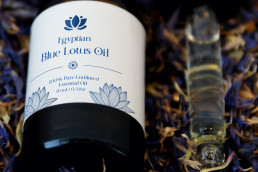
If you have been reading about blue lotus oil dopamine effects, you have probably encountered claims ranging from sober pharmacology to outright mythology. This article sits firmly in the first camp. It explains what is actually known about how Nymphaea caerulea interacts with the dopaminergic system, which compounds are responsible, what that interaction might mean for mood, motivation and reward, and where the honest limits of the evidence lie.
Table of Contents
- What the Dopamine System Actually Does
- The Two Alkaloids That Matter: Aporphine and Nuciferine
- Aporphine
- Nuciferine
- How This Translates to Felt Experience
- Dopamine, Motivation, and the Honest Case for Blue Lotus
- How to Use Blue Lotus Oil If Mood and Motivation Are Your Concerns
- Inhalation first
- Topical as an adjunct
- Consistency over intensity
- What to Expect: Realistic Timeframes
- When Blue Lotus Oil Is NOT the Right Choice
- Complementary Approaches That Actually Help
- Frequently Asked Questions
- Where to Go From Here
- A Quiet Lift, Honestly Made
It is written and clinically reviewed by Antonio Breshears, ND, CCA, a Bastyr-trained naturopathic doctor and certified clinical aromatherapist. If you want the broader context before diving into neurochemistry, The Complete Guide to Blue Lotus Oil covers the plant, its extraction, and its traditional uses in one place, and this article goes deeper into one specific question that guide only touches on.
What the Dopamine System Actually Does
Before we talk about how a flower interacts with dopamine, it is worth stepping back and being clear about what dopamine is and is not. Dopamine is a neurotransmitter, a signalling molecule used by neurons to communicate with one another, and it is involved in a surprisingly wide range of processes: motor control, motivation, reward prediction, working memory, focus, hormonal regulation through the pituitary, and aspects of mood and social behaviour. It is not, despite the popular framing, simply “the pleasure chemical”. It is closer to a salience and motivation signal, flagging things that matter and pulling behaviour toward them.
Dopamine acts through five main receptor subtypes, grouped into two families. The D1-like family (D1 and D5) tends to be excitatory, promoting cortical activation and cognition. The D2-like family (D2, D3, D4) tends to be inhibitory and is heavily involved in motor control and reward circuitry. When drugs, foods, or plant compounds are described as “dopaminergic”, what that usually means is that they either increase dopamine release, block its reuptake, directly stimulate one or more receptors (agonists), or block them (antagonists). The effects depend enormously on which receptors are involved and where in the brain the action takes place.
This matters because blue lotus contains compounds that appear to do several of these things at once, and in opposing directions. Understanding that is the key to understanding why its effects are often described as subtle rather than dramatic.
The Two Alkaloids That Matter: Aporphine and Nuciferine
Blue lotus flowers contain a small family of aporphine-type alkaloids, of which two are repeatedly singled out in the pharmacological literature: aporphine itself and nuciferine. Both have been studied more extensively in their better-known plant source, the sacred lotus (Nelumbo nucifera), but they are also present in Nymphaea caerulea and are widely credited as the main drivers of its psychoactive profile.
Aporphine
Aporphine is structurally related to apomorphine, a well-characterised dopamine agonist used medically for Parkinson’s disease and, historically, as an emetic. The aporphine found in blue lotus is not the same molecule as apomorphine and is considerably weaker, but it shares the same basic scaffold, and in binding studies it shows modest affinity for D1 and D2 receptors. The functional effect in behavioural and receptor studies is that of a weak dopamine agonist, nudging the system gently rather than hammering it.
Nuciferine
Nuciferine is the more interesting character. It behaves largely as a dopamine receptor antagonist, particularly at D2-like receptors, and it also has documented activity at serotonin receptors, most notably 5-HT2A and 5-HT2C. That 5-HT2A activity is worth flagging: it sits in the same broad territory as some atypical antipsychotic medications, which is why nuciferine has been investigated as a potential antipsychotic-like compound in preclinical work. Again, the strengths involved are modest and the clinical relevance for a person sniffing a diluted absolute is correspondingly small.
So within the same flower you have one alkaloid that mildly pushes dopamine signalling upward and another that mildly pulls it downward, overlaid on serotonergic activity. The net result is not a single-direction drug. It is a gentle modulator that seems to take the edge off without producing either the sedation of a benzodiazepine or the activation of a stimulant.
How This Translates to Felt Experience
If you take the neurochemistry seriously, you would expect blue lotus to produce a state that is calm but not stupefied, pleasant but not euphoric, mildly pro-social, and with a slight loosening of rumination or tension. That is, in fact, what most careful users report. The experience is often described as a quiet lift in mood paired with parasympathetic softening: breathing slows, shoulders drop, the internal monologue becomes less insistent, and there is sometimes a sense of mild warmth or gentle contentment.
What you should not expect is anything dramatic. Blue lotus is not a recreational drug in any meaningful sense. It will not produce a dopamine surge comparable to stimulants, it will not “reset” reward circuitry in the way some enthusiast sites imply, and it will not reliably pull someone out of a clinical depressive episode. Its dopaminergic action is best understood as a light touch on a system that is ordinarily regulated by a thousand other inputs.
This also means the effects are dose-sensitive and context-sensitive in ways that simpler substances are not. A few drops in a diffuser before a quiet evening will land differently from the same dose in a loud, overstimulating environment. The underlying pharmacology is the same; the system it is acting on is not.
Dopamine, Motivation, and the Honest Case for Blue Lotus
People looking into blue lotus oil dopamine effects often arrive with a specific hope: that the oil might help with low motivation, anhedonia (difficulty feeling pleasure), or the flat, grey quality that can accompany stress, burnout, or mild depressive states. Can it help with those things? Honestly, sometimes, and within realistic limits.
The mechanism by which it might help is less about directly “boosting dopamine” and more about reducing the chronic sympathetic activation that suppresses reward responsiveness in the first place. When someone is stuck in a prolonged stress state, high cortisol and elevated sympathetic tone blunt the normal functioning of reward circuits. A compound that promotes parasympathetic dominance, lowers arousal, and nudges mood gently upward can, over weeks rather than minutes, allow the reward system to come back online on its own. That is not a dopamine flood. It is a removal of some of the pressure that was keeping dopamine signalling muted.
If you want a single sentence: blue lotus is more plausibly useful for the kind of flatness that comes from being wound too tight for too long than for clinical depression or a genuinely dysregulated dopamine system.
How to Use Blue Lotus Oil If Mood and Motivation Are Your Concerns
Assuming you have read the safety section below and ruled out the obvious contraindications, here is a reasonable way to approach it.
Inhalation first
Inhalation is the fastest and cleanest route for mood-related use, because volatile aromatic molecules reach the olfactory bulb and limbic structures within seconds. Two to four drops in a diffuser, run for twenty to thirty minutes in the morning or at a transition point in the day (end of work, before a creative session, before dinner) is a sensible starting protocol. You are not trying to saturate the room. You are giving your nervous system a consistent, gentle cue.
Topical as an adjunct
A 2 to 3 percent dilution in jojoba or fractionated coconut, applied to pulse points, the sternum, or the back of the neck, extends the effect and adds a ritual component that is itself useful for mood. Rollerballs are convenient here. For mood work specifically, pairing blue lotus with bergamot, neroli, or rose at low concentrations tends to produce a more rounded, lifting result than blue lotus alone.
Consistency over intensity
Most people who report a meaningful shift from blue lotus describe it as something that built over two to four weeks of daily, unflashy use, not something that arrived in a single session. Treat it like a gentle tonic, not an acute intervention.
What to Expect: Realistic Timeframes
In the first session or two, expect very little other than a pleasant scent and perhaps a modest sense of calm. Anyone who tells you they felt their dopamine surge on first sniff is describing expectation, not pharmacology. Over the first two weeks of consistent use, most people notice that evenings feel softer, sleep onset is slightly easier, and there is a small but real reduction in background tension. Mood improvements, where they occur, tend to show up in the third or fourth week as a quiet observation that things feel less heavy, not as a sudden lift.
If after six weeks of consistent, appropriate use nothing has changed, blue lotus is probably not the right tool for you, and it is worth looking elsewhere or seeking clinical assessment. It is a modest modulator, not a universal remedy, and chasing a stronger effect by using more oil is neither safe nor useful.
When Blue Lotus Oil Is NOT the Right Choice
Because it has genuine pharmacological activity on dopaminergic and serotonergic systems, blue lotus is one of the aromatherapy materials where the standard “oils are gentle” reassurance is not enough. There are situations in which it is either unwise or frankly unsafe.
- Pregnancy and breastfeeding. Avoid. The pharmacological profile is not well characterised in these populations and there is no margin for guessing.
- Dopaminergic medications. If you take medications for Parkinson’s disease, restless legs syndrome, or prolactin-related conditions, the interaction direction is not predictable and the safer choice is to avoid blue lotus unless your prescribing clinician has approved it.
- Antipsychotic medications. Nuciferine’s D2 and 5-HT2A activity overlaps with the action of several antipsychotics. That overlap is not necessarily additive in a useful way and may complicate titration. Defer to your psychiatrist.
- MAOIs and strong serotonergic drugs. As a general principle, stacking compounds with serotonergic activity is how serotonin syndrome happens. The risk from inhaled blue lotus is low but not zero, and the conservative choice is to abstain.
- Active psychosis or a personal history of psychotic illness. Anything with measurable activity on dopamine and 5-HT2A receptors warrants caution here. This is not a case to self-experiment.
- Clinical depression or suicidal ideation. Blue lotus is not a treatment. Please see a clinician.
None of these are reasons to be afraid of the oil in ordinary use. They are reasons to be thoughtful, and to recognise that “natural” and “inert” are not the same word.
Complementary Approaches That Actually Help
If your goal is to support a healthy dopamine system, the things that matter most are unglamorous and well-attested: adequate sleep, morning daylight, regular physical movement, protein with breakfast to supply tyrosine, reduction of compulsive short-reward behaviours (the endless scroll), and meaningful engagement with tasks that have a beginning and an end. No essential oil will outperform these. Blue lotus, used well, can sit alongside them as a small, pleasant, ritual element that supports the parasympathetic side of the equation and makes the larger changes a little easier to sustain.
Among other aromatics, rose absolute, neroli, bergamot, frankincense, and Roman chamomile all pair well with blue lotus for mood work. For evening use aimed at sleep rather than mood per se, lavender or vetiver are more appropriate companions.
Frequently Asked Questions
Does blue lotus oil increase dopamine?
Not in any strong or direct sense. The aporphine alkaloids in blue lotus have weak dopamine agonist activity, while nuciferine has weak antagonist activity, so the net effect is modulation rather than a simple boost. Do not expect a dopamine surge; expect a gentle softening of the nervous system that may, indirectly, allow normal reward responsiveness to function better.
Is blue lotus a dopamine agonist or antagonist?
Both, sort of. It contains compounds that act in opposite directions at dopamine receptors, which is why its subjective effects are described as balancing rather than stimulating or sedating.
Can blue lotus oil help with anhedonia?
It may help with the flatness that comes from chronic stress and sympathetic overactivation, by supporting a shift toward parasympathetic dominance. It is not a treatment for clinical anhedonia or major depression, and expectations should be modest.
How long does it take to feel effects on mood?
A single session produces at most a subtle sense of calm. Meaningful mood shifts, where they occur, tend to emerge over two to four weeks of consistent, daily use rather than from acute dosing.
Is it safe to use blue lotus with antidepressants?
This depends on the specific medication. SSRIs, SNRIs, and MAOIs interact with serotonergic systems that blue lotus also touches, and the interaction direction is not fully characterised. Speak with your prescribing clinician before combining them.
Can blue lotus help with focus or motivation for work?
Indirectly, yes, in the sense that lower baseline anxiety and a calmer nervous system make focus easier. It is not a cognitive stimulant and will not function like caffeine or a prescription focus aid.
Will blue lotus oil show up on a drug test?
No. The alkaloids in blue lotus are not the substances that standard drug panels screen for.
Does inhalation or topical use work better for mood?
Inhalation is faster and more direct for mood effects because the olfactory pathway connects rapidly to limbic structures. Topical use extends and supports that effect and adds a useful ritual element, but inhalation is the primary route for this particular goal.
Can I use blue lotus oil every day?
For most healthy adults, yes, at sensible doses (a few drops in a diffuser, or a 2 to 3 percent topical dilution) and with the usual caveats about pregnancy, medications, and individual sensitivity. If you find yourself needing steadily more to feel anything, that is a signal to pause rather than to escalate.
Is blue lotus addictive?
There is no meaningful evidence of physical dependence or addiction at aromatherapy-relevant doses. The dopaminergic activity is too modest to drive the kind of reinforcement seen with genuine drugs of abuse. Habitual use in the sense of a nightly ritual is fine; compulsive escalation is neither expected nor observed.
Where to Go From Here
If this article has clarified the neurochemistry for you and you want to situate it in the broader picture of how blue lotus works and how to use it well, circle back to The Complete Guide to Blue Lotus Oil. If the mood and motivation angle is your main interest, the right next step is probably not more reading: it is a few weeks of consistent, low-dose, inhalation-based use, with honest attention to whether anything actually shifts, and a willingness to move on if it does not.

Antonio Breshears
Antonio Breshears is a renowned expert in holistic medicine and beauty, with over 25 years of research experience dedicated to uncovering the secrets of nature's most powerful remedies. Holding a degree in Naturopathic Medicine, Antonio's passion for healing and well-being has driven him to explore the intricate connections between mind, body, and spirit.
Over the years, Antonio has become a respected authority in the field, helping countless individuals discover the transformative power of plant-based therapies, including essential oils, herbs, and natural supplements. He has authored numerous articles and publications, sharing his wealth of knowledge with a global audience seeking to improve their overall health and well-being.
Antonio's expertise extends to the realm of beauty, where he has developed innovative, all-natural skincare solutions that harness the potency of botanical ingredients. His formulations embody his deep understanding of the healing properties found in nature, providing holistic alternatives for those seeking a more balanced approach to self-care.
With his extensive background and dedication to the field, Antonio Breshears is a trusted voice and guiding light in the world of holistic medicine and beauty. Through his work at Pure Blue Lotus Oil, Antonio continues to inspire and educate, empowering others to unlock the true potential of nature's gifts for a healthier, more radiant life.