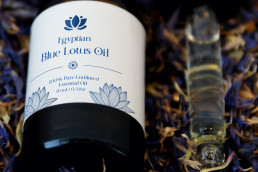
If you have ever stood over a half-empty bottle of jojoba wondering how many drops of blue lotus absolute to add, this page is for you. Consider it a working blue lotus oil dosage calculator: a set of clear formulas, drop-to-millilitre conversions, and dilution tables that tell you exactly how much oil to use for face serums, body blends, bath soaks, inhalers, and diffusers. The maths is simple once you know the rules, and the rules matter because blue lotus absolute is concentrated, expensive, and worth respecting.
Table of Contents
- The Core Formula Every Dilution Calculation Relies On
- The Quick-Reference Drop Chart
- Matching the Dilution to the Application
- Face and Delicate Skin: 0.5 to 1 Percent
- Body Massage and General Use: 2 to 3 Percent
- Targeted or Acute Use: 3 to 5 Percent
- Bath Use: 4 to 8 Drops in a Dispersant
- Diffuser Use: 2 to 4 Drops
- Inhaler Sticks: 10 to 15 Drops
- Using This as a Working Blue Lotus Oil Dosage Calculator
- Step One: What Is the Application?
- Step Two: What Is the Carrier Volume?
- Step Three: Apply the Formula
- Why Precision Matters With Blue Lotus Absolute
- Common Dosage Mistakes and How to Avoid Them
- Counting Drops From a Thick Absolute
- Not Accounting for Multiple Oils in a Blend
- Confusing Absolute With Essential Oil Dilutions
- Ignoring Carrier Oil Character
- When the Calculator Does Not Apply
- Sample Protocols With the Maths Worked Out
- Nightly Face Serum (1 Percent)
- Evening Body Oil (2 Percent)
- Menstrual Abdomen Rollerball (3 Percent)
- Evening Bath Soak (6 Drops)
- Diffuser Session (3 Drops)
- Frequently Asked Questions
- Where to Go From Here
- Blend With Genuine Egyptian Absolute
It is written and clinically reviewed by Antonio Breshears, ND, CCA, a Bastyr-trained naturopathic doctor and certified clinical aromatherapist. For a broader grounding in the oil itself, its chemistry, and its uses, see The Complete Guide to Blue Lotus Oil, which sits above this article as the master reference.
The Core Formula Every Dilution Calculation Relies On
Every aromatherapy dosage calculation rests on one simple relationship: the percentage of essential oil in the finished blend. You decide what percentage is appropriate for the application, and the maths follows.
The standard industry figure is that 1 millilitre of essential oil contains roughly 20 drops from a standard orifice reducer. Viscosity varies, and blue lotus absolute is thicker than most oils, so in practice you may get 18 to 22 drops per millilitre depending on temperature. For calculation purposes, 20 drops per millilitre is the working number used across aromatherapy literature.
The master formula is:
Drops of blue lotus oil = (Carrier volume in ml) × (Desired percentage) × 20 ÷ 100
Or, put more simply, for every 10 ml of carrier oil, a 1 percent dilution is 2 drops, a 2 percent dilution is 4 drops, and a 3 percent dilution is 6 drops. Once you internalise that pattern, every other calculation is scaling.
The Quick-Reference Drop Chart
Here is the chart most aromatherapists keep pinned to the inside of a cupboard door. Read the row for your carrier volume, then read across for the drop count at the dilution you want.
- 5 ml carrier: 0.5 percent is 0.5 drops (round to 1), 1 percent is 1 drop, 2 percent is 2 drops, 3 percent is 3 drops, 5 percent is 5 drops.
- 10 ml carrier: 0.5 percent is 1 drop, 1 percent is 2 drops, 2 percent is 4 drops, 3 percent is 6 drops, 5 percent is 10 drops.
- 15 ml carrier: 1 percent is 3 drops, 2 percent is 6 drops, 3 percent is 9 drops, 5 percent is 15 drops.
- 30 ml carrier: 1 percent is 6 drops, 2 percent is 12 drops, 3 percent is 18 drops, 5 percent is 30 drops.
- 50 ml carrier: 1 percent is 10 drops, 2 percent is 20 drops, 3 percent is 30 drops, 5 percent is 50 drops.
- 100 ml carrier: 1 percent is 20 drops, 2 percent is 40 drops, 3 percent is 60 drops, 5 percent is 100 drops.
If your carrier volume is not on the chart, use the master formula. It works for any container size.
Matching the Dilution to the Application
The right percentage depends entirely on where the blend is going and how often you will use it. Blue lotus absolute sits comfortably across a fairly wide range of dilutions, but each application has its own appropriate window.
Face and Delicate Skin: 0.5 to 1 Percent
Facial skin, the neck, and the area behind the ears are thinner, more reactive, and more permeable than the rest of the body. A dilution of 0.5 to 1 percent is almost always sufficient here, and it is the range I recommend for nightly use in a facial serum. In a 30 ml bottle of jojoba or squalane, that is 3 to 6 drops of blue lotus. Any more and you are spending money without therapeutic advantage, because the skin cannot use more than it can absorb.
Body Massage and General Use: 2 to 3 Percent
For body oils intended for daily or near-daily use, 2 to 3 percent is the standard aromatherapy window. In a 30 ml massage blend, that is 12 to 18 drops of blue lotus. This concentration is high enough to be genuinely aromatic and therapeutically active, but low enough that repeated application does not overwhelm the skin.
Targeted or Acute Use: 3 to 5 Percent
For short-term, targeted application to a specific area (a pulse point, a tense shoulder, a cramped lower abdomen during menstruation), you can push the dilution to 3 to 5 percent. In a 10 ml rollerball, that is 6 to 10 drops. This is not a concentration to use all over, nor to use for weeks on end; it is for acute situations where you want a stronger olfactory and dermal signal.
Bath Use: 4 to 8 Drops in a Dispersant
Essential oils do not dissolve in water. Dropping neat oil into a bath causes it to float on the surface in concentrated spots that can irritate skin. Always pre-blend 4 to 8 drops of blue lotus into a tablespoon of dispersant (full-fat milk, cream, a teaspoon of castile soap, or a carrier oil like jojoba) before adding to the bath. The dispersant breaks the oil into small enough particles that it distributes through the water rather than sitting in slicks.
Diffuser Use: 2 to 4 Drops
For an ultrasonic diffuser of standard 100 to 150 ml capacity, 2 to 4 drops of blue lotus absolute is enough to scent a medium-sized room. Because the absolute is thick, warming the bottle in your hands for a minute before dispensing helps the drops fall cleanly. Diffuse for 30 to 60 minutes at a time rather than running continuously; olfactory fatigue sets in quickly, and beyond an hour you stop noticing the scent anyway.
Inhaler Sticks: 10 to 15 Drops
A personal aromatherapy inhaler with a cotton wick is a closed system; none of the oil touches your skin, and very little reaches your lungs directly. For inhaler sticks, 10 to 15 drops of blue lotus onto the wick is the appropriate loading. This will remain aromatic for weeks to months depending on how often you open and use it.
Using This as a Working Blue Lotus Oil Dosage Calculator
To turn this article into a genuine dosage calculator, work through the three questions below in order. The answers will tell you exactly how many drops to use.
Step One: What Is the Application?
Is this a face serum, a body oil, a targeted rollerball, a bath, a diffuser session, or an inhaler? Match it to the section above and note the recommended percentage range.
Step Two: What Is the Carrier Volume?
Measure the carrier oil you are working with in millilitres. If you are filling an empty 30 ml bottle, your carrier volume is roughly 28 ml once you leave headspace for the blue lotus. For rough calculations, use the labelled bottle size.
Step Three: Apply the Formula
Multiply the carrier volume by the percentage you chose, multiply that by 20, and divide by 100. The answer is your drop count. Round up or down to the nearest whole drop.
Worked example: you want a 2 percent body oil in a 50 ml bottle of sweet almond oil. The calculation is 50 × 2 × 20 ÷ 100, which gives 20 drops. That is your blue lotus dosage for that bottle.
Second worked example: you want a 1 percent face serum in a 15 ml squalane bottle. The calculation is 15 × 1 × 20 ÷ 100, which gives 3 drops. Three drops in 15 ml is a perfectly calibrated nightly serum.
Why Precision Matters With Blue Lotus Absolute
Blue lotus absolute is not a casual oil. It takes 3,000 to 5,000 flowers to produce a single gram, which is why a few millilitres cost what they do. At a 5 percent dilution, a single 30 ml body oil uses 30 drops, or roughly 1.5 ml of absolute; at a 1 percent dilution, the same bottle uses 6 drops, or about 0.3 ml. The difference between using the oil correctly and using it excessively can be five-fold in cost with no five-fold gain in effect.
There is also a physiological ceiling. Above about 3 percent on the body and 1 percent on the face, the skin’s capacity to absorb and respond plateaus. Higher concentrations increase the risk of sensitisation, which is the immune system learning to recognise a compound as an irritant and responding to it thereafter. Once sensitisation develops to an essential oil, it tends to be permanent. Careful dilution is the single most effective way to prevent it.
Common Dosage Mistakes and How to Avoid Them
Counting Drops From a Thick Absolute
Blue lotus absolute is viscous, especially when cool. Drops from a cold bottle may be larger than standard 0.05 ml drops, throwing off your calculation. Warm the bottle in your hands for 60 to 90 seconds before dispensing, and count drops slowly. If a drop hangs and breaks into a fat droplet, count it as 1.5 drops and adjust.
Not Accounting for Multiple Oils in a Blend
If you are blending blue lotus with frankincense, rose, or sandalwood, the total essential oil percentage is what matters for safety, not each individual oil. A 3 percent body oil can contain 1 percent blue lotus plus 2 percent of other oils, or any other combination. Add the percentages; do not stack them.
Confusing Absolute With Essential Oil Dilutions
Some sources quote dilutions specifically for steam-distilled essential oils, which behave slightly differently from solvent-extracted absolutes. For blue lotus, which is almost always sold as an absolute, the dilutions above are appropriate. If you have a rare steam-distilled blue lotus essential oil, the same percentages apply as a starting point.
Ignoring Carrier Oil Character
The carrier matters. Jojoba is shelf-stable and light; sweet almond is richer; fractionated coconut is thin and quick-absorbing; rosehip is active in its own right. The dilution percentage is the same across all of them, but the feel of the finished blend is different. For facial use, jojoba or squalane. For body, sweet almond or jojoba. For rollerballs that travel, fractionated coconut.
When the Calculator Does Not Apply
There are situations where standard dilution calculations are not the right framework. Pregnancy and breastfeeding are the clearest: blue lotus is avoided entirely in these periods regardless of dilution, because the alkaloid profile (aporphine, nuciferine) has not been studied for foetal or infant safety, and prudence demands caution. No dosage is the correct dosage in pregnancy.
Children under twelve should not receive blue lotus at any concentration without professional aromatherapy guidance. The aporphine and nuciferine content interacts with developing neurochemistry in ways we do not fully understand.
Anyone on dopaminergic medications, MAOIs, or significant sedatives should speak to a prescribing clinician before using blue lotus even at low dilutions, because the oil’s alkaloids have measurable, if modest, activity at these same receptor systems. The dosage calculator tells you how to dilute the oil; it does not tell you whether the oil is appropriate for you, which is a separate question and a clinical one.
Sample Protocols With the Maths Worked Out
Nightly Face Serum (1 Percent)
In a 30 ml amber glass dropper bottle: 28 ml of jojoba or squalane, 6 drops of blue lotus absolute. Apply 3 to 4 drops to clean, slightly damp skin at night. One bottle lasts 6 to 8 weeks with nightly use.
Evening Body Oil (2 Percent)
In a 100 ml bottle: 98 ml of sweet almond oil, 40 drops of blue lotus absolute. Apply a teaspoon to shoulders, décolletage, and lower back after a shower. One bottle lasts 4 to 6 weeks.
Menstrual Abdomen Rollerball (3 Percent)
In a 10 ml rollerball: 9.5 ml of fractionated coconut oil, 6 drops of blue lotus absolute. Roll across the lower abdomen and lower back as needed during menstrual discomfort. Use for 5 to 7 days per cycle, not daily.
Evening Bath Soak (6 Drops)
Pre-blend 6 drops of blue lotus absolute into 1 tablespoon of full-fat cream or jojoba oil, then swirl into a drawn bath. Soak for 20 minutes. Use 1 to 3 times per week.
Diffuser Session (3 Drops)
In a standard 100 to 150 ml ultrasonic diffuser: 3 drops of blue lotus absolute, run for 45 minutes in the evening. Repeat as desired.
Frequently Asked Questions
How many drops of blue lotus oil are in 1 ml?
Approximately 20 drops per millilitre from a standard orifice reducer, though viscosity and temperature can shift this to 18 to 22 drops. For calculation purposes, use 20.
What is the safest dilution for daily use?
For daily body use, 2 percent is the sweet spot: effective, economical, and unlikely to sensitise. For daily facial use, 0.5 to 1 percent.
Can I apply blue lotus oil neat?
No. Blue lotus absolute should always be diluted in a carrier oil or dispersant before skin contact. Neat application increases the risk of sensitisation and wastes expensive oil without therapeutic benefit.
How do I calculate dilution for a blend with multiple oils?
Add the percentages of every essential oil in the blend together. The total should stay within the appropriate window for the application, for example 3 percent total for a body oil. Individual oils contribute to the total rather than stacking.
What happens if I use too much blue lotus oil?
The main risks are skin sensitisation over time, olfactory fatigue (you stop smelling it), and simple financial waste. Acute toxicity from topical over-application is unlikely at reasonable cosmetic concentrations, but chronic over-use is the common pitfall.
How much blue lotus oil goes in a 10 ml rollerball?
For a 2 percent dilution: 4 drops. For 3 percent: 6 drops. For 5 percent targeted use: 10 drops. Fill the rest with a carrier like fractionated coconut or jojoba.
How many drops for a diffuser?
Two to four drops in a standard 100 to 150 ml ultrasonic diffuser, run for 30 to 60 minutes rather than continuously.
Does the drop count change for different carrier oils?
No. The drop count depends on the carrier volume and the desired percentage, not on which carrier oil you use. The feel and shelf life of the blend will vary with carrier choice, but the maths does not.
How do I measure drops if my bottle has no dropper?
Use a glass pipette or a standard pharmacy dropper calibrated to 20 drops per millilitre. Avoid plastic pipettes, which can degrade in contact with absolutes. A small measuring syringe that reads in 0.1 ml increments is the most accurate option for larger batches.
Can I double the dose if I do not feel the effect?
Doubling the concentration rarely doubles the effect and often worsens it, because olfactory receptors fatigue quickly. If a blend is not working after consistent use, consider whether the application, the timing, or the underlying issue needs a different approach, not a stronger blend.
Where to Go From Here
The dilution maths is the easy part; choosing the right application for your goal is the harder, more interesting question. If you want the full picture of what blue lotus absolute does, how it is produced, and where it fits in a considered apothecary, The Complete Guide to Blue Lotus Oil is the reference to read next. Keep this dosage page bookmarked; it will answer the same question reliably every time you blend.

Antonio Breshears
Antonio Breshears is a renowned expert in holistic medicine and beauty, with over 25 years of research experience dedicated to uncovering the secrets of nature's most powerful remedies. Holding a degree in Naturopathic Medicine, Antonio's passion for healing and well-being has driven him to explore the intricate connections between mind, body, and spirit.
Over the years, Antonio has become a respected authority in the field, helping countless individuals discover the transformative power of plant-based therapies, including essential oils, herbs, and natural supplements. He has authored numerous articles and publications, sharing his wealth of knowledge with a global audience seeking to improve their overall health and well-being.
Antonio's expertise extends to the realm of beauty, where he has developed innovative, all-natural skincare solutions that harness the potency of botanical ingredients. His formulations embody his deep understanding of the healing properties found in nature, providing holistic alternatives for those seeking a more balanced approach to self-care.
With his extensive background and dedication to the field, Antonio Breshears is a trusted voice and guiding light in the world of holistic medicine and beauty. Through his work at Pure Blue Lotus Oil, Antonio continues to inspire and educate, empowering others to unlock the true potential of nature's gifts for a healthier, more radiant life.
Related Guides
COA Required for Cosmetic Batch Record Blue Lotus Oil: 2026
COA Required for Cosmetic Batch Record Blue Lotus Oil—what to verify: identity,…