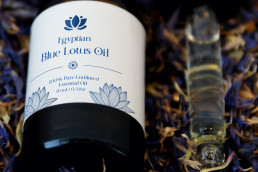
Tantric practice asks something specific of the nervous system: a quality of embodied presence where arousal, awareness, and reverence can coexist without any of them dominating. Blue lotus oil has earned a place in this work for reasons that are both historical and physiological, and this guide examines the blue lotus oil tantric pairing honestly, covering what the oil actually does, how to use it in solo and partner practice, and where its usefulness ends.
Table of Contents
- What Tantric Practice Actually Is
- How Blue Lotus Oil Helps With Tantric Practice
- Parasympathetic Softening Without Sedation
- Mild Mood Elevation and Inhibition Softening
- Scent as Ritual Anchor
- How to Use Blue Lotus Oil for Tantric Practice
- Solo Practice: Anointing Protocol
- Partner Practice: Shared Anointing
- Diffusion for Ritual Space
- On Direct Genital Application
- What to Expect: Realistic Timeframes
- When Blue Lotus Oil Is NOT the Right Choice
- Complementary Approaches
- Frequently Asked Questions
- Where to Go From Here
- Begin Your Ritual Practice
It is written and clinically reviewed by Antonio Breshears, ND, CCA, a Bastyr-trained naturopathic doctor and certified clinical aromatherapist. For broader context on the oil’s chemistry, history, and safe use, readers may want to start with The Complete Guide to Blue Lotus Oil, which serves as the master reference for the topics touched on here.
What Tantric Practice Actually Is
Before discussing how any botanical supports tantra, it helps to strip the term back to something workable. Tantra, in its original Sanskrit and Tibetan sources, refers to a vast body of contemplative practice that treats the body, the senses, and sexual energy as legitimate vehicles for spiritual development rather than obstacles to it. Classical tantric traditions include elaborate visualisation, mantra, breathwork, subtle-body mapping (nadis, chakras, bindus), and in some lineages, partnered sexual ritual conducted within a strict ethical and contemplative frame.
What most modern Westerners mean by “tantra” is typically a simplified descendant: neo-tantra, which emphasises slow, conscious intimacy; eye-gazing; synchronised breathing; sustained presence; and the deliberate cultivation of arousal without a goal-driven rush toward climax. Both the classical and the modern forms share a common thread, which is the cultivation of a nervous system state that is alert, soft, embodied, and unhurried. This is the state blue lotus oil can genuinely support, and it is useful to be precise about that rather than making vague claims about “sacred sexuality”.
How Blue Lotus Oil Helps With Tantric Practice
The oil’s contribution to tantric work rests on three reasonably well-attested mechanisms. None of them are dramatic in isolation. Together, and in the context of deliberate practice, they shift the ground subtly in useful directions.
Parasympathetic Softening Without Sedation
The olfactory-limbic pathway is the fastest route between an external molecule and the emotional brain. A scent enters the nose, binds olfactory receptors, and reaches the amygdala and hypothalamus within seconds, before any conscious appraisal. Blue lotus oil, inhaled at low concentration, tends to nudge the autonomic nervous system toward parasympathetic dominance, which is the “rest and digest” branch responsible for slower heart rate, softer breathing, easier digestion, and, importantly for tantric work, the physiological substrate of genuine sexual responsiveness. Arousal that arises from a sympathetic (stressed, goal-driven) state tends to be fast, genital-focused, and shallow. Arousal that arises from parasympathetic softness tends to be diffuse, whole-body, and sustainable. Blue lotus does not force this shift; it simply makes it slightly easier to access.
Mild Mood Elevation and Inhibition Softening
The oil contains aporphine, a weak dopamine agonist, and nuciferine, which shows activity at serotonin 5-HT2A and 5-HT2C receptors alongside weak dopamine antagonism. The net psychological effect that people report is a gentle euphoric warmth, a softening of self-criticism, and a slight lowering of the internal commentary that often interferes with erotic and contemplative states. This is not intoxication. It is closer to the quality of ease one might feel after a good meal with a trusted friend. In tantric practice, where self-consciousness is often the primary obstacle, this modest easing of the critical mind is genuinely useful.
Scent as Ritual Anchor
The third mechanism is less pharmacological and more behavioural, but it matters. A distinctive scent, used consistently at the beginning of practice, becomes a conditioned cue. Over weeks and months, the nervous system learns to associate the honeyed, aquatic-floral profile of blue lotus with the state of presence that follows. Eventually the scent itself begins to elicit the state, which is classical associative learning applied to contemplative work. This is why temple traditions across cultures have used dedicated ritual oils for millennia. The chemistry helps, but the conditioning compounds the effect.
How to Use Blue Lotus Oil for Tantric Practice
The following protocols are starting points rather than prescriptions. Tantric practice is personal, and the oil should serve the practice, not dominate it. Begin with less than you think you need; the scent is deep, and the reference dose for this kind of work is smaller than most people expect.
Solo Practice: Anointing Protocol
For solo meditation, subtle-body work, or self-pleasuring practices framed contemplatively, a simple five-point anointing ritual works well. Dilute blue lotus oil to 2 percent in a neutral carrier (jojoba is ideal because it has effectively no scent of its own and will not interfere). That works out to roughly 12 drops of blue lotus oil per 30 ml of jojoba. Before practice, with clean hands and unhurried attention, apply a small amount to:
- The centre of the chest, over the sternum
- The inside of each wrist
- The nape of the neck, just below the hairline
- A small amount on the lower abdomen, below the navel
- Very lightly on the temples (avoiding the eyes)
Each application is done slowly, with a moment of attention on the area being anointed. The ritual itself, not only the oil, is the point. This takes about two minutes and primes the nervous system for what follows.
Partner Practice: Shared Anointing
For partnered work, the same 2 percent dilution can be used, with partners anointing one another rather than themselves. Shared anointing is a ritual act in its own right and tends to dissolve the habitual boundary between “preparation” and “practice”. Begin facing one another, seated comfortably, with a small dish of the diluted oil between you. Each partner takes a turn applying to the other’s chest, wrists, and nape while maintaining eye contact. Speech is optional and often unnecessary. Allow around five to ten minutes for this stage before moving into whatever form of practice you have agreed upon (synchronised breath, eye-gazing, or extended intimacy).
Diffusion for Ritual Space
For creating an atmospheric anchor in a dedicated practice space, 3 to 4 drops of undiluted blue lotus oil in an ultrasonic diffuser, run for 20 to 30 minutes before practice begins, is sufficient. Turn the diffuser off before you start, or keep it running on a very low setting; the aim is a scent presence, not a sensory assault. Over time, this conditions the space itself.
On Direct Genital Application
Some traditions describe anointing of the yoni or lingam in ritual context. I would urge caution here. Mucous membranes are significantly more permeable than skin elsewhere on the body, and even well-diluted essential oils can cause irritation in these tissues. If you choose to work this way, the dilution should be no stronger than 0.5 to 1 percent in a well-tolerated carrier (jojoba or fractionated coconut), a patch test on a small area should be done first, and the ritual should be approached with the understanding that any burning, stinging, or irritation means stopping immediately and washing the area with plain carrier oil, not water. Many experienced practitioners keep the oil to the outer pelvis, lower abdomen, and inner thighs rather than direct mucosal contact, which gives much of the effect with none of the risk.
What to Expect: Realistic Timeframes
On the first use, most people notice a pleasant softening of mood within five to ten minutes of inhalation, a subtle warmth in the chest and abdomen, and a slight lowering of the internal chatter that ordinarily fills the mind. These effects are modest rather than dramatic. Anyone expecting an entheogenic-grade experience will be disappointed; blue lotus is not that kind of substance. Its gifts are quieter.
With consistent use over three to six weeks, the conditioned-cue effect begins to mature. Practitioners often report that the scent alone, even before the practice begins, starts to elicit a settling in the body. Partner rapport, for those using it in shared work, tends to deepen in parallel, partly because the ritual itself creates structured attention to one another that modern life rarely provides.
What the oil will not do is manufacture desire where none exists, repair relational ruptures, resolve trauma, or substitute for the actual work of tantric practice. It is an adjunct. The practice does the work; the oil makes the ground slightly more hospitable.
When Blue Lotus Oil Is NOT the Right Choice
There are circumstances in which I would specifically advise against using blue lotus oil in tantric or intimate contexts:
- Pregnancy and breastfeeding. The oil has not been adequately studied in these populations and should be avoided.
- Current use of dopaminergic medication, MAOIs, or significant sedatives. Blue lotus has measurable activity at dopamine and serotonin receptors, and while the effect from topical and inhaled use is modest, combining it with pharmaceutical agents acting on the same systems is not advisable without explicit medical clearance.
- Active sexual trauma processing. If one or both partners are in the acute phase of trauma work, a substance that softens inhibition is not what is called for. Trauma integration requires a particular kind of conscious, titrated engagement that pharmacological softening can actually undermine. Work with a trauma-informed therapist first; introduce ritual oils later, once the ground is stable.
- As a substitute for consent, communication, or sobriety. Any botanical that softens inhibition raises ethical considerations in partnered intimate work. Consent conversations need to happen before the oil is applied, not after, and both partners should be in a state to give and receive clear communication throughout.
- Known sensitivity. A small number of people have idiosyncratic reactions to blue lotus, ranging from mild headache to a dysphoric rather than pleasant shift in mood. If this is your experience, trust it.
Complementary Approaches
Blue lotus oil is one input into tantric practice and not the most important one. The ground on which the oil acts is built from other practices, and it is worth naming them briefly.
Breath work is foundational. Slow, diaphragmatic breathing at roughly six breaths per minute is, on its own, a potent parasympathetic intervention. The oil amplifies what breath establishes. Without the breath, the oil has less to work with.
Consistent practice time matters more than any accessory. A daily 15-minute sit, whether meditative or sensory, builds the capacity that partnered tantric work draws on. Irregular, occasional practice with elaborate ritual accoutrements tends to yield less than simple, consistent practice with minimal props.
Physical environment. Warm room, clean space, absence of screens, candlelight rather than overhead lighting. The oil is one sensory input among several; the others either support it or compete with it.
Other botanical adjuncts. Damiana tea, cacao (in small ritual quantities), and rose absolute all pair well with blue lotus in different contexts. Blue lotus and rose together, at very low dilution, produce a scent profile that most people find genuinely conducive to opening.
Professional support when needed. A somatic therapist, a pelvic floor physiotherapist for those with physical concerns, or a sex-positive relationship counsellor are all resources that do work blue lotus cannot touch. If the obstacles to tantric practice are primarily psychological or relational, address them at that level rather than hoping an oil will bypass the issue.
Frequently Asked Questions
Is blue lotus oil an aphrodisiac?
It has a mild reputation as one, and the chemistry supports a modest effect: parasympathetic softening plus subtle dopaminergic activity creates conditions favourable to relaxed arousal. It is not a pharmaceutical aphrodisiac, and it will not produce desire in someone not already inclined. Think of it as removing obstacles rather than generating drive.
Can I apply blue lotus oil directly to the skin for tantric practice?
Not neat. Always dilute to 2 percent (roughly 12 drops per 30 ml of carrier) for general body application, and to 0.5 to 1 percent if anywhere near mucous membranes. Jojoba is the best carrier because it does not interfere with the scent.
How long before practice should I apply the oil?
Apply 5 to 15 minutes before beginning. This gives time for the initial olfactory shift to settle and for the application ritual itself to start softening the nervous system.
Will blue lotus oil cause any psychoactive effect strong enough to impair consent?
Used topically and by inhalation at the doses described, no. The effect is subtle mood-softening comparable to a cup of chamomile tea, not intoxication. Ingestion (which I do not recommend for this purpose) is a different matter and raises different concerns. For topical and diffused ritual use, consent capacity is not meaningfully affected.
Can both partners use the oil, or only one?
Both, ideally. Shared anointing is part of the ritual, and the conditioning effect builds for both partners when both participate.
Does the oil stain sheets or clothing?
Blue lotus absolute, particularly the dark-amber solvent-extracted version, can stain lighter fabrics. Dilute well, apply sparingly, and allow a minute for absorption before contact with light-coloured textiles.
Can I use blue lotus oil in a bath for partnered practice?
Yes, with care. Add 4 to 6 drops to a tablespoon of full-fat milk, honey, or carrier oil first (essential oils do not disperse in water and will float as an undiluted layer, which can irritate skin), then add the mixture to a drawn bath. Test the water with a hand before fully submerging.
How do I store the oil to preserve it for long-term ritual use?
In its dark glass bottle, cap tight, in a cool dark place away from direct light and temperature swings. Stored well, the absolute holds for three to four years. A ritual oil is ideally kept in a dedicated place used only for practice; this supports the conditioning effect.
Is it safe to combine with cannabis or alcohol in a ritual setting?
I would not combine it with alcohol in any meaningful quantity, and I am cautious about cannabis combinations as well. Cannabis in particular can amplify the subjective shift in ways that move beyond the subtle territory where blue lotus is most useful, and the combined effect on consent capacity is more significant than either alone. If you choose to combine, keep doses of everything low and prioritise communication.
How much should I expect to use per session?
Very little. Two to four drops of the 2 percent diluted blend is typically enough for a full anointing. The oil is concentrated, and more is not better.
Where to Go From Here
Tantric practice is a long path, and blue lotus oil is a modest but genuine companion for parts of it. If you are new to the oil itself, the broader context in The Complete Guide to Blue Lotus Oil will ground what is covered here in chemistry, history, and general safety. If you are new to tantric practice, the oil is worth introducing only after a basic breath and attention practice is established, which usually takes a few weeks of consistent daily sitting. Start small, practice consistently, and allow the oil to become one thread in a richer contemplative fabric rather than the whole garment.

Antonio Breshears
Antonio Breshears is a renowned expert in holistic medicine and beauty, with over 25 years of research experience dedicated to uncovering the secrets of nature's most powerful remedies. Holding a degree in Naturopathic Medicine, Antonio's passion for healing and well-being has driven him to explore the intricate connections between mind, body, and spirit.
Over the years, Antonio has become a respected authority in the field, helping countless individuals discover the transformative power of plant-based therapies, including essential oils, herbs, and natural supplements. He has authored numerous articles and publications, sharing his wealth of knowledge with a global audience seeking to improve their overall health and well-being.
Antonio's expertise extends to the realm of beauty, where he has developed innovative, all-natural skincare solutions that harness the potency of botanical ingredients. His formulations embody his deep understanding of the healing properties found in nature, providing holistic alternatives for those seeking a more balanced approach to self-care.
With his extensive background and dedication to the field, Antonio Breshears is a trusted voice and guiding light in the world of holistic medicine and beauty. Through his work at Pure Blue Lotus Oil, Antonio continues to inspire and educate, empowering others to unlock the true potential of nature's gifts for a healthier, more radiant life.