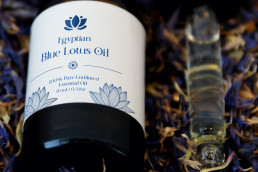
If you have arrived here searching for blue lotus oil for women, you are probably weighing it for one of four reasons: hormonal mood shifts across the cycle, painful or tense periods, skin that changes with hormones, or a quieter but equally real interest in libido and sensual presence. This article addresses each of those specifically, with honest protocols, realistic timeframes and clear limits, so you can decide whether Nymphaea caerulea belongs in your personal ritual or whether a different tool will serve you better.
Table of Contents
- What Blue Lotus Oil Actually Is
- How Blue Lotus Oil Helps With Women's Wellbeing
- Cyclical mood and premenstrual tension
- Period cramps and pelvic tension
- Skin changes across the cycle
- Libido, sensual presence and the nervous system
- How to Use Blue Lotus Oil for Women's Concerns
- Premenstrual mood support
- Period cramp and lower-back tension
- Hormonal skin as part of a facial ritual
- Sensual ritual and intimacy
- What to Expect: Realistic Timeframes
- When Blue Lotus Oil Is Not the Right Choice
- Complementary Approaches for Each Concern
- Frequently Asked Questions
- Where to Go From Here
- Ritual-Grade Blue Lotus for Women
It is written and clinically reviewed by Antonio Breshears, ND, CCA, a Bastyr-trained naturopathic doctor and certified clinical aromatherapist. For the broader chemistry, sourcing and safety background referenced throughout, see The Complete Guide to Blue Lotus Oil, which is the master reference for everything discussed here in condensed form.
What Blue Lotus Oil Actually Is
Blue lotus oil is an aromatic extract of the Egyptian blue water lily, Nymphaea caerulea. Most commercial bottles labelled “oil” are technically absolutes, extracted using food-grade solvents because the flower’s delicate aromatic molecules do not survive steam distillation well. A smaller number of bottles are true steam-distilled essential oils or supercritical CO2 extracts. All three contain the same core constituents in different proportions: aporphine and nuciferine (two alkaloids with mild activity at dopamine and serotonin receptors), plus the flavonoids apigenin, quercetin and kaempferol, which carry calming and anti-inflammatory action.
It takes between 3,000 and 5,000 flowers to produce a single gram of absolute. That yield ratio explains both the price and the reputation: this is a concentrated, precious material, not a casual commodity oil. For women considering it as part of a wellbeing routine, that concentration means a little goes a long way and proper dilution is non-negotiable.
How Blue Lotus Oil Helps With Women’s Wellbeing
There are four distinct areas where blue lotus oil for women earns its place, and they rest on different mechanisms. Treating them as one undifferentiated “women’s oil” obscures what it is actually doing.
Cyclical mood and premenstrual tension
The flavonoid apigenin binds to the central benzodiazepine site on the GABA-A receptor, producing a mild anxiolytic effect without the heavy sedation of pharmaceutical agents. In the premenstrual window, when progesterone withdrawal can leave women feeling raw, irritable or tearful, this gentle GABAergic nudge is genuinely useful. It will not abolish PMS, but it can soften the edge of the week before menstruation so you feel less hijacked by it.
Period cramps and pelvic tension
Dysmenorrhoea has two components: uterine contraction driven by prostaglandins, and the muscular guarding that accumulates in the lower back, hips and abdomen across a painful day. Blue lotus oil does not meaningfully reduce prostaglandin synthesis, so it is not a direct analgesic for cramping in the way ibuprofen is. What it does well is support the parasympathetic shift needed for muscles to actually release, and its warming, grounding aroma pairs beautifully with heat application and gentle abdominal massage.
Skin changes across the cycle
Hormonal skin is rarely one thing. The luteal phase can bring oilier, more reactive skin with breakouts along the jaw; the follicular phase often feels plumper and more luminous; perimenopause introduces dryness and thinning. The flavonoids in blue lotus offer modest anti-inflammatory and antioxidant support, and the oil is non-comedogenic when properly diluted. It will not replace a thoughtful skincare routine or clinical treatment for cystic acne, but as a facial oil component it calms redness and supports barrier function.
Libido, sensual presence and the nervous system
The historical reputation of blue lotus as an aphrodisiac in ancient Egypt is more about nervous system state than any direct hormonal action. Libido in women is highly context-dependent and requires a parasympathetic, safe, unhurried state to emerge. Blue lotus oil’s aromatic effect on the olfactory-limbic pathway supports exactly that shift from vigilant to receptive. Think of it as setting the stage rather than pulling a lever.
How to Use Blue Lotus Oil for Women’s Concerns
Below are specific protocols for each use case. In every instance, the oil is diluted in a carrier; neat application to skin is not appropriate for an absolute of this potency.
Premenstrual mood support
Begin roughly five to seven days before your period is due, timed to the luteal window when symptoms typically emerge. A simple evening protocol: add 2 to 4 drops of blue lotus oil to a diffuser filled with water, run it for 20 to 30 minutes in the room you wind down in. Alternatively, blend 1 to 2 percent in a carrier such as jojoba (that is roughly 6 to 12 drops per 30 ml) and apply to wrists, behind the ears and over the heart in the evening. Pair with slower breathing; the oil’s effect is amplified when the nervous system is invited into parasympathetic activity rather than ambushed by it.
Period cramp and lower-back tension
For abdominal massage, make a 3 percent dilution (roughly 18 drops of blue lotus oil in 30 ml of a warming carrier such as sesame or sweet almond). You can blend it with other well-indicated oils such as clary sage or marjoram for a more targeted cramp-easing formulation. Warm the oil between your palms, then massage clockwise over the lower abdomen and into the lower back and sacrum. Apply a hot water bottle or warm compress afterwards. Repeat two to three times across a painful day. This is adjunctive; it pairs with, rather than replaces, an NSAID when one is appropriate.
Hormonal skin as part of a facial ritual
For facial use, keep dilution at 1 percent, which is roughly 6 drops per 30 ml of a light, non-comedogenic carrier such as jojoba or squalane. Apply a few drops to clean, slightly damp skin in the evening, pressing rather than rubbing it in. If you are prone to luteal-phase breakouts, do not apply it directly to active cystic lesions; use it around them to support surrounding skin calmness. Consistent use across three to four cycles gives a fair read on whether it suits your skin.
Sensual ritual and intimacy
For bedroom or bath use, a 2 percent body-oil dilution on pulse points, the inner wrists, the back of the neck, the sternum, is typically enough. A few drops on a scarf or pillowcase also works if direct skin application is not wanted. Avoid mucous membranes entirely. The point is ambient scent and nervous system quieting; more oil does not equal more effect, and can quickly tip into headache territory with an absolute this dense.
What to Expect: Realistic Timeframes
For acute mood or tension use (a diffuser session, an evening rollerball before bed), most women report a perceptible softening within 15 to 30 minutes. It is not dramatic; it is a gentle downshift, closer to the feeling of a long exhale than a sedative hit. If you are expecting benzodiazepine-strength sedation, you will be disappointed, and that disappointment is a sign that blue lotus is not the right tool for what you actually need.
For cyclical premenstrual use, give it two or three full cycles before judging. The effect compounds when the ritual is consistent: the same oil, the same time of day, the same breathing practice, so that the scent itself becomes a cue for the nervous system to settle. This is classical olfactory conditioning working alongside the oil’s chemistry.
For skin, allow six to twelve weeks. Skin turnover and cyclical hormonal variation both mean short trials are unreliable. If you have not noticed any difference after three cycles of consistent use, it is probably not doing enough for your specific skin to justify the cost.
For libido and sensual presence, there is no “timeframe” in the clinical sense. Either the ritual supports the state you want, or it does not. If after three or four uses you have not felt a shift in how you occupy your own body during intimacy, the issue is probably not aromatic and deserves a wider conversation.
When Blue Lotus Oil Is Not the Right Choice
Honesty matters more than marketing here. Blue lotus oil should be avoided in several situations.
- Pregnancy and breastfeeding. The alkaloid profile has not been adequately studied in these populations, and the sensible default is avoidance. This includes attempts to conceive once you are in the second half of the cycle.
- Alongside dopaminergic medication, MAOIs or strong sedatives. The aporphine and nuciferine content interacts at receptors shared by these medications. The interactions are likely mild but have not been formally characterised, so caution is warranted.
- Severe or cystic acne. A facial oil, however gentle, is not the right primary treatment for significant acne. See a dermatologist or a clinician familiar with hormonal acne protocols.
- Heavy menstrual bleeding, suspected endometriosis or fibroids, or any cycle pain severe enough to disrupt your life. These deserve a proper gynaecological workup, not an aromatherapy ritual.
- Low libido with new onset or distress. If the shift is recent, unexplained or causing you genuine unhappiness, it warrants a medical and relational conversation, not a bottle of oil.
Blue lotus oil is an adjunct. It is a supportive, nervous-system-calming, aromatic tool that works alongside proper clinical care when something more serious is going on. It is not a replacement for diagnosis.
Complementary Approaches for Each Concern
Because blue lotus oil is most useful as one element of a broader approach, the following pairings are worth considering.
For premenstrual mood, regular magnesium intake (dietary or supplemental), consistent sleep timing across the cycle and reduced alcohol in the luteal phase all outperform any single aromatic intervention. Blue lotus oil sits on top of those foundations, not in place of them. Clary sage and bergamot are traditional aromatic companions worth exploring.
For period pain, heat, gentle movement, adequate iron status and a considered conversation about anti-inflammatory support form the backbone. Topical blue lotus oil is genuinely helpful as part of the massage and ritual component. If cramps are severe and consistent, ask about endometriosis.
For hormonal skin, sleep, refined-sugar intake, adequate omega-3 fats and appropriate active ingredients (niacinamide, salicylic acid, retinoids where suitable) do the heavy lifting. Blue lotus oil contributes calmness and barrier support, not clearance.
For libido and sensual wellbeing, the factors are almost always contextual: sleep, stress, relationship safety, medication side effects, perimenopausal hormonal shifts. The oil is a stage-setter. The stage itself needs building first.
Frequently Asked Questions
Is blue lotus oil safe to use every day as a woman?
For non-pregnant, non-breastfeeding women not on interacting medications, daily use at appropriate dilution is generally well tolerated. Most women find a cyclical or intentional-ritual approach gives better results than daily use, because the nervous system response stays responsive rather than habituating.
Can blue lotus oil balance my hormones?
No, and be cautious of any product claiming to. Blue lotus oil does not contain phytoestrogens or act directly on the hypothalamic-pituitary-ovarian axis in any clinically meaningful way. What it does is support the nervous system, which indirectly affects how you experience hormonal shifts. That is a different claim and a more honest one.
Will it help with menopausal symptoms like hot flushes?
Not directly. It does not modulate the vasomotor mechanism behind hot flushes. It can help with the anxiety, sleep disruption and irritability that often accompany perimenopause, which is a different and still worthwhile benefit.
Can I use blue lotus oil while trying to conceive?
During the follicular phase and through ovulation, occasional use is unlikely to be problematic, but once you are in the luteal window with any chance of pregnancy, the sensible approach is to pause. If you are actively cycling through fertility treatment, discuss it with your clinician.
Does it affect my birth control?
There is no known interaction between topical or aromatic blue lotus oil and hormonal contraception. Oral or high-dose preparations are a different matter and are not what this article is about.
How does it compare to clary sage for women’s use?
Clary sage has better-characterised action for menstrual cramping and premenstrual mood, and is often the first choice for those specific uses. Blue lotus oil is more about overall nervous system quieting and sensual presence. The two blend well and are not direct competitors; they do different jobs.
Can I use blue lotus oil in the bath?
Yes, but always dispersed in a carrier first (a tablespoon of jojoba, or full-fat milk, or an unscented bath oil base). Four to six drops in a dispersant added to a warm bath is plenty. Neat drops on bath water will float and contact skin undiluted, which is not what you want with an absolute.
Is it safe to use on the belly during painful periods?
Yes, for non-pregnant women, at appropriate dilution (around 3 percent in a warming carrier), abdominal massage with blue lotus oil during menstruation is a well-tolerated ritual. Avoid broken skin and stop if any irritation develops.
Will it make me drowsy during the day?
At typical aromatic or topical doses, no. Blue lotus oil is not a strong sedative. Most women describe a subtle calming effect that is compatible with ordinary daytime function, closer to a moment of quiet than to drowsiness.
How do I know if the oil I am buying is real?
Price is the first honest signal. Genuine Nymphaea caerulea absolute is expensive because of the flower-to-oil ratio. If a 10 ml bottle is priced similarly to lavender, it is almost certainly diluted or synthetic. Look for clear botanical naming, country of origin (Egypt is the authentic source), extraction method and a reputable supplier. Dark glass, sealed packaging and proper labelling are all baseline expectations.
Where to Go From Here
If you have read this far, you probably have a reasonably clear sense already of whether blue lotus oil for women fits what you are actually looking for. For cyclical mood, period ritual, hormonal skin support and sensual presence, it earns a thoughtful place in the cabinet. For anything more serious, cystic acne, severe dysmenorrhoea, suspected endometriosis, new-onset low libido, perimenopausal symptoms that are disrupting your life, please treat this as one layer of support and seek proper clinical care alongside it.
For the underlying chemistry, extraction methods, sourcing and broader safety considerations that inform every protocol above, the master reference is The Complete Guide to Blue Lotus Oil. That is the place to go if you want to understand why the dilutions sit where they do and what you are actually applying to your skin.

Antonio Breshears
Antonio Breshears is a renowned expert in holistic medicine and beauty, with over 25 years of research experience dedicated to uncovering the secrets of nature's most powerful remedies. Holding a degree in Naturopathic Medicine, Antonio's passion for healing and well-being has driven him to explore the intricate connections between mind, body, and spirit.
Over the years, Antonio has become a respected authority in the field, helping countless individuals discover the transformative power of plant-based therapies, including essential oils, herbs, and natural supplements. He has authored numerous articles and publications, sharing his wealth of knowledge with a global audience seeking to improve their overall health and well-being.
Antonio's expertise extends to the realm of beauty, where he has developed innovative, all-natural skincare solutions that harness the potency of botanical ingredients. His formulations embody his deep understanding of the healing properties found in nature, providing holistic alternatives for those seeking a more balanced approach to self-care.
With his extensive background and dedication to the field, Antonio Breshears is a trusted voice and guiding light in the world of holistic medicine and beauty. Through his work at Pure Blue Lotus Oil, Antonio continues to inspire and educate, empowering others to unlock the true potential of nature's gifts for a healthier, more radiant life.