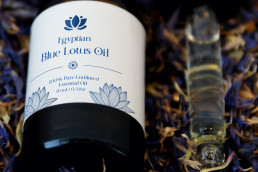
This recipe produces a 100 ml bottle of slow, honeyed, quietly grounding blue lotus massage oil at a 2 percent dilution, suitable for full-body application on healthy adult skin. It is formulated for couples work, long unhurried self-massage, and the kind of evening ritual where the intent is downshift rather than stimulation.
Table of Contents
It is written and clinically reviewed by Antonio Breshears, ND, CCA, a Bastyr-trained naturopathic doctor and certified clinical aromatherapist. If you are new to blue lotus as an aromatic material, the complete guide to blue lotus oil is the better starting point; this article assumes you already have a bottle in hand and want to know precisely what to do with it.
What You Will Need
Equipment first. You do not need a professional apothecary setup, but you do need to be clean and measured. A kitchen that has been wiped down will do.
- One 100 ml dark glass bottle (amber or cobalt) with a pump dispenser or pour cap
- A small glass beaker or measuring jug graduated to millilitres
- A glass stirring rod or stainless steel spoon
- A small funnel
- Optional but recommended: a 0.1 gram digital scale for precision
- Labels and a pen (date and dilution go on the bottle, always)
Ingredients:
- 60 ml sweet almond oil (the body of the blend)
- 30 ml jojoba oil (stability and glide)
- 10 ml fractionated coconut oil (lightness and absorption)
- 40 drops pure blue lotus absolute (Nymphaea caerulea), approximately 2 ml
- Optional: 400 IU vitamin E oil (roughly 4 drops) as a mild antioxidant to extend shelf life
That is the full kit. If you are substituting carriers, read the reasoning below before you deviate, because the carrier choice is not arbitrary.
Why This Formulation Works
The carrier blend is doing real work here. Sweet almond oil gives the massage oil its medium weight and its characteristic slow glide, which is what you want for longer strokes across the back, shoulders, and legs. Jojoba, technically a liquid wax, is chemically stable, resists going rancid, and behaves on skin in a way that closely mirrors human sebum. Fractionated coconut oil lightens the overall texture so the blend does not sit heavily on the skin or stain linens more than necessary. This three-carrier approach gives you a massage oil that feels like something a practitioner would use rather than something improvised from the kitchen cupboard.
The dilution is set at 2 percent, which is the standard recommendation for full-body application on healthy adult skin. Going higher (3 percent or above) is appropriate for targeted work on small areas, but it is unnecessary and wasteful across a full torso and legs, because the olfactory response to blue lotus saturates quickly. The scent profile builds in layers: a cooler floral-aquatic top note reads first, then the deep honeyed-floral heart, and finally a quiet balsamic-smoky base that lingers on skin for hours. At 2 percent the scent is present without being obtrusive, which is the right register for a massage context where the oil is meant to support the experience rather than dominate it.
Step-by-Step Instructions
- Clean and dry your equipment. Water and essential oil formulations do not coexist well; any residual moisture in the bottle or beaker will shorten shelf life and encourage microbial growth.
- Measure 60 ml of sweet almond oil into the beaker. Pour slowly to avoid air bubbles, which make accurate measurement harder.
- Add 30 ml of jojoba oil and 10 ml of fractionated coconut oil. You should now have 100 ml total carrier volume in the beaker.
- Add 40 drops of blue lotus absolute. Count carefully; absolutes are viscous and drops tend to be slightly smaller than standard essential oil drops, so if you have a 0.1 gram scale, weighing approximately 1.8 to 2 grams of blue lotus is more reliable than counting.
- Add 4 drops of vitamin E if using.
- Stir gently for 30 to 45 seconds with a glass rod or stainless spoon. Do not shake vigorously at this stage; you want full integration, not aeration.
- Funnel into your dark glass bottle, cap it, then invert the bottle three or four times to finish blending.
- Label with the date, dilution (2 percent), and ingredients. This is non-negotiable. You will not remember in six months what is in an unmarked amber bottle, and guessing is how people end up using old oils past their best.
- Let it rest for 24 hours before first use, in a cool dark place. The scent integrates and softens noticeably during this rest period.
How to Use the Massage Oil
Warm the oil between your palms before application; cold oil on skin is jarring and works against the parasympathetic downshift you are trying to encourage. For a full-body massage, a total of 15 to 25 ml of oil is typical, which means each 100 ml bottle yields roughly four to six full sessions, or a great many shorter self-massage sessions focused on a single area.
Apply in long, unhurried strokes. Blue lotus is not a circulatory stimulant in the way that rosemary or black pepper are; its character is settling, not activating. Pair the scent with slow breathing and the blend reads coherently. Ideal timing is evening, one to two hours before bed, or as part of a weekend wind-down rather than a pre-work ritual. Avoid applying before driving or operating machinery, because while the sedative effect is modest rather than dramatic, combining it with fatigue or alcohol can produce more drowsiness than expected.
Storage and Shelf Life
Stored in dark glass, capped, in a cool cupboard away from direct light and heat, this blend will hold well for 9 to 12 months. With added vitamin E you can push that to 12 to 15 months. The limiting factor is the sweet almond oil, which is more prone to oxidation than jojoba or fractionated coconut. If the oil begins to smell faintly waxy, crayon-like, or sharp (rather than honeyed and floral), it has oxidised and should be discarded. Refrigeration is not necessary and can cause the blend to cloud; room temperature storage away from a sunny window is ideal.
Variations
Sensitive skin version. Drop the dilution to 1 percent (20 drops of blue lotus in 100 ml) and replace the fractionated coconut oil with an additional 10 ml of jojoba. This produces a gentler blend suitable for first-time users or those with reactive skin. Always patch test on the inner forearm, wait 24 hours, and only proceed if there is no reaction.
Extra calming evening blend. Keep the 2 percent total dilution but split it: 30 drops blue lotus and 10 drops Roman chamomile. The chamomile adds a herbaceous-apple character that deepens the sedative register without overwhelming the blue lotus. Particularly useful for those whose wind-down is being disrupted by a racing mind rather than physical tension.
Richer, more occlusive texture. Replace the 10 ml of fractionated coconut oil with 10 ml of meadowfoam seed oil. This produces a blend with a silkier feel and slightly longer glide, favoured by practitioners doing slow deep-tissue work. It also extends shelf life, as meadowfoam is exceptionally stable.
Warming, sensual variant. Keep the blue lotus at 2 percent but add 4 drops of pink pepper or 6 drops of sandalwood to the blend. Sandalwood in particular harmonises beautifully with blue lotus and extends the base note, producing a massage oil suited to intimate contexts rather than purely therapeutic ones.
Common Mistakes to Avoid
The first mistake is using the wrong grade of blue lotus. Much of what is sold online as blue lotus oil is either heavily diluted in a carrier already (in which case your final dilution is unknowable) or is a synthetic fragrance oil entirely. Neither belongs in a massage oil meant to be applied to large areas of skin. Verify that what you have is a pure solvent-extracted absolute, steam-distilled essential oil, or CO2 extract.
The second mistake is using olive oil or coconut oil (solid) as the main carrier. Olive oil is too heavy and its scent competes with the blue lotus; solid coconut oil has to be melted and re-solidifies at cool room temperature, which makes portioning unreliable.
The third mistake is over-counting drops. Blue lotus absolute is viscous and sticky on a dropper, and it is easy to dispense more than you intended without noticing. If the final blend feels heady, cloying, or gives you a mild headache when you smell it, your dilution is too high. Dilute further by adding more carrier, do not apply it as-is.
The fourth mistake is skipping the label and the rest period. Both matter more than they seem to.
Frequently Asked Questions
Can I use this massage oil during pregnancy?
No. Blue lotus is avoided during pregnancy and breastfeeding due to its alkaloid content (aporphine and nuciferine) and insufficient safety data in these populations. Choose a different aromatic for those stages, or use a carrier-only massage oil without essential oils.
Why 2 percent dilution rather than 3 percent?
Two percent is the standard maximum for full-body application on healthy adult skin. Three percent is reserved for targeted work on small areas (a stiff shoulder, a tense jaw). For an oil being applied across the back, legs, and arms, 2 percent is both safer and more economical without sacrificing effect.
Can I substitute grapeseed oil for sweet almond oil?
You can, but grapeseed has a shorter shelf life and a slightly less luxurious glide. If you or your partner has a nut allergy, grapeseed or sunflower are reasonable substitutes; just add vitamin E and use the blend within 6 to 9 months.
Does the massage oil actually help with sleep?
The massage itself does most of the work through parasympathetic activation; the blue lotus provides an olfactory-limbic contribution through its apigenin content and the subjective experience of the scent. The combination is genuinely useful for transitioning into sleep, though the effect is modestly calming rather than strongly sedative. This is not a substitute for addressing underlying sleep problems clinically.
How much massage oil do I need for one full-body session?
Roughly 15 to 25 ml, depending on skin type and body size. A 100 ml bottle will therefore give you four to six full sessions, or considerably more if you are doing focused self-massage on a single area.
Will the oil stain sheets?
Any plant oil can stain fabric if left to oxidise on natural fibres. Use a dedicated massage towel or sheet, wash promptly in hot water with a good detergent, and the risk is minimal. Fractionated coconut oil in the blend helps, as it absorbs faster than heavier oils.
Can I use this oil in the bath instead?
It is formulated for direct skin application, not bath dispersal. Oils poured directly into bathwater will not emulsify and can leave slippery residues on the tub. If you want a bath application, a separate formulation using a proper dispersant is a better approach.
Is there a contraindication with medications?
Use caution if you are taking dopaminergic medications, MAOIs, or heavy sedatives, as the alkaloid profile of blue lotus has theoretical interactions with these pathways. Discuss with your prescribing clinician if you are on any of these. For a healthy adult not on such medications, topical use at 2 percent is well within a conservative safety margin.
How do I know if my blue lotus oil is pure?
True blue lotus absolute is viscous, deeply honeyed and floral on the first sniff, and priced accordingly (it takes 3,000 to 5,000 flowers to produce a single gram). If a bottle is cheap, thin, and smells one-dimensionally sweet or perfumey, it is almost certainly synthetic or heavily diluted.
Can I double the recipe?
Yes, but do not scale beyond 200 ml at a time unless you go through massage oil quickly. Large batches sit around longer, and the oil is at its best in the first six to nine months after blending.
Where to Go From Here
This massage oil is one of the most rewarding ways to work with blue lotus because it combines the olfactory register (which is where most of the perceived effect lives) with sustained skin contact and the parasympathetic benefits of touch itself. If you want to understand the broader context of why blue lotus behaves this way, its alkaloid profile, its history in Egyptian ritual, its modern aromatherapeutic applications, the complete guide to blue lotus oil covers the subject in depth. From there, the same base carrier approach can be adapted to face oils, pulse-point rollerballs, and bath oils, each with their own dilution logic and textural considerations.

Antonio Breshears
Antonio Breshears is a renowned expert in holistic medicine and beauty, with over 25 years of research experience dedicated to uncovering the secrets of nature's most powerful remedies. Holding a degree in Naturopathic Medicine, Antonio's passion for healing and well-being has driven him to explore the intricate connections between mind, body, and spirit.
Over the years, Antonio has become a respected authority in the field, helping countless individuals discover the transformative power of plant-based therapies, including essential oils, herbs, and natural supplements. He has authored numerous articles and publications, sharing his wealth of knowledge with a global audience seeking to improve their overall health and well-being.
Antonio's expertise extends to the realm of beauty, where he has developed innovative, all-natural skincare solutions that harness the potency of botanical ingredients. His formulations embody his deep understanding of the healing properties found in nature, providing holistic alternatives for those seeking a more balanced approach to self-care.
With his extensive background and dedication to the field, Antonio Breshears is a trusted voice and guiding light in the world of holistic medicine and beauty. Through his work at Pure Blue Lotus Oil, Antonio continues to inspire and educate, empowering others to unlock the true potential of nature's gifts for a healthier, more radiant life.